
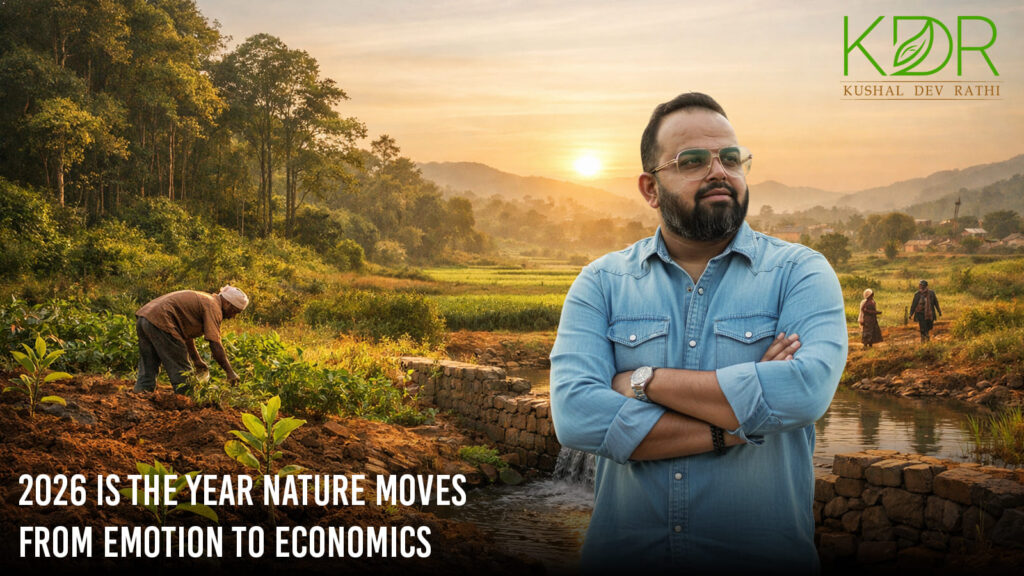
2026 Is the Year Nature Moves from Emotion to Economics
For a very long time, we spoke about nature in emotional language.
We said forests were sacred.
We called rivers our mothers.
We described land as something to be protected, respected, worshipped.
Yet, in parallel, we built economic systems that behaved as if land was infinite, forests were expendable, and soil was merely a surface to be covered.
This contradiction stayed with me for years.
I have spent most of my adult life walking land — coastal stretches, forest edges, mountain slopes, forgotten villages, and rapidly transforming outskirts of cities. And everywhere, I noticed the same pattern: emotion without systems eventually collapses.
Nature does not survive on sentiment alone.
It survives when care is institutionalised.
That is why 2026 feels fundamentally different.
Not louder. Not dramatic.
But deeper.
This is the year nature moves from emotion to economics.
And in India, this shift is becoming visible through policy frameworks that quietly, but decisively, change how land, forests, and restoration are valued. At the centre of this change is the Green Credit Programme India 2026 — a policy that does not speak in slogans, but in outcomes.
For Years, Nature Was a Sentiment — Not a System
For decades, environmental responsibility lived on the sidelines of the economy.
It appeared in:
- CSR sections at the back of annual reports
- plantation drives photographed once a year
- school lessons disconnected from real land use
Meanwhile, the main economic engine ran on extraction, speed, and short-term returns.
Land was valued primarily for:
- location,
- development potential,
- speculative appreciation.
Rarely for what it sustained.
I have seen land fenced and forgotten.
I have seen land stripped and sold.
Both approaches failed.
Because land does not respond to neglect any more than it responds to exploitation.
We spoke of conservation as morality, not as management. And morality without structure does not scale.
This is why forests kept shrinking even as environmental awareness grew.
This is why water stress increased despite rainfall patterns remaining stable in many regions.
This is why health costs rose while “green intentions” multiplied.
Nature was always present in our emotions.
But absent from our economic logic.
What Changed: Why 2026 Is Different From Every Year Before
The shift we are witnessing did not come from a single announcement. It came through layers of policy work that most people ignored.
Between 2023 and 2025, India began reframing environmental action through measurement, verification, and accountability.
The most important signal of this shift is the Green Credit Programme India 2026.
Launched under the Lifestyle for Environment (LiFE) mission, the programme introduces a simple but transformative idea:
Ecological actions must be evaluated the same way economic actions are — by performance over time.
You can read the official framework
This is not a cosmetic change. It fundamentally alters how restoration is understood.
Earlier, plantation meant numbers.
Now, it means outcomes.
Earlier, participation mattered.
Now, persistence matters.
Earlier, we counted saplings.
Now, we measure living systems.
That shift alone places 2026 in a different category.
Understanding the Green Credit Programme India 2026
The Green Credit Programme India 2026 is often misunderstood as another afforestation scheme. It is not.
It is a voluntary, incentive-based framework designed to integrate ecological restoration into India’s formal economic and reporting systems.
What the Green Credit Programme Actually Is
The programme allows individuals, communities, organisations, and corporates to earn green credits by undertaking verified actions such as:
- forest restoration,
- tree plantation with survival guarantees,
- restoration of degraded land,
- water conservation measures,
- sustainable agriculture practices.
But the defining feature is verification over time.
Credits are not issued at the time of planting. They are issued only after ecological performance is demonstrated.
How Green Credits Are Calculated
In 2024 and 2025, the Ministry of Environment notified detailed methodologies that clarify how credits are earned.
Key conditions include:
- A multi-year survival requirement (often five years or more)
- Achievement of approximately 40% canopy density
- Assessment of species suitability and diversity
- Proof of ongoing maintenance
One living tree equals one credit — not ten planted saplings.
This is a crucial moment because quality finally replaces quantity.
Why the Green Credit Programme Is an Economic Tool
The Green Credit Programme India 2026 links restoration with:
- CSR objectives,
- ESG disclosures,
- future regulatory frameworks,
- sustainability-linked reporting.
Credits are currently non-tradable, but they are recognised, verifiable ecological outcomes.
This allows nature to enter balance sheets — not as cost, but as contribution.
Health Is Personal: What Restored Land Does to the Human Body
Health is often reduced to lifestyle choices. Diet. Exercise. Discipline.
But land reminds us that health is also environmental.
Tree cover lowers ambient temperatures.
Healthy watersheds ensure clean drinking water.
Biodiverse ecosystems reduce pollution and disease vectors.
These are not theories. They are measurable outcomes.
The World Health Organization repeatedly highlights the link between environmental degradation and rising health risks
When landscapes regenerate, hospitals quietly empty.
The Green Credit Programme India 2026 recognises this link — encouraging restoration not as charity, but as preventive public health infrastructure.
Health, in this framework, is not individual heroism.
It is collective land stewardship.
Peace Is Ecological: Why Stability Begins With Soil
Peace is usually discussed in political or security terms. But history shows that instability almost always begins with resource stress.
When water disappears, communities fracture.
When forests vanish, livelihoods collapse.
When land degrades, migration accelerates.
India’s renewed emphasis on ecosystem restoration through programmes like the Green India Mission reflects this understanding.
Healthy ecosystems create:
- local employment,
- shared commons,
- social resilience.
The Green Credit Programme India 2026 strengthens this by rewarding restoration that involves communities rather than displacing them.
Peace is not enforced on land.
It is cultivated with it.
Wealth Is Soil + Systems: The New Economics of Land
For generations, wealth was measured in concrete and consumption.
Land was a passive asset — bought, held, sold.
That era is fading.
Why Soil Is Becoming Economically Visible
Healthy soil:
- sequesters carbon,
- regulates water cycles,
- enhances food security,
- stabilises climate patterns.
India’s Carbon Credit Trading Scheme, notified under the Energy Conservation Act, begins aligning climate goals with market mechanisms.
Afforestation and restoration are expected to play a central role in carbon removal methodologies.
From Land as Location to Land as Performance
The future will value land not just by where it is, but by what it does.
Does it regenerate water?
Does it cool microclimates?
Does it support biodiversity?
Does it store carbon?
The Green Credit Programme India 2026 is the first structured attempt to ask these questions at scale.
This is slow wealth.
Quiet wealth.
Intergenerational wealth.
What This Means for Landowners, Developers, and Investors
The implications are clear.
Passive landholding will lose relevance.
Unused land will be questioned.
Speculative cycles will shorten.
Landowners who invest in regeneration will hold assets aligned with future policy direction.
Developers who integrate ecology will build projects that age well.
Investors who think in decades will outperform those who think in quarters.
This is not ideology.
It is alignment.
A Personal Reflection: Why This Shift Feels Inevitable
I have always trusted land more than forecasts.
The soil never rushed.
The forest never panicked.
The river never speculated.
We did.
Now, slowly, our systems are learning to move at land’s pace.
The Green Credit Programme India 2026 does not teach nature anything new.
It teaches us how to listen.
2026 and Beyond: From Extraction to Stewardship
What we are witnessing is not a trend. It is a correction.
Nature is entering economics not because it has changed — but because we have finally learned how to measure its contribution.
The future belongs to stewards, not extractors.
Faq
1. What is the Green Credit Programme India 2026 and why is it important?
The Green Credit Programme India 2026 is a voluntary, government-backed framework that rewards measurable environmental actions such as tree plantation, forest restoration, water conservation, and sustainable land use. Unlike earlier initiatives, it focuses on verified outcomes over time, not symbolic participation.
Its importance lies in the fact that it integrates ecological restoration into economic and compliance systems like CSR and ESG reporting. This marks a shift where nature is no longer treated only as a moral responsibility, but as a performing asset within national development frameworks.
2. How does the Green Credit Programme India 2026 actually work in practice?
Under the Green Credit Programme India 2026, credits are earned only after ecological actions demonstrate real performance. For example, tree plantation projects are evaluated after several years to ensure survival, canopy density, and ecological suitability.
Credits are not issued immediately after planting. They are issued only once restoration outcomes are verified, making the programme outcome-driven rather than activity-driven. This ensures long-term ecological integrity instead of short-term visibility.
3. Who can earn credits under the Green Credit Programme India 2026?
The Green Credit Programme India 2026 is open to a wide range of participants, including:
- individuals and landowners,
- local communities and institutions,
- private companies and corporates,
- public and semi-public bodies.
This inclusive design allows ecological action to be decentralised, encouraging participation from rural landholders, developers, and organisations alike — provided outcomes meet verification standards.
4. Are Green Credits tradable like carbon credits in India?
As of 2026, green credits are not freely tradable like carbon credits. However, they are recognised, verifiable ecological outcomes that can be used for:
- CSR compliance,
- ESG disclosures,
- sustainability reporting.
The structure mirrors early carbon markets, suggesting that future policy evolution may explore linkages between green credits and broader environmental markets.
5. How is the Green Credit Programme India 2026 different from carbon markets?
The Green Credit Programme India 2026 focuses on ecological restoration actions such as forests, water, and land systems, whereas carbon markets focus specifically on measured emission reductions or removals.
However, both share a common philosophy: translating environmental impact into measurable economic value. Over time, restoration projects under the green credit framework may also contribute indirectly to carbon sequestration goals.
6. How does the Green Credit Programme India 2026 impact landowners and developers?
For landowners and developers, the Green Credit Programme India 2026 introduces a new lens through which land is valued. Land is no longer judged solely by location or development potential, but by its capacity to regenerate ecosystems.
Restored land may:
- align with future regulatory expectations,
- attract conscious capital,
- demonstrate long-term resilience.
This encourages a shift from speculative landholding to stewardship-based development.
7. What role does forest restoration play in the Green Credit Programme India 2026?
Forest restoration is central to the Green Credit Programme India 2026. Credits are awarded only when restored forest areas demonstrate:
- long-term tree survival,
- adequate canopy density,
- ecological appropriateness.
This discourages token plantations and promotes genuine forest regeneration that supports biodiversity, water cycles, and climate stability.
8. How does the Green Credit Programme India 2026 connect health and ecology?
The programme indirectly strengthens public health by encouraging landscapes that:
- reduce heat stress,
- improve air quality,
- protect water sources,
- support mental well-being.
The Green Credit Programme India 2026 treats restoration as preventive health infrastructure, recognising that healthy ecosystems reduce long-term healthcare and social costs.
9. Why is 2026 seen as a turning point for nature and economics in India?
2026 represents a turning point because policies like the Green Credit Programme India 2026 formalise what was earlier informal — the economic value of ecosystems.
For the first time, restoration outcomes are:
- measured,
- verified,
- and integrated into economic logic.
This marks a transition from emotional environmentalism to systemic ecological economics.
10. Is the Green Credit Programme India 2026 a short-term initiative or a long-term shift?
The Green Credit Programme India 2026 is designed as a long-term structural shift, not a temporary scheme. Its emphasis on multi-year outcomes, verification, and integration with national missions suggests it will evolve alongside India’s climate, land, and development policies.
Rather than replacing traditional conservation, it strengthens it by embedding care for land into systems that endure beyond political or market cycles.
The Economics of Care
Health is personal.
Peace is ecological.
Wealth is soil plus systems.
In 2026, these truths are no longer poetic.
They are policy-backed.
They are measurable.
They are economic.
Nature always knew this.
We are finally catching up.
