Lifestyle

Category: Lifestyle

Infrastructure-Led Real Estate: 7 Shifts Reshaping India

When I look at India’s changing real estate landscape today, I see something larger than a conventional property-market cycle taking shape.

I see the geography of development itself beginning to change.

For decades, India’s biggest metropolitan cities dominated the real estate conversation. They attracted capital, jobs, businesses, infrastructure and, consequently, large-scale development.

But the latest land-market data points towards a broader transition.

Development is increasingly extending into emerging cities and locations connected by highways, expressways, airports, industrial corridors, logistics networks and digital infrastructure.

This is where infrastructure-led real estate becomes an important lens through which I believe we should understand India’s next phase of development.

According to the latest Cushman & Wakefield India land-market research, 18,158 acres were transacted across more than 880 deals in 33 Indian cities between 2021 and Q1 2026.

Annual transacted acreage increased from 813 acres in 2021 to 6,181 acres in 2025, representing approximately 66% CAGR during the period.

The numbers are significant.

But for me, the more important question is what they reveal about India’s future development map.

Are we gradually moving from a city-centric real estate model towards a more corridor-led model?

If so, what should investors, landowners, developers, and urban observers look for?

What Is Infrastructure-Led Real Estate?

I use the term infrastructure-led real estate to describe development patterns where connectivity and supporting infrastructure become important catalysts for economic and urban activity.

This can include highways, expressways, metro networks, airports, industrial corridors, logistics infrastructure, and increasingly, digital infrastructure such as data centres and fibre networks.

However, I would make one distinction very clear.

Infrastructure does not automatically guarantee an increase in land value.

The more useful way to understand the relationship is:

Infrastructure → connectivity → accessibility → economic activity → development → potential real estate demand

The strength of that chain depends on many factors.

Planning, employment, utilities, regulations, environmental conditions, affordability and actual market demand all matter.

That is why I believe responsible real estate analysis should look beyond announcements and headlines.

A proposed road is not the same as an operational road.

An airport is not the same as an airport-led economic ecosystem.

And connectivity alone does not create a sustainable city.

The real opportunity lies in understanding what develops around the infrastructure.

India’s Land Market Is Moving Beyond Traditional Metros

One of the most interesting developments in India’s current land market is the increasing activity outside established metropolitan centres.

The latest Cushman & Wakefield research provides compelling evidence of this transition.

Between 2021 and Q1 2026, India recorded 18,158 acres of land transactions across more than 880 deals in 33 cities.

Annual transacted acreage increased from:

  • 813 acres in 2021
  • 6,181 acres in 2025

That represents approximately 66% CAGR in annual transacted acreage.

But the Tier-II story is perhaps even more interesting.

Annual Tier-II transaction acreage increased from only 16 acres in 2021 to 2,120 acres in 2025.

The annual share of land transactions in Tier-II cities also increased from approximately 2% in 2021 to 34% in 2025.

A September 2026 report by The Economic Times also highlighted the growing importance of Tier-II cities, reporting that these markets accounted for 67% of land transacted in Q1 2026.

For me, the story is not simply that Tier-II cities are growing.

It is that the scale and geography of land activity itself are changing.

There is another important dimension.

Average Tier-I land deal size declined from approximately 21 acres to 10 acres between 2021 and 2025, while Tier-II average deal size increased from approximately 8 acres to 53 acres.

This suggests that developers are increasingly able to assemble or access larger parcels in emerging markets.

That matters because large parcels can support different forms of development, including integrated residential projects, logistics parks, industrial developments and mixed-use communities.

In other words, the future of infrastructure-led real estate may not be confined to India’s traditional urban cores.

Infrastructure Corridors Are Creating New Development Nodes

A road by itself does not create a city.

But connectivity can change the economic relationship between places.

When an expressway reduces travel time, when a metro connects a peripheral district to an employment centre, or when an industrial corridor links manufacturing clusters with logistics networks, the land around those systems can become part of a larger development ecosystem.

This is why I believe infrastructure corridors deserve to be studied differently from individual infrastructure projects.

The question should not simply be:

“What infrastructure is coming here?”

The better question is:

“What does this infrastructure connect, and what economic activity can that connectivity support?”

The latest Cushman & Wakefield research identifies expressways, metro rail networks, industrial corridors and airport-linked developments among the infrastructure factors influencing land demand.

This is an important distinction.

A highway connecting two major economic centres may have a different development impact from a road that simply improves access to a small local area.

Similarly, an airport connected to hotels, offices, logistics, public transport and commercial districts creates a different economic ecosystem from an airport considered only as a passenger terminal.

This is why infrastructure-led real estate should be studied through an ecosystem rather than through a single project.

The infrastructure checklist I would use

When I study an emerging location, I would ask:

  1. Is the infrastructure approved?
  2. Is funding committed?
  3. What is its implementation stage?
  4. What locations does it connect?
  5. What economic activity does it support?
  6. What supporting infrastructure exists?
  7. What does local planning permit?
  8. What are the environmental and water considerations?

These questions help separate genuine structural change from short-term speculation.

Residential Is Still Dominant, But the Land Story Is Diversifying

Residential development remains the largest category in India’s land market.

According to Cushman & Wakefield, residential accounted for approximately 45% of transacted acreage between 2021 and Q1 2026.

But the broader trend is diversification.

Office-linked land transactions increased approximately five times between 2021–22 and 2024–25.

Industrial and logistics acquisitions increased nearly 13 times.

Mixed-use land transactions increased approximately 2.6 times.

This is important because it tells us that India’s land market is increasingly being connected to different economic activities.

Residential demand is still central.

But industrial employment, logistics, offices, technology infrastructure and mixed-use development are becoming increasingly important components of the land story.

I find this transition particularly significant.

Land is not simply a physical asset waiting for construction.

It is increasingly becoming part of an economic network.

A parcel may derive its strategic importance from its relationship with an employment hub, logistics corridor, airport, industrial cluster or digital infrastructure.

That is one reason why I believe the conversation around infrastructure-led real estate needs to move beyond residential property alone.

 Data Centres Are Expanding the Definition of Infrastructure-Led Real Estate

One of the most interesting changes happening beneath India’s real estate story is the growth of digital infrastructure.

According to Cushman & Wakefield’s India Data Centre Market H1 2026 research, India’s operational data-centre capacity has reached approximately 1.8 GW, compared with around 400 MW in 2019.

The development pipeline is approximately 3.9 GW.

India is now the third-largest data-centre market in the Asia-Pacific region by operational capacity, according to the research.

Mumbai remains the country’s largest data-centre market, while Hyderabad, Chennai and Delhi NCR continue to be significant markets.

The research also identifies Visakhapatnam as an emerging destination for AI-focused data-centre investment.

Why does this matter for land?

Because data centres require a very different infrastructure ecosystem.

They need:

  • suitable land
  • reliable electricity
  • fibre connectivity
  • cooling infrastructure
  • water systems
  • security
  • strong network connectivity

This means the definition of infrastructure-led real estate is becoming much broader.

It is no longer only about roads, railways and airports.

Increasingly, it is also about the infrastructure powering India’s digital economy.

AI, cloud computing and data consumption may sound like purely technological subjects.

But ultimately, they require physical infrastructure occupying physical land.

That connection between the digital economy and real estate is one of the trends I believe deserves considerably more attention.

Infographic highlighting seven forces reshaping India's real estate map: highways, airports, industrial and logistics corridors, data centres, office expansion, Tier-II urbanisation and sustainable urban infrastructure, supported by current land-market and infrastructure statistics.

Airports Are Becoming Economic Ecosystems

Airports have traditionally been viewed primarily as transport infrastructure.

But the airport-city model is beginning to demonstrate how aviation infrastructure can become part of a wider urban ecosystem.

In 2026, Adani Airports announced an integrated airport-city development programme covering more than 655 acres across six airports in five states.

According to the company’s official announcement, the first phase involves more than ₹20,000 crore of investment and approximately 22 million sq ft of development across Mumbai, Navi Mumbai, Ahmedabad, Lucknow, Jaipur and Guwahati.

The planned developments include offices, hospitality, retail, entertainment and convention infrastructure integrated with airport and city transportation.

This is a useful example of how infrastructure can become the nucleus of a broader economic ecosystem.

The potential progression is:

Airport → mobility → tourism → employment → hospitality → commercial activity → urban development

But once again, I would avoid a simplistic assumption that airport proximity automatically means higher land values.

The more meaningful question is whether the airport is accompanied by:

  • employment generation
  • business activity
  • public transportation
  • hospitality
  • logistics
  • urban services
  • appropriate planning

That is the difference between simply being near infrastructure and being part of an infrastructure-led development ecosystem.

The Question Is No Longer Only “Where Is Land Cheap?”

I believe this is where India’s land-investment conversation needs to mature.

Price will always matter.

But price alone does not tell us whether a location has long-term development potential.

When I examine land connected to major infrastructure, I prefer to ask a broader set of questions.

Is the infrastructure actually approved?

There is a significant difference between an idea, an announcement and an approved project.

Is funding available?

Financial commitment provides a stronger basis for assessing execution than a headline about a future project.

What is the implementation timeline?

Infrastructure that may take several years to become operational should be evaluated differently from infrastructure already serving users.

What does it connect?

Connectivity becomes more meaningful when it links economic centres, employment clusters, logistics hubs or established urban areas.

What supporting infrastructure exists?

Road access alone may not create a complete development ecosystem.

Power, water, public transport, healthcare, education and other services also influence liveability and economic activity.

What does the planning framework allow?

Zoning, land-use regulations, development controls and approvals remain fundamental.

What are the environmental constraints?

Natural drainage, water availability, ecological sensitivity and climate exposure should be considered before making long-term land decisions.

What is the actual demand?

Infrastructure can create possibilities.

But sustainable development ultimately requires people, businesses and economic activity.

This is why I see infrastructure-led real estate as a framework for research rather than a shortcut to an investment conclusion.

India’s Future Development Map Could Become More Distributed

The latest land-market research provides another indication of the scale of India’s potential development pipeline.

Cushman & Wakefield estimates that land transacted between 2021 and Q1 2026 represents nearly 1.4 billion sq ft of potential future built-up area, based on prevailing planning norms and capital values.

The estimated potential spans several asset classes.

Asset class

Estimated potential

Residential

559–768 million sq ft

Industrial & logistics

205–225 million sq ft

Office

109–179 million sq ft

Data centres

113–124 million sq ft

Retail

8–26 million sq ft

The research estimates an indicative future revenue potential of approximately ₹16.67 lakh crore based on prevailing planning norms and capital values.

I would treat this number carefully.

It should not be interpreted as guaranteed development, sales or investment returns.

Instead, I see it as an indication of the sheer scale of development capacity represented by land that has already changed hands.

That distinction is important.

India’s future real estate supply is not being created only inside its largest cities.

It is increasingly being assembled across a wider network of cities, corridors and economic clusters.

This is perhaps the biggest structural insight emerging from the current land-market data.

Infrastructure Cannot Be Separated From Sustainability

As someone who has spent years thinking about land, development and the relationship between people and nature, I believe another question must sit alongside every conversation about infrastructure-led real estate.

How do we develop without weakening the systems that make a place liveable?

A highway can improve connectivity.

An airport can expand economic access.

An industrial corridor can create employment.

A new urban district can create housing and commercial opportunities.

But every form of development also interacts with water systems, natural drainage, green spaces, local ecosystems and climate conditions.

This is why I believe the next generation of development needs a broader definition of value.

Economic value matters.

But so do:

  • water security
  • environmental resilience
  • liveability
  • mobility
  • green spaces
  • waste management
  • energy efficiency
  • long-term climate resilience

India’s urbanisation story cannot simply be about building more.

It must also be about building better.

The National Mission on Sustainable Habitat reflects this wider policy direction, with urban sustainability indicators covering areas such as water management, waste management, mobility and green spaces.

For me, responsible development is not about choosing between growth and nature.

It is about designing growth with a better understanding of nature.

How I Would Study an Infrastructure-Linked Land Opportunity

When I examine an emerging location, I prefer to move beyond the excitement surrounding a new project.

My framework is straightforward.

First, verify the infrastructure.

Second, understand its stage of development.

Third, study what it connects.

Fourth, identify the economic activity it can support.

Fifth, understand the planning and regulatory framework.

Sixth, examine utilities and water availability.

Seventh, assess environmental and climate-related constraints.

Finally, think in decades rather than headlines.

This last point is particularly important.

There is a significant difference between:

Announcement → approval → funding → construction → operation → economic absorption

A location can move through these stages at very different speeds.

That is why, when considering infrastructure-led real estate, patience and verification are as important as identifying the infrastructure itself.

The best research begins where the headline ends.

The Bigger Picture

When I look at India’s land market today, I see a country gradually developing a more distributed geography of growth.

The latest transaction data shows significant land activity.

Tier-II markets are becoming more important.

Larger parcels are enabling different forms of development.

Industrial and logistics demand is expanding.

Data centres are creating new forms of digital infrastructure demand.

Airport-city models are demonstrating how transport infrastructure can become part of a wider economic ecosystem.

But I do not believe the future of land should be reduced to one simple equation.

Infrastructure does not automatically create value.

It creates possibilities.

The real question is what happens next.

Does economic activity follow?

Does employment grow?

Do communities become better connected?

Does planning support responsible development?

Are water and environmental systems protected?

Does the location become more liveable?

These are the questions I believe we should be asking when we discuss India’s next development cycle.

For me, the most important lesson from the latest data is simple: India’s real estate map is expanding beyond traditional metropolitan boundaries.

The next generation of development may increasingly be shaped by corridors, connectivity and economic ecosystems.

And if we want that growth to remain valuable over the long term, we must look at land not merely as an asset, but as part of a much larger system of infrastructure, economy, community and nature.

FAQs

1) What is infrastructure-led real estate?
Infrastructure-led real estate refers to development and land-market activity influenced by major infrastructure such as expressways, airports, metro systems, industrial corridors, logistics networks and other connectivity improvements. The underlying idea is that better connectivity can expand development catchments and improve access to economic activity.

Recent data from Cushman & Wakefield’s India land-market research shows that infrastructure-led growth corridors are increasingly influencing land demand across India. Between 2021 and Q1 2026, 18,158 acres were transacted across more than 880 deals in 33 cities.

2) How does infrastructure affect real estate demand?
Infrastructure can influence real estate by improving accessibility, reducing travel friction and expanding the areas that businesses, residents and developers can practically reach. An expressway, airport or metro connection can therefore become one component of a broader development ecosystem.

However, infrastructure alone does not guarantee property appreciation. Investors also need to examine employment growth, commercial activity, population movement, planning regulations, utilities, land-use permissions and actual demand.

Cushman & Wakefield specifically identifies expressways, metro networks, industrial corridors and airport-linked developments as important drivers of land demand.

3) Why are Tier-II cities becoming increasingly important for land investment?
Tier-II markets are gaining attention because infrastructure expansion, larger land parcels and new economic activity are allowing development to move beyond established metropolitan cores.

According to Cushman & Wakefield, annual Tier-II land transactions increased from just 16 acres in 2021 to 2,120 acres in 2025, while their annual share of transacted acreage increased from around 2% to 34%. The average Tier-II deal size also increased from 8 acres to 53 acres during the broader period covered by the research.

This does not mean every Tier-II location will perform similarly. The quality, timing and execution of infrastructure remain critical factors.

4) Which types of infrastructure are most relevant to infrastructure-led real estate?
Several categories can influence development patterns. These include expressways and highways, airports, metro and rail networks, industrial corridors, logistics infrastructure, ports, urban utilities and digital infrastructure.

Their impact can also be interconnected. For example, an airport can improve regional accessibility, while highways and logistics infrastructure can support industrial and commercial activity around it. Digital infrastructure such as data centres introduces another land-demand category where power availability and connectivity are particularly important.

Cushman & Wakefield notes that India’s land acquisitions are becoming more diversified, with residential, industrial and logistics, office, mixed-use and data-centre developments all contributing to land demand.

5) Does infrastructure guarantee real estate appreciation?
No. Infrastructure should be viewed as a potential development catalyst, not a guarantee of returns or appreciation.

A new road or airport may improve accessibility, but the eventual real estate outcome depends on several other factors: land-use permissions, project completion, surrounding infrastructure, employment generation, population growth, supply and demand, environmental constraints, financing and the quality of development.

This distinction is particularly important for long-term investors. The more useful question is not simply “What infrastructure is coming?” but “What economic and urban activity can this infrastructure realistically support?”

6) Why are industrial, logistics and data-centre developments becoming important to land markets?
India’s land market is becoming more diversified beyond conventional residential development. Cushman & Wakefield reports that industrial and logistics land acquisitions expanded nearly 13 times between 2021–22 and 2024–25, while office-linked land transactions increased five-fold. Data-centre acquisitions also expanded in absolute terms.

Digital infrastructure is another emerging driver. Cushman & Wakefield’s India Data Centre Market H1 2026 research tracks the expansion of India’s data-centre market and the growing importance of locations offering suitable connectivity and power infrastructure.

For land-market analysis, this means future demand should be assessed across multiple economic uses rather than residential development alone.

7) How can airports influence surrounding real estate development?
Airports can become anchors for wider economic ecosystems when supported by highways, public transport, hospitality, commercial development, logistics and employment-generating activities.

The effect is therefore broader than simply reducing travel time. Improved air connectivity can support tourism, business travel, hospitality and commercial activity, while associated infrastructure can expand the development footprint around an airport.

Airport-city development is also becoming part of India’s broader urban-development conversation. For example, Adani Airports’ 2026 airport-city development announcement outlines plans for integrated development across multiple airport locations.

The important point for investors is to examine the entire ecosystem around an airport, rather than assuming that proximity by itself creates value.

8) What should investors examine before considering land along an infrastructure corridor?
I would look beyond the headline announcement and examine the development fundamentals systematically. Key questions include:

Is the infrastructure project officially approved and funded?

What is its current construction and completion status?

How much will accessibility actually improve?

Are connecting roads and utilities also being developed?

What is the land-use and zoning status?

Is there evidence of employment or commercial activity emerging nearby?

Are there environmental, water, drainage or ecological constraints?

Is there genuine end-user or occupier demand?

What is the existing and planned competing supply?

What is the realistic development timeline?

This approach is especially important because infrastructure-led real estate is ultimately about the interaction between connectivity, economic activity, land use and long-term urban development. India’s current land-market data shows the scale of this transition, but individual locations still require their own due diligence.

Final Perspective

I believe India’s next real estate story will not be written by property prices alone.

It will be written by connectivity, economic activity, infrastructure, planning and the quality of development that follows.

The opportunity is therefore not simply to ask where development is happening today.

It is to understand why it is happening, what is enabling it, and whether that growth can remain meaningful over the long term.

That is the perspective from which I look at infrastructure-led real estate—not as a promise of returns, but as a way of understanding how India’s physical and economic geography is evolving.


-->
class="post-5245 post type-post status-publish format-standard has-post-thumbnail hentry category-lifestyle ast-grid-common-col ast-full-width ast-article-post" id="post-5245" itemtype="https://schema.org/CreativeWork" itemscope="itemscope">

Category: Lifestyle

India’s Changing Monsoon: 7 Critical Himalayan Lessons

What if the most important question about India’s changing monsoon is not whether India is receiving more rain or less rain, but whether we are beginning to receive rain differently?

I have been thinking about this question while looking at what has happened across Uttarakhand and Himachal Pradesh through the 2026 monsoon. The picture is not as simple as saying that rainfall is increasing everywhere. In fact, the data tells a much more interesting story.

India’s changing monsoon is increasingly marked by uneven rainfall, intense bursts, longer dry intervals, shifting seasonal patterns, and growing interactions between weather and vulnerable landscapes.

This distinction matters.

Because a place can receive rainfall close to its seasonal average and still experience devastating landslides, flash floods or infrastructure failures. India’s changing monsoon is therefore not simply a story about the quantity of rainfall. It is also a story about when, where, how quickly, and with what intensity rainfall arrives.

The 2026 experience in the Himalayas gives us a powerful opportunity to understand this.

What India’s Changing Monsoon Is Telling Us in 2026

The first lesson is that rainfall averages do not tell the entire story.

Uttarakhand offers one of the clearest examples.

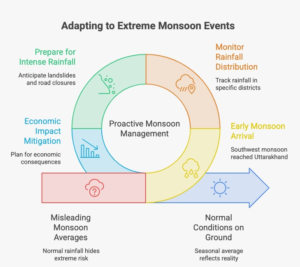
The southwest monsoon reached Uttarakhand on June 30, 2026. By July 21, the state’s overall rainfall was only around 4% below normal, a figure still within the normal range. Yet the district-level picture was dramatically different. Some districts had received more than twice their normal rainfall, while others were experiencing near-drought conditions.

This is one of the most important lessons from India’s changing monsoon.

A state-wide average can suggest relative normality while individual communities are dealing with very abnormal conditions.

The same pattern appeared later in the season. On September 5, Uttarakhand recorded rainfall around 13% above its daily normal, while several districts experienced much larger surpluses. Landslides and boulder falls resulted in more than a hundred road closures. 

This is what India’s changing monsoon can look like on the ground: not necessarily a uniformly wetter state, but a landscape receiving water in highly concentrated and uneven ways.

The India Meteorological Department’s rainfall statistics are particularly useful here because they allow us to move beyond state-level averages and examine rainfall at more granular scales.

That shift in perspective is essential to understanding India’s changing monsoon.

India’s Changing Monsoon in Himachal Pradesh: When Rainfall Becomes an Infrastructure Story

Himachal Pradesh provides another dimension of India’s changing monsoon.

By September 9, 2026, reported monsoon losses in the state had crossed approximately ₹1,550 crore. The Public Works Department accounted for more than ₹1,100 crore, while the Jal Shakti Department reported losses of more than ₹368 crore. Dozens of roads remained blocked. 

There is another important point in these numbers.

Of the 286 reported deaths, 114 were attributed to natural disasters while 172 were associated with road accidents. The distinction matters because it prevents us from presenting every monsoon-related death as a direct climate disaster.

India’s changing monsoon interacts with roads, traffic, settlements, construction, slope stability and human exposure.

This interaction is becoming increasingly important.

The Government of India has itself recognised the growing concern. In August 2026, the Ministry of Home Affairs constituted a Multi-Sectoral Central Team in response to increasing incidents of cloudbursts, flash floods, landslides and extreme rainfall in Himachal Pradesh. The team includes institutions such as NDMA, CBRI, IITM and IIT Indore, along with inputs from IMD, CWC and GSI. 

The government statement also pointed towards climate change, accelerated snowmelt, moraine instability and anthropogenic factors as contributors to increasing risk.

This is why India’s changing monsoon cannot be discussed only from the perspective of weather forecasting.

It has become an infrastructure question.

A Delayed Monsoon Can Still Become a Difficult Monsoon

There is another misconception worth challenging.

A delayed monsoon does not automatically mean a weak or harmless monsoon.

In Himachal Pradesh, the southwest monsoon covered the entire state around July 1, 2026, several days later than the normal date of around June 25.

Yet timing alone tells us very little about the eventual consequences.

This is important because monsoon behaviour is not a simple on-off system.

The timing of onset, the distribution of rainfall, the duration of dry spells and the occurrence of high-intensity rainfall events all interact with one another.

The IMD’s official rainfall information therefore becomes more useful when rainfall is examined across different periods rather than through a single seasonal number.

For planners, this means that the question should not simply be:

How much rain should we expect this year?

It should also be:

What kind of rainfall distribution should we design for?

That is a very different question.

Is India’s Changing Monsoon Actually Changing?

The scientific answer needs nuance.

There is strong evidence that climate change is affecting temperature, precipitation characteristics, and the probability of certain extremes. The IPCC’s assessment for South Asia projects increases in mean and variability of summer monsoon precipitation, as well as increases in heavy precipitation extremes as warming continues.

At the same time, rainfall trends are not uniform across India.

Some regions have experienced increasing extreme rainfall while others show different or weaker trends. Natural variability also remains an important part of the Indian monsoon system.

This is why the phrase India’s changing monsoon should not be interpreted as “everywhere will get more rainfall.”

It means the rainfall system is becoming more variable and complex in ways that matter for people and infrastructure.

One of the most important findings from long-term Indian rainfall research is that extreme rainfall can increase even when total rainfall does not increase proportionately.

Research published in Nature Communications, for example, found a substantial increase in widespread extreme rainfall events over central India during 1950–2015 even as moderate rainfall declined.

That finding changes how we should think about water.

More extreme rain does not necessarily mean more usable water.

Rain falling rapidly over a short period can generate runoff and flooding rather than slowly replenishing soil moisture, groundwater or reservoirs.

So India’s changing monsoon is simultaneously a flood risk and water-management challenge.

Infographic explaining India’s changing monsoon through Uttarakhand rainfall data, showing approximately 4% below-normal state rainfall alongside districts receiving more than twice normal rainfall, September rainfall surpluses, road closures and increasing Himalayan weather risk.

India’s Changing Monsoon: More Rain or Different Rain?

This distinction deserves greater attention.

Imagine two years receiving the same total monsoon rainfall.

In the first year, rainfall is distributed across many moderate events.

In the second, much of the rainfall arrives in a few intense episodes separated by long dry periods.

The annual total may look identical.

The consequences will not be.

Agriculture may face moisture stress between rainfall events.

Urban drainage may be overwhelmed during intense episodes.

Mountain slopes may become saturated rapidly.

Rivers may rise sharply and then fall.

Roads and bridges may face repeated cycles of stress.

This is why India’s changing monsoon should increasingly be understood through rainfall distribution and intensity, not just accumulation.

For an investor or developer, this distinction is equally important.

A location with attractive connectivity and strong economic potential may still require careful examination of drainage, topography, water availability and natural-hazard exposure.

Climate resilience is becoming part of location intelligence.

Why the Himalayas Amplify Weather Risk

The Himalayas are not an ordinary landscape.

They are geologically young, steep and structurally complex. Many settlements and transport routes occupy narrow valleys or slopes. Roads frequently require substantial cutting into mountainsides.

When intense rainfall arrives, gravity becomes part of the equation.

Water infiltrates soil and fractured rock.

Slopes become heavier.

Drainage channels carry sudden volumes of water.

Loose material can move downhill.

Rivers can rapidly change their flow and sediment loads.

A rainfall event that might cause limited disruption in a flat region can have very different consequences in a steep mountain environment.

The Department of Science and Technology has highlighted the interaction of natural and human factors in Himalayan landslide vulnerability, including rainfall, temperature, slope conditions, road cutting, construction and land-use change.

This does not mean that every landslide is caused by construction.

It means that natural hazards and human exposure increasingly interact.

That distinction matters.

When Heavy Rain Becomes a Landslide

The relationship between rainfall and landslides is particularly important.

A mountain slope does not respond only to the rainfall falling at that exact moment.

Its response can depend on what happened over previous days or weeks.

If the ground is already saturated, additional rainfall can have a disproportionate effect.

If a road has altered natural drainage, water may be redirected into vulnerable areas.

If vegetation has been removed, soil stability can change.

If a slope has been heavily cut, its natural geometry may have been disturbed.

This is where India’s changing monsoon intersects directly with land-use planning.

A rainfall forecast may tell us that heavy rain is coming.

Risk-aware development asks a second question:

Which slopes, roads, settlements and structures are most vulnerable to that rainfall?

The second question is where the next generation of planning needs to become much stronger.

The Cryosphere Is Changing Alongside the Monsoon

Rainfall is only one part of the Himalayan climate story.

The other is what happens to snow and ice.

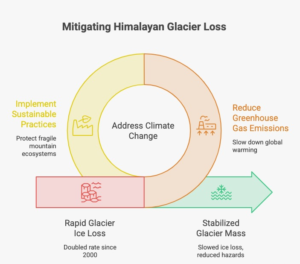
The Hindu Kush Himalaya is undergoing substantial cryospheric change. In 2026, the International Centre for Integrated Mountain Development reported that glaciers across the region are losing ice at an accelerating rate, with ice-loss rates approximately doubling after 2000 compared with the previous decades. 

The snow story is equally important.

ICIMOD reported in April 2026 that snow persistence across the Hindu Kush Himalaya was 27.8% below its long-term average, marking the fourth consecutive year of below-normal snow persistence.

This matters because snow is not simply something we see on mountain peaks.

It is a seasonal water-storage system.

Changes in snowfall, snowmelt, glaciers and runoff can influence rivers, agriculture, hydropower, ecosystems and downstream water security.

The ICIMOD regional cryosphere outlook makes this larger relationship increasingly visible.

India’s changing monsoon is therefore occurring alongside a changing Himalayan water system.

That combination deserves much more attention.

The 2025 Dharali Lesson

The catastrophic Dharali event in Uttarkashi in August 2025 provides an important case study.

The event generated a massive debris flow and caused extensive destruction to buildings, roads, bridges and other assets.

But scientific research conducted after the event has also demonstrated why disaster attribution needs to be careful.

Studies have examined rainfall-triggered debris mobilisation, steep slopes, unconsolidated sediments and local geomorphology. Other explanations have also been debated.

The larger lesson is not simply about Dharali.

It is about how we investigate extreme events.

India’s changing monsoon creates a changing background climate, but a particular disaster can still have a complex chain of causes.

Good climate communication should acknowledge that complexity rather than turning every event into a simplistic climate-change headline.

In my view, this actually makes the argument for preparedness stronger.

If multiple factors can combine to create a disaster, then resilience must address multiple factors as well.

India’s Changing Monsoon and the Future of Development

There is an uncomfortable but necessary question here:

Are we building infrastructure for the climate we had, or for the climate we are beginning to experience?

I am not arguing against development.

Quite the opposite.

Good infrastructure is essential for mountain communities, tourism, agriculture, healthcare, education and economic opportunity.

But India’s changing monsoon means that infrastructure planning needs to become more risk-aware.

Roads need stronger drainage.

Slope stabilisation needs to be treated as a core engineering function.

Bridges need adequate hydraulic capacity.

Construction needs to consider local geology and natural drainage.

Emergency access needs to remain possible even when one route fails.

This is not anti-development.

It is better development.

The National Highways Authority of India and government agencies have undertaken measures on vulnerable Himalayan road stretches that include slope stabilisation, drainage improvements and protective works.

The direction is important.

We should not move away from infrastructure.

We should move towards infrastructure that understands the landscape in which it exists.

Tourism and the New Himalayan Exposure

Tourism adds another layer.

The Himalayan states have become increasingly important destinations for domestic and international travellers.

Tourism creates employment, supports local businesses and generates demand for hotels, restaurants, transport and services.

But more visitors also mean greater exposure.

A road blocked by a landslide is not merely an engineering problem.

It can strand tourists.

A damaged bridge can disrupt supply chains.

A prolonged water shortage can affect hospitality.

A slope failure can damage both private and public assets.

Therefore, India’s changing monsoon needs to become part of tourism infrastructure planning.

The objective should not be to restrict tourism unnecessarily.

It should be to ensure that tourism growth is compatible with the carrying capacity and resilience of the landscape.

The Economics of Climate Risk

Climate risk is often discussed as an environmental issue.

I increasingly see it as an economic issue.

A blocked highway delays goods.

A damaged bridge disrupts tourism.

A landslide cuts off communities.

A disrupted water supply affects households and businesses.

A damaged power network creates secondary losses.

The economic cost therefore extends well beyond the first repair estimate.

This is particularly relevant for real estate and land investment.

Location will remain important.

Connectivity will remain important.

Economic growth will remain important.

But investors increasingly need another layer of information: resilience.

How secure is the water supply?

How does stormwater leave the site?

What is the slope profile?

What are the geological conditions?

How dependent is the location on a single road?

How exposed is it to flooding or landslides?

How adaptable is the surrounding infrastructure?

India’s changing monsoon is making these questions increasingly relevant to long-term asset thinking.

India Does Not Have One Monsoon

Perhaps the biggest lesson I take from all of this is that there is no single Indian monsoon experience.

The rainfall received by Kerala is not the rainfall received by Rajasthan.

Central India has a different rainfall regime from the Himalayan foothills.

Even within Uttarakhand, district-level conditions can vary dramatically.

India’s changing monsoon therefore needs to be understood at multiple scales.

National averages remain important for policy.

State-level data helps with planning.

District-level data reveals exposure.

Local topography determines how rainfall translates into risk.

This hierarchy is critical.

The more local our understanding becomes, the more intelligent our response can be.

What Should Change About the Way We Build?

I believe India’s changing monsoon requires us to rethink three things.

1. Design for extremes, not just averages

Historical averages remain useful, but they should not be the only basis for infrastructure planning.

Drainage, bridges, roads, buildings and slopes must account for changing rainfall intensity and variability.

2. Treat landscapes as part of the infrastructure

A forested slope, wetland, river channel or natural drainage system performs an economic function.

When we remove that function, we often replace it with expensive engineered infrastructure.

The natural landscape should therefore be considered part of our resilience system.

3. Move from response to preparedness

India has become better at responding to disasters.

The next step is to become much better at anticipating them.

That means better rainfall monitoring, local early-warning systems, slope monitoring, hazard mapping, climate-resilient infrastructure and transparent risk information.

The National Water Data Portal and IMD’s rainfall databases demonstrate how increasingly important accessible local data will become.

What This Means for the Future of Indian Development

The conversation about climate resilience should not remain limited to disaster-management departments.

It belongs in urban planning.

It belongs in infrastructure design.

It belongs in real estate.

It belongs in agriculture.

It belongs in tourism.

It belongs in investment strategy.

India’s changing monsoon is effectively creating a new variable in long-term decision-making.

The most resilient locations may not necessarily be those with the most dramatic growth stories.

They may be the places where connectivity, water security, land characteristics, infrastructure quality and environmental conditions work together.

This is an important shift in how we should think about land.

Land is not simply a parcel on a map.

It is part of a living geographical system.

Its value is connected to roads, rivers, drainage, water, climate, surrounding development and the ability of the larger ecosystem to absorb change.

That is why climate awareness is increasingly becoming a part of responsible investment thinking.

So, Is India’s Changing Monsoon Really Changing?

Yes — but not in the simplistic sense that every part of India is becoming uniformly wetter.

India’s changing monsoon is better understood as a combination of shifting rainfall distribution, variability, intense rainfall episodes, changing dry periods and interactions with a warming atmosphere and changing Himalayan cryosphere.

At the same time, natural variability remains important, regional trends differ, and individual disasters require careful scientific attribution.

That nuance is important.

Because the purpose of climate science is not to create fear.

It is to improve decisions.

For me, the most important lesson from Uttarakhand and Himachal Pradesh in 2026 is that climate, geography and development can no longer be treated as separate conversations.

India’s changing monsoon is exposing the connections between them.

The Future Question Is Bigger Than the Monsoon

The Himalayas are not telling us that development should stop.

They are asking us to become more intelligent about development.

If rainfall is becoming more variable, infrastructure must become more adaptive.

If slopes are vulnerable, construction must respect geological realities.

If snow and glaciers are changing, water planning must change with them.

If extreme rainfall can disrupt entire economic corridors, resilience must become part of the investment equation.

And if our understanding of climate risk improves, our definition of good development should improve with it.

India’s changing monsoon is ultimately not just a weather story.

It is a story about the relationship between natural systems and human decisions.

Perhaps that is the question we should be asking more seriously:

If the climate is changing the way water moves through our landscapes, shouldn’t we also rethink the way we build, invest, travel and live within them?

FAQs

1. What is India’s changing monsoon and why is it important?

India’s changing monsoon refers to the evolving patterns of rainfall across the country, including changes in rainfall distribution, intensity, timing, variability and the occurrence of extreme rainfall events. It does not necessarily mean that every part of India is receiving more rainfall every year.

The important issue is that rainfall can become more uneven and concentrated. A region may record rainfall close to its seasonal average while individual districts experience intense rainfall, prolonged dry periods or sudden heavy precipitation.

The India Meteorological Department’s rainfall statistics provide district-level, state-level and subdivision-level rainfall information, making it possible to understand these variations beyond national averages.

Understanding India’s changing monsoon is important for agriculture, water management, infrastructure, disaster preparedness, tourism and long-term development planning.

2. Is India receiving more rainfall because of India’s changing monsoon?

Not necessarily. India’s changing monsoon is more complicated than simply saying that the country is becoming wetter.

Long-term observations show considerable regional differences in rainfall trends. The IPCC notes that South Asia has experienced changes in monsoon precipitation and that recent increases in heavy precipitation have occurred in the region, while trends in annual precipitation vary considerably by location.

The IPCC assessment of Asia’s climate highlights this regional variation and reports an increase in heavy precipitation in South Asia.

This means the more useful question is not simply, “Is India getting more rain?” but rather:

Where is rainfall changing, when is it arriving, how intense is it, and how is the landscape responding?

That is a much more accurate way to understand India’s changing monsoon.

3. Why can normal seasonal rainfall still cause floods and landslides?

A seasonal rainfall average can hide short-duration and highly concentrated rainfall.

For example, a region could receive close to its normal seasonal rainfall overall, but a large proportion of that rainfall may arrive within a few intense episodes. Such rainfall can overwhelm drainage systems, saturate slopes and rapidly increase river or stream flows.

This is particularly significant in mountainous areas such as Uttarakhand and Himachal Pradesh, where steep slopes and narrow valleys can amplify the impact of intense rainfall.

The IMD rainfall monitoring system tracks rainfall at daily, weekly, monthly and cumulative levels, helping demonstrate why looking only at seasonal averages can be misleading.

This is one of the most important lessons from India’s changing monsoon: rainfall distribution can matter as much as rainfall totals.

4. What is Uttarakhand telling us about India’s changing monsoon?

Uttarakhand demonstrates how dramatically rainfall can vary within a relatively small geographical area.

During the 2026 monsoon, Uttarakhand’s overall rainfall at one point remained close to normal, yet individual districts experienced substantial excess rainfall. Later in the season, intense rainfall episodes were associated with landslides and road closures across the state.

This demonstrates why India’s changing monsoon should be studied at district and local scales rather than relying only on state-wide averages.

The IMD’s district rainfall database provides daily, weekly, monthly and cumulative rainfall information, allowing researchers and policymakers to identify these local variations.

For a mountainous state, this information can be critical because rainfall conditions can change significantly from one valley or district to another.

5. How is India’s changing monsoon affecting Himachal Pradesh?

Himachal Pradesh illustrates the connection between extreme weather, fragile terrain and infrastructure.

During the 2026 monsoon, the state experienced repeated incidents involving landslides, flash floods, cloudbursts and infrastructure disruption. The Government of India constituted a Multi-Sectoral Central Team to scientifically assess the causes of increasing extreme weather events and recommend long-term measures.

According to the Ministry of Home Affairs statement released through PIB, assessments by scientific institutions and authorities point to climate change, accelerated snowmelt, moraine instability and anthropogenic factors as contributors to increased risk in the Himalayan region.

Therefore, India’s changing monsoon is not only a weather concern for Himachal Pradesh. It is also an infrastructure, economic and disaster-management concern.

Roads, bridges, power systems, water networks, tourism infrastructure and settlements all need to be evaluated against changing risk conditions.

6. Does climate change cause every flood, cloudburst or landslide in the Himalayas?

No. It is important not to automatically attribute every individual disaster to climate change.

Extreme events can result from several interacting factors, including rainfall intensity, geology, slope conditions, drainage, land-use changes, river morphology, construction and natural climate variability.

However, this does not mean climate change is irrelevant.

The broader scientific evidence indicates that a warming climate can influence the intensity of heavy precipitation and alter snow, glacier and hydrological systems across the Himalayan region.

The IPCC’s regional climate assessment for South Asia explains the region’s complex monsoon, Himalayan and cryospheric interactions.

Therefore, when discussing India’s changing monsoon, it is better to distinguish between event attribution and long-term climate trends.

A particular landslide may require detailed scientific investigation, while the broader changes in climate and extreme-weather risk can be studied through long-term observations.

7. Why are the Himalayas particularly vulnerable to India’s changing monsoon?

The Himalayas combine several natural characteristics that can magnify rainfall-related hazards.

They contain steep and geologically young slopes, narrow valleys, rapidly flowing rivers and areas vulnerable to landslides. Roads and settlements are also frequently located along constrained mountain corridors.

This means intense rainfall can quickly become surface runoff, slope saturation, debris movement or flash flooding.

The situation is further complicated by changes in snow and glaciers. The International Centre for Integrated Mountain Development (ICIMOD) has documented accelerating glacier loss across the Hindu Kush Himalaya and continuing changes in snow conditions.

The IPCC also highlights the importance of changing precipitation, snow and glacier systems in high-mountain Asia.

Consequently, India’s changing monsoon cannot be considered independently from Himalayan landscape change.

Rainfall is one part of a much larger system involving mountains, rivers, snow, glaciers, infrastructure and human settlement.

8. What role do glaciers and snow play in India’s changing monsoon story?

Glaciers and seasonal snow act as important components of the Himalayan water system.

Changes in glacier mass, snowfall and snowmelt can affect the timing and availability of water downstream. This has implications for rivers, agriculture, hydropower, ecosystems and communities.

In 2026, ICIMOD reported continued glacier ice loss across the Hindu Kush Himalaya, while its regional snow update highlighted exceptionally low snow persistence.

The ICIMOD 2026 glacier assessment provides detailed information about recent glacier changes.

This matters because India’s changing monsoon is occurring alongside a changing cryosphere.

The future water equation therefore cannot be understood by looking only at monsoon rainfall. Rainfall, snow, glaciers, evaporation, runoff and groundwater need to be considered together.

9. What should infrastructure planning consider because of India’s changing monsoon?

Infrastructure planning should increasingly move beyond historical rainfall averages and consider rainfall intensity, drainage capacity, slope stability, flood exposure and long-term climate risk.

For mountain infrastructure, this is particularly important.

Roads need effective drainage. Bridges need adequate hydraulic capacity. Slopes need geological assessment and stabilisation. Settlements need to avoid high-risk zones where possible. Tourism infrastructure should consider water availability, emergency access and environmental carrying capacity.

The India Meteorological Department provides rainfall observations and forecasting products that can support such planning.

The broader lesson from India’s changing monsoon is that resilience should be considered during the design stage rather than only after a disaster.

Better planning can reduce both physical damage and economic disruption.

10. What does India’s changing monsoon mean for the future of development and investment?

India’s changing monsoon suggests that climate and weather resilience will increasingly become part of responsible development and investment decisions.

Location, connectivity and economic potential will remain important, but other factors may become equally relevant: water security, drainage, geological stability, flood exposure, infrastructure resilience and the ability of an area to adapt to changing environmental conditions.

This is particularly important in regions experiencing rapid infrastructure growth, tourism development and urbanisation.

The objective should not be to stop development. It should be to make development more informed and resilient.

As the India Meteorological Department’s rainfall monitoring data and the IPCC’s climate assessments show, climate conditions need to be evaluated through regional and local evidence rather than broad assumptions.

Ultimately, India’s changing monsoon is forcing us to ask a larger question: Are we designing today’s infrastructure and investments for yesterday’s climate, or preparing them for the conditions of tomorrow?


-->
class="post-5225 post type-post status-publish format-standard has-post-thumbnail hentry category-lifestyle ast-grid-common-col ast-full-width ast-article-post" id="post-5225" itemtype="https://schema.org/CreativeWork" itemscope="itemscope">

Category: Lifestyle

Jewar Airport Connectivity: The Infrastructure Shift Reshaping NCR Real Estate

Jewar Is No Longer Just an Airport Story

After decades of observing real estate markets, I have learned one principle repeatedly: the most important property stories rarely begin with property.

They begin with infrastructure.

A highway changes accessibility. An airport changes geography. Industrial infrastructure changes employment patterns. Logistics infrastructure changes where businesses choose to locate. And when all of these begin developing around the same region, the real estate story can become considerably larger than any individual project.

That is precisely why I am watching the Jewar Airport connectivity story so closely.

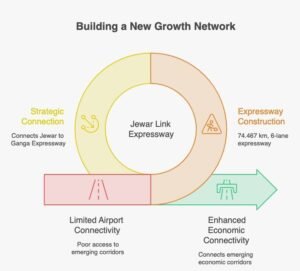
The latest development is particularly important. The Uttar Pradesh Cabinet has approved a ₹8,585.51-crore, 74.467-km greenfield Jewar Link Expressway connecting Noida International Airport with the Ganga Expressway through Bulandshahr. The approved road is six lanes, with provision for expansion to eight lanes. 

But the more significant development today is implementation.

The Uttar Pradesh e-Procurement portal shows that tenders for both packages of the Jewar Link Expressway are active, with bid submission scheduled to close on September 7, 2026 and opening scheduled for September 8. The authority-engineer procurement is also progressing.

For me, that movement from approval to procurement is where the infrastructure story becomes more consequential.

Because Jewar is no longer being developed around one airport.

It is beginning to look like an emerging economic corridor.

The Jewar–Ganga Expressway Changes the Connectivity Equation

The approved Jewar Link Expressway will extend approximately 74.467 kilometres from the Jewar Airport side towards the Ganga Expressway via Bulandshahr.

The project has been conceived as a six-lane access-controlled expressway with provision for future expansion to eight lanes. The approved project cost is ₹8,585.51 crore, and the project is being taken up through the Engineering, Procurement and Construction model. 

The distinction between six lanes and eight-lane provision is important.

I would not describe this as an eight-lane expressway today. It is a six-lane project designed with the ability to expand as future traffic requirements evolve.

That tells me something about how policymakers are thinking about the corridor.

They are not planning only for today’s traffic.

They are creating infrastructure capacity around an economic region that is expected to grow.

And that is precisely the type of signal long-term investors should study.

The Bigger Story Is the Network Around Jewar

The most common mistake in infrastructure-led real estate analysis is looking at one road in isolation.

I prefer to look at the network.

Today, the emerging Jewar ecosystem brings together:

Noida International Airport + Yamuna Expressway + Jewar Link Expressway + Delhi–Faridabad connectivity + Eastern Peripheral Expressway + Dedicated Freight Corridor + industrial clusters + logistics infrastructure + Film City + planned urban development.

This is a fundamentally different proposition from simply saying that an airport has been built near a particular location.

The YEIDA Master Plan 2041 explicitly describes the objective of developing a sustainable, well-connected greenfield city around the economic opportunities created by Noida International Airport and regional economic corridors.

The plan also identifies logistics facilities near the airport, industrial-worker housing, public transport integration, peripheral movement for heavy industrial traffic and green buffers as components of future development. 

That tells us that Jewar is being planned as an integrated economic geography.

And real estate tends to respond more strongly to economic geography than to isolated infrastructure announcements.

Jewar Airport Connectivity Is Becoming a Multi-Directional System

The strength of the emerging network lies in the number of directions it can serve.

The Yamuna Expressway already provides controlled-access connectivity between Greater Noida and Agra and forms the primary road spine serving the airport region.

Noida International Airport itself is directly connected with the six-lane Yamuna Expressway. The airport’s official information states that Phase 1 has capacity for 12 million passengers annually, while its four-phase masterplan provides for capacity of more than 70 million passengers annually

The airport also commenced commercial flight operations on June 15, 2026, marking the transition from a major infrastructure project into an operating economic asset. 

That transition matters enormously.

An airport under construction creates expectations.

An operating airport creates economic behaviour.

Airlines schedule flights.

Passengers travel.

Businesses move.

Cargo begins to flow.

Hotels respond.

Employees require housing.

Retail follows footfall.

And investors begin reassessing accessibility.

The Delhi Connection Adds Another Layer

The other important piece of the network is the greenfield connectivity between Jewar International Airport and the Delhi–Faridabad–Ballabhgarh–Sohna spur of the Delhi-Mumbai Expressway.

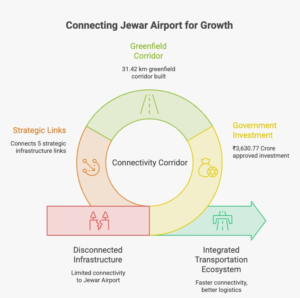
In March 2026, the Union Cabinet approved a revised total capital cost of ₹3,630.77 crore for the 31.42-km corridor.

The official Press Information Bureau announcement states that the corridor will provide direct, high-speed connectivity from South Delhi, Faridabad and Gurugram to Jewar Airport.

More importantly, the government notes that this corridor will intersect the Eastern Peripheral Expressway, Yamuna Expressway and Dedicated Freight Corridor.

This is where the infrastructure story becomes particularly interesting.

The airport is not simply receiving passengers from one direction.

It is increasingly being connected to multiple metropolitan, industrial and freight networks.

That is the essence of Jewar Airport connectivity.

Why Eight-Lane Provision Matters to Long-Term Investors

Infrastructure capacity is a useful indicator of planning horizons.

When a road is designed with future expansion in mind, the underlying assumption is that the surrounding economic geography may require greater capacity over time.

That does not guarantee traffic volumes.

Nor does it guarantee property appreciation.

But it does indicate that the corridor is being planned with long-term scalability in mind.

For investors, this distinction matters.

A short-term property thesis asks:

“What is happening here today?”

A long-term infrastructure thesis asks:

“What capacity is being created for the economy that may exist here tomorrow?”

I believe the second question is more valuable.

From Airport Connectivity to Economic Connectivity

The next phase of Jewar’s growth will not be determined by passengers alone.

It will increasingly depend on the movement of people, products, capital and businesses.

This is where airport-led development becomes more interesting.

The YEIDA Master Plan 2041 identifies airport city-side development involving logistics hubs, warehouses, freight complexes, logistics parks, office corridors, hotels, service apartments, retail, entertainment, medical and wellness facilities.

That is effectively a blueprint for an aerotropolis.

In simple terms:

Airport → Infrastructure → Industry → Jobs → Housing → Services → Consumption → Real Estate

When these links reinforce one another, the real estate market can evolve alongside the economy.

Logistics Could Become One of Jewar’s Most Important Growth Engines

For years, airports were primarily viewed through passenger traffic.

Modern airports are increasingly economic platforms for cargo, logistics and high-value supply chains.

Noida International Airport’s own masterplan anticipates substantial cargo and logistics infrastructure. Its long-term plan provides for cargo capacity rising from approximately 249,600 tonnes in Phase I to more than 1.12 million tonnes by Phase IV.

That is a significant shift in perspective.

Cargo-intensive industries value:

  • High-speed highways
  • Airport access
  • Warehousing
  • Freight infrastructure
  • Reliable connectivity
  • Large development parcels
  • Access to labour
  • Proximity to consumption centres

Jewar’s emerging infrastructure network addresses several of these requirements simultaneously.

The airport has also been developing its cargo ecosystem. In August 2026, Noida International Airport announced an agreement involving Air India SATS, Spicexpress and Total Solutions aimed at expanding freighter operations. 

This is important because cargo creates a different economic multiplier from passenger traffic.

A passenger may spend money once.

A supply chain can generate repeated economic activity through manufacturing, storage, transportation, processing and distribution.

Industrial Growth Could Strengthen Residential Demand

Real estate follows people.

And people often follow jobs.

This is one of the most fundamental relationships in infrastructure-led development.

If industrial, logistics, aviation, manufacturing and commercial activity expand around Jewar, the demand for housing and services can broaden correspondingly.

YEIDA’s planning framework recognises this relationship.

Its Master Plan 2041 specifically identifies affordable housing for industrial workers alongside airport development, logistics facilities and employment-generation objectives.

That is significant.

It means housing is not being considered separately from industrial development.

It is being considered as part of the economic ecosystem.

For the real estate sector, this can create multiple layers of demand:

Workforce housing → Rental housing → Mid-income housing → Premium housing → Serviced accommodation → Commercial property

Different segments will develop at different speeds.

That is why investors should avoid assuming that every property category will perform identically.

Film City Adds Another Demand Generator

Other major planned developments also support the airport ecosystem.

One of the most visible is the International Film City proposed in YEIDA Sector 21.

According to YEIDA, approximately 1,000 acres have been identified for the project, with commercial and industrial uses planned.

The authority states that a detailed feasibility report prepared by CBRE South Asia has been approved by the Uttar Pradesh government.

Film production, post-production, VFX, entertainment, hospitality, retail and commercial services can create a different economic cluster around the airport.

This is another reason I believe the Jewar story needs to be studied through the lens of economic diversification.

The future demand base does not have to depend upon aviation alone.

What Does This Mean for Real Estate?

The relationship between infrastructure and property value is often oversimplified.

A new road does not automatically increase the value of every property around it.

Instead, infrastructure changes the underlying variables that influence real estate.

For Jewar, I would watch five.

1. Accessibility

How easily can residents, employees, tourists, businesses and goods reach a particular location?

This is the most direct impact of Jewar Airport connectivity.

2. Employment

Are industries, logistics companies, aviation businesses and commercial enterprises actually creating jobs?

Employment is one of the strongest foundations for sustainable housing demand.

3. Economic Activity

Are businesses establishing themselves?

Are warehouses being occupied?

Are hotels opening?

Are commercial districts gaining tenants?

These are stronger signals than speculative land quotations.

4. Urban Planning

Is growth being organised through planned land use and infrastructure?

YEIDA’s Master Plan 2041 is particularly relevant here because it explicitly integrates industrial, logistics, residential, commercial, transportation and environmental considerations. 

5. Time

Infrastructure-led real estate is rarely a one-year story.

The most meaningful value creation generally occurs when infrastructure is followed by actual economic absorption.

Infographic showing Jewar Airport connectivity through the 74.467 km Jewar Link Expressway, ₹8,585.51 crore approved investment, six-lane configuration and future eight-lane expansion provision.

NCR’s Premiumisation Makes the Timing Interesting

A broader residential-market trend is also worth considering.

ANAROCK’s 2025 NCR outlook describes the region as entering a period of sustained capital appreciation and consolidation, with premium residential development becoming increasingly important. It specifically identifies the operationalisation of Jewar International Airport as a catalyst for the Noida, Greater Noida and Yamuna Expressway markets.

JLL’s research similarly found that homes priced above ₹1 crore represented 62% of residential sales in India’s top seven cities during H1 2025, while Delhi NCR recorded the highest year-on-year property-price growth among those markets during Q2 2025. 

This is not a prediction specifically for Jewar.

It is broader market context.

But it does tell us that India’s urban buyers are increasingly moving towards premium housing and that NCR remains an important market for higher-value residential demand.

For Jewar, the question is whether the emerging infrastructure and economic ecosystem can convert that broader demand into sustained local absorption.

Land Investment Requires a Different Mindset

I have always believed that land should be evaluated through future utility, not simply present price.

The most important question is not:

“How much can this land appreciate?”

It is:

“What will this land be connected to five, ten or fifteen years from now?”

That requires studying:

  • Master-plan zoning
  • Road hierarchy
  • Airport access
  • Industrial proximity
  • Logistics infrastructure
  • Employment centres
  • Planned commercial development
  • Public infrastructure
  • Legal title
  • Development permissions

This is especially important in an infrastructure-led market.

The closer a region moves towards genuine economic activity, the more important the distinction becomes between strategically located land and land that is merely marketed as being “near the airport.”

Those are not the same thing.

Commercial Real Estate Could Follow the Economic Base

An airport economy requires an ecosystem around it.

Businesses need offices.

Passengers need hotels.

Employees need restaurants.

Companies need meeting spaces.

Visitors need retail.

Logistics companies need support services.

Professionals need healthcare, education and housing.

This creates opportunities for commercial real estate to evolve in stages.

The YEIDA planning framework already anticipates office corridors, hotels, service apartments, retail, entertainment and healthcare as part of the airport city-side ecosystem. 

That is important because successful airport cities are not simply transportation facilities.

They become places of economic activity.

Employment May Be the Most Important Multiplier

Investors often focus on roads and property prices.

I prefer to watch employment.

Why?

Because employment creates recurring demand.

An industrial worker needs housing.

A logistics professional needs housing.

An airport employee needs housing.

A hotel employee needs housing.

A corporate executive may require a premium residence.

Each new employment cluster creates secondary consumption.

That consumption supports:

  • Retail
  • Food and beverage
  • Education
  • Healthcare
  • Transport
  • Hospitality
  • Rental housing
  • Residential development

This is why I see Jewar Airport connectivity as an economic story before I see it as a property story.

The Infrastructure Convergence Is the Real Opportunity

If I were evaluating Jewar today, I would not focus on one expressway.

I would draw the infrastructure map.

I would look at:

Noida International Airport

Yamuna Expressway

Jewar Link Expressway

Ganga Expressway

And separately:

Delhi–Faridabad–Ballabhgarh–Sohna connectivity

Eastern Peripheral Expressway

Yamuna Expressway

Dedicated Freight Corridor

Then I would overlay:

Industrial clusters + Logistics + Film City + Commercial development + Residential planning

That is when the picture becomes much clearer.

The investment thesis is not one road.

It is the convergence of infrastructure and economic activity.

What Investors Should Watch From Here

Infrastructure announcements create attention.

Execution creates value.

Therefore, the next stage should be watched carefully.

I would monitor five indicators.

First: Tender and Construction Progress

The UPEIDA procurement process is already active, with Jewar Link packages moving through the tender stage. 

Second: Airport Traffic

Passenger and cargo volumes will reveal whether the airport is achieving the economic scale envisioned in its masterplan.

Third: Industrial Occupancy

Announcements are useful.

Actual companies occupying industrial and logistics facilities are better indicators.

Fourth: Residential Absorption

Watch actual transactions, launches, occupancy and rental demand rather than only quoted prices.

Fifth: Further Connectivity

The strongest markets are usually those where several infrastructure networks reinforce one another.

What I Would Not Assume

There is an important distinction between optimism and speculation.

I would not assume that:

  • Every property near Jewar Airport will appreciate equally.
  • Every announced infrastructure project will be completed simultaneously.
  • A new expressway automatically guarantees returns.
  • Today’s land prices represent tomorrow’s value.
  • Short-term price movement is the same as long-term wealth creation.

Instead, I would evaluate the fundamentals.

Location.
Connectivity.
Planning.
Economic activity.
Demand.
Land quality.
Execution.
Time.

That framework is far more useful than chasing the latest property headline.

My Strategic Perspective: Follow the Economy, Not the Headline

For me, the most compelling part of the Jewar story is not the number eight.

It is not even the ₹8,585.51-crore investment.

It is the possibility that multiple infrastructure systems are beginning to operate around the same economic geography.

The airport provides global access.

Expressways provide regional access.

Freight infrastructure provides industrial access.

Planned development provides urban structure.

Employment creates people-driven demand.

And real estate sits at the intersection of all of these.

That is how infrastructure can create long-term real estate opportunity.

Not because a road automatically makes land valuable.

But because a well-connected economic corridor can create reasons for people and businesses to be there.

Jewar’s Next Chapter Could Be Bigger Than the Airport

The transformation of Jewar should ultimately be judged by what develops around the airport.

Will businesses establish themselves?

Will logistics scale?

Will manufacturing deepen?

Will employment expand?

Will commercial districts mature?

Will residential communities become established?

Will connectivity continue improving?

Those are the questions I would ask as a long-term investor.

The YEIDA Master Plan 2041 already provides a useful indication of the intended direction: an integrated, sustainable, well-connected urban region built around airport-led economic opportunity.

That is a much bigger proposition than an airport alone.

And it is why Jewar Airport connectivity deserves to be studied as one of the emerging infrastructure-led real estate stories of NCR.

The Road Is Bigger Than the Road

The most important consequence of the Jewar–Ganga connectivity project may ultimately not be the road itself.

It may be the economic geography that the road helps create.

An airport brings connectivity.

Expressways extend that connectivity.

Logistics infrastructure moves goods.

Industrial clusters create employment.

Employment creates housing demand.

Commercial activity follows.

And over time, these forces can reshape how investors perceive an entire region.

This is why I believe long-term real estate investors should look beyond today’s price and today’s headline.

The better question is:

What kind of economy is today’s infrastructure helping to build?

Jewar is increasingly giving us an interesting answer.

It is evolving towards a connected ecosystem where aviation, logistics, industry, commerce, employment and urban development can reinforce one another.

For me, that is the real investment story.

Infrastructure creates access.
Economic activity creates demand.
Time reveals value.

And in real estate, understanding that sequence has always been more important than trying to predict tomorrow’s price.

FAQs

1. What is Jewar Airport connectivity and why is it important for NCR?

Jewar Airport connectivity refers to the growing network of expressways, highways and high-speed road links connecting Noida International Airport at Jewar with Delhi-NCR, Greater Noida, Bulandshahr, the Ganga Expressway and other major economic corridors. Its importance goes beyond airport access because improved connectivity can support passenger movement, logistics, employment and commercial development across the wider Yamuna Expressway region.

The proposed 74.467-km Jewar Link Expressway will connect the airport with the Ganga Expressway through Bulandshahr. According to the Uttar Pradesh government approval, the six-lane access-controlled expressway has provision for future expansion to eight lanes.

For official project and tender updates, investors can follow UPEIDA’s official e-procurement portal.

2. How will the Jewar Link Expressway improve Jewar Airport connectivity?

The Jewar Link Expressway is expected to become one of the most important additions to Jewar Airport connectivity because it creates a direct high-speed connection between Noida International Airport and the Ganga Expressway corridor.

The project is planned as a 74.467-km, six-lane access-controlled greenfield expressway, with the provision to expand it to eight lanes in the future. The route is intended to connect the airport/Yamuna Expressway side with the Ganga Expressway through Bulandshahr, creating a larger eastward and western Uttar Pradesh connectivity network.

This is particularly significant because infrastructure of this scale can reduce dependence on individual urban roads and create new development corridors around major junctions.

3. Is the Jewar Link Expressway already an eight-lane expressway?

Not currently. A key point when discussing Jewar Airport connectivity is the distinction between the project’s present configuration and its future expansion potential.

The approved Jewar Link Expressway is planned as a six-lane access-controlled expressway with provision for expansion to eight lanes. Therefore, it should not be described as an operational eight-lane expressway today.

For investors, this distinction matters because planned capacity expansion indicates how authorities are anticipating future traffic and economic activity. The latest project procurement information can be checked through

4. How does Jewar Airport connectivity connect with the Ganga Expressway?

One of the strongest aspects of Jewar Airport connectivity is its planned integration with the Ganga Expressway network.

The Jewar Link Expressway is designed to connect Noida International Airport with the Ganga Expressway through Bulandshahr. This creates a strategic north-west/east-west connection between the airport ecosystem and several parts of western Uttar Pradesh.

The route is therefore more than an airport access road. It has the potential to strengthen movement between airport-linked businesses, industrial areas, logistics facilities, emerging urban centres and the broader expressway network.

5. How will Jewar Airport connectivity affect real estate around the Yamuna Expressway?

In my view, Jewar Airport connectivity is likely to be one of the most important infrastructure variables shaping the long-term real estate story of the Yamuna Expressway region.

The impact should not be viewed simply as “airport nearby, therefore property prices rise.” The stronger mechanism is the creation of an interconnected economic ecosystem involving aviation, logistics, manufacturing, commercial activity, hospitality, employment and supporting residential demand.

ANAROCK has identified the operationalisation of Jewar Airport as a significant catalyst for Noida, Greater Noida and the Yamuna Expressway region, with potential implications for residential and commercial capital growth.

6. Why is Jewar Airport connectivity important for logistics and industrial development?

Jewar Airport connectivity has significance far beyond passenger travel. Noida International Airport is being developed with a substantial cargo and logistics ecosystem, while the surrounding YEIDA region is planned around industrial, logistics and commercial uses.

The airport’s long-term masterplan includes significant cargo capacity and dedicated logistics-related infrastructure. YEIDA’s planning documents also identify logistics hubs, warehouses, freight complexes, logistics parks, distribution activity and an intermodal freight hub as part of the wider development framework.

The airport authority has also announced MoUs exploring freighter operations at the AISATS Multi Modal Cargo Hub, reinforcing the importance of air-cargo infrastructure in the airport’s development.

For businesses, this combination of Jewar Airport connectivity + expressway connectivity + logistics infrastructure can create a powerful location advantage.

7. How does Jewar Airport connectivity connect the airport with Delhi-NCR?

Jewar Airport connectivity is being developed through multiple transportation links rather than relying on a single corridor.

The airport is directly connected to the six-lane Yamuna Expressway, while additional projects are improving links toward Delhi, Faridabad, Gurugram and other parts of NCR. The Government of India has also approved revised capital expenditure for a 31.42-km greenfield connectivity project linking the Delhi-Faridabad-Ballabhgarh-Sohna corridor toward Jewar Airport.

This creates what I consider an important infrastructure principle: multiple connectivity routes create resilience and widen the airport’s effective economic catchment.

8. What role will Film City play in Jewar Airport connectivity and regional growth?

The proposed Film City in YEIDA Sector 21 adds another important economic layer to Jewar Airport connectivity.

YEIDA’s Film City is planned across approximately 1,000 acres and is located around 4 km from Noida International Airport. Its proximity to the airport means that aviation access can support movement of professionals, visitors, production teams, equipment and businesses associated with the entertainment ecosystem.

From a real estate perspective, the significance is not limited to the Film City itself. Large employment and commercial destinations can generate secondary demand for hospitality, retail, offices, serviced accommodation and housing.

9. Is Jewar Airport connectivity a good long-term investment theme?

I believe Jewar Airport connectivity is better understood as a long-term infrastructure-led investment theme rather than a short-term property speculation story.

The investment thesis is built around several interconnected developments: Noida International Airport, Yamuna Expressway, Jewar Link Expressway, Ganga Expressway connectivity, logistics infrastructure, Film City, industrial development and expanding NCR connectivity.

ANAROCK’s NCR research has highlighted the potential impact of Jewar Airport on Noida, Greater Noida and the Yamuna Expressway region, while Colliers has also identified infrastructure-led micro-markets around Greater Noida and the Jewar belt as areas that could gain momentum.

For anyone evaluating Jewar Airport connectivity as an investment theme, I would focus on legally clear land, approved development plans, actual infrastructure progress, accessibility and the surrounding economic ecosystem rather than buying purely on speculation.

10. What should investors monitor when evaluating Jewar Airport connectivity?

When evaluating Jewar Airport connectivity, I would monitor five major indicators: actual infrastructure execution, expressway connectivity, airport passenger and cargo growth, employment-generating projects and planned urban development.

The first is execution. Investors should distinguish between an announced project, an approved project, a tendered project and an operational project. The Jewar Link Expressway, for example, has moved into the procurement stage, with UPEIDA publishing package-level tender information.

The second is the airport itself. Noida International Airport commenced commercial operations in June 2026, providing a new aviation gateway for NCR and western Uttar Pradesh.

Finally, I would study the entire connectivity ecosystem, not one road in isolation. The real opportunity created by Jewar Airport connectivity lies in how airports, expressways, logistics, industry, employment and planned urbanisation reinforce one another over time.


-->
class="post-5208 post type-post status-publish format-standard has-post-thumbnail hentry category-lifestyle ast-grid-common-col ast-full-width ast-article-post" id="post-5208" itemtype="https://schema.org/CreativeWork" itemscope="itemscope">

Category: Lifestyle

Beyond Climate Change: Understanding the Real Forces Behind Assam and Nepal Floods

When I look at the recent Assam and Nepal floods, I find myself asking a question that goes beyond the headlines: Are we witnessing the consequences of climate change alone, or are several natural and environmental forces coming together at the same time?

The Assam and Nepal floods have occurred within the same Himalayan environmental context, but they are not identical disasters. One has been driven largely by monsoon rainfall, runoff and the extraordinary behaviour of the Brahmaputra river system. The other emerged suddenly from a high-altitude mountain process involving glacier collapse, rock and ice movement and a powerful downstream surge.

That distinction matters.

As I studied the Assam and Nepal floods, I realised that simply calling every extreme event a “climate disaster” can sometimes hide the more interesting scientific story.

Nature is more complicated than that.

And perhaps that is exactly what we need to understand.

Why the Assam and Nepal Floods Made Me Pause

The Assam and Nepal floods made me pause because they reveal two very different ways in which a Himalayan landscape can suddenly become dangerous.

In Assam, repeated spells of heavy to extremely heavy rainfall during late June and early August 2026 produced waves of flooding across Upper Assam and surrounding catchments. The World Weather Attribution assessment found that the consequences were shaped not only by rainfall but also by the physical characteristics of the Brahmaputra basin, river morphology, exposure and structural vulnerability.

In Nepal, the Assam and Nepal floods story took a completely different turn. On 26 August, a sudden surge swept through the Lhende–Bhote Koshi system. Satellite evidence and subsequent scientific reporting indicated that part of a glacier collapsed, producing an ice-rock avalanche that temporarily blocked the river before the blockage failed and released a destructive flow downstream.

So, when I think about the Assam and Nepal floods, I don’t see one single disaster.

I see a conversation between mountains, water, climate, geology, and human settlements.

What Happened in Assam?

The Assam and Nepal floods cannot be understood without first understanding Assam’s geography.

The Government of Assam describes the state as having two major river valleys—the Brahmaputra and Barak—and estimates that around 39.58% of Assam’s geographical area is flood-prone. The government also records an average annual flood-affected area of roughly 9.31 lakh hectares.

That tells me something important.

Flooding is not an unusual visitor to Assam. It is part of the natural behaviour of a landscape shaped by enormous rivers, monsoon rainfall, mountain runoff and sediment.

During 2026, repeated rainfall episodes affected Upper Assam and surrounding hill catchments. The Assam and Nepal floods discussion therefore has to begin with the monsoon.

But it cannot end there.

The Brahmaputra Is More Than a River

When I study the Brahmaputra, I see a river that is constantly changing.

The Government of Assam describes the Brahmaputra basin as extending across Tibet, India, Bhutan and Bangladesh, with numerous tributaries feeding the main river. Its tributaries respond rapidly to rainfall, and when tributary floods coincide with a high Brahmaputra, the consequences can become severe.

This is one reason the Assam and Nepal floods should not be reduced to a rainfall statistic.

The Brahmaputra carries enormous quantities of sediment. Its channels migrate, banks erode, sandbars form and disappear, and the river continuously reshapes its floodplain.

The Assam Water Resources Department records more than 4.27 lakh hectares of land eroded by rivers since 1950 and an average annual erosion rate of around 8,000 hectares.

For me, this is a powerful environmental lesson.

A river is not simply water moving through a permanent channel.

A river is a living geographical process.

And the Assam and Nepal floods remind us what happens when we forget that.

Rainfall Is Only One Part of the Equation

The Assam and Nepal floods also demonstrate why rainfall alone cannot explain flood impacts.

The Brahmaputra’s tributaries drain steep Himalayan and hill catchments. Some northern tributaries have steep gradients, braided channels, and high sediment loads, while several are capable of producing rapid, or “flashy,” floods.

When rainfall falls across these catchments, water begins moving downhill.

If the ground is already saturated, runoff can become rapid.

If several tributaries rise simultaneously, river levels can increase quickly.

If sediment has altered the channel, the river’s capacity and behaviour can also change.

This is why I believe the Assam and Nepal floods need to be understood as hydrological events, not merely weather events.

Wetlands Are Part of the Flood Story

One of the most overlooked lessons from the Assam and Nepal floods is the importance of natural water-storage systems.

Wetlands can temporarily hold water, slow its movement and support natural drainage. Floodplains provide space for rivers to spread during high-flow conditions.

I often think of wetlands as nature’s own infrastructure.

They do not replace engineered infrastructure, but they can complement it.

When natural drainage pathways, wetlands and floodplain functions are maintained, landscapes have more ways to absorb and distribute excess water.

The broader lesson from the Assam and Nepal floods is therefore not simply that we need stronger structures.

We also need stronger ecological systems.

Forests, Soil and the Journey of Water

When I think about the Assam and Nepal floods, I try not to start at the point where water reaches a house.

I follow the water upstream.

Forests, vegetation and healthy soils influence infiltration, runoff and sediment movement. Land degradation can alter the speed at which rainfall becomes surface runoff and can increase the amount of sediment entering rivers.

But I would be careful here.

It would be scientifically inaccurate to say that deforestation alone caused the 2026 Assam floods.

The evidence points toward a combination of rainfall, river behaviour, geography, exposure, and environmental conditions.

That is an important distinction because the Assam and Nepal floods should teach us how systems interact, not encourage us to search for one convenient culprit.

What Does Climate Change Have to Do With It?

This is perhaps the most important question surrounding the Assam and Nepal floods.

The answer requires some scientific humility.

There is strong evidence that Asia is warming rapidly. The World Meteorological Organization’s State of the Climate in Asia reports that Asia is warming at roughly twice the global average and that glacier melt is accelerating.

The WMO also reports that 23 of 24 monitored glaciers in High-Mountain Asia showed mass loss during 2023/24.

These are significant findings.

But they do not automatically mean that climate change caused every individual flood.

That distinction becomes particularly important when examining the Assam event.

What Scientists Found About the Assam Rainfall

The Assam and Nepal floods have generated considerable discussion about climate attribution.

The 2026 World Weather Attribution study examined the rainfall associated with the Assam flooding and found that the rainfall was not exceptional in today’s climate, with estimated return periods of less than two years for the analysed three-day and 30-day rainfall events. It also found no clear observational trend and significant uncertainty because of limited rainfall observations across the region.

That does not mean climate change is irrelevant.

It means something more nuanced.

The broader climate system is changing, but the scientific evidence does not justify saying that human-induced climate change directly caused this particular Assam rainfall event.

When I consider the Assam and Nepal floods, this is one of the most important distinctions I want readers to understand.

Climate science is strongest when it tells us both what we know and what we do not yet know.

Infographic presenting key statistics on Himalayan glacier loss, including approximately doubled ice-loss rates, up to 27 metres of cumulative ice-thickness loss since 1975, and mass loss in 23 of 24 monitored glaciers.

Nepal: When the Mountain Becomes Part of the Flood

The Nepal side of the Assam and Nepal floods story is dramatically different.

On 26 August 2026, a sudden flash flood swept through the Lhende Khola and Bhote Koshi system near the Nepal-Tibet border.

There was little warning because the disaster did not begin with a conventional period of heavy rainfall downstream.

According to reporting based on satellite imagery and scientific assessments, part of a glacier collapsed from high elevation. The falling ice and rock struck the river, temporarily blocking it. When that natural blockage failed, water, sediment, and debris surged downstream.

At least 19 bridges and around 40 kilometres of roads were reported damaged in the immediate disaster zone.

This is why the Assam and Nepal floods represent such an important scientific comparison.

In Assam, the river responded to intense rainfall.

In Nepal, the river appears to have responded to a sudden mountain failure.

Was the Nepal Event a GLOF?

The Assam and Nepal floods discussion also raises the term GLOF—Glacial Lake Outburst Flood.

A GLOF occurs when water stored in or around a glacial system is suddenly released, often because a natural dam fails.

However, I would be cautious about automatically describing the August 2026 Nepal event as a GLOF.

Current evidence points strongly toward a glacier collapse or ice-rock avalanche that temporarily blocked the Lhende River before releasing a destructive downstream surge. The exact mechanics are still being investigated.

That scientific uncertainty is important.

I would rather allow researchers to complete the investigation than force a dramatic label onto a developing event.

What Himalayan Glacier Change Tells Me

The Assam and Nepal floods have brought the Himalayan cryosphere into public attention again.

And here the evidence for long-term environmental change is much stronger.

The International Centre for Integrated Mountain Development (ICIMOD) reported in March 2026 that glaciers across the Hindu Kush Himalaya are losing ice at roughly twice the rate observed around 2000. The assessment also reported cumulative ice-thickness losses of up to about 27 metres since 1975.

The Assam and Nepal floods therefore exist against a Himalayan background that is undeniably changing.

But glacier retreat does not mean that every flood is caused by glacier melt.

A changing glacier can influence:

  • water availability
  • glacial lake development
  • slope stability
  • meltwater timing
  • downstream hazards

But an individual flood may still be triggered by rainfall, landslides, ice avalanches, lake breaches, or combinations of these processes.

The Connection Between Assam and Nepal

Are the Assam and Nepal floods directly connected?

Scientifically, I would answer: not as one physical flood event.

There is no evidence that the Nepal glacier collapse caused Assam’s flooding.

The two events occurred in different river systems and had different immediate triggers.

But the Assam and Nepal floods are connected in a broader environmental sense.

Both demonstrate the extraordinary complexity of the Himalayan water system.

Both involve mountain catchments.

Both ultimately involve rivers carrying water, sediment, and energy downstream.

Both remind us that changes high in the mountains can have consequences far below.

And both show why Himalayan environmental risk cannot be understood through political or administrative boundaries alone.

The Himalayas Are a Water System in Transition

When I look at the Himalayas today, I do not see only mountains and glaciers.

I see a vast water system.

The Assam and Nepal floods demonstrate different components of that system responding to different triggers.

The WMO has documented accelerating glacier mass loss and increasing hazards associated with glacier-related processes, including landslides and glacial lake outburst floods.

At the same time, the IPCC has established that mountain regions face interacting risks from warming, precipitation extremes, glacier loss, snow changes, landslides and other hazards.

The important word is interacting.

The future risk may not come from one factor becoming extreme.

It may come from several moderate changes occurring together.

Rivers Are Living Ecosystems

The Assam and Nepal floods have strengthened something I have believed for a long time: rivers should not be understood merely as obstacles that development needs to cross.

They are ecosystems.

They carry sediment.

They recharge floodplains.

They sustain wetlands.

They support agriculture and biodiversity.

They constantly reshape the land.

The Government of Assam itself uses satellite-based GIS analysis to monitor Brahmaputra migration, erosion, and deposition and to understand future morphological changes.

That is a useful direction.

The more accurately we understand a river’s behaviour, the better we can plan around it.

What the Assam and Nepal Floods Teach Me About Development

The Assam and Nepal floods have reinforced a principle I consider increasingly important:

Resilience must become part of development itself.

The question should not simply be:

“How do we protect ourselves after a flood?”

It should also be:

“How do we understand the landscape before we build?”

That means understanding watersheds, floodplains, drainage, wetlands, river migration and climate patterns.

The Assam Water Resources Department already identifies flood forecasting, warning systems, flood zoning, drainage improvement, riverbank protection, and other measures within its flood-management framework.

The Assam and Nepal floods remind me that engineered solutions and ecological understanding should work together.

What Can We Learn for India’s Environmental Future?

The Assam and Nepal floods are not only disaster stories.

They are planning lessons.

I believe India’s environmental future will require greater attention to five areas.

1. Better Early-Warning Systems

Warnings become valuable only when they reach people quickly enough to act.

Weather forecasting, river monitoring, satellite imagery and community-level communication all need to work together.

The WMO repeatedly emphasises early warnings and anticipatory action as important tools for reducing disaster impacts.

2. Better Understanding of Mountain Hazards

Glacier monitoring, glacial-lake mapping, slope observation and satellite-based surveillance can help identify changing risks.

ISRO’s Disaster Management Support Programme already uses remote sensing to monitor floods, landslides and other hazards and provide information to disaster-management agencies.

3. Protecting Natural Water Systems

Wetlands, forests, floodplains and natural drainage pathways should be considered part of environmental resilience.

4. Designing Infrastructure Around Risk

Roads, bridges and other infrastructure need to be designed with changing hydrological and geological conditions in mind.

5. Thinking Beyond Administrative Boundaries

Water crosses borders.

Mountain processes do not stop at district boundaries.

River systems connect communities across regions and countries.

The Assam and Nepal floods make a strong case for greater scientific cooperation, data sharing and basin-level thinking.

What Can We Learn as Citizens?

The Assam and Nepal floods also have a lesson for ordinary citizens.

Environmental responsibility is not only about planting trees or reducing waste.

It is also about understanding the landscape around us.

Where does rainwater go?

Where are the natural drainage channels?

Which areas are flood-prone?

What does the local river do during extreme rainfall?

How quickly can an official warning reach a community?

These questions may seem simple, but resilience often begins with awareness.

What Concerns Me Most

After studying the Assam and Nepal floods, what concerns me most is not that floods exist.

Floods have always existed.

What concerns me is whether our understanding is keeping pace with environmental change.

If glaciers are changing, we need better glacier monitoring.

If rainfall patterns are uncertain, we need stronger observation networks.

If rivers migrate, we need planning systems that recognise river morphology.

If wetlands store water, we need to value them.

If infrastructure faces new hazards, we need to design for those hazards.

That is how I interpret the Assam and Nepal floods—not as reasons for fear, but as reasons to become more intelligent about our relationship with nature.

My Reflection as an Environmentalist

The Assam and Nepal floods have reminded me of something fundamental.

Land is never only land.

A mountain is never only a mountain.

A river is never only a river.

Every landscape is part of a larger ecological system.

I believe responsible development begins when we understand those relationships.

For me, sustainability is not about stopping progress.

It is about making progress more conscious.

It is about recognising that long-term prosperity depends on healthy ecosystems, resilient communities, responsible land use and a willingness to listen to scientific evidence.

The Assam and Nepal floods have shown us what can happen when water, mountains, climate and geography interact with enormous energy.

Our responsibility is to understand those interactions better.

Hope and the Road Ahead

Despite the destruction associated with the Assam and Nepal floods, I do not believe the appropriate response is pessimism.

We have tools that previous generations did not have.

We have satellites.

We have increasingly sophisticated weather models.

We have glacier monitoring.

We have remote sensing.

We have river forecasting.

We have community-based warning systems.

We have decades of scientific knowledge.

And we have the ability to learn from every disaster.

The World Meteorological Organization has repeatedly emphasised early warning and anticipatory action. ICIMOD continues to expand scientific understanding of Himalayan glaciers and mountain risks. Governments are strengthening flood-management and disaster-preparedness systems.

The opportunity now is to connect these efforts.

The Assam and Nepal floods should not leave us with only memories of destruction.

They should leave us with better questions.

Learning the Language of Water

When I think about the Assam and Nepal floods, I return to the question I asked at the beginning.

Is climate change responsible?

My answer is more nuanced than a simple yes or no.

Climate change is changing the Himalayan environmental baseline. Glaciers are losing mass. Temperatures are rising. Mountain hazards are evolving.

But the Assam and Nepal floods also demonstrate that geography, rainfall, river morphology, sediment, glacier dynamics, land conditions and human exposure all matter.

The Assam event cannot scientifically be reduced to climate change.

The Nepal event cannot yet be assigned entirely to climate change either.

And that is not a weakness in the science.

It is the honesty of the science.

The greatest lesson I take from the Assam and Nepal floods is that nature does not operate in isolated boxes.

Water connects mountains to valleys.

Rivers connect upstream landscapes to downstream communities.

Glaciers connect climate to hydrology.

Wetlands connect ecology to resilience.

And our decisions connect today’s environment to tomorrow’s future.

I believe the wisest response to a changing environment is not fear.

It is understanding.

The Assam and Nepal floods are telling us something important: we cannot build a resilient future by trying to defeat nature.

We have to learn its language.

And perhaps the future of responsible development begins there.

FAQs

1. Why are the Assam and Nepal floods happening?

The Assam and Nepal floods result from different immediate triggers operating within the broader Himalayan water system. In Assam, flooding has been linked to intense monsoon rainfall, rapid runoff from surrounding catchments, rising tributaries, and the dynamic behaviour of the Brahmaputra river system. In Nepal, the recent flash-flood event involved a sudden high-altitude mountain process, with evidence pointing toward glacier collapse, ice-rock movement, temporary river blockage and subsequent release.

The wider climate context is also important. The World Meteorological Organization (WMO) reports significant warming and accelerating glacier loss across Asia, but this does not mean every individual flood can automatically be attributed to climate change. The Assam and Nepal floods demonstrate why each event needs to be examined according to its actual physical mechanism.

2. Are the Assam and Nepal floods directly connected?

The Assam and Nepal floods are connected geographically and environmentally through the larger Himalayan mountain-water system, but they should not be treated as one physical disaster.

Assam’s flooding is closely associated with the Brahmaputra and its tributaries, monsoon rainfall and the enormous Himalayan catchment feeding the river system. Nepal’s recent event occurred within the Bhote Koshi–Lhende river system and was linked to a sudden mountain process.

There is currently no evidence that the Nepal event directly caused the Assam flooding. However, both events demonstrate how Himalayan mountains, glaciers, rainfall, rivers and downstream communities are interconnected. The International Centre for Integrated Mountain Development (ICIMOD) provides extensive research on these interconnected Himalayan systems.

3. Is climate change responsible for the Assam floods?

The relationship between climate change and the Assam and Nepal floods requires careful scientific interpretation. Climate change is warming the Himalayan and wider Asian region and is contributing to significant changes in glaciers, snow and hydrological conditions. However, that does not establish that climate change directly caused every individual flood.

The 2026 World Weather Attribution analysis of the Assam flooding found substantial uncertainty around rainfall trends and did not identify a clear detectable climate-change signal in the specific rainfall event examined. The assessment also highlighted the importance of exposure and structural vulnerability in determining flood impacts.

For the broader climate context, the IPCC provides the scientific assessment of how warming influences precipitation, glaciers, extreme weather and mountain environments.

4. What caused the recent Nepal flood?

The Nepal component of the Assam and Nepal floods story appears to have been triggered by a sudden high-altitude mountain process rather than simply conventional rainfall flooding.

Available satellite observations and scientific reporting indicate that a glacier-related ice and rock collapse entered the Lhende River, creating a temporary natural blockage. When that blockage failed, water, debris and sediment moved rapidly downstream into the Bhote Koshi system.

The precise sequence and mechanics remain an area of scientific investigation. This is why I believe it is important not to simplify every glacier-related flood as a GLOF. The Department of Hydrology and Meteorology, Nepal, is an important official source for Nepal’s hydrological and meteorological monitoring.

5. How does the Brahmaputra contribute to the Assam floods?

The Brahmaputra is central to understanding the Assam and Nepal floods, particularly the Assam side of the story. It drains an enormous transboundary catchment and receives water from numerous Himalayan and hill tributaries.

During periods of intense monsoon rainfall, these tributaries can rise rapidly and deliver large volumes of water and sediment into the main river. The Brahmaputra is also highly dynamic, with channel migration, erosion, deposition and shifting sandbars influencing how floodwaters move across the landscape.

The Assam Water Resources Department documents the state’s river systems, flood behaviour and erosion patterns. Understanding the Brahmaputra as a living river system is therefore essential to understanding Assam’s recurring flood dynamics.

6. Are Himalayan glaciers making floods more dangerous?

The Assam and Nepal floods have drawn renewed attention to Himalayan glaciers because the region’s cryosphere is changing significantly.

According to ICIMOD’s Hindu Kush Himalaya assessment, glaciers across the Hindu Kush Himalaya are losing ice at an accelerating rate, with the rate of loss approximately doubling compared with the beginning of the 21st century. The WMO has similarly reported widespread glacier mass loss across High-Mountain Asia.

Changing glaciers can influence glacial lakes, meltwater, slope stability and mountain hazards. However, glacier change should be treated as one component of flood risk rather than the automatic explanation for every event.

7. What is a Glacial Lake Outburst Flood, or GLOF?

A Glacial Lake Outburst Flood, commonly called a GLOF, occurs when water stored in or around a glacial lake is suddenly released. The resulting surge can travel rapidly downstream, carrying sediment, rocks, and debris.

In the context of the Assam and Nepal floods, understanding GLOFs is particularly important because Himalayan warming can contribute to changes in glaciers and the development or evolution of glacial lakes.

However, not every glacier-related flood is a GLOF. A glacier collapse, ice-rock avalanche, landslide dam failure and glacial-lake outburst are different physical mechanisms. Research from ICIMOD and peer-reviewed Himalayan hazard studies can help distinguish between them.

8. Are the Assam and Nepal floods caused only by natural factors?

The Assam and Nepal floods demonstrate that flood disasters generally emerge from interactions between natural hazards and environmental or human conditions.

Natural processes can include monsoon rainfall, steep mountain terrain, river discharge, sediment movement, glacier instability, landslides and flash floods. At the same time, factors such as floodplain exposure, infrastructure location, drainage conditions and the availability of natural water-storage systems can influence the consequences of those hazards.

This does not mean that any particular community, project or government should be blamed. Instead, it highlights the importance of understanding exposure and resilience. The World Bank provides extensive research on integrated disaster-risk management and climate resilience.

9. What can India learn from the Assam and Nepal floods?

One of the strongest lessons from the Assam and Nepal floods is that resilience needs to begin before a disaster occurs.

I believe several areas deserve continued attention: better rainfall and river monitoring, stronger early-warning systems, glacier and glacial-lake observation, floodplain mapping, watershed management, wetland conservation and climate-informed infrastructure planning.

India already uses satellite technology extensively for disaster monitoring. The Indian Space Research Organisation (ISRO) and its disaster-management programmes use Earth-observation data for applications including flood and landslide monitoring.

The National Disaster Management Authority (NDMA) also provides national frameworks and guidance for disaster preparedness and risk reduction.

10. What is the biggest environmental lesson from the Assam and Nepal floods?

For me, the deepest lesson from the Assam and Nepal floods is that nature does not operate in isolated compartments.

A glacier can influence a river. A mountain slope can suddenly change a river’s behaviour. A river can reshape a floodplain. A wetland can temporarily store water. A forest can influence runoff and soil stability. Climate change can alter the background conditions under which all these systems operate.

That is why I believe the answer is not to search for a single culprit.

The better response is to understand the entire system.

The Assam and Nepal floods remind us that environmental responsibility is ultimately about learning how mountains, water, climate, ecosystems and human settlements interact—and using that knowledge to build a more resilient future. The World Meteorological Organization and UN Office for Disaster Risk Reduction both emphasise stronger early warning, preparedness, and risk reduction as essential elements of future resilience.


-->
class="post-5194 post type-post status-publish format-standard has-post-thumbnail hentry category-lifestyle ast-grid-common-col ast-full-width ast-article-post" id="post-5194" itemtype="https://schema.org/CreativeWork" itemscope="itemscope">

Category: Lifestyle

When Industry Follows Infrastructure: How YEIDA Is Creating a New Land & Growth Corridor

India’s emerging growth corridors are increasingly being shaped by something more powerful than a single road, airport or real estate project: the convergence of infrastructure, industry, employment, logistics, and human movement.

The latest developments around the Yamuna Expressway Industrial Development Authority (YEIDA) provide a compelling example.

As Uttar Pradesh hosts the UP–Japan Investment Meet 2026, two major projects worth a reported ₹3,191 crore have been launched in the YEIDA region. Escorts Kubota is investing around ₹2,000 crore in a new manufacturing facility, while Spark Minda is investing ₹1,166 crore across two manufacturing units. The latter is expected to create approximately 6,440 jobs, according to current reporting.

At the same time, Uttar Pradesh has announced a proposed 500-acre Japanese City in YEIDA, envisioned as an integrated industrial, commercial, and residential ecosystem for Japanese companies and citizens.

For anyone studying YEIDA land investment, these developments deserve attention—not because they guarantee land appreciation, but because they indicate something more fundamental: the gradual formation of an economic ecosystem around the corridor.

And that is where, in my view, the real long-term story begins.

YEIDA Land Investment: Why the Latest Industrial News Matters

The most important development this week is not simply the amount of money being invested.

It is the nature of the investment.

Escorts Kubota’s proposed manufacturing facility is designed around tractors, farm implements and construction equipment, with the company positioning India as an important manufacturing and export base. Spark Minda’s two proposed YEIDA units are focused on automotive components and are expected to create thousands of jobs.

This changes the way we should look at YEIDA land investment.

A manufacturing facility does not operate in isolation.

It requires employees, suppliers, transport operators, warehouses, professional services, maintenance providers, retailers, accommodation, healthcare, education and other supporting infrastructure.

Over time, these requirements can create a wider economic ecosystem.

That is why I believe the more intelligent way to study YEIDA land investment is not simply to ask:

“What is the land price today?”

The better question is:

“What economic activity is likely to surround this land over the long term?”

That distinction is critical for serious investors.

The ₹3,191 Crore Signal: Industry Is Becoming an Economic Anchor

The reported ₹3,191 crore investment represents two major industrial developments in the YEIDA region. Current reporting places Escorts Kubota’s investment at roughly ₹2,025 crore and Spark Minda’s investment at ₹1,166 crore, with combined employment potential running into thousands of jobs.

The projects should be viewed as economic anchors rather than simply real estate announcements.

For YEIDA land investment, this distinction is important.

An economic anchor can generate secondary activity around it.

The sequence often looks something like this:

Industrial investment → employment → supplier ecosystem → logistics → commercial services → housing demand → supporting infrastructure → broader urbanisation

This is not a guarantee of any particular land return. It is an economic mechanism that investors can monitor.

For example, Spark Minda’s two proposed units are expected to create approximately 6,440 jobs.

Thousands of jobs represent more than employment statistics. They potentially translate into additional demand for transportation, services, food, retail, accommodation, and other forms of economic activity.

This is why employment creation is one of the indicators I would encourage anyone evaluating YEIDA land investment to track carefully.

The Proposed 500-Acre Japanese City Adds Another Layer

Another important development is the proposed Japanese City in the YEIDA region.

Invest UP has previously described the proposal as a 500-acre integrated industrial and residential precinct, designed to provide infrastructure and urban amenities for Japanese investors. The proposal has been associated with sectors including automobile and OEM manufacturing, electronics, renewable energy, green hydrogen, IT/ITeS, GCCs and pharmaceuticals.

The word “proposed” matters.

It should not be treated as an already operational township.

But from a strategic perspective, the proposal is significant because it reflects an attempt to create industrial clustering.

Industrial clustering is important because companies often benefit from being closer to:

  • suppliers,
  • skilled workers,
  • logistics networks,
  • business services,
  • infrastructure,
  • institutions and
  • complementary industries.

For YEIDA land investment, the emergence of a planned industrial-residential ecosystem can therefore be studied as a potential long-term economic driver.

The investment thesis is not “a Japanese City has been announced, therefore land prices will rise.”

The more responsible thesis is:

A dedicated economic ecosystem could increase the depth and diversity of activity in the region if the planned investments are successfully executed.

That is a much more evidence-led way of looking at YEIDA land investment.

Noida International Airport Has Changed the Connectivity Equation

The industrial story becomes considerably more interesting when viewed alongside another major transformation: Noida International Airport is now operational.

The airport commenced commercial operations on 15 June 2026, with IndiGo operating the first commercial flight. The airport’s Phase I is designed to handle 12 million passengers annually, while its broader masterplan provides for expansion to more than 70 million passengers annually in later phases.

This matters greatly when analysing YEIDA land investment because connectivity has moved from being primarily a future promise to becoming an operating economic asset.

The airport also has an important cargo dimension.

Its current cargo facilities have an initial annual handling capacity of 200,000 metric tonnes, with plans to scale towards 1.5 million tonnes.

The airport’s cargo infrastructure is being developed around road, air and logistics connectivity, strengthening the potential relationship between aviation and manufacturing activity.

For YEIDA land investment, this creates an important distinction.

The region is no longer being shaped only by passenger accessibility.

It is also developing capabilities connected with:

manufacturing + cargo + logistics + aviation + exports.

That combination can be much more consequential for an economic corridor than simple residential connectivity.

From Infrastructure Corridor to Economic Corridor

This is where I believe the broader lesson for YEIDA land investment becomes clear.

A road creates access.

An airport expands regional and international connectivity.

An industrial plant creates employment.

A logistics network facilitates movement of goods.

A cluster of businesses creates recurring economic activity.

Together, these elements can transform the character of a geography.

This is the difference between an infrastructure corridor and an economic corridor.

For investors studying YEIDA land investment, the distinction is worth remembering.

A location can be physically well connected without becoming a major economic centre.

The stronger transformation occurs when infrastructure begins supporting real economic activity.

That is why I would watch five indicators particularly closely:

  1. Industrial investment
  2. Employment generation
  3. Airport and logistics utilisation
  4. Supporting commercial and residential development
  5. Quality of urban infrastructure

The more of these indicators that become operational rather than merely proposed, the stronger the evidence for a developing economic ecosystem.

Noida International Airport statistics showing passenger capacity, cargo capacity and connectivity impact on YEIDA land investment

What Does This Mean for YEIDA Land Investment?

The answer requires discipline.

Industrial announcements do not automatically translate into land appreciation.

Airport development does not guarantee returns.

And proximity to infrastructure alone is not sufficient to justify an investment decision.

For YEIDA land investment, the more useful approach is to evaluate the underlying drivers.

1. Look at economic activity, not only announcements

Distinguish between:

  • proposed projects,
  • approved projects,
  • projects under construction,
  • operational projects and
  • expansion phases.

The ₹3,191 crore projects now being launched provide stronger evidence than an unconfirmed proposal, while the airport provides an even more concrete example because commercial operations have already commenced.

2. Study employment

Employment is one of the clearest links between industrial investment and local economic activity.

For YEIDA land investment, job creation can potentially influence demand for housing, transportation, services and commercial infrastructure.

3. Study logistics

Manufacturing depends on the efficient movement of raw materials and finished products.

The presence of airport cargo infrastructure, the Yamuna Expressway and planned multimodal connectivity makes logistics an important part of the YEIDA story.

4. Study the surrounding urban ecosystem

A successful industrial corridor ultimately needs more than factories.

It needs:

  • housing,
  • healthcare,
  • education,
  • retail,
  • hospitality,
  • recreation,
  • public transport and
  • community infrastructure.

This is where YEIDA land investment becomes an urban transformation story rather than simply a land story.

The Sustainability Question Cannot Be Separated From Land Development

There is another dimension that I believe deserves far greater attention.

As economic corridors grow, we should not ask only:

“How much development can this land accommodate?”

We should also ask:

“What kind of environment will this development create for the next generation?”

This is particularly relevant to my own philosophy around land.

Land is not merely a financial instrument.

It is soil, water, biodiversity, food potential, open space and human habitat.

A genuinely future-ready growth corridor should therefore integrate economic development with:

  • water conservation,
  • efficient waste management,
  • renewable energy,
  • green infrastructure,
  • biodiversity,
  • productive landscapes,
  • urban farming and
  • climate-conscious planning.

This does not weaken the investment conversation.

In my view, it strengthens it.

Long-term wealth creation and responsible development should not be treated as opposing ideas.

The most enduring communities are likely to be those that combine economic opportunity with liveability.

What Entrepreneurs and Landowners Can Learn From YEIDA

The lessons from YEIDA land investment extend beyond investors.

For entrepreneurs

An emerging industrial ecosystem can create opportunities beyond manufacturing itself.

Ancillary services, logistics, hospitality, technology, professional services and workforce-oriented businesses can all become relevant as economic activity deepens.

For landowners

Land should be evaluated in its wider context.

What infrastructure is coming?

Which projects are actually approved?

Where are employment centres emerging?

How is connectivity improving?

What is the applicable land-use framework?

These questions are more useful than simply asking what someone else is willing to pay for a parcel today.

For long-term investors

The central lesson is patience.

YEIDA land investment should be viewed through a multi-year or multi-decade lens, because infrastructure and economic ecosystems rarely mature overnight.

For policymakers

The challenge is to ensure that industrialisation and urbanisation are accompanied by appropriate housing, mobility, water, environmental planning and social infrastructure.

Economic growth becomes more durable when communities can grow alongside it.

A Practical Framework for Evaluating YEIDA Land Investment

Before considering YEIDA land investment, I would suggest looking at the corridor through ten questions:

  1. What infrastructure is already operational?
  2. What projects have received formal approval?
  3. Which announced investments have entered execution?
  4. How many jobs could the industrial ecosystem create?
  5. How accessible is the location by road, air, rail and public transport?
  6. What logistics infrastructure is available?
  7. What commercial and residential ecosystem is developing?
  8. What is the applicable land-use and planning framework?
  9. What environmental and water considerations should be evaluated?
  10. Does the investment thesis still make sense over a 10–20 year horizon?

This framework is useful because YEIDA land investment should never be reduced to a single number.

Price is one variable.

The economic ecosystem around the land is another.

The quality of future development is another.

And sustainability is increasingly part of the long-term equation.

The 10–20 Year Perspective

One of the biggest mistakes in real estate is judging long-duration assets using short-duration thinking.

A road may take years to influence development.

An airport may take years to build its passenger and cargo ecosystem.

An industrial cluster may require multiple investment cycles.

A city itself evolves over decades.

Therefore, the most meaningful question around YEIDA land investment is not what happens next month.

It is what happens when infrastructure, industry, employment and urbanisation reinforce each other over the next 10–20 years.

The current developments provide several signals worth monitoring:

Operational airport

Industrial investment

Employment

Cargo and logistics

Supporting businesses

Urban services

Community formation

Long-term economic geography

None of these stages guarantees a specific investment outcome.

But together, they provide a framework for understanding why YEIDA land investment has become an increasingly relevant subject for long-term investors.

The Bigger Lesson: Land Value Follows Economic Purpose

After decades of observing real estate and land markets, I believe one principle remains remarkably consistent:

The best land decisions begin with understanding purpose.

Why is infrastructure being built?

Why are companies investing?

Where will employment come from?

Where will people live?

How will goods move?

How will communities function?

And how responsibly will the land be developed?

The emerging YEIDA story brings all of these questions together.

The current Japanese investment developments, the proposed 500-acre Japanese City and the operational Noida International Airport are not isolated events. They represent different components of a larger economic geography.

For anyone considering YEIDA land investment, that is the perspective I would recommend.

Do not look only at today’s price.

Study the infrastructure.

Study the economic anchors.

Study employment.

Study connectivity.

Study planning.

Study sustainability.

And above all, think in years and decades rather than weeks and quarters.

Because ultimately, land becomes truly valuable when it becomes part of a productive, connected and liveable ecosystem.

That is the difference between simply owning land and understanding its long-term potential.

FAQs

1. What is driving YEIDA land investment in 2026?

YEIDA land investment is gaining strategic attention because several major infrastructure and economic developments are converging in the region. These include the operational Noida International Airport, new industrial investments, expanding logistics infrastructure, and the proposed Japanese City.

The latest UP–Japan investment developments include reported investments of approximately ₹3,191 crore by Escorts Kubota and Spark Minda in the YEIDA region. Spark Minda’s proposed projects are expected to generate thousands of jobs, creating the potential for wider demand for logistics, services, commercial activity and supporting infrastructure.

For investors, the important point is that YEIDA land investment should be evaluated as part of a developing economic ecosystem rather than simply by today’s land prices.

The official Invest UP platform provides government information on investment initiatives and industrial development in Uttar Pradesh.

2. Why is YEIDA becoming an important growth corridor for YEIDA land investment?

The YEIDA land investment story is increasingly connected with the convergence of road, aviation, industrial and logistics infrastructure.

The Yamuna Expressway provides major road connectivity, while Noida International Airport began commercial operations on 15 June 2026. Phase I of the airport has a designed annual passenger capacity of 12 million, providing a new aviation gateway for the wider region. (Noida International Airport)

At the same time, industrial projects are bringing manufacturing activity closer to this infrastructure.

This creates a potentially powerful sequence:

Connectivity → Industry → Employment → Logistics → Services → Urbanisation

That ecosystem effect is one of the most important factors to monitor when evaluating YEIDA land investment over a long-term horizon.

3. What is the proposed 500-acre Japanese City in YEIDA?

The proposed Japanese City is an important component of the broader YEIDA land investment and industrial-development narrative.

According to Invest UP, the proposed development covers approximately 500 acres and is intended to provide an integrated environment for Japanese industrial, commercial and residential activity. The planned ecosystem has been associated with sectors including automobiles, electronics, renewable energy, green hydrogen, IT/ITeS, GCCs and pharmaceuticals. (Invest UP)

It is important to describe the Japanese City as a proposed/planned development, rather than an operational city.

From a YEIDA land investment perspective, its significance lies in the potential for industrial clustering. When businesses, suppliers, employees and supporting services operate within the same geographical ecosystem, the nature of local economic activity can change substantially.

However, investors should distinguish between announced plans, approved projects, construction and operational developments before making decisions.

4. What does the ₹3,191 crore investment mean for YEIDA land investment?

The reported ₹3,191 crore investment represents a significant industrial-development signal for YEIDA land investment.

Current reporting indicates approximately ₹2,025 crore of investment from Escorts Kubota and ₹1,166 crore from Spark Minda’s proposed projects. Spark Minda has stated that its two YEIDA units are expected to create approximately 6,440 jobs

The significance extends beyond the factories themselves.

Large manufacturing projects can create demand for:

  • Employees and workforce housing
  • Logistics and warehousing
  • Transportation
  • Suppliers and ancillary businesses
  • Retail and services
  • Hospitality
  • Professional services

This does not mean that surrounding land prices will automatically increase. Instead, it creates an economic driver that investors can monitor when evaluating YEIDA land investment.

5. How does Noida International Airport influence YEIDA land investment?

Noida International Airport is one of the most important infrastructure developments to consider when studying YEIDA land investment.

Commercial operations commenced on 15 June 2026, marking a transition from a planned infrastructure project to an operational aviation asset. Phase I has a designed capacity of 12 million passengers annually. 

The airport also has a cargo dimension. Its initial cargo facilities have an annual handling capacity of approximately 200,000 metric tonnes, with planned expansion toward substantially higher capacity. 

For YEIDA land investment, this means the region’s connectivity story is becoming broader than highway access.

It potentially combines:

Road + Airport + Cargo + Manufacturing + Logistics + Employment

That combination can support the development of a more diversified economic corridor over time.

6. Is YEIDA land investment suitable for long-term investors?

YEIDA land investment may be relevant for investors who understand and are comfortable with a long-duration land-investment strategy, but suitability depends on individual financial circumstances, land title, approvals, land-use regulations, location, liquidity requirements and investment horizon.

The strongest approach is to evaluate the underlying fundamentals rather than relying solely on current market sentiment.

Investors should examine:

  1. Infrastructure that is already operational
  2. Projects formally approved or under execution
  3. Industrial investment
  4. Employment potential
  5. Road, airport and logistics connectivity
  6. Applicable land-use regulations
  7. Surrounding development
  8. Environmental considerations
  9. Local demand
  10. Their own long-term financial objectives

The Invest UP and Noida International Airport websites can help investors distinguish between official infrastructure and investment information and market speculation.

Most importantly, YEIDA land investment should never be treated as a guaranteed-return proposition.

7. What factors should investors examine before considering YEIDA land investment?

Before considering YEIDA land investment, investors should look at the entire economic and planning context surrounding a parcel rather than focusing exclusively on its quoted price.

A useful evaluation framework includes:

Infrastructure: Is the promised infrastructure operational, under construction, or merely proposed?

Economic anchors: Are credible companies investing in the surrounding area?

Employment: Are projects expected to create meaningful employment?

Connectivity: How accessible is the location through roads, airport, rail, and public transport?

Land use: Is the proposed use legally and officially permissible?

Urban ecosystem: Are housing, healthcare, education, retail, and other services developing?

Environment: What are the area’s water, drainage, green-space and ecological considerations?

Time horizon: Does the investment thesis remain meaningful over 10–20 years?

For YEIDA land investment, this type of due diligence is more useful than relying on short-term price speculation.

Official information from Invest UP and Noida International Airport should be prioritised when verifying major infrastructure and investment developments.

8. Can industrial development increase demand around YEIDA land?

Industrial development can potentially influence surrounding demand, which is why it is an important consideration for YEIDA land investment.

A manufacturing facility creates direct employment. Employees and businesses then require transportation, food, retail, housing, healthcare, logistics and professional services.

As multiple companies establish themselves within the same geography, these requirements can contribute to a broader economic ecosystem.

The current YEIDA land investment narrative is particularly interesting because the region is seeing multiple layers develop simultaneously: industrial investment, airport connectivity and logistics infrastructure.

However, the relationship is not automatic.

A factory announcement alone does not establish a future property market. The actual impact depends on project execution, employment creation, supporting infrastructure, planning and real economic activity.

That is why the reported projects by Escorts Kubota and Spark Minda should be viewed as economic indicators, rather than guarantees of future land appreciation.

9. How important is sustainability to the future of YEIDA land investment?

Sustainability should become an increasingly important part of the YEIDA land investment conversation as the corridor develops.

Large-scale economic development requires more than roads, factories and buildings. Future communities also need effective water management, green infrastructure, waste management, energy efficiency, open spaces and climate-conscious planning.

From a long-term perspective, land is not merely a financial asset. It is also a physical ecosystem containing soil, water, vegetation and biodiversity.

This is particularly relevant to my own approach to YEIDA land investment and sustainable development: development should create economic value while also supporting healthier and more liveable communities.

Future-ready planning can potentially incorporate:

  • Water conservation
  • Renewable energy
  • Green spaces
  • Urban farming
  • Productive landscapes
  • Biodiversity
  • Efficient waste systems
  • Climate-resilient infrastructure

The Ministry of Housing and Urban Affairs is a useful primary source for India’s broader urban-development policies and planning frameworks.

10. What is the long-term outlook for YEIDA land investment?

The long-term outlook for YEIDA land investment should be viewed through the gradual development of an economic corridor rather than a short-term price forecast.

Several developments are worth monitoring:

  • Noida International Airport’s passenger growth
  • Expansion of airport cargo activity
  • Industrial project execution
  • Employment generation
  • Japanese investment and the proposed Japanese City
  • Logistics development
  • Supporting commercial infrastructure
  • Residential and social infrastructure
  • Broader Yamuna Expressway regional development

The airport’s commercial operations and the latest industrial investments provide tangible developments to monitor, while the proposed Japanese City represents a longer-term planning initiative.

For YEIDA land investment, I believe the most useful perspective is therefore a 10–20 year framework.

Infrastructure may create accessibility. Industry can create employment. Employment can attract services. Services can support communities.

But the outcome will depend on execution, economic conditions, planning, and sustainable development.

The most important lesson is simple:

Do not evaluate land only by what it is today. Understand the economic, infrastructural and environmental ecosystem that may shape what it becomes tomorrow.

For official investment and industrial-development updates, investors should continue monitoring Invest UP, while aviation developments can be tracked through the official Noida International Airport website

Final Perspective

The story emerging from YEIDA is ultimately larger than real estate.

It is about how India is building new economic geographies.

When airports become operational, industries establish manufacturing capacity, logistics networks expand and employment begins to cluster, land can acquire a new economic context.

That is why YEIDA land investment deserves to be studied through a broader lens.

Not through hype.

Not through short-term speculation.

But through infrastructure, industry, employment, connectivity, sustainability and time.

Infrastructure may open the door. Industry may create the opportunity. But a sustainable economic ecosystem determines what comes next.


-->
class="post-5176 post type-post status-publish format-standard has-post-thumbnail hentry category-lifestyle ast-grid-common-col ast-full-width ast-article-post" id="post-5176" itemtype="https://schema.org/CreativeWork" itemscope="itemscope">

Category: Lifestyle

The New Geography of Wealth: Why India’s Next Investment Opportunities Will Be Built Around Ecosystems, Not Just Cities

The Question About Land Is Changing

For decades, one of the simplest questions in real estate has been: Where is land available, and what is it worth today?

For a long-term investor, however, that question is becoming incomplete.

A more useful question is:

What is being built around that land—and what kind of economic ecosystem could emerge there over the next 10, 15 or 20 years?

This distinction matters because India’s economic geography is changing.

Cities are expanding. Infrastructure is connecting previously separate economic centres. Businesses are looking beyond established urban cores. Governments are increasingly evaluating states and regions through investment competitiveness, infrastructure, regulatory capacity and environmental resilience. At the same time, India’s urban population is expected to grow substantially over the coming decade, creating enormous requirements for housing, mobility, services, logistics and supporting infrastructure. 

A particularly important signal came in 2026 with NITI Aayog’s Investment Friendliness Index 2026. Rather than measuring investment attractiveness through a single indicator, the framework examines 84 indicators across eight pillars, including infrastructure, business climate, resources, government policy, regulatory environment, institutional capacity, financial health, and environmental resilience.

That framework tells us something important.

The geography of wealth is becoming more sophisticated.

The future value of a region cannot be understood simply by looking at today’s property prices. It has to be understood through the economic, infrastructural, demographic, institutional, and environmental systems developing around it.

This is why the conversation around future real estate investment in India needs to move beyond the traditional idea of “buying property in a good location.”

The deeper opportunity lies in understanding why a location becomes economically important in the first place.

India Is Entering a New Phase of Regional Competition

India is often discussed as one enormous investment market. At a macro level, that is understandable. But beneath the national growth story is a much more diverse network of states, cities, corridors and emerging economic regions.

NITI Aayog’s Investment Friendliness Index 2026 is significant precisely because it attempts to examine this regional dimension systematically.

The index considers eight broad pillars:

  • Infrastructure
  • Business climate
  • Resources
  • Government policy
  • Regulatory environment
  • Institutional environment
  • Financial health
  • Environmental resilience

The message is broader than a simple state ranking.

A region’s ability to attract capital depends on the ecosystem surrounding businesses and investors.

That has direct relevance to future real estate investment in India.

Real estate does not operate independently of the economy.

A residential development needs employment and connectivity.

A logistics facility needs transport infrastructure.

A hospitality destination needs visitors and accessibility.

A manufacturing cluster needs utilities, labour and supply chains.

A second-home market needs connectivity, lifestyle appeal and services.

An agricultural enterprise needs water, land, logistics and markets.

The physical asset is only one component of a much larger system.

This is why I believe investors should increasingly learn to read economic geography.

Instead of asking only, “Which property should I buy?”, the more sophisticated question is:

“Which economic forces are likely to make this geography more relevant over time?”

That is a very different approach to future real estate investment in India.

It requires patience, research and the willingness to look beyond today’s headlines.

What Actually Makes a Region Valuable?

Location has always mattered in real estate.

But “location” itself is not a single variable.

A location is a combination of access, economic activity, infrastructure, institutions, resources, demographics and quality of life.

1. Connectivity

Roads, railways, airports, ports and digital networks reduce the effective distance between people and markets.

But connectivity should not be viewed only in kilometres.

A new road becomes economically meaningful when it improves access to:

  • employment centres
  • industrial areas
  • tourism destinations
  • logistics hubs
  • educational institutions
  • healthcare
  • commercial markets
  • neighbouring cities

For investors evaluating future real estate investment in India, this distinction is critical.

The question is not merely:

“How close is this property to a highway?”

It is:

“What does that highway connect this property to?”

2. Economic Activity

Infrastructure becomes powerful when economic activity follows—or already exists around it.

Employment creates population movement.

Population movement creates demand for housing and services.

Businesses create demand for commercial space.

Tourism creates hospitality ecosystems.

Manufacturing creates logistics and ancillary industries.

Agriculture creates processing, storage and distribution opportunities.

This is how land becomes part of an economic system.

3. Institutional Environment

Investors also need to understand planning, regulation, approvals, land records and development frameworks.

This is particularly important for long-duration investments.

A sophisticated approach to future real estate investment in India therefore involves studying not only the physical asset but also the institutional framework governing the surrounding geography.

4. Resources and Livability

Water, energy, environmental quality and access to essential services are becoming increasingly relevant.

This is where real estate begins to overlap with sustainability.

A location that is economically connected but difficult to live in does not tell the whole story.

The future of real estate will increasingly be about where people can build productive, healthy and resilient lives.

India’s Urbanisation Is Expanding the Definition of Real Estate

One of the biggest structural forces behind future real estate investment in India is urbanisation.

According to World Bank research, around 600 million people are expected to live in Indian cities by 2036, representing roughly 40% of the country’s projected population. The same body of research estimates that India will require approximately $840 billion in urban infrastructure investment over 15 years, or about $55 billion annually, to meet the needs of its growing urban population.

These numbers are not simply about constructing more buildings.

Urbanisation creates an interconnected demand system.

More urban residents require:

  • homes
  • roads
  • public transport
  • schools
  • hospitals
  • offices
  • warehouses
  • entertainment
  • hospitality
  • food supply
  • utilities
  • recreational spaces

And this expansion does not necessarily stop at the formal boundary of an existing city.

It can extend into suburbs, satellite towns, peri-urban areas and regional corridors.

That creates an important distinction for anyone studying future real estate investment in India.

The next generation of growth may not always occur where today’s city is most concentrated.

It can emerge around the systems connecting the city to its wider economic region.

The expanding urban ecosystem

Think of a major urban centre as the centre of a series of concentric economic relationships:

City → suburbs → satellite towns → transport corridors → industrial clusters → rural enterprises → regional markets

Each layer can perform a different economic function.

This does not mean that every peripheral location will automatically become valuable.

It means that investors need to understand why and how urban expansion is occurring before making assumptions about future demand.

That is the difference between speculation and research-led future real estate investment in India.

The Infrastructure Corridor Is Becoming More Than a Road

One of the most interesting developments in India’s infrastructure story is the increasing importance of corridors.

A highway was once primarily understood as a transportation asset.

Today, its broader economic significance can be much greater.

A successful corridor can connect:

people + businesses + markets + logistics + tourism + services.

That can change the economic geography of an entire region.

Consider the logic.

A new transport connection reduces travel time.

Reduced travel time can improve accessibility.

Improved accessibility can make certain business activities more practical.

Business activity can create employment.

Employment can attract population.

Population can create demand for housing, healthcare, education, retail and services.

Those services can create further economic activity.

This is one reason infrastructure matters so much to future real estate investment in India.

But there is an important distinction

Infrastructure announcements and infrastructure execution are not the same thing.

A sophisticated investor should therefore separate:

announced infrastructure

from

approved infrastructure

from

funded infrastructure

from

construction underway

from

operational infrastructure

That distinction is essential.

The existence of a proposal can influence expectations. Actual infrastructure delivery can influence real-world accessibility and economic activity.

This is why official project documents, government planning authorities and execution updates should always form part of serious future real estate investment in India research.

From Infrastructure to Economic Ecosystems

The most important conceptual shift is this:

Infrastructure does not create value in isolation. It creates the conditions through which economic activity can develop.

This is particularly relevant when studying large corridors.

A road may pass through hundreds of kilometres of land.

But the economic impact will depend on what exists—or develops—around its network.

Consider five possible components:

Transport

Can people and goods move efficiently?

Employment

Are businesses, industries or service sectors creating jobs?

Population

Are people moving into, working in or regularly visiting the region?

Services

Are healthcare, education, hospitality, retail and other services developing?

Planning

Is land-use development being coordinated with infrastructure?

When these components begin reinforcing one another, a location can become part of a broader economic ecosystem.

That is the deeper idea behind future real estate investment in India.

The investor is not merely buying land.

The investor is studying the potential relationship between land and the economic system around it.

This does not guarantee appreciation.

No serious investment framework can guarantee that.

But it provides a much more rational basis for understanding why demand may emerge.

Environmental Resilience Is Entering the Investment Equation

For many years, environmental sustainability and investment strategy were discussed as separate subjects.

That separation is becoming increasingly difficult to maintain.

NITI Aayog’s Investment Friendliness Index 2026 includes environmental resilience among its eight pillars of investment friendliness. 

That is significant.

It suggests that environmental resilience is increasingly being understood as part of economic competitiveness.

Why?

Because environmental conditions can influence:

  • infrastructure continuity
  • productivity
  • operating costs
  • water availability
  • quality of life
  • urban resilience
  • long-term development capacity

The World Bank has also emphasised the importance of resilient urban development in India, noting that a large share of the infrastructure India will need in coming decades has yet to be built. That creates an opportunity to incorporate resilience into new infrastructure and urban development rather than treating resilience only as a retrofit exercise.

For future real estate investment in India, this changes the analytical framework.

Climate resilience should not be treated merely as an environmental checklist.

It can also be viewed as part of long-term asset usability and regional competitiveness.

What should investors examine?

A long-term investor can ask:

  • How is water managed?
  • What is the area’s drainage infrastructure?
  • How are heat conditions being addressed?
  • What is the availability of green space?
  • How resilient is essential infrastructure?
  • What is the quality of local services?
  • How is future development being planned?

These questions do not predict returns.

They improve the quality of the investment analysis.

And that is increasingly important when thinking about future real estate investment in India over a 10- or 20-year horizon.

From Concrete to Nature: The Emerging Economics of Land

Another development deserves attention.

In July 2026, NITI Aayog launched a ten-year roadmap for building India into a leading bioeconomy powerhouse by 2035. The roadmap brings together biotechnology, agriculture, environmental sustainability, biomanufacturing and other areas of biological economic activity.

This is relevant to future real estate investment in India because it expands the way we think about land.

Land is not merely a surface on which buildings are constructed.

It can also support:

  • agriculture
  • food production
  • agroforestry
  • ecological restoration
  • tourism
  • wellness
  • rural entrepreneurship
  • biological resources
  • sustainable communities

India’s bioeconomy has already grown significantly over the past decade. Government data reported that the country’s bioeconomy reached approximately $165.7 billion in 2024, compared with $10 billion in 2014.

The new NITI Aayog roadmap outlines an even more ambitious long-term trajectory.

This does not mean every piece of agricultural or ecological land should be viewed as a financial product.

It means the economic relationship between land, biology, food, environment and enterprise deserves greater attention.

For someone like me, who has spent years thinking about land not merely as a commodity but as part of a living ecosystem, this is a particularly important shift.

The future may require us to think about land in two dimensions:

What can be built on it?

and

What can be sustained through it?

That second question may become increasingly important in the next generation of future real estate investment in India.

What Does This Mean for Long-Term Investors?

The first lesson is simple:

Stop looking at property in isolation.

A sophisticated investor should study the geography around the asset.

That means examining:

Infrastructure

What has been built? What is under execution? What is officially planned?

Economic activity

What businesses, industries and employment drivers exist?

Demographics

Who is moving into the region? Who is working there? Who is visiting?

Planning

How is the region expected to develop?

Resources

What are the long-term fundamentals around water, energy and land?

Livability

Would people actually want to spend time or build lives there?

Resilience

How prepared is the ecosystem for future environmental and climatic pressures?

This is where future real estate investment in India becomes less about prediction and more about observation.

You do not need to predict exactly what a region will look like in 2040.

You need to understand the forces that could shape it.

The HNI and Family Office Perspective

For HNIs, UHNIs and family offices, real estate can play a different role from a conventional retail investment.

The question may not simply be:

“What return can this property generate?”

A family office may instead ask:

  • What role does this asset play in the wider portfolio?
  • Does it provide geographic diversification?
  • Is it aligned with the family’s long-term objectives?
  • Can it be held across generations?
  • Does it have productive or lifestyle utility?
  • What is the legal ownership structure?
  • How liquid or illiquid is the asset?
  • What are the carrying costs?
  • How does it fit into succession planning?

This is where future real estate investment in India becomes connected to wealth architecture.

The strongest land strategies are rarely built around one variable.

They require a combination of:

capital discipline + location research + legal due diligence + infrastructure analysis + patience.

For long-duration capital, time itself becomes an important analytical tool.

A five-year view can produce one interpretation.

A fifteen-year view can produce another.

A twenty-year family-wealth perspective can reveal an entirely different dimension of value.

The NRI Perspective: Look Beyond the Narrative

NRIs have an interesting relationship with India’s real estate market.

They may understand the country’s broader economic growth story while being physically distant from local developments.

That makes research discipline even more important.

An NRI evaluating future real estate investment in India should distinguish between:

  • announced and operational infrastructure
  • marketing narratives and official plans
  • projected demand and actual demand
  • development potential and permitted development
  • asking prices and verified transactions
  • ownership claims and documented title

The most useful information often comes from primary sources.

Government planning documents, land records, infrastructure authorities, municipal records and regulatory documentation can be far more valuable than a collection of online opinions.

The principle is straightforward:

The farther you are from the asset, the more important your verification framework becomes.

Infrastructure Also Creates Entrepreneurial Opportunity

There is another side of the story that is often missed.

Infrastructure does not only create opportunities for property owners.

It can create opportunities for entrepreneurs.

When accessibility improves, new business models can emerge around:

  • hospitality
  • logistics
  • food processing
  • healthcare
  • education
  • tourism
  • recreation
  • wellness
  • agriculture
  • warehousing
  • local services

This is why future real estate investment in India should not be viewed exclusively through a property lens.

Land can become a platform for enterprise.

A piece of land can support an agricultural business.

A well-planned rural property can support hospitality.

A strategically located parcel can support logistics or commercial activity, subject to planning permissions.

A sustainable community can combine living, agriculture, wellness and environmental stewardship.

The opportunity is therefore not simply:

“What can I construct?”

It can also be:

“What productive ecosystem can this land support?”

That is a much more entrepreneurial question.

My Perspective: Wealth Should Be Measured Across Generations

I have spent much of my professional journey thinking about land, real estate, wealth creation and sustainable living.

One lesson becomes clearer with time:

Wealth is not simply what an asset is worth today.

It is also what that asset can contribute to a family’s future.

That contribution may be financial.

But it may also be:

  • lifestyle
  • wellbeing
  • food
  • nature
  • community
  • productive use
  • resilience
  • family continuity
  • legacy

This is why I believe the conversation around future real estate investment in India needs to become more mature.

We should move from:

Property → Price → Appreciation

towards:

Land → Utility → Ecosystem → Resilience → Wealth → Legacy

This is not an argument against financial returns.

Returns matter.

Capital efficiency matters.

Liquidity matters.

Due diligence matters.

But wealth creation becomes more meaningful when we think beyond the next transaction.

A piece of land that supports a productive enterprise, provides a meaningful lifestyle, preserves ecological value and remains relevant to the next generation can have a different kind of significance.

That is the philosophy behind my interest in sustainable development, FarmHome living, urban farming and responsible land strategy.

The question I increasingly ask is not simply:

“What can this land become worth?”

It is:

“What can this land become part of?”

That is, in my view, one of the most important questions in future real estate investment in India.

A 10-Point Framework for Evaluating the Future Geography of Wealth

Investors looking at emerging regions can use a simple framework.

1. Connectivity

Understand current and planned transport links.

2. Infrastructure

Look beyond announcements and examine implementation.

3. Economic Activity

Identify the businesses and sectors supporting the region.

4. Demographics

Understand population movement, workforce patterns and visitor flows.

5. Employment

Ask where future jobs are expected to come from.

6. Land-Use Planning

Study official development plans and permitted uses.

7. Water and Resources

Evaluate the long-term resource base.

8. Environmental Resilience

Consider heat, flooding, drainage, green infrastructure and environmental quality.

9. Livability

Look at healthcare, education, recreation, food, community and quality of life.

10. Legal and Institutional Clarity

Verify title, permissions, records and applicable regulations.

None of these factors provides a guaranteed investment outcome.

Together, however, they can create a much stronger framework for evaluating future real estate investment in India.

What Should Investors Watch Over the Next 5–15 Years?

The future does not announce itself all at once.

It leaves signals.

For investors, those signals can include:

  • completion of major infrastructure
  • new transport connections
  • business formation
  • employment growth
  • population movement
  • tourism activity
  • institutional investment
  • logistics expansion
  • new educational or healthcare infrastructure
  • land-use changes
  • municipal investment
  • environmental-resilience initiatives

The important skill is learning to distinguish noise from structural change.

A single announcement can create excitement.

A sustained pattern of infrastructure, business activity, population movement and institutional development is much more meaningful.

This is why long-term future real estate investment in India requires continuous observation rather than one-time research.

The best investors I have encountered are often not the ones trying to predict every headline.

They are the ones quietly tracking what is changing underneath the headlines.

India’s Next Growth Map Will Be More Complex Than a City Map

India’s next phase of development is unlikely to fit neatly into the old idea of “city versus countryside.”

Instead, we may increasingly see overlapping systems:

cities + suburbs + satellite towns + infrastructure corridors + industrial clusters + tourism economies + rural enterprises + ecological landscapes.

The World Bank’s urban research reinforces the scale of India’s coming infrastructure requirements, while NITI Aayog’s recent work shows that investment competitiveness and the bioeconomy are being considered through increasingly broad frameworks.

This is why future real estate investment in India should be studied through a wider lens.

The geography of opportunity is not simply about identifying a place.

It is about understanding the relationships between places.

Where are people coming from?

Where are businesses going?

Where are roads and railways connecting?

Where are new economic activities emerging?

Where are governments planning?

Where can people live well?

Where can businesses operate sustainably?

Those questions reveal a much richer picture of India’s future economic map.

7 Practical Takeaways for Investors

1. Study the ecosystem, not just the asset.

Land exists within a larger economic and environmental system.

2. Follow infrastructure carefully.

But distinguish announcements from actual execution.

3. Understand the reason for future demand.

Do not rely solely on a location story.

4. Study official planning documents.

Planning often reveals more than promotional narratives.

5. Include environmental resilience.

Water, heat, drainage and livability can matter over long holding periods.

6. Think in cycles, not headlines.

Long-term wealth creation requires patience.

7. Make due diligence part of your investment strategy.

Research is not a preliminary step to investing.

Research is part of investing.

Don’t Just Ask Where Land Is Cheap. Ask What Is Being Built Around It.

India is entering an extraordinary period of physical and economic transformation.

Millions more people will participate in urban economies.

Infrastructure will connect more regions.

Businesses will continue to seek efficient locations.

States will compete for investment.

New economic corridors will emerge.

Sustainability and resilience will become increasingly relevant to development.

And entirely new economic opportunities may emerge from the intersection of technology, biology, agriculture, tourism and land.

In this environment, the old definition of location becomes too narrow.

Location is no longer simply a point on a map.

It is a network.

It is an economy.

It is infrastructure.

It is people.

It is policy.

It is resources.

It is environment.

It is quality of life.

That is why the future of future real estate investment in India should not be reduced to a search for the next “hot” location.

The more valuable question is:

What ecosystem is being built around this land—and can I understand its long-term significance before it becomes obvious to everyone else?

For me, that is the real meaning of the new geography of wealth.

The future may not belong simply to those who own more land.

It may belong to those who understand what the land is becoming part of.

 FAQs

1. What does future real estate investment in India look like in 2026?

Future real estate investment in India is increasingly being shaped by structural factors rather than property prices alone. Urbanisation, infrastructure development, economic corridors, business activity, demographic changes, connectivity, and environmental resilience are becoming important considerations for long-term investors.

The World Bank estimates that around 600 million people could live in India’s cities by 2036, creating significant requirements for housing, transport, utilities and urban infrastructure. This makes understanding how cities and surrounding economic regions evolve particularly important for investors.

Investors can also examine broader regional competitiveness through NITI Aayog’s Investment Friendliness Index 2026, which evaluates states across infrastructure, business climate, resources, policy, regulation, institutional capacity, financial health and environmental resilience.

2. How does infrastructure influence future real estate investment in India?

Infrastructure can influence real estate by improving connectivity between people, businesses, markets and services. Highways, airports, railways, logistics infrastructure and urban transport can reduce travel time and potentially encourage economic activity around connected regions.

However, infrastructure should not be viewed as an automatic indicator of property appreciation. Investors should distinguish between announced, approved, funded, under-construction and operational infrastructure.

For future real estate investment in India, it is therefore useful to examine what an infrastructure project actually connects and what economic activity exists or is developing around it.

The World Bank’s research on India’s urban transformation highlights the scale of infrastructure required as the country’s urban population grows.

3. Why is urbanisation important for future real estate investment in India?

Urbanisation is one of the fundamental drivers of future real estate investment in India because growing urban populations create demand for housing, commercial spaces, transportation, healthcare, education, logistics, hospitality and other services.

According to the World Bank, India’s urban population could reach approximately 600 million by 2036. Meeting the needs of this population will require substantial investment in physical and social infrastructure.

For investors, the important point is that urbanisation does not necessarily stop at existing city boundaries. Economic activity can extend into suburbs, satellite towns, peri-urban areas and connected regional corridors.

Therefore, investors should study how urban expansion is occurring, rather than simply identifying locations that are currently experiencing high demand.

4. What factors should investors evaluate for future real estate investment in India?

Investors evaluating future real estate investment in India should consider the complete ecosystem surrounding an asset rather than relying on location or price alone.

Important factors include:

  • Connectivity and accessibility

  • Existing and planned infrastructure

  • Economic and employment activity

  • Population and demographic trends

  • Land-use planning

  • Availability of utilities and water

  • Environmental resilience

  • Quality of life and services

  • Tourism or business potential

  • Legal title and regulatory clarity

A useful approach is to ask: Why would people, businesses or capital need this location in the future?

The answer should be supported by evidence such as government plans, infrastructure progress, demographic data, economic activity and credible market research.

For macroeconomic context, investors can also refer to the Government of India’s annual Economic Survey.

5. Are infrastructure corridors important for future real estate investment in India?

Infrastructure corridors can become important to future real estate investment in India because they can connect cities, industrial centres, logistics networks, tourism destinations and emerging economic regions.

The investment relevance of a corridor, however, depends on more than the physical road or railway. Investors should examine:

Connectivity → Economic activity → Employment → Population movement → Services → Development

This helps explain why some infrastructure investments can have broader regional implications.

Investors should also verify project status through official government or infrastructure-agency sources instead of relying solely on promotional material or announcements.

The Government of India’s infrastructure and economic-planning resources provide useful primary information for understanding India’s broader infrastructure development.

6. How does sustainability influence future real estate investment in India?

Sustainability is becoming increasingly relevant to future real estate investment in India because long-term development depends on resources, infrastructure resilience, water management, environmental quality and livability.

This is reflected in NITI Aayog’s Investment Friendliness Index 2026, which includes environmental resilience as one of its eight assessment pillars.

For investors with long holding periods, sustainability can therefore be considered alongside traditional factors such as connectivity and economic activity.

Relevant considerations may include:

  • Water availability and management

  • Drainage

  • Heat resilience

  • Green infrastructure

  • Energy efficiency

  • Environmental quality

  • Infrastructure continuity

  • Responsible land use

These factors do not guarantee investment returns. Instead, they provide additional information for evaluating the long-term quality and resilience of an investment ecosystem.

7. How can the bioeconomy influence future real estate investment in India?

The emerging bioeconomy adds another dimension to future real estate investment in India by connecting land with agriculture, biotechnology, food systems, environmental sustainability and biological resources.

In 2026, NITI Aayog released a roadmap focused on building India as a leading bioeconomy powerhouse by 2035. The roadmap considers areas including biotechnology, agriculture, biomanufacturing and sustainability.

For land investors, this reinforces an important idea: land can be viewed not only as a physical asset but also as a platform for productive activities such as agriculture, agroforestry, sustainable tourism and other nature-linked enterprises, subject to applicable regulations and economic viability.

This does not mean that every land parcel will benefit from the bioeconomy. Rather, it highlights the expanding economic relationship between land, nature, technology and enterprise.

8. How should HNIs and NRIs approach future real estate investment in India?

HNIs and NRIs evaluating future real estate investment in India should adopt a long-term, research-led approach that goes beyond projected appreciation.

Important areas to examine include:

  • Clear and verified ownership records

  • Applicable land-use regulations

  • Infrastructure status

  • Regional economic fundamentals

  • Development plans

  • Water and environmental considerations

  • Holding period

  • Liquidity requirements

  • Tax and legal implications

  • Succession and family-wealth objectives

For HNIs and family offices, the question can extend beyond potential financial value to the role an asset may play within a broader wealth strategy.

For NRIs, independent local due diligence becomes particularly important because distance from the asset can make verification more difficult.

The fundamental principle is simple:

Do not invest only in a property narrative. Invest only after understanding the ecosystem, documentation and long-term fundamentals behind it.

For broader policy and economic context, investors can refer to the Government of India’s Economic Survey.

-->
class="post-5159 post type-post status-publish format-standard has-post-thumbnail hentry category-lifestyle ast-grid-common-col ast-full-width ast-article-post" id="post-5159" itemtype="https://schema.org/CreativeWork" itemscope="itemscope">

Category: Lifestyle

How Jewar’s New Airport Connectivity Corridor Could Shape North India’s Next Investment Hub

Infrastructure Builds More Than Roads—It Shapes the Future

For years, I have believed that true wealth creation begins long before buildings rise or land values appreciate. It starts with visionary infrastructure, thoughtful planning, and a commitment to creating ecosystems where businesses, communities, and nature can thrive together. Every major economic transformation around the world has been driven by investments in connectivity, and India is now witnessing a similar evolution through strategic infrastructure corridors that promise to redefine regional development.

One such transformative initiative is the Jewar Airport Connectivity Corridor, a project that goes far beyond improving travel time. In my view, the Jewar Airport Connectivity Corridor represents a significant step toward building an integrated economic ecosystem where transportation, logistics, industry, sustainable development, and long-term investment converge. Rather than viewing it as merely another road project, I see it as a catalyst that has the potential to reshape how North India grows over the coming decades.

The Government of India’s recent approval of the revised ₹3,630.77 crore capital investment for the 31.42-kilometre greenfield connectivity corridor demonstrates the strategic importance of this project. The corridor will establish a direct connection between the Delhi–Mumbai Expressway and the upcoming Noida International Airport at Jewar, improving accessibility from Delhi, Gurugram, Faridabad, and surrounding regions while integrating with the Yamuna Expressway and other major transport networks. This integrated planning reflects a long-term vision of creating seamless mobility for people, businesses, and industries alike.

As someone who advocates responsible development and sustainable land planning, I believe infrastructure should never be evaluated solely by its construction cost or physical dimensions. Its true value lies in the opportunities it creates—new industries, employment generation, improved logistics, enhanced regional competitiveness, and better quality of life for future generations. The Jewar Airport Connectivity Corridor has the potential to become one of those defining infrastructure projects that influences economic activity for decades rather than years.

History consistently demonstrates that airports do much more than facilitate air travel. They become magnets for manufacturing, logistics, warehousing, hospitality, commercial development, technology parks, and residential communities. Around the world, successful airport-led development has transformed entire regions into thriving economic hubs, and India is steadily adopting a similar approach through integrated infrastructure planning. The Jewar Airport Connectivity Corridor is expected to play a critical role in connecting these emerging economic opportunities with one of the country’s largest consumer and industrial markets.

Understanding the Jewar Airport Connectivity Corridor

The Jewar Airport Connectivity Corridor has been designed to strengthen regional mobility while supporting India’s broader infrastructure and economic development goals. Instead of functioning as an isolated transportation project, the corridor forms an essential component of a larger multimodal network that connects expressways, industrial corridors, freight movement, and the upcoming Noida International Airport.

According to the Government of India, the project will provide direct connectivity between the Delhi–Mumbai Expressway and the airport, significantly improving access for travellers, cargo operators, industries, and logistics companies. The project is also expected to reduce congestion on existing routes, improve travel efficiency, and strengthen connectivity between major economic centres across the National Capital Region.

What makes the Jewar Airport Connectivity Corridor particularly significant is not merely the road itself but the strategic planning behind it. When infrastructure projects are interconnected with airports, expressways, freight corridors, and industrial zones, they create powerful economic networks that attract businesses, encourage private investment, and support long-term regional development.

Another encouraging aspect of India’s evolving infrastructure strategy is the growing emphasis on sustainability. Recent highway initiatives have demonstrated the government’s commitment to incorporating recycled construction materials, bio-mined waste, extensive plantation drives, and environmentally responsible engineering practices into major infrastructure projects. This reflects an important shift toward balancing economic growth with environmental stewardship—a philosophy that closely aligns with my belief that development should enhance both prosperity and ecological resilience.

As I see it, the Jewar Airport Connectivity Corridor is not simply creating a faster route to an airport. It is laying the foundation for a future-ready growth corridor where infrastructure, sustainability, investment, and responsible urban planning work together to build stronger communities and a more resilient regional economy. Understanding this broader perspective is essential for policymakers, investors, entrepreneurs, and anyone seeking to appreciate how transformative infrastructure can shape the future of an entire region.

Why Connectivity Creates Economic Growth: The Real Value of the Jewar Airport Connectivity Corridor

Whenever I analyse a major infrastructure project, I look beyond its engineering specifications or construction budget. Roads, expressways, and airports are not merely physical assets—they are economic catalysts that influence how businesses operate, where industries invest, how communities grow, and ultimately how regions create long-term prosperity. This is precisely why I believe the Jewar Airport Connectivity Corridor deserves attention not only from urban planners and policymakers but also from long-term investors, entrepreneurs, and business leaders.

Infrastructure has always been one of the strongest indicators of future economic growth. Across the world, regions with superior connectivity have consistently attracted higher levels of industrial investment, commercial activity, and employment. Improved transportation networks reduce travel time, lower logistics costs, enhance supply chain efficiency, and increase the competitiveness of businesses operating within the region. The Jewar Airport Connectivity Corridor has been planned with exactly this long-term vision in mind.

According to the National Highways Authority of India (NHAI) and the Ministry of Road Transport & Highways, improving multimodal connectivity remains one of the key priorities for strengthening India’s logistics ecosystem and reducing transportation costs. Better connectivity not only benefits businesses but also enhances the efficiency of trade, manufacturing, exports, and regional development.

One of the most significant advantages of the Jewar Airport Connectivity Corridor is that it is not being developed as an isolated transport project. Instead, it forms part of an integrated infrastructure network that connects the Delhi–Mumbai Expressway, Yamuna Expressway, Eastern Peripheral Expressway, Dedicated Freight Corridor, and the upcoming Noida International Airport. This interconnected approach creates a seamless movement of passengers, cargo, goods, and services, making the region increasingly attractive for industries that depend on efficient logistics.

In my experience, airports have always acted as powerful economic engines rather than simple transportation facilities. Around every successful international airport, one eventually sees the emergence of logistics parks, warehousing clusters, commercial centres, hospitality projects, manufacturing units, technology parks, and supporting residential communities. The Jewar Airport Connectivity Corridor is expected to strengthen this ecosystem by ensuring that businesses can access the airport quickly while remaining connected to some of India’s most important industrial and economic corridors.

Global institutions such as the World Bank have repeatedly highlighted that investments in quality infrastructure contribute directly to productivity, employment generation, and long-term economic competitiveness. Efficient transport networks reduce operational inefficiencies, improve market access for businesses, and encourage greater private investment in emerging regions.

Similarly, NITI Aayog has consistently emphasised that integrated infrastructure development is essential for achieving sustainable economic growth, improving logistics performance, and supporting India’s ambition of becoming a globally competitive manufacturing and investment destination.

Another important dimension of the Jewar Airport Connectivity Corridor is its potential to create a multiplier effect across multiple sectors of the economy. Every major infrastructure investment generates opportunities that extend far beyond the construction phase. Improved connectivity attracts industries, industries generate employment, employment increases housing demand, housing supports commercial development, and commercial activity stimulates further investment in public infrastructure. This interconnected cycle has been observed in many successful infrastructure-led growth corridors across the world.

From an investment perspective, I believe it is essential to understand this economic sequence rather than focusing only on short-term market movements. Sustainable wealth creation is rarely driven by speculation. Instead, it is built upon strong economic fundamentals such as infrastructure, employment growth, industrial expansion, governance, and long-term regional planning. The Jewar Airport Connectivity Corridor represents one of these foundational developments that can influence the trajectory of an entire region over many years.

However, infrastructure alone does not guarantee success. Responsible planning, environmental stewardship, efficient implementation, and coordinated policy support remain equally important. When these elements work together, infrastructure becomes more than a transportation network—it becomes the backbone of resilient, future-ready communities.

As I see it, the Jewar Airport Connectivity Corridor is not simply improving connectivity between an expressway and an airport. It is creating the conditions for a more integrated regional economy where mobility, commerce, sustainability, innovation, and long-term investment reinforce one another. Understanding this broader economic relationship allows investors to look beyond immediate headlines and appreciate how thoughtfully planned infrastructure can shape the future of an entire growth corridor.

The Integrated Infrastructure Network Transforming Jewar: Why the Jewar Airport Connectivity Corridor Is More Than a Road Project

Whenever I evaluate a large-scale infrastructure project, I never assess it in isolation. Roads, airports, railways, logistics parks, industrial corridors, and urban development plans are all interconnected pieces of a much larger economic puzzle. In my experience, it is this integration—not individual projects—that creates sustainable regional growth. That is precisely what makes the Jewar Airport Connectivity Corridor one of India’s most strategically significant infrastructure initiatives today.

The true strength of the Jewar Airport Connectivity Corridor lies in its ability to connect multiple national infrastructure assets into one seamless mobility network. Rather than serving only as an access road to the upcoming Noida International Airport, the corridor will integrate some of India’s most important transportation networks, creating a future-ready ecosystem for trade, industry, logistics, tourism, and sustainable urban development.

According to the Press Information Bureau (PIB), the newly approved corridor will directly connect the Delhi–Mumbai Expressway with Noida International Airport while significantly improving accessibility from Delhi, Gurugram, Faridabad, and neighbouring regions. This strategic connectivity is expected to reduce travel time, improve freight movement, and strengthen regional mobility.

The Delhi–Mumbai Expressway: India’s Economic Spine

One of the most significant advantages of the Jewar Airport Connectivity Corridor is its direct integration with the Delhi–Mumbai Expressway, India’s flagship infrastructure project. Spanning approximately 1,386 kilometres, the expressway is expected to reduce travel time between Delhi and Mumbai while enhancing freight efficiency and industrial connectivity across several states.

For businesses, manufacturers, exporters, and logistics companies, faster transportation translates into lower operational costs, quicker deliveries, and improved competitiveness. For investors, it signals the creation of an infrastructure ecosystem capable of supporting long-term economic expansion rather than short-term speculative growth.

Yamuna Expressway: Strengthening Regional Mobility

The Jewar Airport Connectivity Corridor also benefits from its integration with the Yamuna Expressway, one of North India’s most important transportation corridors. Connecting Greater Noida with Agra, the expressway has already transformed regional accessibility and supported industrial, institutional, residential, and commercial development along its route.

The addition of the Jewar Airport Connectivity Corridor further strengthens this network by creating faster access to the airport while improving connectivity for businesses and communities across western Uttar Pradesh and the National Capital Region.

Dedicated Freight Corridor: Powering India’s Logistics Future

Another defining feature of the Jewar Airport Connectivity Corridor is its proximity to the Dedicated Freight Corridor (DFC), one of India’s largest logistics infrastructure initiatives. Developed to enhance the movement of goods across the country, the DFC is expected to reduce congestion on passenger rail networks while significantly improving freight efficiency.

When airports, expressways, and freight corridors function together, they create an integrated logistics ecosystem capable of supporting manufacturing, exports, e-commerce, warehousing, and supply chain operations. This level of connectivity makes regions more attractive to domestic and global businesses seeking efficient transportation infrastructure.

Noida International Airport: A Catalyst for Regional Transformation

In my opinion, the upcoming Noida International Airport is not merely another aviation project—it is a catalyst for economic transformation. Globally, major airports have evolved into centres for commerce, innovation, hospitality, logistics, and employment. The Jewar Airport Connectivity Corridor will play an equally important role by ensuring that this emerging airport ecosystem remains efficiently connected to national transport networks.

The airport is expected to support passenger mobility, cargo operations, aviation services, tourism, and international business connectivity, creating opportunities across multiple sectors. However, these opportunities can only be fully realised through efficient road and multimodal connectivity, which is precisely where the Jewar Airport Connectivity Corridor becomes indispensable.

Building an Integrated Growth Corridor

What inspires me most about the Jewar Airport Connectivity Corridor is the government’s broader vision of integrated infrastructure planning. Rather than investing in isolated assets, India is increasingly developing interconnected transportation systems that link highways, airports, industrial corridors, logistics parks, and urban centres into one coordinated growth network.

This integrated approach aligns closely with recommendations from NITI Aayog, which has consistently highlighted that multimodal infrastructure and logistics integration are essential for improving economic productivity, reducing logistics costs, and enhancing India’s global competitiveness.

As I see it, the Jewar Airport Connectivity Corridor represents far more than enhanced connectivity. It demonstrates how thoughtful infrastructure planning can strengthen regional resilience, encourage industrial diversification, improve mobility, and create the foundation for sustainable economic growth. When expressways, airports, freight corridors, and urban development are planned together, they do not simply connect destinations—they connect opportunities. It is this integrated vision that has the potential to shape the future of the Jewar region and position it as one of North India’s most promising long-term growth corridors.

Infrastructure and Sustainable Development: Building Beyond Roads Through the Jewar Airport Connectivity Corridor

As someone who has always believed that development should create value for both people and the planet, I see infrastructure as far more than an engineering achievement. Roads, airports, and expressways should not only improve connectivity but also strengthen environmental resilience, support responsible urbanisation, and enhance the quality of life for future generations. This philosophy is particularly relevant when evaluating the Jewar Airport Connectivity Corridor, a project that has the potential to become a benchmark for integrated and sustainable infrastructure development in India.

For decades, infrastructure projects were often measured by their size, speed of execution, or economic output. Today, the conversation is evolving. Governments, policymakers, investors, and developers increasingly recognise that future-ready infrastructure must balance economic growth with environmental responsibility. The Jewar Airport Connectivity Corridor reflects this broader transition, where connectivity is being planned alongside long-term regional development rather than as an isolated transportation project.

One encouraging aspect of India’s infrastructure strategy is the growing emphasis on sustainable construction practices. According to the Ministry of Road Transport & Highways (MoRTH), several national highway projects are incorporating innovative approaches such as the use of bio-mined waste from landfill sites, recycled construction materials, extensive plantation drives, improved drainage systems, and environmentally responsible engineering techniques. These initiatives demonstrate that infrastructure can support both economic progress and environmental conservation.

In my opinion, this approach represents the future of infrastructure planning. Every kilometre of road should contribute not only to economic efficiency but also to climate resilience, resource conservation, and sustainable land use. As the Jewar Airport Connectivity Corridor becomes part of North India’s expanding transport network, integrating environmentally responsible practices will be essential for ensuring that growth remains balanced and inclusive.

The importance of sustainable infrastructure is also recognised globally. The United Nations Sustainable Development Goals (SDGs) highlight resilient infrastructure, sustainable cities, responsible consumption, and climate action as key priorities for long-term economic prosperity. Similarly, the World Economic Forum has consistently emphasised that infrastructure investments should improve environmental performance while supporting economic competitiveness and social well-being.

For me, sustainable development also extends beyond construction methods. It includes thoughtful land use planning, preservation of natural ecosystems, efficient water management, green mobility, biodiversity conservation, and creating communities that remain liveable for generations. Infrastructure should enable progress without compromising ecological balance. This principle is particularly important in emerging growth corridors where urban expansion is expected to accelerate over the coming decades.

Real Estate, Industry and Investment Outlook: Looking Beyond Short-Term Market Cycles

Whenever a transformative infrastructure project is announced, conversations often shift immediately towards property prices. While market appreciation naturally attracts attention, I believe the more important question is why infrastructure influences long-term economic value. The answer lies in the broader ecosystem that projects like the Jewar Airport Connectivity Corridor help create.

Infrastructure attracts businesses. Businesses create employment. Employment generates demand for housing, retail, healthcare, education, hospitality, and commercial services. As these sectors expand, they contribute to a stronger regional economy that supports sustainable real estate growth over the long term. The Jewar Airport Connectivity Corridor is expected to strengthen this cycle by improving accessibility between industrial zones, logistics hubs, commercial centres, and the upcoming Noida International Airport.

Leading real estate consulting firms such as JLL, Knight Frank, CBRE, Colliers, ANAROCK, and Savills have consistently observed that high-quality infrastructure remains one of the strongest long-term drivers of real estate demand, institutional investment, and commercial expansion across emerging urban corridors. Rather than reacting to short-term market sentiment, these organisations emphasise the importance of infrastructure, economic activity, employment generation, and governance as the true foundations of sustainable market growth.

From an investor’s perspective, I believe the Jewar Airport Connectivity Corridor should be viewed through the lens of long-term regional transformation rather than short-term speculation. Successful infrastructure corridors evolve gradually as connectivity improves, industries establish operations, businesses expand, employment opportunities increase, and supporting urban infrastructure develops over time. This phased development creates stronger economic fundamentals and encourages more resilient growth.

The most successful investment decisions are rarely driven by headlines alone. They are built upon careful analysis of infrastructure planning, government policy, environmental sustainability, demographic trends, industrial expansion, and long-term economic vision. The Jewar Airport Connectivity Corridor represents one such opportunity to understand how integrated infrastructure can shape future growth while reinforcing the importance of responsible development.

As I reflect on India’s evolving infrastructure landscape, I remain convinced that projects like the Jewar Airport Connectivity Corridor are not simply connecting destinations—they are connecting industries, people, ideas, and opportunities. When infrastructure is planned responsibly, supported by sustainable practices, and integrated with long-term regional development strategies, it becomes far more than a transportation asset. It becomes the foundation upon which resilient economies, thriving communities, and lasting prosperity are built.

Infographic illustrating the Jewar Airport Connectivity Corridor, highlighting the ₹3,630.77 crore investment, 31.42 km corridor, five integrated transport networks, and its expected impact on connectivity, logistics, employment, and sustainable regional development.

Lessons for Long-Term Investors: Why the Jewar Airport Connectivity Corridor Should Be Viewed Through a Long-Term Lens

Throughout my journey in real estate and sustainable land development, I have observed one consistent pattern: the most successful investments are rarely driven by short-term market excitement. Instead, they are built upon strong economic fundamentals, visionary infrastructure planning, responsible governance, and patience. This is exactly how I believe investors should evaluate the Jewar Airport Connectivity Corridor.

Major infrastructure projects often attract immediate attention because of the opportunities they appear to create. However, experienced investors understand that true value is not created overnight. Roads may be constructed within a few years, but the economic ecosystem that develops around them—industries, commercial centres, educational institutions, healthcare facilities, logistics hubs, hospitality businesses, and thriving communities—takes time to mature. The Jewar Airport Connectivity Corridor should therefore be viewed as a long-term economic catalyst rather than simply another transportation project.

India’s infrastructure strategy is increasingly centred on creating integrated economic corridors instead of standalone assets. Government initiatives such as the PM Gati Shakti National Master Plan aim to improve multimodal connectivity by bringing together highways, railways, airports, ports, industrial corridors, and logistics infrastructure under a unified planning framework. The Jewar Airport Connectivity Corridor aligns closely with this national vision by enhancing connectivity between the Delhi–Mumbai Expressway, Noida International Airport, the Dedicated Freight Corridor, and the wider National Capital Region.

From my perspective, investors should always begin by asking one simple question: What problem does this infrastructure solve? In the case of the Jewar Airport Connectivity Corridor, the answer extends far beyond reducing travel time. It improves freight movement, enhances airport accessibility, supports industrial development, encourages commercial investment, and strengthens regional competitiveness. These are structural improvements that can influence economic activity for decades.

Five Principles I Believe Every Long-Term Investor Should Consider

Rather than focusing solely on current market sentiment, I believe investors should evaluate infrastructure-led regions using a structured framework.

1. Infrastructure Before Appreciation

In my experience, infrastructure usually precedes economic expansion. Expressways, airports, industrial corridors, and logistics networks create the conditions that allow businesses and communities to flourish. The Jewar Airport Connectivity Corridor is one of these enabling investments that can strengthen the region’s long-term economic foundation.

2. Employment Drives Sustainable Demand

Economic growth is ultimately supported by people. As industries expand and businesses establish operations, employment opportunities increase. This creates demand for housing, retail, healthcare, hospitality, education, and commercial spaces. Sustainable real estate demand is therefore closely linked to job creation rather than speculation alone.

According to Invest India, infrastructure and industrial development remain among the key drivers supporting manufacturing, logistics, exports, and employment across India’s emerging economic corridors.

3. Connectivity Creates Competitive Regions

Regions with efficient transportation infrastructure generally become more attractive for businesses because they reduce logistics costs and improve operational efficiency. The Jewar Airport Connectivity Corridor strengthens multimodal connectivity by linking national highways, expressways, freight corridors, and an international airport into a single integrated transport ecosystem.

The World Bank has consistently recognised quality infrastructure as one of the primary contributors to long-term productivity and sustainable economic competitiveness.

4. Sustainability Is Becoming an Investment Indicator

As an environmentalist, I strongly believe sustainability should no longer be viewed as an optional consideration. Around the world, investors increasingly evaluate regions based on environmental resilience, resource management, green infrastructure, and responsible planning.

Projects that integrate ecological conservation with infrastructure development are likely to create healthier, more resilient communities over the long term. The Jewar Airport Connectivity Corridor, when supported by sustainable construction practices and responsible urban planning, has the opportunity to contribute positively to this evolving investment landscape.

5. Patience Creates Long-Term Wealth

Perhaps the most valuable lesson I have learned is that infrastructure-led development follows a gradual cycle. First comes planning. Then infrastructure. This is followed by industrial activity, employment generation, commercial expansion, residential demand, and eventually broader regional economic maturity.

Attempting to predict short-term price movements often distracts investors from understanding these larger structural changes. The Jewar Airport Connectivity Corridor should therefore be appreciated as part of a much longer development journey rather than a short-term market event.

Responsible Investing Begins with Responsible Understanding

I believe every investment decision should be guided by research rather than emotion. Before evaluating any emerging growth corridor, investors should study official government announcements, infrastructure master plans, environmental policies, demographic trends, and independent market research. Understanding how these factors interact provides a far stronger foundation than relying solely on market speculation.

The Jewar Airport Connectivity Corridor demonstrates how thoughtful infrastructure planning can influence mobility, industrial development, logistics, sustainability, and regional competitiveness simultaneously. For me, this is its greatest significance. It is not merely creating a faster route to an airport—it is contributing to the development of a future-ready economic corridor where connectivity, responsible planning, and sustainable growth work together to create enduring value.

As I often say, successful real estate investment begins long before construction starts. It begins with understanding where governments are investing, how infrastructure is evolving, and whether that growth is supported by sustainable planning. Viewed through this perspective, the Jewar Airport Connectivity Corridor is far more than an infrastructure project—it is an example of how integrated development can shape the future of an entire region for generations to come.

Challenges, Responsible Development and the Road Ahead

As optimistic as I am about the transformative potential of the Jewar Airport Connectivity Corridor, I also believe that every major infrastructure project should be viewed with a balanced perspective. Infrastructure has the power to reshape economies, but its long-term success depends on thoughtful planning, efficient execution, environmental stewardship, and collaborative governance. Sustainable prosperity is achieved not merely by constructing roads or airports but by creating resilient ecosystems that continue to benefit society for decades.

One of the most important lessons I have learned over the years is that infrastructure should always be evaluated over its entire lifecycle. Planning, land acquisition, engineering, environmental approvals, construction, operational efficiency, and future expansion are all interconnected phases that determine the lasting impact of a project. The Jewar Airport Connectivity Corridor is no exception. While the government’s vision is ambitious and strategically significant, the corridor’s true success will depend on how effectively these stages are implemented.

According to the PM Gati Shakti National Master Plan, India’s infrastructure development strategy focuses on integrated planning across highways, railways, airports, logistics parks, ports, and industrial corridors to improve efficiency while reducing project delays and enhancing inter-agency coordination.

This integrated approach is encouraging because it recognises that economic growth cannot rely on isolated infrastructure projects. Instead, long-term competitiveness depends upon well-coordinated transportation systems, sustainable urban planning, efficient logistics, environmental protection, and responsible governance working together.

Sustainable Development Must Remain the Foundation

As an environmentalist, I firmly believe that infrastructure and ecology should never be viewed as competing priorities. Economic progress becomes truly meaningful only when it enhances environmental resilience rather than diminishing it. The Jewar Airport Connectivity Corridor provides an opportunity to demonstrate how modern infrastructure can coexist with responsible environmental practices.

The Government of India has already introduced several sustainability initiatives within national highway development, including recycled construction materials, bio-mined landfill waste utilisation, roadside plantation programmes, improved drainage systems, and environmentally conscious engineering techniques. These initiatives illustrate that infrastructure development can contribute to both economic productivity and ecological conservation.

Similarly, the United Nations Sustainable Development Goals (SDGs) continue to emphasise the importance of resilient infrastructure, sustainable cities, responsible resource management, and climate-conscious development as essential pillars of long-term prosperity.

For me, responsible development means preserving natural ecosystems, encouraging efficient land use, strengthening water conservation, promoting biodiversity, and ensuring that future urban expansion remains environmentally balanced. Infrastructure should create opportunities for both economic advancement and ecological well-being.

A Vision Beyond Connectivity

When I reflect on the broader significance of the Jewar Airport Connectivity Corridor, I do not see merely a road connecting an airport to an expressway. I see an infrastructure ecosystem that has the potential to improve mobility, strengthen supply chains, encourage industrial diversification, enhance regional competitiveness, and support sustainable economic growth across North India.

However, I also believe investors should avoid viewing such projects through the lens of short-term market speculation. Real value emerges gradually as infrastructure attracts businesses, businesses generate employment, employment supports communities, and communities contribute to a stronger regional economy. Understanding this development cycle is far more valuable than chasing temporary market sentiment.

Independent research by leading global real estate advisory firms such as JLL, Knight Frank, CBRE, Colliers, and Savills consistently highlights infrastructure quality, economic fundamentals, governance, and demographic trends as critical drivers of long-term regional growth and investment confidence.

Infrastructure Creates the Future We Choose to Build

Throughout this article, I have attempted to look beyond the headlines surrounding the Jewar Airport Connectivity Corridor and examine its broader implications for infrastructure, sustainability, regional development, and long-term investment.

For me, the Jewar Airport Connectivity Corridor represents more than improved transportation. It reflects India’s evolving approach towards integrated infrastructure planning—where expressways, airports, logistics networks, industrial corridors, environmental responsibility, and sustainable urban development work together to create resilient economic ecosystems.

History consistently shows that transformative infrastructure creates opportunities far beyond its original purpose. It improves productivity, attracts businesses, supports employment, strengthens regional competitiveness, and enhances the quality of life for future generations. Yet these benefits are realised only when infrastructure is supported by responsible governance, environmental stewardship, and long-term planning.

As someone deeply committed to sustainable land development, I remain convinced that the future of real estate lies not in speculative growth but in creating places where infrastructure, ecology, communities, and economic opportunity exist in harmony. The Jewar Airport Connectivity Corridor offers an important opportunity to move in that direction.

Ultimately, successful investment is not about predicting tomorrow’s headlines—it is about understanding today’s structural transformations. Infrastructure is one of the clearest indicators of those transformations. By studying projects like the Jewar Airport Connectivity Corridor through the lens of sustainability, connectivity, economic fundamentals, and responsible planning, we gain a deeper appreciation of how enduring wealth and resilient communities are truly created.

FAQs

1. What is the Jewar Airport Connectivity Corridor, and why is it important?

The Jewar Airport Connectivity Corridor is a 31.42-kilometre greenfield road project approved by the Government of India to provide direct connectivity between the Delhi–Mumbai Expressway and the upcoming Noida International Airport (Jewar Airport). The corridor has been designed to improve passenger mobility, freight transportation, and regional accessibility while integrating with major infrastructure such as the Yamuna Expressway, Eastern Peripheral Expressway, and the Dedicated Freight Corridor.

Beyond improving transportation, the Jewar Airport Connectivity Corridor is expected to strengthen logistics efficiency, encourage industrial investment, support employment generation, and contribute to long-term regional economic development across the National Capital Region (NCR).

2. How will the Jewar Airport Connectivity Corridor improve regional connectivity across North India?

The Jewar Airport Connectivity Corridor will significantly enhance connectivity by integrating India’s major transportation networks into one seamless mobility ecosystem. Once operational, it will provide faster access between Delhi, Gurugram, Faridabad, Greater Noida, western Uttar Pradesh, and the Noida International Airport.

This improved connectivity is expected to reduce travel time, lower logistics costs, improve freight movement, and enhance accessibility for businesses, industries, tourists, and residents. Better transportation infrastructure also supports stronger regional integration, making the corridor an important component of India’s long-term infrastructure strategy.

3. How does the Jewar Airport Connectivity Corridor influence long-term real estate and land investment?

The Jewar Airport Connectivity Corridor should be viewed as an infrastructure-led development initiative rather than simply a transportation project. Historically, integrated infrastructure projects improve regional accessibility, attract industries, strengthen commercial activity, and support long-term economic growth.

As businesses establish operations and employment opportunities increase, demand for residential, commercial, hospitality, warehousing, and logistics infrastructure generally grows over time. While infrastructure alone does not guarantee appreciation, the Jewar Airport Connectivity Corridor contributes to stronger economic fundamentals that may positively influence long-term real estate demand when combined with responsible planning and sustainable development.

4. Which industries are expected to benefit from the Jewar Airport Connectivity Corridor?

The Jewar Airport Connectivity Corridor is expected to support multiple sectors that rely on efficient transportation and logistics infrastructure. These include aviation services, manufacturing, logistics, warehousing, e-commerce, hospitality, tourism, commercial real estate, industrial parks, and export-oriented businesses.

Improved connectivity between the Delhi–Mumbai Expressway, the Dedicated Freight Corridor, and Noida International Airport creates an integrated ecosystem that enhances supply chain efficiency and reduces operational costs for businesses operating in the region.

5. Why is sustainable infrastructure important for the success of the Jewar Airport Connectivity Corridor?

Sustainability plays a crucial role in ensuring that the Jewar Airport Connectivity Corridor delivers long-term economic and environmental benefits. Modern infrastructure projects increasingly incorporate recycled construction materials, bio-mined waste utilisation, roadside plantation programmes, efficient drainage systems, and environmentally responsible engineering practices.

By integrating sustainable construction methods with strategic infrastructure planning, projects like the Jewar Airport Connectivity Corridor can contribute to climate resilience, resource conservation, healthier communities, and responsible urban development while supporting long-term economic growth.

6. How does the Jewar Airport Connectivity Corridor align with India’s PM Gati Shakti National Master Plan?

The Jewar Airport Connectivity Corridor closely aligns with the objectives of the PM Gati Shakti National Master Plan, which focuses on integrating highways, railways, airports, ports, logistics parks, and industrial corridors into a unified transportation network.

The objective is to improve multimodal connectivity, reduce logistics costs, minimise project delays, strengthen supply chains, and enhance India’s global economic competitiveness. The corridor supports this vision by improving connectivity between key infrastructure assets and facilitating coordinated regional development.

7. What factors should long-term investors evaluate before considering opportunities around the Jewar Airport Connectivity Corridor?

Long-term investors should evaluate infrastructure projects using a comprehensive framework rather than focusing solely on short-term market trends. Important considerations include government infrastructure plans, regional connectivity, industrial development, employment generation, environmental sustainability, urban planning, governance, demographic trends, and future economic activity.

The Jewar Airport Connectivity Corridor represents one component of a broader infrastructure ecosystem. Investors should therefore analyse how expressways, airports, freight corridors, industrial zones, and supporting social infrastructure work together to create sustainable regional growth before making investment decisions.

8. Why is the Jewar Airport Connectivity Corridor considered a long-term growth corridor rather than a short-term infrastructure project?

The Jewar Airport Connectivity Corridor is considered a long-term growth corridor because its impact extends beyond transportation. Major infrastructure projects typically influence regional development over many years by improving accessibility, encouraging industrial expansion, creating employment opportunities, supporting commercial activity, and attracting institutional investment.

As infrastructure networks mature, they contribute to stronger economic ecosystems where businesses, communities, and supporting services grow together. This long-term development cycle makes the Jewar Airport Connectivity Corridor an important example of integrated infrastructure planning designed to strengthen regional competitiveness and sustainable economic development.


-->
class="post-5140 post type-post status-publish format-standard has-post-thumbnail hentry category-lifestyle ast-grid-common-col ast-full-width ast-article-post" id="post-5140" itemtype="https://schema.org/CreativeWork" itemscope="itemscope">

Category: Lifestyle

Why Regenerative Land Investment Will Become India’s Most Valuable Asset Class in the Next Decade

For more than twenty-five years, I have studied land across India—not merely as a real estate asset, but as a living system that reflects economics, ecology, infrastructure, culture, and long-term human progress. My journey began in banking and risk underwriting, where I learned that the most valuable assets are rarely those attracting the most attention. They are the ones whose true potential is understood before the market recognizes it. The same principle has guided my work in land investment ever since.

Today, I believe we are witnessing another fundamental shift—one that will redefine how investors, governments, family offices, and institutions evaluate land. The future belongs not simply to land that can be built upon, but to land that can regenerate, produce, conserve, and adapt. In my view, Regenerative Land Investment represents the next evolution of long-term wealth creation.

For decades, land has largely been valued through conventional parameters such as location, connectivity, zoning, and development potential. These factors will always remain important. However, climate change, water scarcity, food security, carbon markets, and environmental regulations are introducing entirely new dimensions of value. Increasingly, investors are asking different questions: Can this land retain water? Can it improve soil health? Can it support biodiversity? Can it contribute to carbon sequestration? Can it remain productive and resilient for future generations?

These are no longer philosophical questions—they are becoming economic ones.

The World Economic Forum estimates that more than half of global GDP depends moderately or highly on nature, highlighting that environmental degradation is now an economic risk as much as an ecological one. As governments and businesses prioritize resilience, natural capital is emerging as a strategic asset rather than a peripheral concern. This broader shift is creating new opportunities for Regenerative Land Investment as investors seek assets capable of generating both financial and environmental value.

The concept of natural capital has gained increasing attention across global policy discussions. Institutions such as the World Bank, the United Nations Environment Programme (UNEP), and the World Economic Forum now recognize ecosystems, forests, agricultural land, wetlands, and biodiversity as assets that deliver measurable economic benefits through food production, water security, climate regulation, and ecosystem services. Rather than viewing land solely as a static physical asset, these institutions encourage decision-makers to understand its dynamic role within long-term economic systems.

For India, this transformation arrives at a particularly significant moment. Rapid urbanization, infrastructure expansion, population growth, and climate variability are simultaneously increasing demand for land while emphasizing the importance of responsible land stewardship. This convergence makes Regenerative Land Investment especially relevant for investors seeking durable, future-ready assets.

Unlike speculative real estate cycles that often depend heavily on short-term market sentiment, regenerative land emphasizes long-term resilience. Healthy soils, efficient water management, agroforestry, biodiversity restoration, and climate adaptation improve not only ecological outcomes but also the long-term productivity and stability of the land itself. While these benefits may take years to mature, they align closely with the investment horizon preferred by many family offices and long-term capital allocators.

The Investment World Is Entering a New Era

Every major investment cycle has been shaped by structural economic change. Industrialization transformed manufacturing. Digital technology reshaped communication and commerce. Artificial intelligence is redefining productivity today. The next significant transformation may well be the transition toward a nature-positive economy, where environmental resilience becomes an essential component of financial value.

Around the world, governments are strengthening climate policies, corporations are integrating sustainability into business strategies, and institutional investors are expanding their focus beyond traditional financial metrics. Environmental, Social, and Governance (ESG) considerations—while evolving in implementation across regions—have accelerated conversations about responsible capital allocation and long-term risk management.

In this changing landscape, Regenerative Land Investment offers a compelling framework because it recognizes that land can simultaneously generate agricultural productivity, support ecological restoration, strengthen climate resilience, and contribute to long-term wealth preservation.

India’s own policy direction reflects this broader transition. The Government of India has introduced the Carbon Credit Trading Scheme (CCTS), laying the foundation for a domestic carbon market that supports the country’s climate commitments while creating future opportunities for verified emission reductions and carbon sequestration projects. Although carbon credit generation requires compliance with approved methodologies and rigorous verification, the policy signals a growing recognition that regenerative landscapes may play an increasingly valuable role within the country’s environmental and economic future.

Similarly, India’s commitment toward achieving net-zero emissions by 2070, expanding renewable energy capacity, restoring degraded ecosystems, and promoting sustainable agriculture demonstrates that climate resilience is becoming integrated into long-term national development planning rather than remaining a standalone environmental objective.

For investors, this evolution introduces an important strategic consideration. Traditional investment analysis has typically focused on appreciation potential, rental income, and market demand. Increasingly, however, future land value may also depend on factors such as ecosystem resilience, water security, carbon storage, biodiversity enhancement, and agricultural productivity.

This does not diminish the importance of infrastructure or location; rather, it expands the investment framework. Roads, airports, logistics corridors, and urban development will continue to influence land appreciation. Yet the land capable of adapting to environmental challenges while generating multiple forms of long-term value may become increasingly differentiated within the broader market.

From my perspective, this represents a fundamental shift in thinking. The most valuable land of the next decade may not simply be the land closest to the next city expansion. It may be the land that combines strategic location with ecological strength, productive capacity, technological adaptability, and responsible stewardship.

That is why I believe Regenerative Land Investment should not be viewed as a niche environmental concept. It is emerging as a comprehensive investment philosophy—one that integrates economics, sustainability, infrastructure, climate science, and long-term wealth creation into a single framework. In the sections that follow, I will explore how regenerative land differs from conventional land investment and why this approach is becoming increasingly relevant for investors preparing for the decades ahead.

Understanding Regenerative Land Investment

For decades, land investment has largely been measured by familiar parameters—location, infrastructure, future development potential, and market appreciation. While these factors remain fundamental, I believe they no longer provide a complete picture of long-term value. The world is changing rapidly, and so are the forces that determine how land creates wealth. This is where Regenerative Land Investment offers a fundamentally different perspective.

To me, Regenerative Land Investment is not simply about owning agricultural land or investing in green projects. It is the practice of investing in land that continuously improves its ecological, economic, and social value over time. Instead of extracting value from the land, regenerative principles focus on restoring soil health, conserving water, increasing biodiversity, strengthening climate resilience, and enhancing long-term productivity. In essence, the land becomes more valuable because it becomes healthier.

This approach reflects a growing global understanding of natural capital—the idea that ecosystems provide measurable economic benefits through food production, water regulation, carbon storage, and biodiversity. Organizations such as the World Bank and the World Economic Forum increasingly recognize that protecting and restoring nature is essential for long-term economic resilience.

Unlike conventional land investment, Regenerative Land Investment creates multiple layers of value simultaneously. A well-managed regenerative landscape can improve agricultural productivity through healthier soils, reduce water stress through better watershed management, support biodiversity through native vegetation, and potentially participate in future carbon markets where projects meet regulatory and certification requirements. Rather than depending on a single source of appreciation, regenerative land generates value across environmental, operational, and economic dimensions.

In my own philosophy, I evaluate land through five interconnected lenses: agricultural productivity, infrastructure readiness, cultural and heritage significance, carbon and climate potential, and trust in execution. These factors are not isolated—they reinforce one another. Productive soil improves agricultural output. Healthy ecosystems strengthen water security. Better water management increases resilience to climate change. Strategic infrastructure enhances accessibility, while responsible stewardship ensures these benefits endure for generations. When these elements align, Regenerative Land Investment becomes more than a real estate decision—it becomes a long-term capital allocation strategy.

A useful way to understand this shift is by comparing traditional and regenerative approaches:

Traditional Land Investment

Regenerative Land Investment

Focus on location and appreciation

Focus on appreciation and ecosystem value

Development-driven returns

Multi-dimensional long-term value creation

Limited environmental consideration

Soil, water, biodiversity, and climate integrated into investment decisions

Single economic outcome

Multiple value streams, including agricultural productivity and potential environmental benefits

This broader framework also aligns with emerging investment priorities among institutional investors, family offices, and impact funds that increasingly evaluate environmental resilience alongside financial performance.

Why Climate Change Is Reshaping Land Economics

Climate change is no longer solely an environmental discussion—it has become a defining economic issue. Rising temperatures, changing rainfall patterns, declining groundwater levels, and increasing frequency of extreme weather events are directly influencing agricultural productivity, infrastructure planning, insurance costs, and long-term asset values. Consequently, investors are beginning to assess land not only for its current market price but also for its ability to remain productive and resilient under changing climatic conditions.

According to the Intergovernmental Panel on Climate Change (IPCC), land plays a central role in climate mitigation through carbon sequestration, ecosystem restoration, and sustainable land management. Similarly, the Food and Agriculture Organization (FAO) emphasizes that regenerative agricultural practices improve soil health, enhance water retention, reduce erosion, and strengthen resilience against droughts and floods.

India is also moving decisively toward integrating sustainability into its economic planning. Through initiatives such as the Carbon Credit Trading Scheme (CCTS), the government is establishing the framework for a domestic carbon market that supports emission reduction and carbon sequestration projects. While participation depends on approved methodologies and independent verification, these policy developments demonstrate that environmental performance is increasingly becoming an economic consideration.

This is why I believe Regenerative Land Investment represents one of the most significant long-term investment opportunities of the coming decade. Land that conserves water, restores soil, supports biodiversity, and adapts to climate challenges is likely to become increasingly relevant in a world where resilience itself carries measurable value. Investors who recognize this shift today are not simply purchasing land—they are investing in assets designed to remain productive, sustainable, and economically relevant for generations to come.

India’s Carbon Economy Has Officially Begun

For decades, the financial value of land was determined primarily by its location, development potential, and market demand. Today, however, another dimension is quietly emerging—the ability of land to store carbon, restore ecosystems, and contribute to climate resilience. This transformation marks one of the most significant structural shifts in modern land economics, and it is one of the strongest reasons why I believe Regenerative Land Investment will play an increasingly important role in India’s long-term investment landscape.

Around the world, governments are recognizing that achieving climate goals requires more than reducing industrial emissions. Healthy forests, fertile agricultural landscapes, wetlands, and regenerative ecosystems act as natural carbon sinks, absorbing carbon dioxide from the atmosphere while improving biodiversity, water security, and ecological resilience. As a result, land is no longer viewed solely as a physical asset—it is increasingly being recognized as a strategic environmental asset capable of generating long-term economic value.

India has taken a significant step in this direction through the Carbon Credit Trading Scheme (CCTS), notified under the Energy Conservation Act. The framework lays the foundation for a structured domestic carbon market that will gradually support verified emission reductions and carbon removal projects across multiple sectors. According to the Press Information Bureau (Government of India), the Carbon Credit Trading Scheme forms an important part of India’s strategy to achieve its climate commitments while encouraging sustainable economic development.

For investors, this policy represents more than an environmental initiative—it signals a long-term shift in how productive landscapes may be valued. It is important to understand that Regenerative Land Investment does not automatically generate carbon credits. Carbon projects must comply with approved methodologies, monitoring standards, and third-party verification before any credits can be issued. Nevertheless, the emergence of India’s carbon market demonstrates that environmental performance is becoming increasingly measurable and economically relevant.

This transition aligns with India’s broader climate ambitions. The Government of India has reported that the country achieved a 36% reduction in the emissions intensity of GDP from 2005 levels by 2020, ahead of its trajectory toward the nationally determined contribution (NDC) target. In addition, India has created an estimated 2.29 billion tonnes of additional carbon sink between 2005 and 2021, reflecting significant progress toward its afforestation and ecosystem restoration goals. These achievements highlight the growing importance of landscapes capable of absorbing carbon while supporting sustainable development. Detailed progress can be accessed through the Ministry of Environment, Forest and Climate Change (MoEFCC) and the Press Information Bureau.

From my perspective, Regenerative Land Investment is perfectly aligned with this evolving policy environment. Land that improves soil health, supports agroforestry, conserves native vegetation, and strengthens ecosystem services is becoming increasingly relevant in a future where environmental stewardship and economic performance are no longer viewed as separate objectives.

This shift is also attracting attention globally. The World Bank’s Natural Capital Program emphasizes that healthy ecosystems underpin economic productivity by supporting agriculture, water availability, disaster resilience, and livelihoods. Similarly, the World Economic Forum’s Nature Action Agenda identifies nature-positive investments as essential for reducing long-term economic risk. These developments reinforce the idea that Regenerative Land Investment is increasingly aligned with global capital allocation trends rather than being a niche environmental concept.
Infographic illustrating how regenerative land investment is becoming a future-ready asset class through healthy soils, climate resilience, biodiversity, and India's sustainability goals.

Why Soil May Become More Valuable Than Concrete

When most people think about land investment, they naturally focus on what can be built above the ground. I believe the more important question for the coming decades is what lies beneath it.

Healthy soil is one of the world’s most valuable natural assets, yet it is often overlooked in conventional real estate discussions. Soil stores carbon, filters water, supports biodiversity, produces food, and sustains ecosystems that ultimately influence economic stability. As climate risks increase, the quality of soil may become just as important as the location of the land itself. This is one of the core reasons why Regenerative Land Investment deserves serious attention from long-term investors.

According to the Food and Agriculture Organization (FAO), approximately 95% of global food production depends directly on healthy soil. However, soil degradation caused by erosion, excessive chemical use, deforestation, and unsustainable farming practices continues to threaten agricultural productivity worldwide. Restoring soil health is therefore not only an environmental priority but also a strategic economic necessity.

Regenerative agricultural practices—including cover cropping, reduced tillage, compost application, crop diversification, agroforestry, and integrated water management—have demonstrated significant potential to improve soil organic carbon, enhance moisture retention, and increase long-term productivity. Scientific research published by Nature Portfolio and studies conducted by organizations such as ICRISAT indicate that regenerative practices strengthen ecosystem resilience while helping landscapes adapt to increasingly unpredictable climatic conditions.

For Regenerative Land Investment, healthy soil represents multiple forms of value. Improved soil quality enhances agricultural output, reduces irrigation requirements, lowers erosion risks, increases biodiversity, and strengthens resilience against droughts and floods. These benefits contribute to both environmental sustainability and long-term economic performance, making regenerative landscapes fundamentally different from land that depends solely on future development or speculative appreciation.

Water security further reinforces this relationship. Healthy soils absorb and retain significantly more rainfall than degraded soils, improving groundwater recharge and reducing runoff during extreme weather events. As India’s urbanization accelerates and water stress intensifies across many regions, landscapes capable of naturally conserving water are likely to become increasingly valuable. Reports from NITI Aayog have consistently emphasized the importance of integrated water resource management and sustainable land use for India’s future development.

Ultimately, I do not see Regenerative Land Investment as replacing traditional real estate principles such as connectivity, infrastructure, or market demand. Instead, it expands the investment framework by recognizing that the healthiest landscapes are often the most resilient economic assets. In the decades ahead, investors who understand the economic value of healthy soils, restored ecosystems, and climate-resilient land may find themselves holding assets that appreciate not only because cities expand around them, but because the land itself continues to regenerate and create enduring value.

Technology Is Changing How Land Is Evaluated

For centuries, investors assessed land by physically walking the site, studying its surroundings, and relying on local market intelligence. While experience and field knowledge remain invaluable, today’s investment landscape demands a far more sophisticated approach. The convergence of artificial intelligence, drone technology, satellite imagery, Geographic Information Systems (GIS), and remote sensing is fundamentally changing how land is evaluated, monitored, and managed. This technological transformation is another reason why I believe Regenerative Land Investment is becoming one of the most future-ready investment approaches.

Modern investors no longer need to rely solely on historical records or visual inspections. Today, high-resolution satellite imagery can monitor vegetation health, soil moisture, land-use changes, and water bodies almost in real time. Drone-based surveys generate highly accurate topographical maps, while AI-powered analytics process large volumes of geospatial data to identify patterns that would otherwise remain invisible. Together, these technologies enable more informed investment decisions while reducing uncertainty.

For Regenerative Land Investment, technology serves a much greater purpose than improving operational efficiency—it enables measurable environmental stewardship. Investors can now assess watershed conditions, identify degraded ecosystems, monitor tree cover, estimate biomass, evaluate crop health, and document changes in soil and vegetation over time. These capabilities are becoming increasingly valuable as sustainability reporting, environmental compliance, and carbon accounting gain importance across global markets.

India is actively integrating digital technologies into agriculture and land management. Through initiatives such as the Digital Agriculture Mission and ongoing geospatial programs supported by ISRO, the country is promoting data-driven decision-making across agriculture, natural resource management, and infrastructure planning. These initiatives reflect a broader recognition that technology will play a central role in improving productivity while supporting sustainable land use.

One of the most exciting developments is the application of drones and AI in regenerative agriculture. Climate technology companies are already using satellite monitoring, machine learning, and remote sensing to measure land restoration, estimate carbon sequestration, and improve agricultural performance. According to a case study published by NITI Frontier Tech Hub, AI-enabled monitoring is helping regenerative agriculture projects scale while improving transparency and verification.

For investors, this creates a significant advantage. Regenerative Land Investment is no longer dependent solely on assumptions regarding future productivity or environmental performance. Technology increasingly allows these factors to be measured, monitored, and documented using objective data. As environmental regulations continue to evolve and carbon markets mature, data-driven verification is expected to become an essential component of sustainable land management.

In my own approach, I view technology not as a replacement for experience but as an extension of it. Walking the land will always matter, but combining field knowledge with satellite intelligence, drone mapping, and geospatial analytics allows investors to understand land with far greater precision. Ultimately, the future of Regenerative Land Investment will belong to those who can integrate traditional wisdom with modern technology to make informed, long-term decisions.

Why Family Offices and Institutional Investors Are Watching This Space

Every generation of investors seeks assets capable of preserving wealth while adapting to changing economic conditions. For decades, family offices and institutional investors have diversified across equities, bonds, commercial real estate, infrastructure, and precious metals. Today, however, global capital is increasingly recognizing the importance of tangible assets that combine financial resilience with long-term sustainability. This shift is one of the strongest indicators supporting the future of Regenerative Land Investment.

Unlike speculative investments driven primarily by short-term market cycles, Regenerative Land Investment aligns closely with the long investment horizons typically adopted by family offices and institutional capital. These investors often prioritize wealth preservation over rapid returns, making them particularly interested in assets capable of generating stable appreciation while mitigating long-term environmental and economic risks.

Global real estate research consistently highlights the growing influence of sustainability on investment decisions. Reports published by JLL Research, Knight Frank Research, CBRE Research, and Colliers Research indicate that investors increasingly evaluate environmental resilience, climate adaptation, resource efficiency, and ESG considerations alongside traditional financial metrics. While these reports primarily focus on commercial and institutional real estate, the underlying principles are equally relevant for long-term land investment.

At the same time, the concept of natural capital is gaining momentum among global financial institutions. The World Bank Natural Capital Program emphasizes that healthy ecosystems contribute directly to economic productivity by supporting agriculture, water security, disaster resilience, and sustainable livelihoods. This broader understanding reinforces the notion that well-managed land possesses intrinsic value beyond conventional development potential.

From my perspective, Regenerative Land Investment offers family offices a unique combination of strategic advantages. It provides exposure to a tangible real asset while also supporting agricultural productivity, ecological restoration, water conservation, and climate resilience. Unlike purely financial instruments, regenerative land has the capacity to generate multiple forms of value simultaneously—economic, environmental, and social. This multi-dimensional value proposition is becoming increasingly relevant as investors seek portfolios that remain resilient across changing economic and environmental conditions.

Another important consideration is intergenerational wealth. Family offices rarely invest for the next quarter; they invest for future generations. Land that improves in productivity, ecological health, and resilience over decades aligns naturally with this philosophy. Rather than viewing sustainability as a cost, many sophisticated investors now recognize it as a driver of long-term asset quality and risk management.

This evolution also reflects changing societal expectations. Governments, financial institutions, and businesses are increasingly integrating sustainability into policy frameworks, financing mechanisms, and corporate strategies. Investors who understand these structural trends are better positioned to identify opportunities that may continue compounding over extended time horizons.

Ultimately, I believe Regenerative Land Investment is attracting institutional attention because it addresses some of the defining challenges of the twenty-first century: climate resilience, food security, water conservation, biodiversity restoration, and responsible capital allocation. As these issues become more central to economic planning, the land capable of contributing to their solutions may become among the most valuable assets an investor can own—not simply because of where it is located, but because of what it is capable of sustaining for generations to come.

Regenerative Land Investment Creates Multiple Value Streams

For generations, investors have assessed land primarily through a single question: How much will it appreciate? While capital appreciation will always remain an important component of real estate investing, I believe the next decade will reward investors who ask a far more comprehensive question: How many forms of value can this land create over its lifetime?

This is precisely where Regenerative Land Investment stands apart from conventional investment models. Instead of relying solely on future market appreciation, regenerative land has the potential to generate multiple interconnected value streams that strengthen both financial resilience and environmental sustainability. These value streams are not speculative concepts—they are increasingly supported by scientific research, public policy, and global investment trends.

Capital Appreciation Remains the Foundation

Every successful land investment begins with sound fundamentals. Strategic location, infrastructure connectivity, legal clarity, and future development corridors will continue to influence appreciation. India’s ongoing investments in highways, multimodal logistics, freight corridors, airports, and industrial infrastructure are reshaping regional economies and creating new opportunities for long-term land investors.

Government initiatives such as the PM Gati Shakti National Master Plan and the National Infrastructure Pipeline are improving connectivity across the country, strengthening the long-term outlook for strategically located land. For Regenerative Land Investment, infrastructure remains an important pillar—but it is no longer the only driver of value.

Productive Land Creates Economic Resilience

Unlike idle land that depends entirely on appreciation, Regenerative Land Investment emphasizes productive landscapes capable of generating ongoing economic activity. Healthy soils support diversified agriculture, horticulture, agroforestry, and nature-based enterprises that can enhance long-term land utility while improving ecological performance.

According to the Food and Agriculture Organization (FAO), sustainable land management improves agricultural productivity while strengthening resilience against climate-related risks. Productive land therefore contributes not only to food security but also to long-term economic stability.

For investors with extended investment horizons, productive landscapes provide an additional layer of resilience that complements traditional appreciation. The objective is not merely to own land but to own land that continuously improves in quality, productivity, and environmental performance.

Water Has Become One of Land’s Most Valuable Assets

Water security is rapidly becoming one of the defining economic challenges of the twenty-first century. As urban populations expand and climate variability intensifies, landscapes capable of conserving and managing water efficiently are expected to become increasingly valuable.

Healthy soils rich in organic matter absorb significantly more rainfall, reduce runoff, improve groundwater recharge, and help maintain agricultural productivity during periods of drought. Reports published by NITI Aayog consistently emphasize the importance of integrated water resource management for India’s long-term economic development.

Within the framework of Regenerative Land Investment, water is not merely a natural resource—it is a long-term economic asset. Land that conserves water is inherently more resilient, more productive, and better positioned to adapt to changing climatic conditions.

Biodiversity Is Becoming an Economic Advantage

Historically, biodiversity has been viewed primarily through an environmental lens. Increasingly, however, global institutions recognize biodiversity as an essential component of economic resilience.

The World Economic Forum identifies biodiversity loss as one of the most significant risks facing the global economy. Healthy ecosystems support pollination, soil fertility, water regulation, and climate adaptation—all of which influence long-term agricultural productivity and ecosystem stability.

For Regenerative Land Investment, restoring native vegetation, protecting ecological corridors, and improving habitat quality are not simply conservation efforts. They strengthen the overall health of the landscape while supporting sustainable long-term value creation.

Carbon and Climate Value

Perhaps the most significant emerging value stream is carbon.

As India’s domestic carbon market evolves under the Carbon Credit Trading Scheme (CCTS), regenerative landscapes that improve carbon sequestration may become increasingly relevant within approved regulatory frameworks. It is important to emphasize that Regenerative Land Investment does not automatically qualify for carbon credits. Participation requires compliance with approved methodologies, monitoring systems, and independent verification.

Nevertheless, this policy evolution demonstrates that environmental performance is gradually becoming measurable within economic systems. Investors who understand these structural changes may be better positioned as climate finance continues to evolve.

Beyond Financial Returns: Return on Impact

One of the reasons I believe Regenerative Land Investment represents the future of responsible investing is that it expands the definition of investment success.

Traditional investing often focuses exclusively on financial returns. Regenerative investing asks an additional question: Can this investment improve the land while creating economic value?

Healthy soils, restored ecosystems, improved biodiversity, water conservation, climate resilience, and responsible stewardship all contribute to stronger landscapes capable of supporting future generations. In many ways, these environmental outcomes reinforce long-term financial resilience rather than competing with it.

Ultimately, the strongest investments of the future may not be those that extract the greatest value from the land, but those that enable the land to create greater value year after year. That, in my view, is the defining principle of Regenerative Land Investment and the reason it is emerging as one of India’s most compelling long-term investment philosophies.

The Future Investment Framework: A New Way to Read Land

For much of my career, I have observed that successful land investing has never been about predicting tomorrow’s headlines—it has been about understanding long-term structural trends before they become obvious. Markets fluctuate, policies evolve, and infrastructure expands, but the underlying characteristics that make land truly valuable remain remarkably consistent. That is why I believe Regenerative Land Investment requires investors to move beyond conventional valuation models and adopt a broader, future-focused framework.

Rather than asking only “How much will this land appreciate?”, I encourage investors to ask five deeper questions that determine whether an asset is capable of creating sustainable value over the next twenty to thirty years.

1. Can the Land Regenerate Itself?

The first question is whether the land is becoming healthier over time.

Healthy soils, native vegetation, balanced ecosystems, and sustainable agricultural practices indicate that land is capable of maintaining productivity while adapting to environmental change. Scientific studies published by the Food and Agriculture Organization (FAO) and the Intergovernmental Panel on Climate Change (IPCC) consistently demonstrate that regenerative land management improves soil organic carbon, water retention, and long-term agricultural resilience.

For Regenerative Land Investment, regeneration is not merely an environmental objective—it is a long-term indicator of asset quality.

2. Can the Land Adapt to Climate Change?

Climate resilience is becoming an increasingly important investment criterion.

Changing rainfall patterns, rising temperatures, and water scarcity will influence the future performance of both agricultural and real estate assets. Land capable of conserving water, protecting biodiversity, and supporting resilient ecosystems is better positioned to withstand these long-term challenges.

According to the World Bank Climate Change Program, investments that strengthen climate resilience reduce future economic risks while improving sustainable development outcomes.

For me, Regenerative Land Investment is fundamentally about preparing today’s assets for tomorrow’s environmental realities.

3. Does Infrastructure Support Long-Term Growth?

Infrastructure remains one of the strongest drivers of land appreciation.

Expressways, logistics corridors, airports, industrial zones, freight networks, and urban expansion continue to influence regional development across India. However, infrastructure should complement—not replace—the intrinsic quality of the land itself.

Programs such as the PM Gati Shakti National Master Plan and the National Infrastructure Pipeline illustrate India’s long-term commitment to integrated infrastructure development.

The most compelling Regenerative Land Investment opportunities often emerge where ecological strength and strategic infrastructure evolve together rather than independently.

4. Can Technology Improve Decision-Making?

Technology is transforming the way investors understand land.

Satellite imagery, drone mapping, artificial intelligence, GIS, and remote sensing now enable far more accurate assessment of land characteristics than was possible only a decade ago.

The integration of these technologies helps evaluate:

  • Soil conditions
  • Water resources
  • Vegetation health
  • Terrain analysis
  • Crop productivity
  • Land-use change

Initiatives led by ISRO and the Digital Agriculture Mission demonstrate how technology is becoming an essential component of sustainable land management.

For Regenerative Land Investment, data-driven insights complement on-ground experience, enabling investors to make more informed and transparent decisions.

5. Will This Land Create Value for the Next Generation?

Perhaps the most important question is not what the land is worth today, but what it will represent decades from now.

True wealth creation extends beyond financial appreciation. It encompasses environmental stewardship, food security, water conservation, biodiversity restoration, and the preservation of natural capital for future generations.

This long-term perspective aligns closely with the investment philosophy of many family offices and institutional investors, who increasingly prioritize resilience, sustainability, and intergenerational wealth preservation.

To me, Regenerative Land Investment is ultimately about leaving assets stronger than we found them.

My Perspective: Reading Land Through Five Lenses

Over the last twenty-five years, I have learned that no single metric can fully explain the true value of land.

My investment philosophy has therefore evolved around five interconnected lenses that together provide a more complete understanding of long-term land potential.

Agriculture

Every parcel of land should first be evaluated for what it can sustainably produce.

Healthy soils, balanced ecosystems, and responsible farming practices create productive landscapes capable of generating long-term value while supporting food security.

Infrastructure

Infrastructure remains a powerful catalyst for appreciation.

Roads, airports, industrial corridors, and logistics networks influence accessibility and economic growth. However, I believe infrastructure should enhance naturally resilient landscapes rather than replace them.

Climate

Climate resilience is rapidly becoming an economic advantage.

Land capable of conserving water, storing carbon, supporting biodiversity, and adapting to changing environmental conditions is likely to become increasingly valuable as sustainability becomes integrated into investment decisions.

India’s evolving climate policies, including the Carbon Credit Trading Scheme (CCTS), reinforce the importance of landscapes that contribute to long-term environmental goals while supporting responsible economic development.

Heritage

I have always believed that development should respect history rather than erase it.

Cultural landscapes, traditional agricultural systems, and heritage assets contribute to regional identity while enriching long-term community development. Responsible investment protects these assets while creating new opportunities for sustainable growth.

Trust

Finally, every investment ultimately depends on trust.

My early years in banking taught me that successful investing begins with disciplined underwriting, rigorous due diligence, and responsible partnerships. The same principle applies to land. Trust cannot be accelerated, but over time it becomes one of the most valuable assets any investor can possess.

Looking Ahead

The future of land investing will not be defined solely by urban expansion or speculative appreciation. It will increasingly be shaped by the ability of land to produce food, conserve water, restore ecosystems, support biodiversity, adapt to climate change, and integrate with emerging technologies.

This is why I believe Regenerative Land Investment represents more than a new investment category—it represents a new way of thinking about wealth itself.

As governments strengthen sustainability policies, institutional investors expand their focus on natural capital, and technology enables more informed decision-making, the definition of valuable land will continue to evolve.

For the next generation of investors, the question may no longer be “Where should I buy land?”

Instead, the more important question will be:

“Which land will continue creating value—for people, for nature, and for future generations?”

In my view, that question will define the future of Regenerative Land Investment, and perhaps the future of long-term wealth creation itself.

FAQs

1. What is Regenerative Land Investment, and why is it becoming important in India?

Regenerative Land Investment is a long-term investment approach that focuses on acquiring and managing land in a way that improves its ecological, agricultural, and economic value over time. Unlike traditional land investment, which primarily emphasizes appreciation based on location and infrastructure, Regenerative Land Investment integrates soil restoration, water conservation, biodiversity enhancement, climate resilience, and sustainable productivity into the investment strategy.

India is entering a phase where environmental sustainability is becoming closely linked with economic development. Government initiatives such as the Carbon Credit Trading Scheme (CCTS), sustainable agriculture programs, watershed management, and climate adaptation policies are encouraging responsible land management. At the same time, investors are increasingly recognizing that healthy landscapes are more resilient, productive, and valuable over long investment horizons.

To understand India’s evolving climate policies, visit the Ministry of Environment, Forest and Climate Change (MoEFCC) and the Press Information Bureau (PIB).

2. How is Regenerative Land Investment different from traditional land investment?

Traditional land investment generally evaluates assets based on location, future infrastructure, development potential, and market appreciation. While these remain important factors, Regenerative Land Investment expands the evaluation framework by considering environmental performance and long-term resilience.

A regenerative approach asks additional questions:

  • Can the land restore soil health?

  • Can it conserve water?

  • Can it improve biodiversity?

  • Can it adapt to climate change?

  • Can it remain productive for future generations?

This multi-dimensional perspective creates stronger long-term asset quality while aligning with emerging sustainability and ESG trends.

Global organizations including the World Bank Natural Capital Program and the World Economic Forum – Nature & Biodiversity increasingly recognize healthy ecosystems as important economic assets.

3. Can Regenerative Land Investment generate carbon credits in India?

Regenerative Land Investment has the potential to support carbon sequestration through practices such as agroforestry, improved soil management, afforestation, and ecosystem restoration. However, it is important to understand that land ownership alone does not automatically generate carbon credits.

Projects must comply with approved methodologies, undergo monitoring, and receive independent verification before carbon credits can be issued under recognized standards. India’s Carbon Credit Trading Scheme (CCTS) is creating the framework for a domestic carbon market, but project eligibility depends on future regulatory requirements and certification protocols.

For official updates, refer to the Carbon Credit Trading Scheme (Government of India).

4. Why are soil health and water conservation essential for Regenerative Land Investment?

Healthy soil forms the foundation of every successful Regenerative Land Investment. Soil rich in organic matter stores more carbon, retains more moisture, improves agricultural productivity, reduces erosion, and enhances resilience against droughts and floods.

Similarly, efficient water management—including rainwater harvesting, watershed restoration, groundwater recharge, and sustainable irrigation—helps land remain productive despite changing climatic conditions.

According to the Food and Agriculture Organization (FAO), approximately 95% of global food production depends on healthy soils, emphasizing their critical role in food security and long-term agricultural sustainability.

5. What role does technology play in Regenerative Land Investment?

Modern Regenerative Land Investment increasingly relies on technology to improve planning, monitoring, and decision-making. Artificial intelligence, drone surveys, satellite imagery, Geographic Information Systems (GIS), and remote sensing allow investors to evaluate land far more accurately than traditional methods alone.

These technologies help assess:

  • Soil quality

  • Water availability

  • Vegetation health

  • Crop productivity

  • Topography

  • Biodiversity

  • Land-use changes

India’s ISRO and the Digital Agriculture Mission continue to promote digital technologies that strengthen sustainable land management and precision agriculture.

6. Why are family offices and institutional investors showing growing interest in Regenerative Land Investment?

Family offices and institutional investors often invest with multi-generational perspectives rather than focusing on short-term market cycles. Regenerative Land Investment aligns well with this philosophy because it combines tangible asset ownership with long-term environmental resilience, agricultural productivity, and sustainable value creation.

Rather than relying exclusively on appreciation, regenerative land can potentially deliver multiple long-term benefits, including productive agriculture, ecosystem restoration, improved water security, and climate resilience.

Research published by Knight Frank Research, JLL Research, CBRE Research, and Colliers Research highlights the growing importance of sustainability and resilience in long-term investment strategies.

7. How does Regenerative Land Investment support long-term wealth creation?

Long-term wealth is built by owning assets that remain relevant through changing economic cycles. Regenerative Land Investment supports this objective by combining traditional appreciation with environmental resilience, agricultural productivity, responsible land stewardship, and sustainable resource management.

As climate risks, water scarcity, and sustainability become increasingly important investment considerations, land capable of adapting to these changes may become more attractive to long-term investors.

Rather than focusing solely on short-term appreciation, regenerative land emphasizes durability, resilience, and the ability to generate value across multiple generations.

Additional insights on climate resilience and sustainable development are available from the World Bank Climate Change Program and the United Nations Environment Programme (UNEP).

8. What should investors evaluate before considering Regenerative Land Investment?

Every Regenerative Land Investment opportunity should be evaluated through a comprehensive due diligence framework rather than a single financial metric.

Investors should consider:

  • Legal ownership and title clarity

  • Land-use regulations and zoning

  • Soil quality and agricultural suitability

  • Water availability and watershed conditions

  • Infrastructure connectivity

  • Biodiversity and ecological characteristics

  • Long-term regional development plans

  • Climate resilience

  • Sustainable management potential

  • Alignment with future environmental regulations

A disciplined, research-based approach helps investors understand both the opportunities and the responsibilities associated with regenerative land ownership.

Useful policy resources include NITI Aayog, Ministry of Agriculture & Farmers Welfare, and the Food and Agriculture Organization (FAO).

For decades, land has been evaluated primarily through the lens of location, infrastructure, and market appreciation. While these factors will continue to shape investment decisions, I believe the coming decade will redefine what truly makes land valuable. The future belongs to landscapes that are not only strategically located but also capable of regenerating soil, conserving water, supporting biodiversity, adapting to climate change, and creating enduring value for future generations.

That is why I view Regenerative Land Investment as more than an emerging investment trend—it represents a fundamental evolution in how we understand wealth creation. Healthy ecosystems are increasingly recognized as economic assets, governments are strengthening sustainability and carbon market frameworks, technological innovation is transforming land evaluation, and long-term investors are seeking resilient assets capable of performing across economic and environmental cycles.

However, Regenerative Land Investment should never be viewed as a shortcut to guaranteed returns. Like every responsible investment, it demands rigorous due diligence, scientific understanding, legal clarity, and a long-term perspective. The greatest opportunities will belong to investors who combine traditional investment fundamentals with environmental stewardship, technological intelligence, and disciplined capital allocation.

Throughout my journey, I have learned that land should never be judged solely by what can be constructed upon it. Its true value lies in what it can continuously produce, protect, regenerate, and sustain. Land that nourishes ecosystems, strengthens communities, supports food security, conserves natural resources, and adapts to future challenges is likely to remain relevant long after market cycles have passed.

As India moves toward a more sustainable and resilient economic future, Regenerative Land Investment offers an opportunity to think differently—not only about real estate, but about legacy itself. The question for the next generation of investors is no longer simply where to invest. It is which landscapes will continue creating value for people, nature, and future generations alike.

In my view, those investors who begin reading land through the combined lenses of ecology, infrastructure, productivity, climate resilience, and trust today will be better positioned to participate in one of the most significant transformations shaping the future of long-term wealth creation.

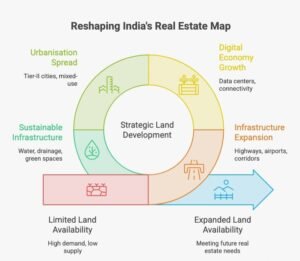
 

-->
class="post-5128 post type-post status-publish format-standard has-post-thumbnail hentry category-lifestyle ast-grid-common-col ast-full-width ast-article-post" id="post-5128" itemtype="https://schema.org/CreativeWork" itemscope="itemscope">

Category: Lifestyle

India’s Real Estate Evolution and the Foundation of Long-Term Wealth

Why Real Estate Investment in India Is Entering a New Era

For decades, Real Estate Investment in India has been regarded as one of the country’s most reliable avenues for wealth creation. However, the sector today is fundamentally different from what it was even a decade ago. The conversation has shifted beyond buying apartments in metropolitan cities to identifying emerging investment corridors, premium plotted developments, sustainable communities, villa plots, and second-home destinations that offer both long-term capital appreciation and lifestyle value.

India’s robust economic growth, unprecedented infrastructure spending, rising household incomes, and rapidly expanding tourism industry are creating favourable conditions for Real Estate Investment in India. Investors today are no longer evaluating land purely as a physical asset; they increasingly view it as a strategic component of diversified wealth portfolios capable of preserving capital across generations.

According to the India Brand Equity Foundation (IBEF), the Indian real estate sector is projected to contribute significantly more to the country’s GDP by 2030, supported by urbanisation, infrastructure development, digital transformation, and sustained economic expansion. These structural changes are strengthening the long-term outlook for Real Estate Investment in India.

For discerning investors—including HNIs, NRIs, entrepreneurs, business owners, family offices, and wealth advisors—the focus has shifted toward acquiring premium land in locations where infrastructure, tourism, environmental sustainability, and economic development intersect. Regions such as Sindhudurg (Maha Goa), North Goa, Rajasthan, Himachal Pradesh, and other emerging investment corridors illustrate how long-term planning and government-led development can gradually transform underdeveloped regions into high-potential investment destinations.

Equally important is the growing preference for environmentally responsible developments. Sustainable communities, low-density living, wellness-oriented neighbourhoods, and regenerative real estate projects are attracting investors seeking financial returns alongside quality of life. This evolution reflects changing buyer aspirations and reinforces why Real Estate Investment in India continues to be viewed as a future-ready asset class.

Understanding Why Real Estate Investment in India Continues to Appreciate

Unlike many financial assets that fluctuate with short-term market sentiment, Real Estate Investment in India is influenced by structural drivers that evolve over years or even decades. Population growth, infrastructure creation, industrial expansion, tourism development, government policy reforms, and increasing land scarcity collectively contribute to long-term appreciation.

Land Is a Finite Resource

One of the strongest fundamentals supporting Real Estate Investment in India is the finite nature of land. While buildings depreciate over time and require maintenance, well-located land remains a scarce resource. As cities expand and infrastructure reaches new regions, the availability of strategically located land gradually decreases while demand continues to rise.

This principle becomes particularly relevant in premium plotted developments and villa communities, where investors are purchasing not only land ownership but also future development potential. Whether the objective is to build a holiday home, create a family legacy asset, or develop a boutique hospitality venture, premium land offers flexibility that many built assets cannot.

Industry research from leading real estate consultancies consistently highlights the growing demand for plotted developments across India, driven by buyers seeking greater control over design, lower-density living environments, and stronger long-term appreciation potential.

Infrastructure Is Reshaping Investment Geography

Historically, investment opportunities were concentrated within established metropolitan regions. Today, major infrastructure investments are expanding economic activity into previously overlooked destinations, creating new opportunities for Real Estate Investment in India.

Government initiatives such as the PM Gati Shakti National Master Plan, Bharatmala Pariyojana, Sagarmala Programme, airport expansion, railway modernisation, and industrial corridor development are improving accessibility across the country. Better connectivity not only reduces travel time but also stimulates tourism, logistics, commerce, hospitality, and residential demand.

For investors, infrastructure serves as one of the strongest indicators of future land appreciation. Regions witnessing improvements in highways, airports, ports, and multimodal transport networks often experience increased economic activity over the long term, encouraging residential and commercial development.

Rising Wealth Is Supporting Premium Real Estate Demand

India’s growing economy has created a significant increase in affluent households, successful entrepreneurs, business owners, and globally mobile professionals. This demographic shift is changing investment behaviour.

Instead of concentrating wealth exclusively in equities or traditional residential apartments, many investors now allocate capital toward premium plotted developments, villa plots, sustainable communities, and second homes. These assets provide opportunities for capital appreciation while also serving as lifestyle investments that can be enjoyed by future generations.

According to global wealth reports published by Knight Frank, India continues to witness growth in its high-net-worth population, reinforcing long-term demand for premium real estate assets.

Sustainable Living Is Becoming a Major Investment Theme

Another defining trend influencing Real Estate Investment in India is the growing preference for environmentally responsible developments.

Modern investors increasingly prioritise communities that incorporate:

  • Rainwater harvesting
  • Renewable energy integration
  • Native landscaping
  • Organic farming
  • Open green spaces
  • Water conservation
  • Biodiversity preservation
  • Wellness-focused planning

These features not only improve residents’ quality of life but also align with global sustainability goals and evolving consumer preferences.

As climate resilience becomes an increasingly important consideration, projects integrating sustainable planning are expected to remain attractive for long-term investors seeking future-ready assets.

Tourism Is Creating New Investment Opportunities

India’s tourism sector has become an important catalyst for Real Estate Investment in India. Domestic travel has expanded significantly over the past decade, while international tourism continues to recover and diversify.

Experience-led tourism has increased demand for:

  • Holiday homes
  • Boutique resorts
  • Luxury villas
  • Eco-retreats
  • Wellness destinations
  • Vacation rentals

Emerging destinations offering natural beauty, improved infrastructure, and authentic cultural experiences are benefiting from this shift. Investors increasingly recognise that premium land in tourism-driven regions can support multiple value propositions, including personal use, hospitality development, and long-term appreciation.

According to the Ministry of Tourism, domestic tourism continues to play a major role in supporting regional economies and encouraging investment in hospitality infrastructure.

Infrastructure, Tourism & Premium Land Are Transforming Real Estate Investment in India

Infrastructure Development: The Strongest Catalyst for Real Estate Investment in India

Infrastructure has historically been one of the most reliable indicators of long-term real estate appreciation. Around the world, improved connectivity has transformed regional economies, and India is witnessing a similar evolution. Today, Real Estate Investment in India is increasingly influenced by government-led infrastructure initiatives that are opening new growth corridors beyond traditional metropolitan markets.

The Government of India has significantly increased capital expenditure on roads, railways, airports, ports, logistics parks, and multimodal transportation. These investments are reducing travel time, improving accessibility, attracting businesses, and creating employment opportunities. As a result, surrounding land markets often experience gradual increases in demand over the medium and long term.

Some of the country’s most influential infrastructure initiatives include:

  • PM Gati Shakti National Master Plan, integrating infrastructure planning across multiple ministries.
  • Bharatmala Pariyojana, enhancing national highway connectivity.
  • Sagarmala Programme, improving port-led economic development.
  • Expansion of regional airports through the UDAN Scheme.
  • Ongoing railway modernization and freight corridor development.

For investors evaluating Real Estate Investment in India, these projects provide valuable indicators of future economic activity rather than short-term speculation.

How Infrastructure Supports Capital Appreciation

Infrastructure contributes to property appreciation by:

For example, destinations connected by new highways or airports often become attractive for second homes, villa communities, boutique resorts, and premium plotted developments. While appreciation rates vary by location and market conditions, infrastructure has consistently been identified by leading real estate consultancies as one of the most significant long-term value drivers.

Tourism Growth Is Creating New Opportunities for Real Estate Investment in India

Tourism is no longer viewed solely as a hospitality industry—it has become a major driver of Real Estate Investment in India. As domestic and international travel continues to grow, destinations offering natural beauty, cultural heritage, wellness experiences, and coastal or mountain lifestyles are attracting sustained investment interest.

According to the Ministry of Tourism, domestic tourism in India has witnessed a strong recovery in recent years, supported by improved connectivity, digital travel platforms, and rising disposable incomes. This growth is encouraging investment in accommodation, holiday homes, eco-resorts, and premium villa developments.

Regions such as Sindhudurg (Maha Goa), North Goa, Rajasthan, and Himachal Pradesh are benefiting from this trend because they combine tourism potential with infrastructure improvements and lifestyle-driven demand.

Why Tourism Supports Long-Term Property Demand

Tourism creates a multiplier effect across the local economy. As visitor numbers increase, demand rises for:

  • Vacation homes
  • Boutique hotels
  • Eco-resorts
  • Wellness retreats
  • Holiday villas
  • Restaurants and retail
  • Local services and experiences

This expanding ecosystem can strengthen long-term demand for strategically located land and premium residential developments. For investors, Real Estate Investment in India in tourism-oriented destinations offers the possibility of combining capital appreciation with future hospitality or rental opportunities, subject to local regulations and market conditions.

The Rise of Experience-Led Tourism

Modern travellers increasingly seek immersive experiences rather than conventional hotel stays. Wellness retreats, farm experiences, nature escapes, heritage tourism, and coastal holidays are becoming key segments of India’s tourism economy.

This shift has increased interest in:

Developments designed around sustainability, wellness, and environmental stewardship are particularly well-positioned to benefit from these changing travel preferences.

Premium Plotted Developments Are Reshaping Real Estate Investment in India

One of the most significant trends identified by industry research is the increasing demand for premium plotted developments. Investors are increasingly choosing land over built structures because of the flexibility and long-term value that land ownership can provide.

Unlike apartments, which may experience physical depreciation over time, well-located land remains a finite asset. As urban centres expand and infrastructure reaches surrounding regions, the availability of premium land gradually decreases, supporting long-term demand.

Leading consultants such as Knight Frank, JLL, ANAROCK, CBRE, and Colliers have observed growing interest in plotted developments driven by changing buyer preferences, post-pandemic lifestyle shifts, and the desire for greater space and flexibility.

Why Investors Prefer Premium Villa Plots

Premium plotted developments appeal to investors because they offer:

  • Long-term capital appreciation potential.
  • Freedom to build according to future needs.
  • Lower-density living environments.
  • Opportunity to create family legacy assets.
  • Flexibility for holiday homes or retirement residences.
  • Potential integration with sustainable design principles.

For many HNIs, entrepreneurs, and NRIs, Real Estate Investment in India through premium villa plots represents both a financial investment and a lifestyle decision aligned with future aspirations.

Looking Ahead

The convergence of infrastructure development, tourism expansion, and rising demand for premium plotted communities is fundamentally reshaping Real Estate Investment in India. Rather than focusing solely on established metropolitan markets, investors are increasingly evaluating emerging destinations where long-term structural growth is supported by connectivity, sustainability, and evolving lifestyle preferences.

The next section explores how second-home ownership, Airbnb rentals, boutique hospitality, and sustainable communities are creating additional opportunities for long-term wealth creation while reinforcing the investment case for premium land across India’s emerging growth corridors.

The Rise of Second Homes, Sustainable Communities, HNI Investments & Emerging Growth Corridors

The Growing Demand for Second Homes Is Transforming Real Estate Investment in India

Over the past few years, one of the most significant shifts in Real Estate Investment in India has been the rapid growth of the second-home market. Once considered a luxury reserved for a select few, second homes have now become an integral part of wealth creation, lifestyle planning, and long-term investment strategies for affluent buyers.

The COVID-19 pandemic fundamentally changed how people perceive living spaces. Remote working, hybrid work models, increased focus on wellness, and the desire for healthier environments encouraged many investors to move beyond traditional city apartments. Instead, buyers started exploring premium villa plots, nature-inspired communities, coastal destinations, mountain retreats, and holiday homes that provide both lifestyle benefits and long-term appreciation.

Today, Real Estate Investment in India is increasingly driven by investors who seek a balance between financial returns and quality of life. Second homes are no longer viewed simply as vacation properties—they are evolving into flexible assets that can serve as family retreats, retirement homes, rental properties, or long-term legacy investments.

According to industry reports by ANAROCK, Knight Frank, and Savills, demand for second homes has grown significantly in destinations that offer strong infrastructure, tourism potential, and environmental appeal.

Why Investors Are Choosing Second Homes

Several factors are driving this trend:

  • Flexible work culture allows professionals to work from scenic destinations.
  • Families increasingly prioritize wellness and outdoor living.
  • Rising disposable incomes support lifestyle investments.
  • Investors seek diversification beyond traditional financial assets.
  • Premium plotted developments offer future construction flexibility.
  • Holiday homes can generate rental income while appreciating over time.

Rather than purchasing purely for immediate returns, many investors are adopting a multi-generational perspective, viewing premium land and second homes as assets that future generations can enjoy.

Infographic illustrating the five major drivers of Real Estate Investment in India, including infrastructure development, tourism growth, sustainable communities, premium plotted developments, and rising HNI investment.

Airbnb, Boutique Hospitality & Vacation Rentals Are Creating New Investment Opportunities

The rapid growth of India’s tourism sector has significantly influenced Real Estate Investment in India, particularly in destinations known for beaches, mountains, heritage tourism, and nature-based experiences.

Platforms offering short-term holiday accommodation have expanded the earning potential of premium villas and holiday homes. Investors are increasingly evaluating properties not only for capital appreciation but also for their ability to generate recurring rental income during peak tourism seasons.

This has encouraged the development of:

  • Boutique resorts
  • Luxury villas
  • Farm stays
  • Eco-resorts
  • Wellness retreats
  • Premium holiday homes
  • Nature-based hospitality projects

The popularity of experiential travel has also increased demand for accommodations that provide privacy, sustainability, and authentic local experiences rather than conventional hotel stays.

For investors, Real Estate Investment in India in tourism-oriented locations offers multiple avenues for value creation:

  • Long-term land appreciation.
  • Potential rental income.
  • Lifestyle usage.
  • Hospitality development opportunities.
  • Diversification of investment portfolios.

It is important to note that rental performance varies based on location, tourism demand, local regulations, occupancy rates, operational quality, and seasonality. Investors should evaluate these factors carefully before making investment decisions.

Sustainable Communities Are Redefining Real Estate Investment in India

Environmental consciousness is increasingly influencing investment decisions across the real estate sector. Modern investors are no longer evaluating projects solely on location and pricing—they are also considering sustainability, climate resilience, wellness, and long-term environmental impact.

As a result, Real Estate Investment in India is witnessing growing interest in sustainable communities that integrate responsible planning with modern infrastructure.

These developments often include:

  • Rainwater harvesting systems.
  • Solar-powered common infrastructure.
  • Native landscaping.
  • Organic farming spaces.
  • Water recycling.
  • Green mobility.
  • Open green areas.
  • Biodiversity conservation.
  • Low-density layouts.

Sustainability is no longer viewed as an optional feature. Instead, it is becoming a defining characteristic of premium developments that seek to remain relevant over the coming decades.

Organizations such as the Indian Green Building Council (IGBC) and GRIHA continue promoting environmentally responsible construction practices that improve resource efficiency while reducing environmental impact.

For long-term investors, sustainable developments may benefit from stronger buyer preference as awareness regarding climate resilience and environmental responsibility continues to increase.

Why HNIs, NRIs & Family Offices Continue to Increase Real Estate Investment in India

India’s growing affluent population has changed the investment landscape considerably. High-net-worth individuals (HNIs), non-resident Indians (NRIs), entrepreneurs, business owners, family offices, and wealth managers increasingly consider Real Estate Investment in India an essential component of diversified portfolios.

Unlike volatile financial instruments, premium land provides investors with tangible ownership, long-term appreciation potential, and wealth preservation characteristics.

Key reasons institutional and affluent investors prefer premium real estate include:

  • Portfolio diversification.
  • Inflation hedge.
  • Legacy planning.
  • Limited land availability.
  • Capital preservation.
  • Long-term appreciation potential.
  • Strategic asset allocation.

The annual Wealth Report published by Knight Frank consistently highlights India’s expanding affluent population and the increasing importance of real estate within diversified investment portfolios.

Similarly, global property consultants such as CBRE, JLL, and Colliers continue to identify India as one of the world’s most attractive long-term real estate investment destinations due to strong economic fundamentals, urbanization, and infrastructure development.

Emerging Investment Corridors Are Expanding Opportunities Across India

One of the defining characteristics of modern Real Estate Investment in India is the emergence of high-growth investment corridors beyond traditional metropolitan cities.

Regions supported by improving infrastructure, tourism, industrial development, and environmental appeal are attracting increasing attention from long-term investors.

Among the destinations receiving growing interest are:

Sindhudurg (Maha Goa)

  • Mopa International Airport connectivity
  • Mumbai–Goa Highway improvements
  • Coastal tourism
  • Marine tourism
  • Luxury hospitality
  • Premium plotted developments
  • Sustainable communities

North Goa

  • International tourism
  • Luxury villa demand
  • Strong hospitality ecosystem
  • Holiday home investments

Rajasthan

  • Heritage tourism
  • Luxury hospitality
  • Cultural tourism
  • Wellness resorts
  • Highway connectivity

Himachal Pradesh

  • Nature-based tourism
  • Mountain wellness destinations
  • Second-home demand
  • Eco-tourism
  • Sustainable living communities

Each of these destinations demonstrates how infrastructure, tourism, environmental quality, and economic development collectively influence Real Estate Investment in India over the long term.

Rather than relying on speculation, successful investors increasingly focus on locations supported by measurable structural growth drivers and government-backed development initiatives.

Government Policies Are Strengthening the Foundation of Real Estate Investment in India

One of the strongest reasons Real Estate Investment in India continues to attract long-term investors is the government’s sustained focus on infrastructure, connectivity, tourism, industrial development, and urban transformation. These initiatives are not designed to increase property prices directly; instead, they improve accessibility, stimulate economic activity, create employment opportunities, and enhance the overall investment ecosystem.

Over the last decade, several flagship initiatives have reshaped India’s physical infrastructure and investment landscape.

PM Gati Shakti National Master Plan

The PM Gati Shakti National Master Plan aims to integrate infrastructure planning across various ministries to improve logistics efficiency, reduce transportation costs, and accelerate economic development. Better road, rail, port, and airport connectivity can indirectly support Real Estate Investment in India by making emerging regions more accessible for businesses, residents, and tourists.

Bharatmala Pariyojana

The Bharatmala programme focuses on expanding India’s highway network and improving freight movement. Enhanced road connectivity often contributes to increased commercial activity, tourism, and residential demand in surrounding regions.

Sagarmala Programme

India’s extensive coastline presents significant economic opportunities. The Sagarmala Programme seeks to modernize ports, improve coastal logistics, and encourage port-led industrial development. Coastal destinations experiencing improved connectivity may benefit from growing tourism and hospitality investment over the long term.

Smart Cities Mission

The Smart Cities Mission continues to encourage better urban infrastructure, digital governance, mobility solutions, and sustainable urban planning. Such initiatives contribute to improving the livability and investment appeal of many Indian cities.

UDAN Regional Connectivity Scheme

Regional airport development under the UDAN initiative has significantly improved air connectivity to several emerging destinations, supporting tourism and economic activity.

Expert Insights: Why Long-Term Investors Continue to Prefer Real Estate Investment in India

Leading real estate consultancies consistently identify India as one of the world’s most promising long-term property markets.

Several structural factors continue supporting Real Estate Investment in India:

  • Strong economic growth.
  • Expanding middle and affluent classes.
  • Increasing urbanization.
  • Infrastructure modernization.
  • Digital transformation.
  • Rising tourism.
  • Higher disposable incomes.
  • Growing institutional participation.
  • Stable long-term demand for quality residential assets.

According to research published by CBRE, JLL, Knight Frank, Colliers, and Savills, premium residential developments, plotted communities, logistics infrastructure, hospitality assets, and sustainable projects remain among the strongest long-term themes shaping the sector.

Rather than short-term speculation, experienced investors increasingly evaluate:

  • Infrastructure quality.
  • Tourism potential.
  • Environmental sustainability.
  • Economic development.
  • Governance.
  • Long-term demographic trends.

These factors provide a stronger foundation for investment decisions than temporary market fluctuations.

The Future Outlook for Real Estate Investment in India

The future of Real Estate Investment in India is expected to be shaped by multiple long-term structural trends rather than isolated market cycles.

Increasing Infrastructure Investment

India continues to prioritize roads, airports, logistics, industrial corridors, ports, and multimodal transportation to improve accessibility across emerging destinations.

Expansion of Sustainable Communities

Developers are increasingly integrating environmentally responsible planning through renewable energy, water conservation, biodiversity preservation, and green infrastructure.

Growth of Experience-Led Tourism

Nature tourism, heritage tourism, wellness tourism, eco-tourism, and experiential hospitality continue to create opportunities for premium residential and hospitality developments.

Digital Transformation

Technology is improving transparency across property transactions, project management, investment research, and customer experiences.

Rising Demand for Lifestyle Investments

Future buyers are expected to prioritize wellness, open spaces, flexible living, and environmentally conscious developments rather than conventional high-density housing.

Collectively, these trends indicate that Real Estate Investment in India will increasingly focus on quality, sustainability, connectivity, and long-term value creation.

Key Takeaways for Long-Term Investors

Investors evaluating Real Estate Investment in India should focus on measurable growth drivers rather than short-term market sentiment.

Important considerations include:

  • Infrastructure connectivity.
  • Government development initiatives.
  • Tourism growth.
  • Employment generation.
  • Environmental sustainability.
  • Quality of planning.
  • Long-term demographic demand.
  • Availability of social infrastructure.
  • Regulatory compliance.
  • Responsible development practices.

A disciplined investment approach based on research and long-term fundamentals generally provides stronger outcomes than decisions based solely on speculative appreciation expectations.

FAQs

1. Why is Real Estate Investment in India considered a long-term wealth-building strategy?

Real Estate Investment in India benefits from long-term structural drivers such as urbanization, infrastructure expansion, economic growth, tourism development, and increasing demand for premium residential communities. While returns vary by location and market conditions, well-researched investments can contribute to long-term wealth creation.

2. Why are premium plotted developments gaining popularity?

Premium plotted developments offer land ownership, flexibility for future construction, lower-density living, and the potential to create long-term family assets. They are also increasingly associated with sustainable community planning and lifestyle-oriented investments.

3. How does infrastructure influence Real Estate Investment in India?

Infrastructure improves connectivity, stimulates business activity, attracts tourism, enhances accessibility, and encourages residential and commercial development. These factors often strengthen the long-term investment appeal of surrounding regions.

4. Are second homes becoming a major investment trend?

Yes. Hybrid work, wellness-focused lifestyles, and increased domestic tourism have encouraged many buyers to consider second homes as both lifestyle assets and long-term investments.

5. Can tourism contribute to long-term property demand?

Tourism supports hospitality, retail, transportation, and local economic activity. Destinations experiencing sustained tourism growth often witness increased demand for holiday homes, boutique hospitality projects, and premium residential developments.

6. Why are HNIs and NRIs increasing their Real Estate Investment in India?

Many HNIs and NRIs view premium real estate as a tangible asset that supports portfolio diversification, wealth preservation, legacy planning, and long-term capital appreciation.

7. What role does sustainability play in modern real estate investment?

Sustainability has become a major consideration for both developers and investors. Green infrastructure, water conservation, renewable energy, biodiversity protection, and environmentally responsible planning are increasingly influencing purchasing decisions.

8. Which factors should investors evaluate before purchasing premium land?

Investors should assess:

  • Infrastructure connectivity.

  • Government development plans.

  • Regulatory approvals.

  • Tourism potential.

  • Environmental conditions.

  • Accessibility.

  • Long-term demand.

  • Local market fundamentals.

  • Professional legal and financial advice.

The evolution of Real Estate Investment in India reflects far more than rising property values—it represents the convergence of infrastructure development, economic expansion, environmental responsibility, tourism growth, and changing lifestyle aspirations. As India continues to invest in highways, airports, logistics networks, digital infrastructure, and sustainable urban development, new investment corridors are emerging across the country.

For long-term investors, premium plotted developments, villa communities, sustainable neighbourhoods, and strategically located land parcels offer opportunities that extend beyond financial returns. They provide flexibility, legacy planning, lifestyle value, and the potential to participate in India’s long-term growth story.

At the same time, successful investing requires discipline, thorough research, regulatory due diligence, and a long-term perspective. Rather than chasing short-term market movements, experienced investors increasingly focus on structural growth drivers such as infrastructure, tourism, governance, environmental sustainability, and demographic trends.

As India’s investment landscape continues to evolve, Real Estate Investment in India is expected to remain an important asset class for those seeking resilient, future-ready opportunities aligned with responsible development and sustainable wealth creation.


-->
class="post-5109 post type-post status-publish format-standard has-post-thumbnail hentry category-lifestyle ast-grid-common-col ast-full-width ast-article-post" id="post-5109" itemtype="https://schema.org/CreativeWork" itemscope="itemscope">

Category: Lifestyle

How India’s Infrastructure Revolution Is Creating the Next Generation of High-Return Land Investments

The Greatest Investment Opportunities Often Begin with Infrastructure

Over the years, I have had the privilege of observing India’s real estate landscape through multiple economic cycles, policy reforms, and infrastructure transformations. While every investment cycle has its own unique characteristics, one lesson has remained remarkably consistent—infrastructure has the power to redefine the future of a location long before the market fully recognizes its potential.

In my experience, successful land investing is rarely about chasing today’s popular destinations. Instead, it is about understanding tomorrow’s growth corridors. The investors who consistently create long-term wealth are often those who identify opportunities when roads are still being planned, airports are under construction, metro corridors are being surveyed, and industrial parks exist only on government blueprints.

Today, India stands at one of the most exciting moments in its development journey. Massive public investments in expressways, metro rail systems, industrial corridors, multimodal logistics parks, ports, airports, and smart cities are reshaping not only how people travel but also where businesses operate, industries expand, and communities flourish. This unprecedented transformation is creating entirely new destinations for infrastructure-led land investments in India, making connectivity one of the most influential drivers of long-term land appreciation.

Unlike previous decades, where growth was largely concentrated in a handful of metropolitan cities, India’s current infrastructure strategy is far more integrated and future-oriented. Initiatives such as the PM Gati Shakti National Master Plan, the National Infrastructure Pipeline (NIP), Bharatmala Pariyojana, Sagarmala Programme, Dedicated Freight Corridors, and expanding metro networks are designed to connect cities, industries, logistics hubs, and rural regions into a unified economic ecosystem. Together, these initiatives are laying the foundation for sustainable economic growth over the coming decades.

According to the Government of India, the National Infrastructure Pipeline envisages investments exceeding ₹111 lakh crore across key sectors such as transportation, energy, urban development, and logistics, highlighting the country’s long-term commitment to infrastructure-led growth. You can explore these initiatives through the official portals of the National

As someone who believes in responsible and long-term investing, I have always considered infrastructure not merely as physical development but as an economic catalyst. Roads do not simply reduce travel time. Airports do not merely connect cities. Metro systems do not only transport commuters. They create employment, attract industries, encourage migration, improve accessibility, and ultimately reshape the economic identity of an entire region.

That is why I believe infrastructure-led land investments in India deserve far greater attention from investors than short-term market speculation. In this article, I want to share the principles I have learned over years of studying infrastructure-driven growth, explain how connectivity influences land appreciation, explore historical examples that validate this pattern, and discuss why India’s ongoing infrastructure revolution may create some of the country’s most significant long-term investment opportunities.

India’s Largest Infrastructure Revolution Since Independence

When I look at India’s current development trajectory, I do not see isolated infrastructure projects. I see a coordinated national vision that aims to transform the country’s economic geography.

Over the past decade, infrastructure has moved to the center of India’s development agenda. Successive Union Budgets have significantly increased capital expenditure, with public investment reaching historic levels to improve transportation, logistics, manufacturing, and urban infrastructure. This strategic focus reflects the understanding that infrastructure is not merely an expense—it is an investment in future productivity, competitiveness, and economic resilience.

One of the most transformative initiatives is the PM Gati Shakti National Master Plan, launched to integrate infrastructure planning across multiple ministries using digital mapping and data-driven coordination. Rather than developing roads, railways, ports, airports, and industrial zones independently, the objective is to ensure they function as a connected ecosystem that reduces logistics costs and improves operational efficiency.

Similarly, the National Infrastructure Pipeline (NIP) outlines long-term investments across transport, energy, water, digital infrastructure, and urban development, creating a comprehensive roadmap for India’s future growth.

The scale of infrastructure development is equally visible on the ground.

Projects such as the Delhi–Mumbai Expressway, Delhi–Dehradun Expressway, Mumbai Trans Harbour Link, Jewar International Airport, Dedicated Freight Corridors, expanding metro networks, industrial corridors, and multimodal logistics parks are reshaping how people, goods, and businesses move across the country.

For investors evaluating infrastructure-led land investments in India, these projects represent more than engineering achievements—they are indicators of where future economic activity is likely to concentrate.

In my view, infrastructure investment creates a chain reaction. Improved connectivity encourages industries to establish manufacturing facilities. Businesses follow industrial growth. Employment opportunities attract skilled professionals. Residential demand increases. Retail and commercial developments emerge. Over time, these interconnected factors contribute to stronger land demand and sustained appreciation.

This is precisely why experienced investors spend considerable time studying government infrastructure announcements, master plans, industrial policies, and transportation networks rather than relying solely on current property prices. Infrastructure often changes the long-term potential of a location before that transformation becomes visible in the real estate market.

Why Infrastructure Has Become India’s Biggest Wealth Creator

One question I am often asked is: Why does infrastructure have such a profound impact on land values?

My answer is simple.

Infrastructure changes economics before it changes skylines.

When a new expressway reduces travel time between two cities, businesses gain access to larger markets. Logistics become more efficient. Manufacturers reduce transportation costs. Tourism becomes more accessible. Residential communities become viable farther from city centers. Commercial establishments expand to serve growing populations.

The result is a gradual but powerful shift in demand.

This is why I believe infrastructure-led land investments in India are fundamentally different from speculative investments. Their potential is often supported by tangible improvements in connectivity, economic activity, employment generation, and regional development rather than short-term market sentiment.

Consider the evolution of many of India’s fastest-growing urban regions. Whether it is Gurugram’s emergence alongside improved highway connectivity, the transformation of Greater Noida through expressways and metro expansion, or Hyderabad’s western growth corridor supported by the Outer Ring Road, the underlying pattern remains remarkably consistent. Infrastructure attracts opportunity, and opportunity attracts investment.

How Connectivity Creates Value: The Direct Relationship Between Infrastructure and Land Appreciation

Throughout my years of studying India’s real estate markets, I have realized that land appreciation is rarely accidental. Behind every successful investment corridor lies a combination of strategic planning, economic activity, and most importantly, infrastructure.

Whenever I evaluate a location, I ask a simple question: What is changing here that will influence how people live, work, travel, and conduct business over the next decade? More often than not, the answer begins with infrastructure.

Roads, expressways, airports, metro systems, industrial corridors, and logistics hubs do far more than improve transportation. They redefine accessibility, attract businesses, create employment, and expand urban boundaries. Together, these forces become the foundation of Infrastructure-led land investments in India, where long-term value is created through economic transformation rather than short-term speculation.

Expressways: Compressing Distance, Expanding Opportunity

One of the most powerful catalysts for regional development is the expressway.

While the physical distance between two cities may never change, improved road infrastructure dramatically reduces travel time, making previously distant locations commercially and residentially viable.

This phenomenon is evident across several landmark infrastructure projects.

The Delhi–Mumbai Expressway, stretching approximately 1,350 kilometres, is expected to significantly improve connectivity across Delhi, Haryana, Rajasthan, Madhya Pradesh, Gujarat, and Maharashtra. Beyond faster travel, the corridor is anticipated to strengthen logistics, manufacturing, tourism, warehousing, and industrial investments, creating entirely new economic ecosystems.

Similarly, the Delhi–Dehradun Expressway is expected to reduce travel time between Delhi and Dehradun considerably while supporting tourism, hospitality, education, healthcare, and residential expansion across Uttarakhand and western Uttar Pradesh.

Another significant development is Maharashtra’s proposed Shaktipeeth Expressway, which aims to improve connectivity across several districts while strengthening pilgrimage tourism, agricultural logistics, and regional commerce.

For investors focused on Infrastructure-led land investments in India, these projects demonstrate how transportation infrastructure often becomes the first step toward long-term regional economic growth.

As I often say, roads rarely create value by themselves—they create access, and access creates opportunity.

Airports: Catalysts for New Economic Cities

Airports have evolved far beyond being transportation facilities. Today, they function as economic growth engines capable of transforming surrounding regions into thriving business districts.

The concept of the Aerotropolis—an urban ecosystem built around airports—is increasingly shaping modern urban planning worldwide.

India offers a compelling example through the development of Noida International Airport (Jewar Airport).

As one of the country’s largest upcoming aviation hubs, the airport is expected to support aviation services, logistics parks, manufacturing clusters, hospitality, commercial developments, and residential communities. The surrounding Yamuna Expressway Industrial Development Area (YEIDA) has already witnessed significant planning activity driven by long-term infrastructure expectations.

Likewise, the Navi Mumbai International Airport, combined with the operational Mumbai Trans Harbour Link (Atal Setu), is expected to further integrate Mumbai and Navi Mumbai while supporting industrial growth, logistics, financial services, and commercial development.

These examples illustrate an important lesson I have observed repeatedly: airports create much more than passenger traffic—they attract businesses, investments, talent, and long-term urban expansion.

Metro Rail Networks: Redefining Urban Growth

When metro rail systems expand, cities begin to grow differently.

Instead of concentrating development only around traditional commercial centres, metro connectivity encourages distributed growth by making peripheral neighbourhoods more accessible.

Cities such as Delhi, Bengaluru, Hyderabad, Mumbai, Pune, Ahmedabad, Nagpur, Lucknow, Kochi, and Chennai continue expanding their metro networks, influencing residential demand, office development, retail activity, and mixed-use communities.

Global real estate consultancies including JLL, Knight Frank, Colliers, and CBRE have consistently highlighted the growing importance of transit-oriented development, where improved public transport contributes to higher occupancy, stronger commercial activity, and increased investor interest in well-connected locations.

From my perspective, metro infrastructure changes something fundamental—it gives people the confidence to live farther from traditional city centres without sacrificing accessibility.

That confidence gradually reshapes urban demand.

Industrial Corridors and Logistics Parks: The Economic Backbone of Future Growth

If expressways improve mobility and airports enhance connectivity, industrial corridors create the economic foundation that sustains long-term development.

Manufacturing, warehousing, logistics, exports, and industrial production generate employment on a scale that permanently changes regional economies.

The Delhi–Mumbai Industrial Corridor (DMIC) remains one of India’s most ambitious infrastructure initiatives, integrating industrial townships, freight connectivity, logistics hubs, smart cities, and manufacturing zones across multiple states.

Complementing these initiatives are the Dedicated Freight Corridors (DFC), designed to improve freight movement while reducing logistics costs and increasing supply chain efficiency.

The Western and Eastern Dedicated Freight Corridors are expected to support industrial competitiveness while encouraging the development of warehousing clusters, manufacturing parks, and multimodal logistics hubs.

According to the National Logistics Policy, reducing logistics costs remains a strategic priority for enhancing India’s global competitiveness. Efficient freight movement strengthens industrial investments, which in turn generates sustained demand for commercial, residential, and industrial land.

For anyone studying Infrastructure-led land investments in India, industrial infrastructure deserves equal attention alongside residential development because employment remains one of the strongest long-term drivers of real estate demand.

What History Teaches Us About Infrastructure-Led Land Appreciation

While future infrastructure projects generate excitement, I believe the most valuable lessons come from history.

India has repeatedly demonstrated that infrastructure-led development is not a theoretical concept—it is an observable economic pattern.

Consider Gurugram.

Several decades ago, much of the region consisted of agricultural villages. However, improved highway connectivity through NH-48, the development of Cyber City, metro connectivity, and commercial expansion transformed Gurugram into one of India’s largest corporate and residential markets.

Similarly, Noida and Greater Noida evolved through the combined impact of expressways, metro rail connectivity, planned industrial development, educational institutions, and more recently, the announcement of Jewar International Airport. Infrastructure did not merely improve transportation—it fundamentally reshaped the region’s economic identity.

Hyderabad offers another compelling example. The Outer Ring Road (ORR) significantly improved accessibility to the western part of the city, encouraging IT expansion in Gachibowli, the Financial District, Kokapet, and nearby locations. As employment opportunities increased, residential and commercial demand followed.

North Bengaluru presents a similar story. The establishment of Kempegowda International Airport, coupled with technology parks, aerospace industries, and expanding road infrastructure, accelerated urban growth in areas that were once considered peripheral.

Even Pune’s western growth corridor demonstrates how infrastructure influences long-term appreciation. The combination of the Mumbai–Pune Expressway, metro expansion, Ring Road planning, and a thriving IT ecosystem has supported continuous residential and commercial development over the years.

These examples reinforce a principle I have consistently observed throughout my career.

Infrastructure does not guarantee appreciation overnight.

However, when supported by employment generation, industrial activity, urban planning, and demographic growth, it creates the conditions under which Infrastructure-led land investments in India have historically delivered sustainable long-term value.

Flowchart illustrating how infrastructure investment drives long-term land appreciation in India through connectivity, business expansion, employment growth, urban development, and infrastructure-led land investments in India.

India’s Next Generation of Infrastructure Projects Could Define the Investment Corridors of the Next Decade

One of the most valuable lessons I have learned as a long-term investor is that every generation witnesses a handful of infrastructure projects that reshape the country’s economic geography. These projects do much more than improve connectivity—they influence where industries establish operations, where businesses expand, where employment is generated, and eventually where cities grow.

As I observe India’s current infrastructure pipeline, I believe we are entering one of the most transformative decades in the nation’s history. The combination of expressways, airports, industrial corridors, logistics parks, freight networks, and metro expansions is laying the foundation for the next chapter of Infrastructure-led land investments in India.

While no investment outcome can ever be guaranteed, history consistently shows that major infrastructure development often becomes the catalyst for long-term regional transformation.

The Delhi–Mumbai Expressway: Redefining Economic Connectivity

Among India’s most ambitious infrastructure projects, the Delhi–Mumbai Expressway stands out as a remarkable example of long-term nation-building.

Connecting Delhi with Mumbai across multiple states, the expressway is expected to improve freight movement, reduce travel time, strengthen manufacturing, encourage tourism, and support logistics infrastructure throughout its corridor.

For investors, the significance lies beyond transportation.

Every major expressway creates opportunities for industrial parks, logistics hubs, hospitality businesses, commercial centres, and residential communities. As these ecosystems mature, they contribute to increasing economic activity and long-term demand for land.

Official project details are available through the National Highways Authority of India (NHAI).

Delhi–Dehradun Expressway: Unlocking New Growth Across Northern India

The Delhi–Dehradun Expressway is another project that reflects how strategic connectivity can influence regional development.

By significantly reducing travel time between Delhi NCR and Uttarakhand, the project is expected to strengthen tourism, healthcare, education, hospitality, logistics, and residential demand across multiple districts.

Whenever travel becomes easier, businesses begin to rethink expansion plans, professionals become willing to commute farther, and investors start evaluating locations that were previously overlooked.

This gradual shift often creates new opportunities for Infrastructure-led land investments in India, particularly in regions supported by complementary economic activity.

Shaktipeeth Expressway: Strengthening Maharashtra’s Emerging Corridors

Another infrastructure initiative that deserves attention is the proposed Shaktipeeth Expressway.

Although discussions around the project continue to evolve, its broader vision highlights an important investment principle.

Large-scale road connectivity has the potential to improve regional accessibility, facilitate agricultural logistics, strengthen pilgrimage tourism, and encourage commercial development across previously underserved districts.

From my perspective, infrastructure should never be evaluated in isolation.

The real question investors should ask is:

What industries, businesses, institutions, and employment opportunities are likely to emerge once connectivity improves?

That answer often reveals far more than the infrastructure project itself.

Dedicated Freight Corridors and Industrial Corridors: Building India’s Manufacturing Future

While highways receive considerable public attention, I believe some of India’s most significant long-term opportunities may emerge through industrial infrastructure.

The Western Dedicated Freight Corridor and Eastern Dedicated Freight Corridor are transforming freight transportation by improving cargo efficiency and reducing logistics costs.

Complementing these freight networks are large-scale industrial corridor programmes, including:

  • Delhi–Mumbai Industrial Corridor (DMIC)
  • Chennai–Bengaluru Industrial Corridor
  • Bengaluru–Mumbai Economic Corridor
  • Amritsar–Kolkata Industrial Corridor
  • East Coast Economic Corridor

These initiatives are designed to integrate manufacturing, logistics, exports, urban development, and industrial investment.

Information is available through the National Industrial Corridor Development Corporation (NICDC).

In my opinion, industrial corridors deserve close attention because sustainable land appreciation is rarely driven by speculation alone.

Long-term value is generally supported by employment generation, industrial production, business expansion, and population growth—all of which are strengthened through integrated infrastructure planning.

Metro Expansion and Multimodal Connectivity Will Continue Reshaping Urban India

India’s urban infrastructure story is equally compelling.

Metro rail networks continue expanding across cities such as Delhi, Mumbai, Bengaluru, Pune, Ahmedabad, Nagpur, Lucknow, Kanpur, Kochi, Chennai, Indore, Patna, and several emerging urban centres.

At the same time, the Government’s PM Gati Shakti National Master Plan is integrating highways, railways, ports, airports, logistics parks, and industrial zones into a single coordinated infrastructure ecosystem.

I believe this integrated planning approach represents one of the most important shifts in India’s infrastructure strategy.

Rather than developing isolated projects, the emphasis is now on creating interconnected economic corridors capable of supporting manufacturing, trade, logistics, exports, and urban development simultaneously.

This integrated approach strengthens the long-term foundation for Infrastructure-led land investments in India, particularly in locations where multiple infrastructure assets converge.

Why Experienced Investors Buy Land Before Infrastructure Is Completed

People often ask me why experienced investors prefer entering a market years before a major infrastructure project becomes operational.

The answer lies in understanding how markets discover value.

In most cases, land prices evolve through several distinct stages.

Infrastructure Announcement

Government Approvals

Land Acquisition

Construction Begins

Private Investments Follow

Businesses Establish Operations

Employment Increases

Residential Demand Accelerates

Commercial Development Expands

Market Recognition and Price Discovery

By the time a project is fully operational and widely celebrated in the media, much of the early pricing advantage may already have narrowed in several locations.

This does not imply that opportunities disappear after completion.

Rather, it illustrates why patient investors often spend considerable time studying government policies, infrastructure announcements, and regional development plans before the broader market fully appreciates their significance.

Throughout my investment journey, I have learned that successful investing is rarely about predicting the future with certainty.

It is about recognizing long-term structural trends earlier than the majority of market participants.

Infrastructure planning provides one of the clearest windows into those structural trends.

My Framework for Identifying India’s Future High-Growth Corridors

Many readers ask me whether there is a structured approach to evaluating future investment destinations.

While every region has unique characteristics, I generally rely on a combination of economic, infrastructure, and planning indicators rather than short-term market sentiment.

1. Government Infrastructure Announcements

I carefully study projects announced by the Ministry of Road Transport & Highways, NHAI, Ministry of Railways, and state infrastructure agencies.

2. Regional Master Plans

Urban development authorities often reveal future land use, transportation corridors, industrial zones, and planned urban expansion years before large-scale private investment begins.

3. Employment Drivers

I prefer locations where infrastructure is likely to support manufacturing, logistics, technology, healthcare, education, tourism, or industrial growth because employment remains one of the strongest indicators of sustainable demand.

4. Multiple Connectivity Advantages

The most resilient growth corridors often benefit from more than one infrastructure asset.

For example:

  • Expressway
  • Airport
  • Railway
  • Metro
  • Logistics Park
  • Industrial Corridor

The convergence of multiple infrastructure projects typically creates stronger long-term economic ecosystems.

5. Regulatory and Planning Clarity

Before considering any opportunity related to Infrastructure-led land investments in India, I believe investors should carefully examine land titles, zoning regulations, environmental permissions, development plans, and legal compliance.

Infrastructure alone cannot substitute for proper due diligence.

Ultimately, my investment philosophy has remained remarkably consistent over the years.

I do not attempt to identify the fastest-growing location for the next six months.

Instead, I look for regions where infrastructure, employment, governance, planning, and economic activity are likely to reinforce one another over the next ten to twenty years.

That long-term perspective has repeatedly proven far more valuable than chasing short-term market excitement.

Important Risks Every Investor Should Evaluate Before Making Infrastructure-Led Land Investments in India

Throughout this article, I have discussed how infrastructure has the potential to transform regions, improve connectivity, generate employment, and create long-term economic opportunities. However, over the years, I have also learned that successful investing is never driven by optimism alone—it is driven by disciplined research.

One of the biggest misconceptions I encounter is that every infrastructure announcement automatically translates into immediate land appreciation. While infrastructure has historically played a significant role in shaping Infrastructure-led land investments in India, every opportunity deserves careful evaluation before capital is committed.

As investors, our objective should never be to chase announcements. Instead, we should seek to understand whether the supporting fundamentals are strong enough to sustain long-term growth.

Legal Due Diligence Must Always Come First

No infrastructure project can compensate for an unclear land title.

Before considering any investment, I believe every investor should verify ownership records, legal documentation, land use permissions, mutation status, encumbrances, and applicable regulations. Proper due diligence remains the foundation of responsible investing.

Understand Project Timelines

Large infrastructure projects often span several years.

Expressways, airports, industrial corridors, metro systems, and logistics parks involve multiple phases of planning, approvals, land acquisition, construction, and commissioning.

As investors, patience is often one of our greatest assets.

Rather than expecting immediate appreciation, I believe it is wiser to align investment horizons with realistic infrastructure development timelines.

Evaluate the Complete Economic Ecosystem

Infrastructure alone rarely creates sustained appreciation.

Whenever I evaluate Infrastructure-led land investments in India, I ask whether the surrounding ecosystem is equally capable of supporting long-term growth.

Questions I typically consider include:

  • Will industries establish operations here?
  • Are employment opportunities expected to increase?
  • Is population growth likely?
  • Will educational institutions, hospitals, commercial centres, and retail infrastructure follow?
  • Does the master plan support long-term urban expansion?

When infrastructure is accompanied by these broader economic drivers, regions often develop stronger and more resilient growth trajectories.

Diversification Remains an Important Principle

No single infrastructure project should determine an entire investment strategy.

Diversifying across different regions, development stages, and economic corridors can help investors manage uncertainties associated with policy changes, execution timelines, or market cycles.

In my experience, disciplined diversification often proves more valuable than attempting to identify one perfect investment destination.

Why I Believe India’s Infrastructure Story Is Still in Its Early Chapters

Whenever I travel across India, I am reminded that our infrastructure journey is far from complete.

Instead, I believe we are witnessing the beginning of one of the most significant development cycles in independent India’s history.

The country’s urbanisation rate continues to rise. Manufacturing is receiving renewed policy support through initiatives such as Make in India and the Production Linked Incentive (PLI) Scheme. Logistics efficiency remains a national priority. Metro rail systems continue expanding into newer cities. Airports are connecting emerging regions. Industrial corridors are encouraging manufacturing investments, while expressways are bringing previously distant districts closer to economic centres.

I often view infrastructure as a long-term enabler rather than a short-term event.

Roads create access.

Access attracts businesses.

Businesses generate employment.

Employment encourages migration.

Population growth increases demand for housing, commercial establishments, education, healthcare, and services.

This chain reaction has repeatedly shaped some of India’s most successful urban regions, and I believe similar patterns may continue to emerge as the country’s infrastructure network expands.

For investors studying Infrastructure-led land investments in India, this reinforces the importance of evaluating economic fundamentals alongside physical infrastructure.

Wealth Is Often Created Where Vision Meets Infrastructure

As I reflect on India’s remarkable infrastructure journey, one thought continues to resonate with me.

Infrastructure does far more than connect places—it connects possibilities.

Throughout history, the most successful investment destinations have rarely emerged overnight. They evolved because transportation improved, industries expanded, businesses invested, employment increased, and communities gradually flourished around these developments.

This pattern has repeated itself across numerous regions in India, from expanding metropolitan corridors to emerging industrial hubs.

That is why I believe Infrastructure-led land investments in India should never be viewed purely through the lens of property prices.

Instead, they should be understood as part of a much larger economic transformation.

Whenever I study a location, I try to look beyond today’s headlines.

I ask where future employment may emerge.

I observe where governments are investing in connectivity.

I analyse master plans, logistics networks, industrial corridors, demographic trends, and urban expansion.

Most importantly, I remind myself that patience often creates opportunities that speculation cannot.

India’s infrastructure ambitions are among the largest in the world today.

From expressways and freight corridors to airports, metro systems, logistics parks, industrial townships, and integrated economic corridors, the country is laying the foundation for decades of future growth.

Not every project will produce identical outcomes, and not every location will appreciate at the same pace. Markets remain dynamic, infrastructure timelines may evolve, and every investment carries its own risks.

However, history consistently demonstrates that regions supported by strong connectivity, sound planning, employment generation, and sustained economic activity often become the places where long-term value is created.

As investors, our responsibility is not to predict the future with certainty.

Our responsibility is to prepare for it with knowledge.

For me, that has always been the true philosophy behind Infrastructure-led land investments in India.

The future is rarely built overnight.

It is built kilometre by kilometre, corridor by corridor, and connection by connection.

Those who learn to recognise these patterns with patience, discipline, and perspective are often better positioned to participate in India’s next chapter of growth.

FAQs

1. What are Infrastructure-led land investments in India?

Infrastructure-led land investments in India refer to investing in land located near upcoming or existing infrastructure such as expressways, airports, metro networks, industrial corridors, logistics parks, and economic zones that have the potential to improve connectivity and stimulate long-term economic development.

2. Why do expressways often influence land appreciation?

Expressways reduce travel time, improve accessibility, strengthen logistics, encourage industrial development, and support residential and commercial expansion. These factors can contribute to increased demand for surrounding land over time.

3. How do airports contribute to real estate growth?

Modern airports often become economic hubs by attracting logistics companies, aviation-related businesses, hospitality projects, commercial developments, and residential communities, creating long-term regional growth opportunities.

4. Why do experienced investors often buy before infrastructure is completed?

Many long-term investors study infrastructure announcements because market recognition frequently develops gradually during planning, construction, and operational phases. Early research may provide greater visibility into future growth trends, although investment outcomes are never guaranteed.

5. Which infrastructure projects are expected to influence future Infrastructure-led land investments in India?

Projects such as the Delhi–Mumbai Expressway, Delhi–Dehradun Expressway, Dedicated Freight Corridors, industrial corridors, metro expansions, Jewar International Airport, multimodal logistics parks, and PM Gati Shakti initiatives are expected to influence future regional development.

6. How do industrial corridors support long-term land demand?

Industrial corridors encourage manufacturing, logistics, exports, employment generation, and urban development, creating broader economic ecosystems that may contribute to sustained demand for residential, commercial, and industrial land.

7. What indicators help identify future high-growth corridors?

Some important indicators include:

  • Government infrastructure announcements

  • Master plans

  • Industrial investments

  • Employment potential

  • Logistics connectivity

  • Airport and railway expansion

  • Population growth

  • Urban development policies

  • Regulatory clarity

8. What risks should investors evaluate before making Infrastructure-led land investments in India?

Investors should assess legal documentation, land title, zoning regulations, environmental permissions, infrastructure timelines, accessibility, utility availability, and the long-term economic viability of the region before making investment decisions.

9. Are infrastructure projects alone enough to drive land appreciation?

Infrastructure is an important catalyst, but long-term appreciation is generally influenced by multiple factors including employment generation, industrial growth, urban planning, demographics, governance, and overall economic development.

10. What is the biggest lesson investors can learn from India’s infrastructure story?

Perhaps the most important lesson is that successful investing is rarely about reacting to today’s popularity. It is about understanding how infrastructure, economic activity, and long-term planning come together to shape tomorrow’s opportunities. Investors who combine patience, research, and disciplined decision-making are often better equipped to identify sustainable long-term value.


-->
class="post-5092 post type-post status-publish format-standard has-post-thumbnail hentry category-lifestyle ast-grid-common-col ast-full-width ast-article-post" id="post-5092" itemtype="https://schema.org/CreativeWork" itemscope="itemscope">

Talk to us?