
AIR POLLUTION IN DELHI 2025: WHEN A CITY CANNOT BREATHE, WHERE DO ITS PEOPLE GO?
There comes a moment in every crisis when a city stops blaming the weather, the farmers, the government, or even fate—and starts accepting that something has fundamentally broken.
Right now, that moment is unfolding in the National Capital Region.
Every morning, millions open their windows only to shut them again instantly. The air smells of burnt smoke, chemicals, and dust. The horizon disappears. The sky becomes a single grey sheet. The throat burns before breakfast. Children cough before school. Traffic lights hang in a yellow haze.
This is not fog. This is not winter. This is air pollution in Delhi.
Doctors across major hospitals—from AIIMS to Sir Ganga Ram—have started saying something no one in Delhi ever expected to hear:
“If you can leave Delhi for a month… leave.”
But here is the truth that rarely gets spoken aloud:
Most people cannot leave.
Most people do not have a second home to escape to.
Most people do not have parents in Himachal or land in Uttarakhand.
Most people cannot pack their life into a suitcase and drive towards clean air.
Air pollution in Delhi has now become a story of privilege.
Those who can leave, leave.
Those who can’t… simply breathe whatever the city gives them.
This is where the real narrative begins.
THE EMERGENCY NO ONE CAN OUTRUN: UNDERSTANDING AIR POLLUTION IN DELHI
Let’s begin with the hard facts—because the truth is not subtle anymore.
Delhi’s Air Quality Index hasn’t improved—it’s worsening.
- In November 2024 and early 2025, AQI touched 452 (Severe+) in parts of the NCR.
- PM2.5 levels crossed 80–100 times the WHO safety limit on peak days.
- In several neighbourhoods—Punjabi Bagh, Anand Vihar, Wazirpur—AQI monitors maxed out.
- Flights were delayed, construction was halted, and emergency rooms overflowed.
This is not a bad weather week. This is a yearly event.
The pattern is now painfully predictable:
- September: humidity traps pollutants
- October: stubble burning begins
- November: wind speeds drop
- December: inversion layers form
- January: trapped toxic air becomes a blanket
- February: slight relief, but not clean air
This is why saying “air pollution in Delhi” is not an observation.
It is a calendar.
THE DOCTOR’S DILEMMA: “LEAVE, IF YOU CAN.”
Pediatricians are reporting unprecedented spikes in:
- asthma
- wheezing
- eye inflammation
- respiratory infections
- low oxygen saturation in children
Pulmonologists are telling chronic patients to:
- stop morning walks
- switch to N95 indoors
- avoid outdoor schooling
- reduce travel
But the loudest advice has been the harshest:
“If you can leave Delhi, leave for 30–45 days.”
Doctors have confirmed this across:
- AIIMS Delhi
- Max Hospital
- Sir Ganga Ram
- Apollo
- Fortis
- Artemis
But… who can actually leave?
Delhi has 3 classes of residents during peak pollution:
Those with second homes or rural roots
People who can temporarily move to:
- Himachal
- Uttarakhand
- Goa
- Rajasthan outskirts
- Ancestral homes in villages
- Farmhouses outside NCR
Those with remote jobs or flexible businesses
Founders, freelancers, consultants who can work from anywhere.
Those who have no choice
Teachers
Drivers
Office workers
Security guards
Delivery agents
Small business owners
Students
Elders
People who run shops
People living in congested neighbourhoods
This last category—millions of them—have to breathe the city’s air, no matter what.
This is the group that suffers the worst consequences of air pollution in Delhi.
THE CRUEL MATH OF BREATHING IN DELHI
Here is what Delhi residents are inhaling during peak season:
- PM2.5: toxic micro-particles smaller than 2.5 microns
- PM10: coarse dust particles
- SO2: from coal burning
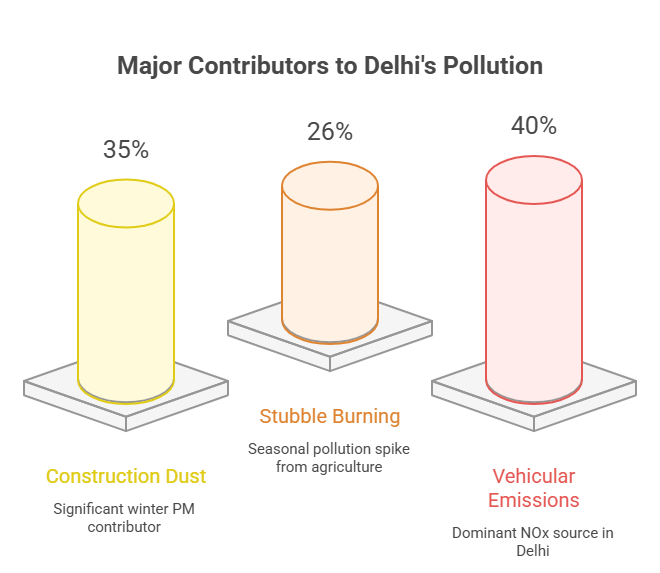
- NOx: from vehicle emissions
- Ammonia: converting to secondary PM
- Ozone: created by sunlight + pollutants
- Black carbon: from diesel and biomass burning
Do you know what PM2.5 does?
It enters:
- lungs
- bloodstream
- heart
- placenta
- foetal organs
- brain
The European Association for the Study of the Liver even connects PM2.5 to metabolic disorders—but that’s another story.
Now imagine all this multiplying during:
- low winds
- stubble burning
- construction dust
- industrial emissions
- thermal plants running at winter peak load
Air pollution in Delhi is not an event.
It is a metabolic attack.
WHY MOST PEOPLE CANNOT ESCAPE — THE HARDEST TRUTH OF ALL
Out of Delhi’s ~33 million population (Delhi + NCR):
- Less than 7–10% have a second home
- Less than 4% can work fully remote
- More than 70% depend on in-person work
- More than 50% live in areas with no air purifiers
- More than 40% live in poorly ventilated homes
This means:
When the city chokes, only a fraction can leave.
Millions cannot run from air pollution in Delhi because life pins them to the city:
- jobs
- schools
- hospitals
- rent
- parents
- responsibilities
- lack of alternative shelters
And even if someone wanted to leave for 30 days…
Where would they go?
Who will pay the rent for two places?
Who will pay for travel?
Who will move with children’s school schedules?
This is the social truth no report, no doctor, no government plan fully acknowledges.
Air pollution in Delhi divides people:
those who can escape, and those who endure.
THE WINNERS ARE THE ONES WHO THINK MONTHS AHEAD
Every year, from September to February, the city becomes a hazard zone.
Yet every year, people react—never prepare.
But the families who are winning this struggle against air pollution in Delhi do one thing differently:
They think long-term.
Not in November.
Not when AQI touches 450.
Not when the child starts coughing.
They think in:
- April
- May
- June
- July
When they know that six months later—
Delhi will hurt them again.
This is the new logic of urban India:
The smart prepare.
The wise hedge.
The long-term thinkers plan for clean-air escape routes.**
Which brings us to a solution almost no one talks about publicly:
SECOND HOMES & LAND BUFFERS — THE ONLY REAL ESCAPE FROM AIR POLLUTION IN DELHI
The concept of second homes in India used to be about:
- vacations
- status
- leisure
But now?
A second home is survival infrastructure.
Why second homes matter during air pollution in Delhi:
(1) They provide seasonal escape
When Delhi hits AQI 400+, families temporarily relocate to:
- Himachal (Chail, Kasauli, Shimla outskirts)
- Uttarakhand (Binsar, Naukuchiatal, Mukteshwar)
- Goa (interior villages, not too coastal)
- Rajasthan (Alwar, Sariska, Pushkar outskirts)
These are quieter, greener, cleaner landscapes.
(2) They protect children
Doctors highlight that children lose lung capacity every time they inhale toxic PM2.5.
A second home lets parents protect their kids during severe weeks.
(3) They reduce medical risk
A clean-air retreat reduces exposure for:
- seniors
- patients
- pregnant women
- asthmatics
(4) They improve mental health
You cannot think, build, or grow while struggling to breathe.
Clean air resets the nervous system.
(5) Long-term appreciation
Eco-rich, low-density towns are rising in value because they are becoming climate buffers.
WHY LAND IS THE REAL SOLUTION – THE KDR LENS
Here is the truth most people miss:
Air pollution in Delhi is not an air problem.
It is a land problem.
Bad land management created:
- dust
- erosion
- degraded soil
- waste mountains
- dead rivers
- concrete sprawl
- vanishing green belts
Air is simply the messenger.
Land is the root cause.
When soil loses strength, air loses purity.
This is why land becomes the solution:
1. Trees sequester PM and CO₂
2. Forest belts buffer dust and winds
3. Regenerative landscapes repair microclimates
4. Healthy soil traps particulates
5. Rural ecosystems detoxify bodies worn by city air
A second home on land is not luxury.
It is a respiratory refuge.
WHAT INDIA MUST DO (A LAND-FIRST FRAMEWORK)
1. Restore soil
Use agroforestry, bio-compost, mulching, wetlands.
2. Stop treating waste like “someone else’s problem”
Delhi’s Ghazipur landfill fires are a major source of toxins.
3. Protect green belts & Aravalli ridges
The Aravallis are Delhi’s lungs.
4. Build low-density eco-settlements
Not concrete jungles.
5. Educate families about seasonal migration patterns
Air pollution in Delhi is predictable.
6. Create clean-air corridors
Tree belts, green highways, wind pathways.
FAQs
1. Why is air pollution in Delhi getting worse every year?
Air pollution in Delhi keeps worsening because the city sits inside a perfect geographical “pollution bowl.” Low winter winds trap pollutants close to the ground, and temperature inversion creates a lid that prevents harmful particles from escaping into the upper atmosphere. Add to this:
Stubble burning across Punjab & Haryana
Construction dust from NCR’s rapid urban expansion
Industrial emissions from Ghaziabad, Sonipat, Faridabad
Vehicle congestion with over 1.2 crore registered vehicles
Thermal power plants in the surrounding belt
Land degradation & soil erosion contributing massive dust loads
Waste burnings at Ghazipur, Bhalswa & Okhla
All of this creates a cocktail of PM2.5, PM10, NOx, SO₂ and black carbon.
Delhi doesn’t have a pollution problem; it has a pollution system, and every winter, the system activates with brutal precision.
2. Is it true doctors are advising families to leave due to air pollution in Delhi?
Yes. Multiple Indian news outlets have quoted pulmonologists, pediatricians, cardiologists, and emergency physicians warning families—especially those with small children, elderly parents, or asthma patients—to temporarily relocate for 2–4 weeks during peak smog periods.
Doctors from AIIMS, Sir Ganga Ram, Max, Fortis, and Apollo have all made similar recommendations. The logic is simple:
During peak smog weeks, PM2.5 is 80–100× higher than WHO’s safe limit.
Children inhale 2× more air per body weight than adults, making them extremely vulnerable.
Seniors and cardiac patients face higher risks of stroke, arrhythmia, and COPD flare-ups.
Pregnant women are warned about risks to foetal development due to polluted air entering the placenta.
Yet, doctors also admit the uncomfortable truth:
Most people do not have the privilege to leave the city.
This is where the divide between those who can escape and those who cannot becomes painfully visible.
3. Who is most affected by air pollution in Delhi?
While everyone breathes the same air, the impact is not equal. The highest burden falls on:
Children (0–14 years)
Underdeveloped lungs
Higher breathing rate
Outdoor school exposure
Long-term lung capacity loss
Elderly (65+)
Weak immunity
Higher risk of pneumonia, COPD and heart attacks
Reduced pulmonary resilience
Outdoor Workers
Delivery riders
Cab drivers
Construction workers
Traffic police
Vendors
Security guards
These groups breathe toxic air 8–12 hours daily.
Pregnant Women
Exposure affects foetal lung, heart, and cognitive development.
Asthma & Cardiac Patients
Air pollution in Delhi is a direct trigger for:
hospitalisations
acute attacks
low oxygen saturation
inflammation spikes
The poor suffer the most because they cannot afford air purifiers, sealed homes, or temporary relocation.
4. How can a second home help during air pollution in Delhi?
Second homes were once seen as luxury. Today they are respiratory sanctuaries. They help because:
Temporary escape
Families can relocate for 20–40 days when AQI hits “Severe+”.
Better lung protection
Children and elders get a recovery window from toxic exposure.
Lower medical dependency
Staying in cleaner areas reduces hospital visits for:
wheezing
asthma attacks
breathlessness
migraines
eye/skin irritation
Mental health benefit
Clean air resets the nervous system and reduces stress.
Long-term investment logic
As air pollution in Delhi worsens yearly, demand for second homes in:
Himachal
Uttarakhand
Rajasthan outskirts
Goa
Maharashtra highlands
…keeps rising.
A second home is no longer a vacation asset.
It is a clean-air strategy.
5. What is the safest period to stay in Delhi?
Typically, the cleaner months are:
March
April
July (monsoon)
August (monsoon peak)
Air pollution in Delhi spikes during:
October (post-harvest burning begins)
November (low winds + inversion)
December (cold + trapped pollutants)
January (dense fog + stagnant air)
February is transitional.
This predictable cycle is why long-term thinkers plan ahead—for school holidays, remote work, and relocation windows.
6. Can air purifiers solve the problem of air pollution in Delhi?
Air purifiers help inside homes, but they cannot change what is happening outdoors.
Limitations:
Purifiers don’t work in open spaces.
They cannot filter NOx, SO₂ or ozone.
They don’t address micro-leaks in poorly insulated homes.
They cannot stop infiltration when doors/windows open.
The city has only a handful of public purifier towers—too few to matter.
Think of air purifiers as “masks for your home.”
Useful, not transformational.
Only land regeneration and environmental systems can solve air pollution in Delhi at its root.
7. Which Indian regions have healthier air compared to Delhi NCR?
Cleaner-air zones include:
Himachal Pradesh
Chail
Shimla outskirts
Solan
Kasauli
Dharamshala
Uttarakhand
Mukteshwar
Naukuchiatal
Binsar
Ranikhet
Rajasthan (Aravalli belt)
Sariska
Alwar outskirts
Pushkar rural belt
Goa (interior villages)
Sattari
Bicholim
Quepem
Maharashtra (Western Ghats)
Lonavala rural
Karjat
Mulshi
These regions have:
lower dust loads
greener microclimates
lower traffic density
healthier soil systems
natural air corridors
This is why second homes in these areas are rising in demand.
8. Is air pollution in Delhi connected to soil degradation?
Absolutely—this is the connection almost no one talks about.
Soil → Dust → PM10 → PM2.5 → Air pollution
When soil dries, erodes, or degrades, the wind lifts it into the atmosphere.
Construction waste, barren land, broken riverbeds, and deforested patches become dust factories.
That dust becomes PM10.
PM10 breaks into PM2.5.
PM2.5 becomes the smog people breathe.
Add Delhi’s massive construction sector + desert winds from Rajasthan + degraded Aravallis, and you get a perfect storm.
The truth is simple:
Air pollution in Delhi is not an air issue.
It is a land issue.
Fix the land → fix the air.
9. When does air pollution in Delhi reach its most dangerous levels?
Peak season:
Late October to mid-January
Immediately after Diwali
During cold, windless nights
During heavy fog weeks
When inversion layers trap pollutants close to the ground
This is when:
lungs inflame
oxygen saturation dips
schools close
doctors issue emergency advisories
children stop outdoor activities
This predictable season is why proactive families plan second-home exits well in advance.
FINAL THOUGHT — THE AIR IS ONLY THE MESSENGER. THE LAND IS THE MESSAGE.
When I walk through my projects in the forests of Sariska or the ridges of Goa, the same truth repeats itself:
Nature is not punishing us.
Nature is only mirroring us.
Air pollution in Delhi is not a weather accident.
It is a land consequence.
The families who will breathe easier in the future are not the ones who bought purifiers…
but the ones who bought foresight.
The ones who planned for September.
The ones who didn’t wait for October.
The ones who invested in land—not as property, but as protection.
Because the air will always tell the truth.
And the soil will always remember our choices.
The smartest decision any Delhi household can make today?
Find a second place where your children can breathe.
Not because you are running away from Delhi…
but because you are running towards life.
