
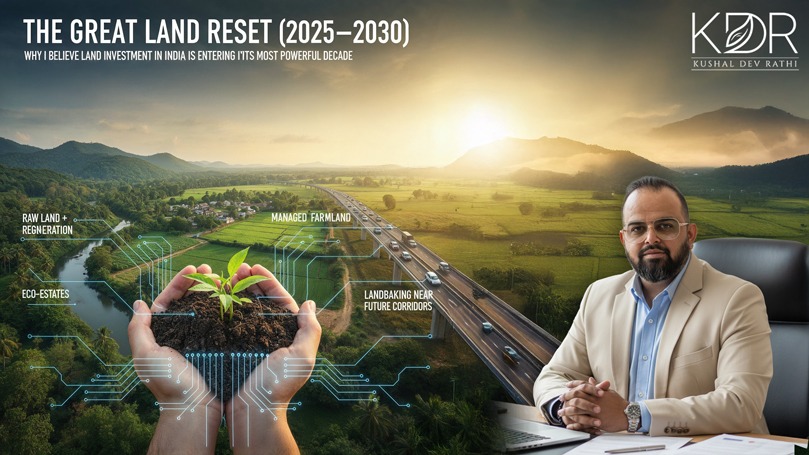
THE GREAT LAND RESET (2025–2030): WHY I BELIEVE LAND INVESTMENT IN INDIA IS ENTERING ITS MOST POWERFUL DECADE
Land has been my teacher for more than two decades.
And if there’s one thing the soil keeps reminding me, it’s this:
Land remembers.
Land heals.
Land outlives us.
But in 2025, I noticed something new — something I haven’t seen in all my years working in forests, hills, coasts, and rural belts across the country.
Land suddenly stopped behaving like an asset.
It started behaving like a signal.
A signal that families were tired.
Cities were choking.
The climate was shifting.
And people were finally looking at land not as a transaction, but as a life-support system.
I felt this transformation everywhere I walked:
- In Goa, when a family office offered 4× market price for a barren hillside I wasn’t even planning to sell.
- In Sariska, where three HNIs tried to corner the same 22-acre forest-edge parcel — not for villas, but for long-term ecological security.
- In Himachal, where a rocky slope with no road, no water, no power sold in eleven days.
These moments made one thing clear to me:
A new era of land investment in India has begun — quieter, wiser, more ecological, and deeply personal.
Before I take you into the heart of this shift, let me ground you in the basics.
LAND IN 60 SECONDS — HOW I SEE IT TODAY
After years of walking land, studying policy changes, and observing migration patterns, here’s the simplest way I can explain what’s happening:
1. We’re running out of land per person
India’s per capita land availability has fallen by 35% since the 1960s.
2. Climate migration is real
Delhi NCR had more than 25 days of “severe” AQI last winter.
People are moving — from polluted cores to ecological belts.
3. Ecological capability is now a valuation metric
Land that grows trees, holds water, stores carbon, or regenerates soil appreciates faster.
4. Digitisation is cleaning the land market
Most states now have transparent portals:
UP Bhulekh
Dharani (Telangana)
Rajasthan Apna Khata
5. Government auctions have reset price floors
DDA, BDA, CIDCO, GMADA — everyone is monetising at scale.
All this together is creating the strongest foundation I’ve ever seen for long-term land investment in India.
But the turning point of 2025 wasn’t just economic — it was personal.
WHAT I SAW ACROSS INDIA (MY 14-MONTH PATTERN)
Across Goa, Sariska, Bicholim, Kufri, Chail, Karnataka, Vidarbha, and Uttarakhand, I met buyers with completely different intentions compared to the last decade.
Here’s the pattern I couldn’t ignore:
1. People aren’t buying to build anymore
They’re buying for:
- Clean air
- Quiet
- Water security
- Ecological continuity
- A backup life
- A return to soil
2. HNIs are quietly exiting built real estate
Raw land feels safer, purer, uncorrelated.
I see this every week.
3. Families want legacy, not leverage
They want land their grandchildren can inherit, not apartments their grandchildren will demolish.
4. NRIs want emotional return
Soil > structures.
Roots > rentals.
5. Everyone wants resilience, not speculation
This is the biggest shift I’ve witnessed in land investment in India.
People are not chasing appreciation.
They are chasing anchoring.
But this shift didn’t happen alone.
Policy played a huge role.
THE POLICY RESET NOBODY IS TALKING ABOUT
2025 quietly became the most consequential year for land governance.
Let me break down the three biggest changes I tracked personally:
1. Maharashtra Regularised 60 Years of Titles
The repeal of fragmentation laws cleared decades of irregularities and provided clean titles to 49 lakh families.
This is monumental.
Land without title clarity is land that cannot appreciate.
2. Waqf Amendment Bill 2025 — Boundary Clarity
The Bill modernised laws, tightened dedication rules, and reduced disputes.
Clean boundaries = reduced friction.
3. The Supreme Court’s 2025 Compensation Ruling
In Mihin Laling vs State of Arunachal Pradesh, the Court ensured states couldn’t bypass fair compensation rules.
For investors, this means predictability along infrastructure corridors.
THE ECOLOGICAL TRUTH: LAND IS NOW A HEALTH INSTRUMENT
For decades, we treated land as a commodity.
2025 forced us to see land as a health asset.
Here are the uncomfortable truths I live with:
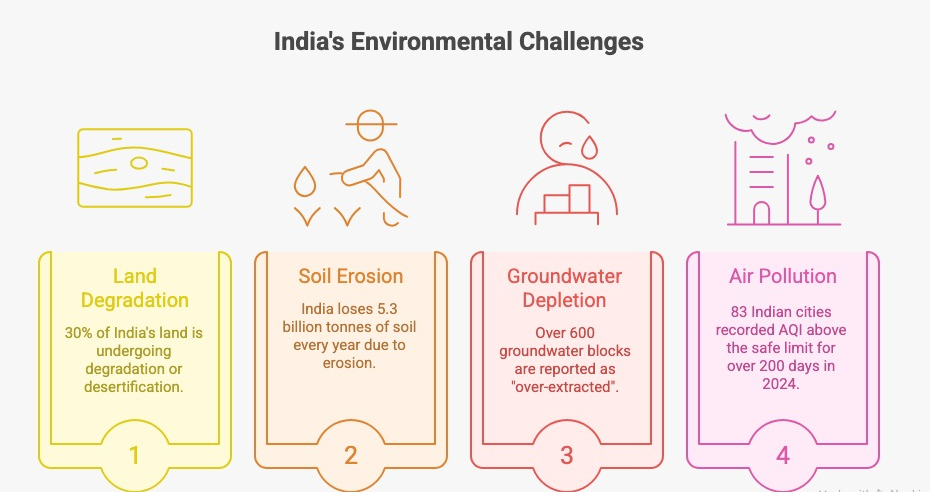
• 30% of India’s land is degrading
ISRO Desertification Atlas
• 5.3 billion tonnes of soil is lost every year
FAO
• 600+ groundwater blocks are over-extracted
CGWB
• AQI is becoming a reason for migration
CPCB
Families are not buying land for luxury.
They are buying for livability.
And this reality is reshaping land investment in India at its core.
THE NEW ECONOMICS OF LAND
Today, when I evaluate land, I no longer ask:
“What can be built here?”
I ask:
“What can this land support over the next 50 years?”
That question changes everything.
The new valuation lens includes:
- Ecological capability
- Soil carbon percentage
- Water retention
- AQI patterns
- Digitised title strength
- Regenerative potential
- Intergenerational value
This is what I call ecosystem-first investing — the foundation of how I evaluate land investment in India.
Let me simplify the formats emerging from this transformation.
THE FOUR FORMATS OF FUTURE LAND (2025–2030)
1. Managed Farmland (₹10–25 Lakh)
For first-time land investors who want access without burden.
Drivers:
- Soil quality
- Water table (CGWB)
- Community farming
- Maintenance ecosystem
2. Raw Land + Regeneration (₹50 Lakh – ₹3 Crore)
My personal favourite format.
Because here, you create value through:
- Native trees
- Water systems
- Soil improvement
- Boundary protection
3. Eco-Estates (₹5–25 Crore)
20–200 acre private estates built around nature.
Not luxury in the conventional sense—
Quiet luxury.
Slow luxury.
Legacy luxury.
4. Landbanking Near Future Corridors (₹10–100 Crore)
For patient capital and long horizons.
Guided by:
- Gati Shakti
- MoRTH
- Industrial corridors
- Mobility networks
THE THREE INVESTOR ARCHETYPES I SEE EVERY WEEK
1. The Seeker
Wants clean air, silence, and space.
Buys 1–5 acres.
2. The Strategist
Wants scarcity and appreciation.
Buys 5–50 acres.
3. The Architect
Wants legacy and ecology.
Buys 50–200 acres.
Builds ecosystems, not structures.
WHAT TO BUY BASED ON YOUR CAPITAL
A) ₹10–25 LAKH — Managed Farmland
Your checklist:
Water table from CGWB
Clean title
Transparent management
B) ₹50 LAKH – ₹2 CRORE — Raw Land
Checklist:
7/12 or Jamabandi
Drone survey
GIS coordinates
Water access
Native vegetation
Then regenerate.
C) ₹5–15 CRORE — Eco-Estates
Checklist:
Forest Survey of India map
Climate patterns
Water availability
Contiguous acreage
D) ₹20–50 CRORE — Landbanking
Checklist:
Future mobility plans
Expansion patterns
Contiguous blocks
Clean title and mutation
This is the slow-compounding zone of land investment in India.
THE 2025–2030 LAND APPRECIATION CYCLE (MY VIEW)
2025–26 — Reset Phase
Digitisation + title clarity + auction benchmarks.
2026–27 — Ecological Premium Phase
Land with water, trees, and microclimates appreciates faster.
2027–28 — Migration Wave
Families shift away from polluted metro regions.
2028–30 — Scarcity Era
Forest-edge, water-secure, and low-density land becomes gold.
MY PERSONAL FRAMEWORK FOR BUYING LAND (WHAT I FOLLOW)
1. Purpose before plot
Clarity brings the right land to you.
2. Study the soil, not the brochure
Soil truth > marketing fiction.
3. Verify every legal angle
Always use official portals.
4. Follow water
Water decides destiny.
5. Understand regional intention
Some land wants to be forest; some wants to be farm.
6. Think in decades, not years
Land rewards slowness.
7. Build an ecosystem, not a structure
Structures depreciate.
Landscapes appreciate.
8. Leave the land better than you found it
This is the highest form of wealth.
FAQ
1. Is land investment in India safe in 2025–2030?
Yes — if you buy with clean title, correct classification, and verified documents. Policies, digitisation, and record reforms have significantly improved safety for land investment in India. Always verify mutation entries, revenue records, and ownership history using official state portals before purchase.
2. Can NRIs legally buy land in India?
NRIs can buy non-agricultural land freely, but agricultural land purchase depends on state rules. Some states restrict agricultural land to only agriculturists. Always verify the local law before planning any land investment in India, especially if you are an NRI purchasing agricultural parcels.
3. Does farmland appreciate slower than real estate?
No. In many regions, farmland has outperformed urban real estate due to scarcity, water access, and ecological value. With climate stress rising, well-located farmland is becoming a prime category of land investment in India, especially for long-term wealth builders.
4. What documents are required for land purchase?
Key documents include: Sale deed, mother deed, mutation records, 7/12 extract or Jamabandi, encumbrance certificate, survey map, classification certificate, RTC, and tax receipts. Verifying these carefully is essential for secure land investment in India.
5. How do I know if land is good for agriculture or regeneration?
Check soil carbon %, water table data, vegetation type, previous land use, and nearby cultivation patterns. Government soil portals and CGWB groundwater reports provide reliable reference points. Good soil and stable water significantly increase the long-term value of land investment in India.
6. Is buying forest-adjacent land legal?
Yes, as long as the land is revenue land (private) and not part of protected forest, reserve forest, wildlife sanctuary, or eco-sensitive zone. Always cross-check boundaries using Forest Survey of India maps. This is a crucial step in safe land investment in India.
7. What is the best size to start with?
Start with what is manageable — even 0.5 to 1 acre is enough for regenerative value creation. The key to land investment in India is not the size, but the clarity of purpose and the ecological potential of the land.
8. Which is better — buying land or buying property?
Land offers sovereignty, control, permanence, and ecological abundance. Property offers convenience but depreciates faster and depends on market cycles. For long-term stability, land investment in India remains a stronger, more resilient asset compared to built real estate.
9. How long should I hold land for best returns?
Ideal hold time is 7–15 years. Land compounds quietly but powerfully across ecological cycles. The longer you hold — and the more you regenerate — the higher your outcomes in land investment in India.
10. Can land generate passive income?
Yes — through agroforestry, plantations, eco-tourism, homestays, water credits, carbon credits, and nature-linked revenue models. As India expands climate-linked markets, passive income from land investment in India will grow significantly.
THE LAND REMEMBERS
Land doesn’t respond to speculation.
Land doesn’t move with markets.
Land doesn’t care about trends.
Land responds to:
Care.
Patience.
Regeneration.
Intention.
Continuity.
In a world racing toward speed and convenience, land forces us to slow down — and rewards us for listening.
This is why I believe the next decade belongs to land.
Not for quick returns, but for deep roots.
We don’t own land.
We are only borrowing it from every generation that will walk after us.
If you build a structure, you leave a building.
If you build an ecosystem, you leave a legacy.
This — to me — is the real meaning of land investment in India.
And it is the wealth I want my grandchildren to inherit — not square feet, but soil.
Not concrete, but continuity.
Not noise, but nature.
