
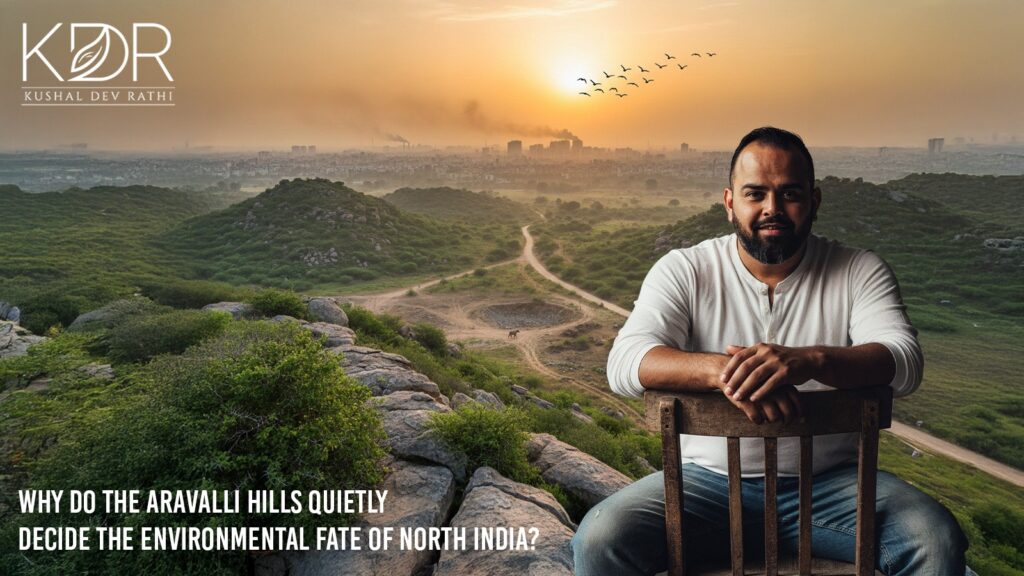
Why Do the Aravalli Hills Quietly Decide the Environmental Fate of North India?
I have walked land long enough to know this truth:
Land does not collapse overnight. It erodes quietly.
Yet today, entire mountain systems are declared “dead” in a single viral post.
In recent months, the Aravalli Hills have become the centre of a digital storm. Headlines scream. Videos circulate. Messages get forwarded with urgency and fear. The Supreme Court, we are told, has “allowed mining.” The Aravallis, we are told, are “finished.” India’s oldest mountains, we are told, have finally lost the battle.
But land does not operate on WhatsApp timelines.
And ecological truth does not fit into Instagram captions.
This essay is not written to calm outrage or provoke it. It is written to slow the conversation down—because the Aravalli Hills ecological importance cannot be understood at the speed of virality.
To speak about the Aravallis is not to speak only about hills. It is to speak about water, air, heat, dust, wildlife, cities, and the fragile thread that still holds North India’s ecological balance together.
Before we shout, we must understand.
Before we react, we must read the land.
When Social Media Judges Mountains Faster Than Time
We live in a moment where attention moves faster than soil can settle.
A technical Supreme Court judgment—dense, legal, and layered—is reduced to a single sentence graphic:
“SC allows mining in Aravallis below 100 metres.”
That sentence travels faster than context ever could.
Environmental anxiety is understandable. The Aravallis have already suffered decades of degradation—illegal mining, urban sprawl, road cuts, forest loss. So when people see a legal definition that seems to shrink what qualifies as “Aravalli Hills,” fear becomes immediate.
But fear is not the same as fact.
The danger of viral environmental narratives is not emotion—it is oversimplification. Complex ecological systems are flattened into binary outcomes: saved or destroyed, protected or sold.
The Aravalli Hills ecological importance cannot be reduced to a yes-or-no legal category. It exists across gradients—of elevation, vegetation, geology, and hydrology. When we reduce land to a legal measurement, we risk misunderstanding its real function.
This does not mean people are wrong to worry. It means worry must be anchored in truth, not acceleration.
What the Supreme Court Actually Said — And What It Did Not
Let us step away from social media and into facts.
The Supreme Court, while addressing long-standing disputes around mining in the Aravalli region, accepted recommendations from a government-appointed committee to adopt a uniform definition of the “Aravalli Hills and Ranges.”
This definition uses local relief of 100 metres as one criterion—meaning a landform must rise at least 100 metres above the surrounding terrain to qualify as a “hill” under this legal framework.
This is where most viral narratives stop.
But the judgment does not.
What the Supreme Court DID do
- Accepted the need for uniformity across states to reduce legal ambiguity
- Directed the preparation of a Management Plan for Sustainable Mining (MPSM)
- Ordered that no new mining leases be granted until this plan is finalised
- Recognised the Aravallis as ecologically critical for desertification control, biodiversity, and environmental stability
What the Supreme Court DID NOT do
- It did not open all Aravalli land for mining
- It did not remove environmental clearance requirements
- It did not say land below 100 metres has no ecological value
- It did not lift protections indiscriminately
The real concern lies not in what the Court said—but in how definitions shape future governance.
And that is where ecological vigilance becomes necessary.
Legal Definitions vs Living Landscapes
Law needs clarity.
Ecology thrives on continuity.
A legal definition draws a boundary. A watershed ignores it. A wildlife corridor does not pause at 99 metres. Groundwater does not ask for elevation certificates before flowing.
The Aravalli Hills ecological importance lies not only in prominent ridges, but in:
- low scrub-covered hillocks
- forested pediments
- rocky outcrops that slow runoff
- continuous belts that connect forests, wetlands, and human settlements
When protection is fragmented, ecosystems weaken even if “hills” remain protected on paper.
This is why many environmental scientists worry that excluding lower-elevation landforms from formal definitions may create ecological blind spots, even if intentions are not malicious.
Ecology is not a courtroom argument.
It is a system.
Why the Aravalli Hills Matter More Than We Acknowledge
The Aravalli range is among the oldest mountain systems on Earth, older than the Himalayas. But age alone does not make it important.
Function does.
The Aravalli Hills ecological importance is foundational to North India’s survival:
1. A Barrier Against Desertification
The Aravallis slow the eastward spread of the Thar Desert. This role is recognised under India’s commitments to the UN Convention to Combat Desertification (UNCCD).
Without this barrier, dust storms, heat, and aridity intensify across Rajasthan, Haryana, and the NCR.
2. Groundwater Recharge
Fractured rocks and vegetated slopes allow rainwater to percolate and recharge aquifers. This is critical in regions already facing groundwater stress.
https://cgwb.gov.in/
3. Climate Moderation
Vegetation cover reduces heat islands, stabilises local climates, and moderates extreme temperatures.
4. Biodiversity & Corridors
Leopards, hyenas, birds, reptiles, and plant species depend on these landscapes. Fragmentation increases human-wildlife conflict and ecosystem collapse.
These services do not announce themselves. But cities collapse without them.
Mining Is Not Just Extraction — It Is a Chain Reaction
Mining is often defended as an economic necessity. But economics that ignore ecological cost are incomplete.
When mining expands without intelligence:
- vegetation is removed
- soil loosens
- dust increases
- air quality worsens
- groundwater recharge declines
- wildlife corridors fracture
The World Health Organization links particulate matter and dust exposure to respiratory disease:
Environmental research bodies like the Centre for Science and Environment have repeatedly warned that fragile landscapes cannot absorb unplanned extraction:
The Aravalli Hills ecological importance lies precisely in preventing these cascading failures.
How Much Mining Is Actually Allowed Today?
This is where clarity matters most.
As of now:
- Existing legal mining may continue under regulatory oversight
- No new mining leases can be issued until the MPSM is finalised
- Ecologically sensitive and core areas are expected to remain protected
This is not a free-for-all.
Nor is it a blanket ban.
It is a governance test.
Mining itself is not evil.
Unregulated, short-term mining is.
The question is not “Is mining allowed?”
The question is: Is mining aligned with ecological limits?
The Question We Are Avoiding
Every viral debate avoids the real issue.
Instead of asking whether land meets a measurement, we should ask:
What role does this land play in the system?
The Aravalli Hills ecological importance cannot be measured only in metres. It must be understood through:
- water flow
- vegetation continuity
- climate moderation
- biodiversity support
- human dependence
When land is treated as inventory, it is consumed.
When land is treated as a system, it is stewarded.

What Responsible Stewardship Actually Looks Like
Protection is not anti-development.
It is intelligent development.
True stewardship includes:
- ecological zoning
- inviolate core areas
- restoration obligations
- long-term monitoring
- accountability beyond paperwork
The government’s Aravalli Green Wall Project aims to restore degraded stretches and strengthen ecological continuity:
https://moef.gov.in/en/aravalli-green-wall-project/
Globally, institutions like the World Economic Forum now recognise nature loss as a direct economic risk
Land that collapses ecologically eventually collapses economically.
This is not philosophy.
It is systems thinking.
Why Viral Environmentalism Often Fails the Land
Outrage feels active.
Understanding feels slow.
But land responds only to the latter.
The Aravallis do not need viral saviours. They need patient governance, scientific mapping, and long-term accountability.
The Aravalli Hills ecological importance deserves maturity—not panic.
FAQ
1. Why is the Aravalli Hills ecological importance so critical for North India?
The Aravalli Hills ecological importance lies in their role as a natural environmental regulator for North India. The Aravallis slow the eastward spread of the Thar Desert, moderate regional temperatures, support groundwater recharge, and act as a biodiversity corridor across Rajasthan, Haryana, and the NCR. Without the Aravallis, dust storms, heat waves, water stress, and land degradation would intensify significantly. This role is recognised under India’s commitments to combat desertification.
2. Did the Supreme Court allow unrestricted mining in the Aravalli Hills?
No. Claims that the Supreme Court allowed unrestricted mining are inaccurate. The Court accepted a uniform definition for the Aravalli Hills but also ordered that no new mining leases be granted until a Management Plan for Sustainable Mining is finalised. The Aravalli Hills ecological importance was acknowledged, and safeguards were emphasised.
3. What does the 100-metre definition mean for the Aravalli Hills ecological importance?
The 100-metre local relief definition is a legal classification, not an ecological judgment. While it helps standardise governance, the Aravalli Hills ecological importance extends beyond elevation to include low hillocks, forested slopes, groundwater zones, and ecological corridors that continue to perform vital environmental functions regardless of height.
Source: https://www.thehindu.com/news/national/
4. How do the Aravalli Hills affect groundwater and water security?
The fractured rock systems and forest cover of the Aravallis allow rainwater to percolate and recharge aquifers. The Aravalli Hills ecological importance is closely linked to water availability in arid and semi-arid regions, particularly in Rajasthan and Haryana, where groundwater depletion is already severe.
5. What happens to air quality and climate if the Aravalli Hills degrade further?
Loss of vegetation and soil stability increases dust and particulate matter, worsening air quality in nearby cities, including Delhi-NCR. The Aravalli Hills ecological importance includes reducing heat islands, controlling dust, and moderating local climates—functions that directly affect public.
6. Is mining completely banned in the Aravalli region today?
Mining is not completely banned, but it is strictly regulated. Existing legal operations may continue under environmental safeguards, while new leases are paused pending sustainable mining plans. The Aravalli Hills ecological importance requires that extraction, where allowed, be scientifically managed and ecologically limited.
7. Why do environmental experts worry about defining Aravallis only by elevation?
Ecologists warn that elevation-only definitions risk excluding connected landforms that support water flow, biodiversity, and climate regulation. The Aravalli Hills ecological importance depends on landscape continuity, not isolated peaks. Fragmented protection can weaken entire ecosystems even if some hills remain legally protected.
8. How does Aravalli degradation impact wildlife and biodiversity?
The Aravallis serve as wildlife corridors for mammals, birds, reptiles, and plant species. Habitat fragmentation disrupts migration routes and increases human-wildlife conflict. Protecting the Aravalli Hills ecological importance is essential for maintaining biodiversity in an otherwise rapidly urbanising region.
9. What is the Aravalli Green Wall Project and how does it help?
The Aravalli Green Wall Project is a government initiative aimed at restoring degraded stretches of the Aravalli range through afforestation and soil conservation. It recognises the Aravalli Hills ecological importance in preventing desertification and strengthening climate resilience.
10. How can responsible land development coexist with Aravalli Hills ecological importance?
Responsible development respects ecological limits by protecting core areas, restoring degraded land, and ensuring long-term monitoring. The Aravalli Hills ecological importance shows that sustainable land stewardship is not anti-development—it is essential for long-term economic and environmental stability.
A Final Reflection
Social media will move on.
Another judgment will trend.
Another mountain will be declared doomed.
But the Aravallis will continue their quiet work—holding soil, slowing deserts, filtering water, cooling air—if we allow them to.
If we lose them, it will not be because of one court order.
It will be because we replaced understanding with noise.
Land does not ask for slogans.
It asks for responsibility.
And responsibility begins with truth.
