
World Cancer Day 2026: What the Land, the Body, and Time Have Been Trying to Tell Us
Sitting With World Cancer Day 2026
Every year, World Cancer Day 2026 arrives quietly on the 4th of February. There are banners, statistics, campaigns, and well-intentioned messages across media platforms. And yet, for many of us, it passes like background noise—noticed, acknowledged, and quickly replaced by the urgency of everyday life.
For me, World Cancer Day 2026 does not feel like a reminder. It feels like a pause.
I have spent over three decades working closely with land—studying it, developing it, sometimes stepping back from it when it needed time to heal. And if land has taught me anything, it is this: systems speak long before they break. They whisper before they scream. They signal before they collapse.
The human body is no different.
On World Cancer Day 2026, I find myself thinking less about cancer as a disease and more about cancer as a message—a message about how we live, how we build, how we consume, and how little time we allow for regeneration.
This is not a medical essay. It is a human one. A systems one. A land-first reflection on what World Cancer Day 2026 is truly asking of us.
What World Cancer Day 2026 Actually Represents
World Cancer Day 2026 is part of a global movement led by the Union for International Cancer Control (UICC), in collaboration with the World Health Organisation (WHO). Its purpose is not limited to awareness alone, but to mobilise governments, institutions, communities, and individuals toward prevention, early detection, equitable care, and long-term policy change.
The current global campaign cycle (2025–2027) carries the theme “United by Unique.” It is an important shift in language. Instead of viewing cancer through a singular, clinical lens, World Cancer Day 2026 emphasises people-centred cancer care—care that recognises individual realities, social contexts, and lived experiences.
This idea resonates deeply with how I view land.
No two pieces of land are the same. Soil composition changes every few metres. Microclimates differ. Water behaves differently across slopes. When developers ignore this individuality, projects may succeed briefly—but fail structurally over time.
World Cancer Day 2026 is making the same argument for health: uniform solutions applied to unique lives create fragile outcomes.
The Global Cancer Burden: What the Numbers Are Really Saying
To understand the urgency of World Cancer Day 2026, we must look at the data—not emotionally, but honestly.
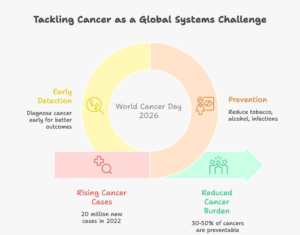
According to the World Health Organisation, cancer is one of the leading causes of death worldwide. The International Agency for Research on Cancer (IARC) reported nearly 20 million new cancer cases globally in 2022, with approximately 10 million deaths.
These figures are not static.
WHO projects that by 2050, global cancer incidence could rise to 35 million new cases annually, a nearly 77% increase compared to 2022.
This projected rise is driven by:
- Population ageing
- Rapid urbanisation
- Lifestyle transitions
- Environmental exposure
- Inequitable access to prevention and early diagnosis
When I read these projections in the context of World Cancer Day 2026, I don’t see an inevitable future. I see a systems failure in slow motion—one that can still be altered.
Land behaves the same way. Degradation rarely happens overnight. It is cumulative. Predictable. And preventable.
World Cancer Day 2026 and the Indian Reality
In India, World Cancer Day 2026 holds particular significance.
Cancer incidence in India has been steadily rising, not only because of better detection, but also due to changing lifestyles, environmental stressors, and longer life expectancy. The Indian Council of Medical Research (ICMR), through its National Cancer Registry Programme (NCRP), provides one of the most reliable pictures of cancer trends in the country.
These registries reveal patterns linked strongly to:
- Tobacco use (smoked and smokeless)
- Dietary transitions
- Urban air pollution
- Physical inactivity
- Late-stage diagnosis
The Ministry of Health and Family Welfare (MoHFW) has acknowledged this burden and expanded national initiatives under the National Programme for Prevention and Control of Non-Communicable Diseases (NP-NCD), including large-scale screening and district-level care infrastructure.
From a systems perspective, World Cancer Day 2026 in India is not just about disease—it is about access, geography, and timing. Early detection in theory means little if diagnosis or treatment is unreachable in practice.
Prevention: The Quiet Power Behind World Cancer Day 2026
One of the most misunderstood aspects of World Cancer Day 2026 is prevention.
The World Health Organisation states clearly that 30–50% of cancers are preventable. This is not speculation or optimism—it is evidence-based public health science.
Key preventable risk factors include:
- Tobacco exposure
- Harmful alcohol use
- Unhealthy diets
- Physical inactivity
- Excess body weight
- Certain infections (HPV, Hepatitis B & C)
- Environmental and occupational exposures
Prevention is not about individual blame. It is about designing healthier systems.
In land development, prevention looks like respecting natural drainage, preserving tree cover, and allowing soil to breathe. In health, prevention looks like walkable cities, cleaner air, balanced diets, reduced exposure to toxins, and accessible primary care.
World Cancer Day 2026 reminds us that prevention is not dramatic—but it is deeply effective.
Early Detection: Timing Is Everything
Another pillar of World Cancer Day 2026 is early detection.
The WHO distinguishes clearly between screening and early diagnosis. Early diagnosis focuses on recognising symptoms early and ensuring timely access to diagnosis and treatment. Screening, on the other hand, must be evidence-based and system-ready.
Examples include:
- Cervical cancer: WHO recommends HPV testing as the preferred screening method
- Breast cancer: Mammography is recommended primarily for women aged 50–69 in well-resourced settings
Early detection changes outcomes dramatically. It reduces treatment intensity, improves survival, and lowers financial strain.
In land terms, this is equivalent to conducting soil and water studies before construction, not after cracks appear.
World Cancer Day 2026 is a reminder that delayed attention always costs more.
Environment, Air, and the Cancer Conversation We Avoid
One of the least discussed yet most critical dimensions of World Cancer Day 2026 is the environment.
The International Agency for Research on Cancer (IARC) has classified outdoor air pollution as a Group 1 carcinogen, meaning there is sufficient evidence linking it to cancer, particularly lung cancer.
This matters because air pollution is not an individual choice—it is a collective outcome of urban planning, transport systems, industrial policy, and land use decisions.
As someone who works closely with land, I see this clearly: how we design spaces determines how we breathe.
World Cancer Day 2026 cannot be separated from conversations about air quality, green cover, and livable cities. Environmental health is cancer prevention at scale.
“United by Unique”: Why Human-Centred Care Matters
The theme of World Cancer Day 2026—United by Unique—is not poetic language. It is a systems critique.
Cancer outcomes vary widely based on:
- Income
- Location
- Gender
- Education
- Social support
- Healthcare access
Two individuals with the same diagnosis may experience entirely different journeys.
World Cancer Day 2026 calls for care models that recognise these differences—not just technologically advanced systems, but compassionate, accessible, and responsive ones.
In my experience, land projects succeed when they respect people, context, and culture. Health systems are no different.
What Land Has Taught Me About Health and Cancer
Over decades, land has taught me patience, humility, and restraint.
It has taught me that overuse leads to collapse, that regeneration requires time, and that systems respond positively when pressure is reduced.
Cancer teaches us similar lessons.
World Cancer Day 2026 is not asking us to panic. It is asking us to reconsider speed, excess, and neglect—both in how we treat our bodies and how we design our environments.
FAQ
1. What is World Cancer Day 2026, and why is it observed globally?
World Cancer Day 2026 is observed on 4 February as part of a global movement led by the Union for International Cancer Control (UICC), supported by the World Health Organization (WHO). Its purpose is to raise awareness about cancer, promote prevention and early detection, and encourage equitable access to care worldwide.
What makes World Cancer Day 2026 significant is that it goes beyond medical conversations. It focuses on how societies, systems, and everyday environments influence cancer risk and outcomes. The day brings together governments, healthcare institutions, researchers, communities, and individuals under a shared responsibility—to reduce the global cancer burden thoughtfully and sustainably.
2. What is the theme of World Cancer Day 2026, and what does it mean?
The theme of World Cancer Day 2026 is part of the 2025–2027 campaign titled “United by Unique.” This theme recognises that while cancer affects millions globally, every individual’s experience with cancer is different—shaped by biology, environment, access to care, and social context.
From a systems perspective, this theme highlights that health solutions cannot be uniform. Just as land responds differently depending on soil, water, and climate, cancer care must respond to individual realities rather than one-size-fits-all models.
3. How big is the global cancer burden today, according to WHO?
According to the World Health Organization, cancer remains one of the leading causes of death worldwide. Data from the International Agency for Research on Cancer (IARC) shows that there were approximately 20 million new cancer cases in 2022, with nearly 10 million deaths globally.
What makes World Cancer Day 2026 particularly important is the future outlook. WHO projects that cancer cases could rise to 35 million per year by 2050, driven by population ageing, lifestyle changes, and environmental factors.
4. How is World Cancer Day 2026 relevant for India specifically?
In India, World Cancer Day 2026 highlights a growing public health challenge. Cancer incidence is rising due to changing lifestyles, tobacco use, air pollution, dietary shifts, and longer life expectancy.
The Indian Council of Medical Research (ICMR), through the National Cancer Registry Programme (NCRP), tracks these trends across states and regions. These registries help policymakers understand where prevention and early detection are most urgently needed.
5. How much of cancer is actually preventable according to science?
One of the most important messages reinforced on World Cancer Day 2026 is that 30–50% of cancers are preventable, according to the World Health Organisation.
Prevention focuses on reducing known risk factors such as tobacco use, harmful alcohol consumption, unhealthy diets, physical inactivity, certain infections (like HPV and Hepatitis B), and environmental exposures. Prevention is not about individual blame—it is about designing healthier systems and environments.
6. What role does early detection play in World Cancer Day 2026 messaging?
Early detection is a central pillar of World Cancer Day 2026. The WHO distinguishes between screening and early diagnosis, emphasising that both must be evidence-based and supported by accessible healthcare systems.
For example:
- Cervical cancer: WHO recommends HPV testing as the preferred screening method
- Breast cancer: Mammography is advised for specific age groups where systems can support follow-up care
Early detection improves survival rates, reduces treatment intensity, and lowers emotional and financial stress on families.
7. Is there a proven link between environment and cancer risk?
Yes. One of the strongest evidence-based links highlighted in conversations around World Cancer Day 2026 is environmental exposure—especially air pollution.
The International Agency for Research on Cancer (IARC) has classified outdoor air pollution as a Group 1 carcinogen, meaning there is sufficient evidence that it can cause cancer, particularly lung cancer.
This reinforces the idea that cancer prevention is not only a medical issue, but also an urban planning and environmental responsibility.
8. What does “people-centred cancer care” mean in the context of World Cancer Day 2026?
People-centred care, a core message of World Cancer Day 2026, means recognising that cancer affects individuals differently depending on their social, economic, and geographic realities.
It emphasises dignity, access, emotional support, and continuity of care—not just advanced treatment. Two people with the same diagnosis may have vastly different outcomes based on these factors.
This approach aligns with WHO’s broader health systems thinking, where equity and access are as important as technology.
9. Why does World Cancer Day 2026 emphasise systems rather than individual behaviour alone?
World Cancer Day 2026 acknowledges that individual choices are shaped by larger systems—food systems, urban design, air quality, healthcare access, and education.
Just as land degradation is rarely caused by a single action, cancer risk accumulates through long-term systemic exposure. Addressing cancer, therefore, requires changes at policy, community, and environmental levels—not only personal willpower.
This systems-based understanding is central to WHO and UICC strategies.
10. What is the most important takeaway from World Cancer Day 2026 for individuals?
The most important message of World Cancer Day 2026 is not fear—it is attention.
Attention to early signals.
Attention to environments we live in.
Attention to prevention and access.
Cancer outcomes improve when societies listen early rather than react late. Just as land responds to care over time, health responds to thoughtful, sustained attention.
World Cancer Day 2026 reminds us that awareness is not passive—it is an active form of responsibility.
As World Cancer Day 2026 comes to a close, I find myself returning to a simple, uncomfortable truth:
Most of what harms us does not arrive suddenly.
It accumulates.
Cancer, much like land degradation, is rarely an accident. It is often the result of long-term neglect—of signals ignored, of balance disturbed, of systems pushed beyond what they were designed to hold. The body does not betray us without warning. It speaks quietly first. We just live in a world that no longer listens well.
What World Cancer Day 2026 asks of us is not panic, and not perfection. It asks for attention.
Attention to how we breathe.
Attention to what we consume.
Attention to how our cities are built, how our days are structured, and how little space we leave for rest, movement, and recovery.
Over the years, I have learned that land responds generously to care—but only when care is consistent and patient. Health behaves the same way. Prevention does not make headlines. Early detection does not feel dramatic. Clean air, balanced food systems, and slower living rarely feel urgent—until their absence becomes impossible to ignore.
This is why World Cancer Day 2026 matters.
Not because it reminds us that cancer exists—we already know that.
But because it reminds us that much of cancer’s burden is shaped long before diagnosis, in the environments we normalise and the systems we accept without question.
The theme “United by Unique” feels especially important here. No two lives are the same. No two bodies carry the same history. And no two cancer journeys unfold identically. Care, therefore, must be human before it is technical. Listening must come before intervention. Dignity must come before efficiency.
If there is one lesson land has taught me repeatedly, it is this:
What we honour early, we do not have to repair later.
On World Cancer Day 2026, I hope we move away from seeing cancer only as a medical emergency and begin seeing it as a societal mirror—reflecting how we live, how we build, and how gently or harshly we treat the systems that sustain us.
Awareness is not fear.
Prevention is not control.
And care is not only something that happens in hospitals.
Sometimes, care begins by slowing down enough to listen—
to our bodies,
to our surroundings,
and to the quiet warnings that arrive long before crisis.
That, to me, is the most meaningful message of World Cancer Day 2026.
