
Indian Festivals — Unity in Diversity
Every January, as the Indian winter softens and the Sun begins its northward journey, I find myself returning to a familiar thought:
India doesn’t celebrate festivals because of the calendar — the calendar follows India’s festivals.
After spending decades observing India’s social, environmental, and cultural transitions, I have realised something fundamental. Our festivals are not interruptions to productivity. They are civilisational checkpoints — moments when communities pause to acknowledge nature, labour, gratitude, and continuity.
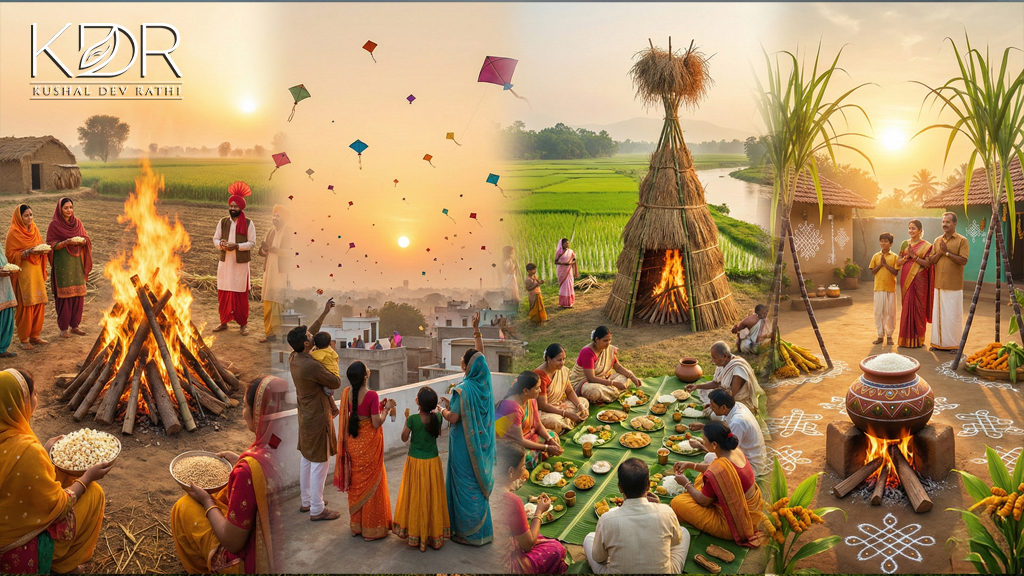
Nowhere is this more evident than in the mid-January harvest season. Across the country, from the fields of Punjab to the river plains of Assam, from Gujarat’s rooftops to Tamil Nadu’s courtyards, millions of Indians celebrate the same agricultural milestone — but in profoundly different ways.
This is where the idea of Indian festivals unity in diversity moves beyond rhetoric and becomes lived experience.
Lohri.
Makar Sankranti.
Magh Bihu.
Pongal.
Different names. Different rituals. Different languages.
Yet, one shared truth: gratitude for the harvest and respect for nature’s cycles.
This blog is not a travelogue of festivals. It is an attempt to understand how Indian festivals unity in diversity has survived centuries of change — and why it remains one of India’s strongest cultural assets today.
The Agrarian Foundation of Indian Festivals
To understand Indian festivals unity in diversity, we must begin with agriculture.
For over 60% of India’s population, agriculture remains directly or indirectly linked to livelihood . Long before economic indices and policy frameworks existed, India’s rural communities aligned their lives with seasons, soil, rainfall, and solar cycles.
Harvest festivals evolved as community acknowledgements of survival and success.
They served three purposes:
- Thanksgiving to nature
- Redistribution of food and wealth
- Strengthening of social bonds
Unlike modern celebrations centred on consumption, traditional harvest festivals were rooted in collective resilience. This is why Indian festivals unity in diversity is inseparable from India’s agrarian history.
The Sun’s transition into Capricorn — known astronomically as Uttarayana — marks longer days and agricultural renewal. This single solar event becomes the foundation for multiple festivals across India.
Different geography. Different crops.
Same Sun. Same gratitude.
Lohri: Fire, Community, and Collective Memory
In North India, particularly Punjab, Haryana, and parts of Himachal Pradesh, the harvest season begins with Lohri on January 13.
What strikes me most about Lohri is its simplicity. A bonfire. A circle of people. Folk songs passed through generations.
Lohri is deeply connected to the rabi crop cycle — especially wheat and sugarcane. The fire symbolises warmth, protection, and prosperity during the coldest phase of winter.
Families gather to offer sesame seeds, jaggery, peanuts, and popcorn into the flames — ingredients chosen not by luxury, but by seasonal relevance and nutritional value.
In villages, Lohri becomes a communal event. In cities, it transforms into cultural memory — an act of preservation. Either way, Lohri reinforces Indian festivals unity in diversity by reminding us that celebration does not require excess — only participation.
What I find powerful is that Lohri is not a religious festival. It is social. Cultural. Inclusive. Anyone can stand by the fire.
That inclusiveness is not accidental. It is civilisational design.
Makar Sankranti: When Astronomy Meets Culture
On January 14, Makar Sankranti is celebrated across India — one of the few Indian festivals fixed to the solar calendar, not the lunar one (NASA Solar Movement Explanation).
This astronomical shift marks the Sun’s movement into Capricorn, symbolising longer days, agricultural optimism, and spiritual progress.
Makar Sankranti is perhaps the strongest example of Indian festivals unity in diversity because it exists everywhere — yet looks different everywhere.
In Uttar Pradesh and Bihar, it is known as Khichdi.
In Gujarat, Uttarayan.
In West Bengal, Poush Sankranti.
In Maharashtra, Tilgul Sankranti.
Sesame and jaggery dominate culinary traditions across regions because they provide warmth and energy in winter — a reminder that traditional knowledge often predates modern nutrition science.
Despite regional names, the symbolism remains identical:
- Share food
- Let go of bitterness
- Begin anew
That shared meaning is the invisible thread binding Indian festivals unity in diversity.
Uttarayan: When the Sky Becomes a Community Space
In Gujarat, Makar Sankranti transforms into Uttarayan, one of the world’s largest kite-flying festivals.
What fascinates me is how Uttarayan democratises celebration. Rooftops replace temples. The sky becomes a shared canvas. Strangers exchange smiles and sweets.
The International Kite Festival of Gujarat now attracts participants from over 30 countries, showing how local traditions can scale globally without losing authenticity.
Here, Indian festivals unity in diversity becomes visible — not in ritual, but in collective joy.
There is competition, yes. But there is also cooperation. When a kite is cut, applause follows — not hostility.
That emotional maturity is cultural inheritance.
Magh Bihu: The North-East’s Celebration of Abundance
In Assam and parts of the North-East, the harvest season culminates in Magh Bihu, also called Bhogali Bihu — literally, the festival of feasting.
Rice dominates the agricultural economy here, and Magh Bihu celebrates its successful harvest.
Temporary huts (Bhelaghar) are built using bamboo and straw, symbolising impermanence and humility. Community bonfires (Meji) are lit, and people gather for shared meals featuring rice cakes (pitha) and sweets (laru).
Magh Bihu reinforces Indian festivals unity in diversity by highlighting a key truth:
Different crops, same gratitude.
The rituals may differ from Lohri or Sankranti, but the emotional centre is identical — acknowledgment of collective labour and nature’s generosity.
Pongal: A Four-Day Conversation with Nature
In Tamil Nadu, the harvest celebration unfolds over four days as Pongal — one of India’s most structured and environmentally conscious festivals.
Each day carries a distinct meaning:
- Bhogi Pongal – letting go of the old
- Thai Pongal – thanking the Sun
- Mattu Pongal – honouring cattle
- Kaanum Pongal – strengthening social bonds
The act of cooking rice until it overflows (pongal) symbolises abundance — not accumulation.
What I admire most about Pongal is its explicit recognition of non-human contributors to agriculture. Cattle are decorated, respected, and fed first. In an era where sustainability is often discussed abstractly, Pongal demonstrates how Indian festivals unity in diversity has always included ecological ethics.
Common Threads Across Diverse Celebrations
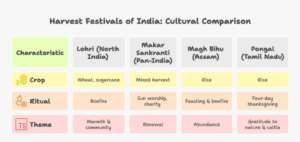
When we step back and compare Lohri, Makar Sankranti, Magh Bihu, and Pongal, a pattern emerges:
- Agriculture as the foundation
- Sun as the central force
- Food as the medium of sharing
- Community as the core participant
This is why Indian festivals unity in diversity is not a contradiction. Diversity exists in expression; unity exists in purpose.
Across states, languages, and rituals, the message remains consistent:
Gratitude. Renewal. Togetherness.
Economic and Social Impact of Harvest Festivals
Beyond culture, harvest festivals generate tangible economic value.
According to Ministry of Tourism estimates, domestic travel spikes during January festivals, supporting rural artisans, food producers, and local economies.
Festivals like Uttarayan and Pongal sustain:
- Handicraft clusters
- Local food ecosystems
- Folk art traditions
They are informal economic engines — decentralised, inclusive, and sustainable.
This economic layer further strengthens Indian festivals unity in diversity by ensuring that celebration translates into livelihood.
Why Indian Festivals Unity in Diversity Still Matters
In an age of global homogenisation, India’s festivals resist simplification.
They teach us:
- Unity does not require uniformity
- Progress does not require erasure
- Diversity does not weaken identity — it strengthens it
As someone deeply invested in India’s long-term sustainability narrative, I see festivals not as nostalgia but as instruction manuals — guiding how communities can remain rooted while adapting.
Indian festivals unity in diversity is not a cultural accident.
It is a carefully evolved system.
FAQ
1. Why are harvest festivals celebrated around mid-January across India?
Harvest festivals in India are primarily celebrated around mid-January because this period marks the Sun’s transition into Capricorn (Makara) — a phenomenon known as Uttarayana. Astronomically, this signals longer daylight hours and a gradual shift towards warmer weather, which is crucial for agricultural cycles.
From an agrarian standpoint, this period coincides with the completion of the rabi harvest in many regions, making it a natural moment for thanksgiving and celebration. This shared solar event explains why Indian festivals unity in diversity manifests so strongly in January, despite regional variations.
2. How does Makar Sankranti differ from Lohri, Bihu, and Pongal if all celebrate harvest?
While all these festivals celebrate harvest, their cultural expressions are shaped by geography, crops, and local traditions.
- Lohri focuses on fire rituals and community bonding in North India
- Magh Bihu emphasises feasting and rice culture in Assam
- Pongal follows a structured four-day thanksgiving to nature and cattle
- Makar Sankranti serves as the pan-Indian astronomical anchor
This diversity of expression built on a shared agricultural reality is a classic example of Indian festivals unity in diversity.
3. Is Makar Sankranti the only Indian festival based on the solar calendar?
Makar Sankranti is one of the very few Indian festivals strictly based on the solar calendar, which is why it falls on almost the same date every year (January 14 or 15). Most Hindu festivals follow the lunar calendar, causing their dates to shift annually.
This solar consistency is why Makar Sankranti becomes the common reference point for multiple regional harvest festivals, reinforcing Indian festivals unity in diversity through shared cosmic timing.
4. Why are sesame (til) and jaggery common foods during these festivals?
Sesame seeds and jaggery are not symbolic by accident. Traditional Indian food systems were deeply aligned with seasonal nutrition. Sesame provides warmth and healthy fats, while jaggery boosts immunity and digestion during winter.
Across regions — til-gul in Maharashtra, til sweets in North India, and similar preparations elsewhere — food becomes a unifying cultural language, strengthening Indian festivals unity in diversity through shared dietary wisdom.
5. What role do cattle play in Indian harvest festivals like Pongal?
In agrarian India, cattle are not assets — they are partners. Festivals like Mattu Pongal explicitly honour bulls and cows for their contribution to farming, transportation, and soil fertility.
This recognition reflects India’s ecological worldview, where humans, animals, and nature coexist. Such practices demonstrate that Indian festivals unity in diversity has always included environmental ethics, long before sustainability became a global discourse.
6. How do Indian harvest festivals promote social harmony?
Harvest festivals are community-centric rather than individualistic. Bonfires, shared meals, kite flying, and village feasts dissolve social hierarchies, encouraging participation across age, class, and occupation.
By prioritising collective celebration over private ritual, these festivals strengthen social cohesion — a foundational reason Indian festivals unity in diversity continues to endure across centuries.
7. Are Indian harvest festivals religious or cultural in nature?
Indian harvest festivals are primarily cultural and agrarian, with religious elements layered in over time. Their core purpose remains thanksgiving, community bonding, and seasonal transition rather than strict religious observance.
This cultural openness allows people from different faiths and backgrounds to participate, reinforcing Indian festivals unity in diversity as an inclusive civilisational principle.
8. How do regional crops influence festival traditions in India?
Festival rituals are deeply influenced by locally grown crops:
- Wheat and sugarcane in North India influence Lohri offerings
- Rice dominates Magh Bihu and Pongal
- Sesame and pulses shape Sankranti foods
Despite these differences, the act of celebrating harvest success remains constant — a practical illustration of Indian festivals unity in diversity rooted in agricultural geography.
9. What is the economic significance of harvest festivals in modern India?
Harvest festivals significantly boost local economies, supporting artisans, farmers, food vendors, transport providers, and rural tourism. Events like Gujarat’s International Kite Festival attract global visitors, generating employment and preserving traditional skills.
Thus, Indian festivals unity in diversity is not only cultural but also economic — sustaining livelihoods while celebrating heritage.
10. Why is “unity in diversity” best reflected through Indian festivals?
Indian festivals demonstrate that unity does not require uniformity. Different languages, rituals, foods, and customs coexist without conflict because they are anchored in shared values — gratitude, renewal, and community.
This is why Indian festivals unity in diversity is not a slogan but a functioning social system — one that continues to bind the country emotionally, culturally, and economically.
The Harvest That Truly Sustains India
As the fires of Lohri fade into embers, as kites descend from January skies, as rice overflows pots in southern courtyards, and as Assamese villages settle after shared feasts, something far more enduring than celebration remains.
What remains is continuity.
In a country as complex and layered as India, unity has never meant sameness. It has meant shared intent expressed through different languages, landscapes, and lived realities. And nowhere is this truth more visible — or more quietly powerful — than in our harvest festivals.
When I step back and observe Lohri, Makar Sankranti, Magh Bihu, and Pongal together, I don’t see isolated traditions. I see a civilisational framework that understands nature, labour, and community far better than many modern systems claim to.
Each festival teaches the same lesson in its own dialect:
- Gratitude must be expressed, not assumed
- Prosperity must be shared, not hoarded
- Renewal requires letting go of what no longer serves us
- Community is not optional — it is foundational
This is why Indian festivals unity in diversity is not a philosophical abstraction. It is a working model — one that has survived invasions, colonisation, industrialisation, urbanisation, and now digital acceleration.
In an age where identity is often reduced to binaries, India’s festivals offer a more mature alternative. They show us that diversity does not dilute unity — it deepens it. That tradition does not oppose progress — it stabilises it. That sustainability is not new — it is remembered.
What I find most remarkable is that these festivals do not demand conformity. A Punjabi bonfire does not replace a Tamil pot of Pongal. A Gujarati kite does not overshadow an Assamese rice feast. They coexist — effortlessly — because they are rooted in respect for the same Sun, the same soil, and the same seasonal truth.
And perhaps that is the real harvest India gathers every January.
Not just crops.
Not just food.
But cultural intelligence — passed down quietly, practiced collectively, and preserved without force.
As India navigates the complexities of growth, climate stress, and social change, these festivals remind us of something essential: progress without roots is fragile. Unity without diversity is hollow.
But when diversity is anchored in shared purpose — as it is in our harvest festivals — unity becomes resilient.
That is the India I continue to believe in.
And that is why Indian festivals unity in diversity remains one of our greatest strengths — not just culturally, but civilisationally.
