
Why I Believe Sindhudurg Real Estate Deserves Serious Attention in Maharashtra’s Future
I Have Learned That Real Estate Is Not About Noise. It Is About Direction.
Over the years, I have seen markets rise, plateau, and fade.
Some became headlines overnight.
Some disappeared just as quickly.
But the most meaningful real estate opportunities I have encountered were never loud in the beginning.
They did not rely on urgency.
They did not depend on marketing narratives.
They emerged quietly—when geography, infrastructure, policy, and human behaviour began aligning in a way that could not be ignored.
Today, when I observe the shifting landscape of Sindhudurg real estate, I see that same quiet alignment beginning to take shape.
This is not speculation.
It is not excitement.
It is a pattern.
For Years, Sindhudurg Was Admired—But Not Fully Understood
Sindhudurg has always had what many destinations struggle to create:
Unspoiled coastline
Cultural depth
Natural biodiversity
A slower, more grounded way of life
And yet, for decades, it remained outside serious real estate conversations.
Why?
Because beauty alone does not create markets.
Access does.
Policy does.
Movement does.
Sindhudurg was appreciated—but not activated.
That distinction matters.
Because in real estate, regions do not become relevant when they are discovered.
They become relevant when they become usable.
Sindhudurg Real Estate Is Not Emerging by Chance
I have learned to trust one principle:
Real estate transformation is never accidental.
It happens when multiple forces begin working together.
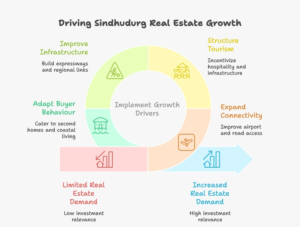
When I look at Sindhudurg real estate today, I see four forces aligning:
Connectivity
Tourism momentum
Policy support
Behavioural shifts in buyers
Each of these, independently, is important.
Together, they create direction.
Connectivity Has Quietly Redefined the Region
Real estate relevance does not begin with construction.
It begins with access.
Mopa Airport Has Expanded the Geography of Opportunity
The development of Manohar International Airport has fundamentally changed how the North Goa–Sindhudurg belt is perceived.
According to official data, Goa’s Mopa airport handled over 4.6 million passengers in FY 2024–25, reflecting a strong and growing flow of travellers.
This matters more than most people realise.
Airports do not just move people.
They expand maps.
They make nearby regions more accessible, more visible, and more investable.
Sindhudurg, by virtue of proximity, is now part of that expanded map.
Sindhudurg Airport Has Strengthened Regional Confidence
The inauguration of Sindhudurg Airport under the UDAN scheme was not just symbolic.
It reduced travel time from Mumbai to under two hours by air—something that was once an all-day journey.
This is not a small shift.
Time compression changes behaviour.
It turns distant regions into viable weekend destinations.
It transforms occasional visits into repeat movement.
Road Infrastructure Is Becoming a Silent Enabler
The importance of NH-66 (Mumbai–Goa Highway) cannot be overstated.
Road connectivity is often underestimated in premium real estate conversations, but I have always seen it as a foundational layer.
When highways improve:
Travel becomes predictable
Logistics becomes easier
Weekend movement becomes practical
This is where Sindhudurg real estate begins to transition from remote to reachable.
The Proposed Nagpur–Goa Expressway Reflects Future Intent
The Shaktipeeth Expressway, connecting Nagpur to Goa, is still evolving.
But its scale—over 800 km—and its inclusion of districts like Sindhudurg signal something important.
It shows intent.
Infrastructure projects are not only about completion.
They are about attention.
And attention, over time, translates into capital.
Tourism Is No Longer Informal. It Is Being Structured
One of the most misunderstood aspects of Sindhudurg real estate is its relationship with tourism.
For years, tourism here was organic.
Now, it is becoming strategic.
Maharashtra Tourism Policy 2024 Is a Turning Point
The Maharashtra Tourism Policy 2024 introduces:
Capital subsidies
SGST reimbursements
Interest subsidies
Homestay incentives
Single-window clearance systems
This is not just policy language.
This is ecosystem building.
Why Policy Matters for Real Estate
Real estate does not grow in isolation.
It grows when surrounding systems mature.
When tourism becomes structured:
Hospitality improves
Visitor confidence increases
Local economies strengthen
And when that happens, land stops being passive.
It becomes active.
That is when Sindhudurg real estate begins to move from possibility to participation.
Coastal Activation Through Tourism Policies
Policies such as the Beach Shack framework are enabling regulated coastal activity in areas like Tarkarli and Kunkeshwar.
This is important.
Because it signals that the state is not just promoting tourism—it is organising it.
Organised tourism creates repeatability.
And repeatability creates demand.
The New Buyer Is Not Thinking Like the Old Buyer
For a long time, Indian real estate followed a simple pattern:
City-centric
Density-driven
Transaction-focused
That pattern is changing.
Today’s premium buyer is asking different questions:
Where can I disconnect?
Where can I own land, not just space?
Where can lifestyle and value coexist?
This shift is subtle—but powerful.
And it is directly influencing Sindhudurg real estate.
The Rise of Low-Density, Experience-Led Real Estate
I have observed that more investors today are not chasing square footage.
They are seeking:
Open land
Natural surroundings
Flexible usage
Long-term holding value
This is where coastal districts like Sindhudurg become relevant.
Not because they are replacing cities.
But because they are complementing them.
Sindhudurg Real Estate Is Not a Speculative Story
It is important to say this clearly.
Not every emerging region becomes a successful real estate market.
And not every project within a region is equal.
What matters is fundamentals.
Sindhudurg’s strength lies in:
Its geography
Its coastline
It’s improving access
Its policy direction
These are structural factors—not temporary ones.
Timing Matters More Than Visibility
Most investors enter a market when it becomes visible.
Few enter when it becomes viable.
There is a difference.
Visibility brings crowds.
Viability builds value.
In my experience, the most meaningful outcomes come to those who recognise timing—not noise.
This is where Sindhudurg real estate stands today.
Not early enough to be uncertain.
Not late enough to be saturated.
But in a phase where clarity is beginning to emerge.
I See Projects Like Cida De Luxora as a Reflection—Not the Cause
Projects do not create regions.
Regions create projects.
Developments such as Cida De Luxora—with its mix of villa plots, commercial spaces, and proximity to Mopa, NH-66, and coastal zones—are emerging because the region itself is becoming more relevant.
They are not the beginning of the story.
They are a response to it.
This distinction is important.
Because it shifts the conversation from promotion to understanding.
Real Estate, When Done Right, Is About Alignment
I have always believed that strong real estate decisions are not driven by urgency.
They are driven by alignment.
When access improves
When policy strengthens
When movement increases
When behaviour shifts
That is when regions begin to matter.
That is what I see in Sindhudurg real estate today.
The Future of Coastal Real Estate in India Will Expand Beyond Goa
Goa will always remain a strong tourism and real estate destination.
But every mature market eventually expands.
It extends into surrounding regions.
It creates spillover.
This is not a theory.
It is a pattern seen across the world.
Sindhudurg is part of that natural expansion.
Not as a replacement.
But as a continuation.
What Investors Need to Understand About Sindhudurg Real Estate
This is not a market for short-term speculation.
It is a market for:
Patience
Clarity
Long-term thinking
It requires:
Understanding of land
Respect for geography
Awareness of policy
Realistic expectations
Those who approach it with discipline will understand its potential.
Those who chase quick outcomes may not.
Land Teaches You What Markets Cannot
Markets react.
Land responds.
This is something I have learned not from theory, but from experience.
Land does not reward speed.
It rewards understanding.
It does not follow sentiment.
It follows cycles.
That is why regions like Sindhudurg require a different mindset.
Sindhudurg Real Estate Is Entering a More Serious Phase
I do not see Sindhudurg as a trend.
I see it as a transition.
A district moving from appreciation to relevance.
From isolation to accessibility.
From potential to participation.
This transition is still unfolding.
And that is precisely why it matters.
Because by the time a market becomes obvious,
its most meaningful opportunities are often behind it.
Sindhudurg is not there yet.
But it is no longer where it once was.
And that, in real estate, is where attention should begin.
FAQs
1. Why is Sindhudurg real estate becoming increasingly relevant for investors?
The growing relevance of Sindhudurg real estate is not driven by hype, but by the alignment of multiple structural factors. Improved connectivity through airports like Manohar International Airport and Sindhudurg Airport has significantly reduced travel friction. Additionally, policy frameworks such as the Maharashtra Tourism Policy 2024 are strengthening tourism ecosystems and investor confidence.
When infrastructure, policy, and buyer behaviour begin aligning, regions naturally move from being overlooked to becoming investable. Sindhudurg is currently in that transition phase.
2. How does connectivity influence the growth of Sindhudurg real estate?
Connectivity is one of the strongest drivers of real estate transformation. In the case of Sindhudurg real estate, improved access through highways like NH-66 and proximity to airports have made the region more reachable and practical for both short-term visits and long-term ownership.
Better connectivity leads to:
Reduced travel time
Higher tourism footfall
Increased investor interest
Improved logistics and development feasibility
This is why regions connected to strong transport networks tend to see gradual and sustained real estate growth.
3. Is Sindhudurg real estate suitable for long-term investment?
Yes, Sindhudurg real estate is better suited for long-term investors rather than short-term speculators. The region’s growth is driven by structural improvements such as infrastructure development, tourism policy, and changing lifestyle preferences.
Long-term investors benefit from:
Land appreciation over time
Increasing tourism-driven demand
Low-density development advantages
Potential for lifestyle and legacy ownership
However, like any real estate investment, it requires careful due diligence and realistic expectations.
4. What role does tourism play in Sindhudurg real estate growth?
Tourism is central to the evolution of Sindhudurg real estate. The district’s coastal appeal, combined with structured tourism policies, is gradually increasing visitor inflow and economic activity.
Government initiatives such as the Beach Shack Policy and tourism incentives are helping formalise and organise the tourism ecosystem.
As tourism strengthens, it creates demand for:
Hospitality developments
Second homes
Rental and vacation properties
Local commercial ecosystems
This directly influences real estate value and usability.
5. How is Sindhudurg different from other coastal real estate markets like Goa?
While Goa is a mature and established market, Sindhudurg real estate represents an emerging extension of that coastal belt.
Key differences include:
Lower saturation levels
Greater land availability
Early-stage pricing relative to Goa
Less density and more natural surroundings
Sindhudurg benefits from proximity to Goa while maintaining its own identity, making it attractive for investors seeking long-term growth rather than already-priced-in markets.
6. What kind of buyers are exploring Sindhudurg real estate today?
The profile of buyers in Sindhudurg real estate is evolving.
It increasingly includes:
HNI investors looking for diversification
Urban professionals seeking second homes
Entrepreneurs exploring hospitality opportunities
Eco-conscious individuals interested in nature-led living
These buyers are not just looking for financial returns—they are looking for a combination of lifestyle, ownership, and long-term value.
7. Are there risks involved in investing in Sindhudurg real estate?
Like any real estate market, Sindhudurg real estate carries certain risks that must be understood.
These include:
Project-specific risks
Legal and title verification challenges
Infrastructure execution timelines
Market absorption rates
Investors should focus on:
Clear land titles
Regulatory compliance
Developer credibility
Location fundamentals
Risk is not eliminated—but it can be managed through informed decision-making.
8. How do government policies impact Sindhudurg real estate?
Government policies play a significant role in shaping the future of Sindhudurg real estate.
Policies like the Maharashtra Tourism Policy 2024 provide incentives that encourage tourism-related investments, infrastructure development, and ease of doing business.
These policies contribute to:
Improved investor confidence
Structured tourism growth
Better infrastructure support
Enhanced economic activity
Over time, policy-backed regions tend to show more stable and sustained growth.
9. What types of developments are emerging in Sindhudurg real estate?
The development landscape of Sindhudurg real estate is gradually diversifying.
It includes:
Villa plotting projects
Second-home developments
Boutique hospitality projects
Mixed-use developments
Projects like Cida De Luxora reflect this shift by combining residential plots with commercial and lifestyle components, aligned with the region’s growing relevance.
10. Is Sindhudurg real estate driven by speculation or fundamentals?
At this stage, Sindhudurg real estate is more fundamentally driven than speculative.
Its growth is supported by:
Infrastructure development
Tourism expansion
Policy frameworks
Geographic advantages
However, speculation can enter any emerging market.
That is why it is important to differentiate between:
Region-level potential
Project-level execution
Understanding this distinction is key to making informed investment decisions.
