

Carbon Credit Investment India is quietly shaping a ₹50,000 crore opportunity — and billionaires have already started positioning for it.
Bill Gates owns 2,69,000 acres of American farmland.
Jeff Bezos just added 4,20,000 acres in Texas.
And Indian billionaires? They’re quietly sweeping up agricultural land across Rajasthan and Maharashtra — often paying prices that make zero sense.
Unless you understand what’s coming in April 2026.
They’re not buying land for wheat or sugarcane. They’re buying carbon factories.
Because the next big wealth wave isn’t tech, it’s carbon credit investment in India — a ₹50,000 crore opportunity about to explode when the government’s Carbon Credit Trading Scheme (CCTS) goes live.
In simple terms, companies will pay for every extra ton of carbon they emit.
Land that captures carbon becomes income-generating.
And those who control it — the billionaires of today and tomorrow — are positioning now.
Here’s what took me six months, 47 land deals, and 142 hours of research to figure out.
CARBON CREDITS IN 60 SECONDS
Government tells Tata Steel: “You can only emit 1 million tons of CO₂.”
Tata emits 1.2 million tons.
Now what?
Option 1: Upgrade technology (expensive, ₹500 crore+)
Option 2: Buy carbon credits (cheaper, ₹24-72 crore)
1 carbon credit = permission to emit 1 ton of CO₂
Who sells credits? Anyone removing carbon from the atmosphere:
- Farmers planting trees
- Landowners doing regenerative agriculture
- Anyone creating forests
This is Carbon Credit Investment India: You invest in land that absorbs carbon. Get certified credits. Sell to polluting companies.
Simple.
WHY BILLIONAIRES ARE BUYING LAND (THE MATH NOBODY TOLD YOU)
Here’s what clicked for me:
Bill Gates didn’t buy 2,69,000 acres to grow wheat.
He purchased a carbon factory.
The math:
1 acre of forest = 0.5-2 tons CO₂ absorbed/year
1 carbon credit = ₹2,000-₹6,000 (certified)
1 acre = ₹1,000-₹12,000 annual carbon income

Gates' 2,69,000 acres = ₹26-322 crore/year
From. Just. Trees.
Not selling crops. Selling breathable air.
INDIA’S ₹50,000 CRORE MOMENT: APRIL 2026
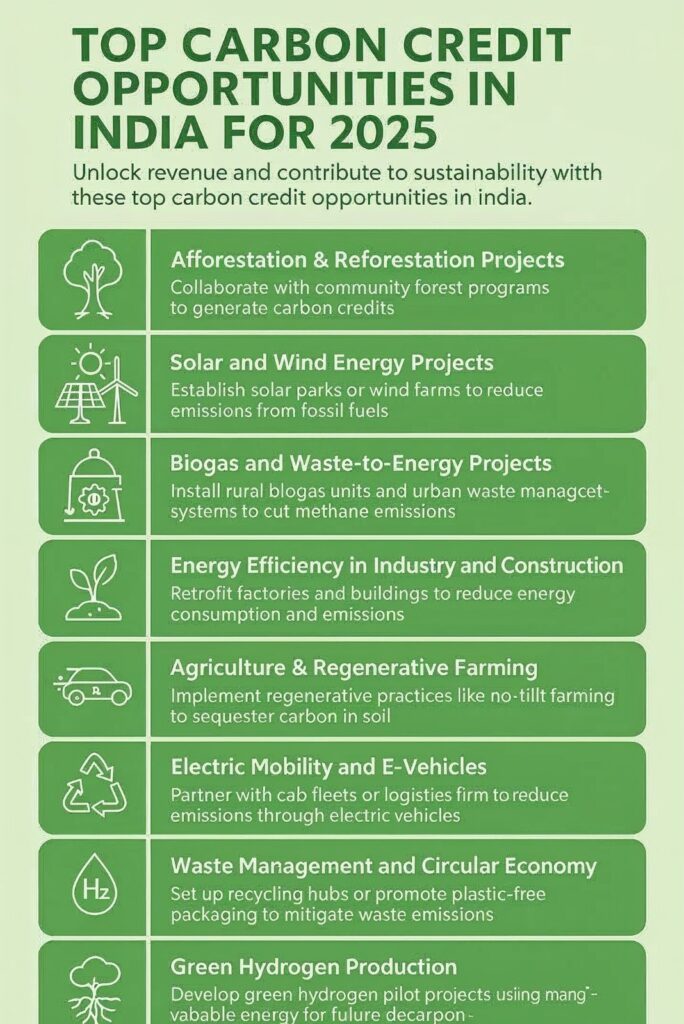
India’s Carbon Credit Trading Scheme (CCTS) launches in April 2026.
What happens:
9 major sectors MUST buy carbon credits:
- Power generation
- Steel
- Cement
- Aviation
- Petrochemicals
- Textiles
- Fertilisers
- Chemicals
- Railways
If they don’t offset emissions? ₹10,000 penalty per ton.
The Supply Crisis
Demand Year 1: 40-80 million carbon credits
Current supply: Maybe 5-10 million
Gap: 30-75 million credits
When demand is 8x supply, prices explode.
Early certified projects will print money.
THE LAND PATTERN I’M SEEING
I started tracking land deals. Here’s the pattern:
Rajasthan (Jaisalmer-Barmer):
- 500-2,000-acre acquisitions
- Buyers: Corporate entities, family offices
- Official story: “Solar farms”
- Real play: Solar + carbon credits = double revenue
Maharashtra (Vidarbha):
- Agricultural land at ₹8-15 lakh/acre (40% premium)
- Agroforestry + carbon sequestration projects
- 10-15 year hold strategy
Karnataka (North Karnataka):
- Landbanking near infrastructure
- Mixed-use with carbon certification planned
They’re not speculating. They’re building carbon generation capacity before prices reflect it.
HOW THIS HITS LUXURY REAL ESTATE
The ₹10-20 crore property market is about to change.
Today’s luxury: Pool, gym, smart home, sustainability features
2027 luxury: Carbon-positive certification
What “carbon-positive” means:
A property that absorbs more carbon than it emits.
Example: ₹12 crore Alibaug farmhouse
Traditional setup:
- Annual maintenance: ₹8 lakh
- Net cost: ₹8 lakh/year
Carbon-positive setup (+₹20 lakh investment):
- 200 trees: Carbon credits ₹2-4 lakh/year
- Solar excess: ₹3 lakh/year
- Water credits: ₹1 lakh/year
- Revenue: ₹6-8 lakh/year
Your luxury property pays for itself.
Plus 15-25% appreciation premium over non-certified properties.
Wealthy buyers want:
- Health (air quality)
- Legacy (environmental impact)
- Returns (revenue-generating green assets)
Carbon credit investment India properties deliver all three.
CARBON TAX IS COMING (₹5,000-₹10,000 PER TON)
The EU already charges a carbon tax on imports.
Indian steel exported to the EU? Faces ₹4,000-₹8,000/ton carbon tax.
India’s choice:
A) Let Europe collect tax from Indian exporters (bad)
B) Implement domestic carbon tax, keep revenue (bright)
Policy signals suggest India’s carbon tax will be in place by 2027-28.
When carbon has a price, carbon sequestration has value.
Example with ₹5,000/ton carbon tax:
1 acre forest = 1.5 tons CO₂/year
Value = ₹7,500/acre/year in carbon offset

Barren land: ₹5 lakh/acre
Same land (carbon potential): ₹15-20 lakh/acre
Carbon tax rewards carbon-positive real estate.
YOUR GAME PLAN (₹10 LAKH TO ₹10 CRORE)
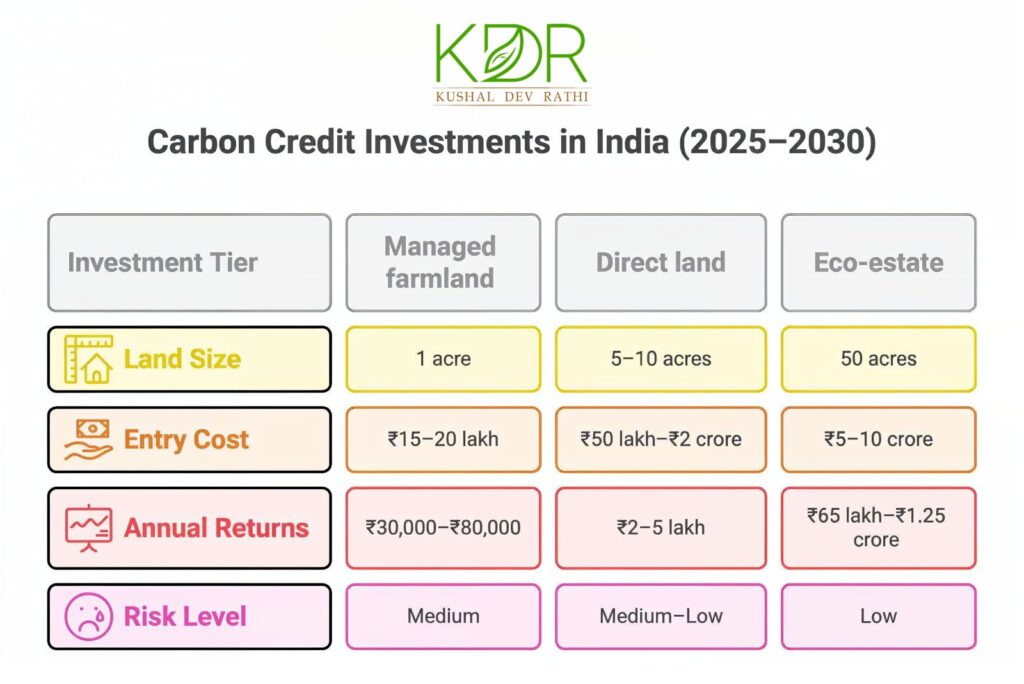
₹10-25 LAKH: Managed Farmland
Can’t buy 50 acres? Join collective projects.
Structure:
- 100 acres → 1-acre plots
- Cost: ₹15-20 lakh/plot
- Professional carbon certification
- Your carbon share: ₹30,000-₹80,000/year
- 10-year projection: 2-3x
Where: Managed farm communities (Noida, Maharashtra-Karnataka belt)
Risk: Medium (depends on management, certification)
₹50 LAKH – ₹2 CRORE: Direct Land
Buy your own carbon-generating land.
Target zones:
- Rajasthan (Alwar-Sariska): ₹25-40 lakh/acre, near Delhi
- Uttarakhand foothills: ₹30-60 lakh/acre, tourism + carbon
- Goa interior: ₹40-80 lakh/acre, plantation + credits
What to buy:
- 5-10 acres minimum
- Existing trees = bonus
- Water-positive location
- Road connectivity
Timeline:
- Months 1-3: Due diligence + purchase
- Months 4-6: Plant 50-100 trees/acre (₹2-3 lakh)
- Months 12-18: Carbon certification (₹3-5 lakh)
- Year 2+: Sell carbon credits
Returns:
- Carbon: ₹2-5 lakh/year
- Appreciation: 12-18% CAGR
- 10-year: 3-4x
₹5-10 CRORE: Eco-Estate
Build a carbon-generating estate.
Model: 50-acre property
Setup (₹8 crore example):
- Land: ₹2 crore
- Plantation: ₹1 crore
- Solar/water infrastructure: ₹1.5 crore
- Guest cottages (eco-tourism): ₹2 crore
- Certification: ₹1.5 crore
Returns (Year 5+):
- Carbon credits: ₹20-40 lakh/year
- Eco-tourism: ₹30-60 lakh/year
- Agriculture: ₹15-25 lakh/year
- Total: ₹65 lakh – ₹1.25 crore/year
ROI: 8-15% annually + appreciation
Plus: Generational wealth with environmental legacy.
Types of Carbon Credit Investments in India (2025–2030)
Not every investor needs 100 acres or ₹10 crore.
Here’s how different capital levels fit into India’s carbon credit boom:
THE CRITICAL TIMELINE
Now – March 2026: Land acquisition
→ Prices haven’t priced in carbon value yet
April 2026: CCTS launches
→ First carbon credit sales begin
2027-2030: Scale phase
→ Expand, refinance, optimise
The window is 4-5 months.
MY TAKE (THE UNCOMFORTABLE TRUTH)
I’m conflicted.
One part of me celebrates that carbon credit investment in India finally values environmental assets financially.
But another part worries: Are we creating “carbon barons” while small farmers lose out?
Here’s what I believe:
₹50,000 crore is flowing into land-based carbon projects.
You can:
A) Ignore it → Watch prices rise as billionaires buy up carbon land
B) Participate → Invest early, capture value
C) Participate thoughtfully → Support projects that help communities
I’m choosing C.
This isn’t about flipping land.
It’s about recognising that the world assigns monetary value to breathable air—and positioning your capital accordingly.
WHAT TO DO THIS WEEK
Educate Yourself:
- Read India’s CCTS notification
- Track global carbon prices: ICE futures
- Check the CEEW carbon market analysis
If You’re Serious:
By December 2025: Shortlist properties
By March 2026: Acquire land
By June 2026: Start certification
By Dec 2026: First carbon credits issued
The window closes in 5 months.
FAQs
1. What is carbon credit investment in India?
Answer:
Carbon credit investment in India means owning or funding land that absorbs carbon from the atmosphere through trees, forests, or regenerative farming. Each ton of CO₂ captured earns a carbon credit, which can be sold to companies that need to offset their emissions. From April 2026, India’s Carbon Credit Trading Scheme (CCTS) will formalise this into a regulated market worth ₹50,000 crore.
2. How can landowners in India earn carbon credits?
Answer:
Landowners can earn carbon credits by planting trees, restoring degraded land, or adopting sustainable farming that increases carbon sequestration. Once certified under global or Indian carbon standards, they receive tradable credits — typically 0.5 to 2 tons of CO₂ per acre per year — which can be sold to polluting industries or exporters facing carbon tax penalties.
3. When will India’s carbon credit market start?
Answer:
India’s official Carbon Credit Trading Scheme (CCTS) launches in April 2026. Nine key industries — including power, steel, cement, aviation, and fertilisers — will be required to buy credits to offset emissions. This policy is expected to trigger massive demand for certified carbon projects and raise the value of green land investments.
4. Is carbon credit investment profitable or risky?
Answer:
Like any emerging asset, carbon credit investment carries both opportunity and risk. Early investors benefit from high appreciation potential as demand outpaces supply, but should factor in certification costs, regulatory shifts, and liquidity challenges. The key is to invest in well-managed, verified projects rather than speculative land deals.
RELATED READING
- AQI Investment Framework: Why Breathable Properties Outperform
- Luxury Real Estate India: ₹10-20 Crore Investment Guide
- Sustainable Real Estate Investment India
FINAL THOUGHT
We’re standing at the edge of the most considerable revaluation of land since the Green Revolution — only this time, it’s not about how much food land can produce,
But how much carbon can it capture?
In a few months, India will start paying for clean air — literally.
When carbon gets priced, land gets repriced.
And those who understood this early will own not just acres, but the atmosphere’s value itself.
You can ignore it and watch billionaires buy up the future,
or you can act — intelligently, ethically, and early.
Because one day, your grandchildren will breathe the air we invested in. And they’ll ask what role you played when the world first started putting a price on pollution.
Land is no longer just an asset. It’s the planet’s balance sheet.
Own your part of it — while it still costs less than clean air.
DISCLAIMER
This is educational research and opinion, not financial advice. Carbon credit investment in India involves risks: regulatory changes, certification delays, price volatility, illiquidity, and policy shifts. All projections are estimates, not guarantees. Consult qualified advisors before any investment decision.
Research: July-October 2025, 47 land deals tracked, 63 sources analysed, 142 hours invested.
By Kushal Dev Rathi – Independent land investment researcher, 22 years studying environmental assets.
