
2006 to 2026: My 20-Year Journey Across Real Estate, Land & Sustainable Living in India
I Didn’t Start With a Vision. I Started With a Question.
In 2006, I wasn’t sitting in a boardroom sketching out a 20-year real estate empire on a whiteboard.
I was simply asking a question that most people never bother to ask.
Why does land make people feel something?
Not just own something. Feel something.
You’ll notice it the moment you stand on a piece of open land — city skyline behind you, silence in front. Something stirs. Something primitive. Like your soul is telling your brain, “this is what we’re actually built for.”
That quiet, stubborn curiosity became the foundation of everything I’ve built over the last two decades.
No MBA thesis. No PowerPoint vision document. Just observation — the most underrated real estate tool that nobody puts on their resume.
The Market Was Sprinting. I Was Walking. (And That Was the Point.)
By 2006, Indian real estate was already in a full gallop.
Cities were swallowing villages. Flyovers were cutting through farmlands. Every uncle at every family gathering had suddenly become a “property expert.”
While everyone was sprinting toward deals, I was walking — slowly, deliberately — trying to understand the why before the what.
Why do certain locations grow faster? Why does the same square footage feel like a goldmine in one city and a graveyard in another? Why do people buy land they’ve never visited, in cities they’ve never lived in beacuse its sustainable living in India?
The answer, I slowly realised, was never purely financial.
Land in India is emotional collateral.
People don’t just park money in it. They park hope in it. Dreams of a farmhouse. A weekend escape. A legacy to hand down. Real estate in India has always been as much about identity as it is about investment returns.
That insight — that emotional undercurrent beneath every transaction — became my compass for the next 20 years.
2009: When Observation Became Action
By 2009, I had enough bruises from watching to finally want some from doing.
This is when things got serious. This is when ventures like Nine Divine Group and TOTL Realty stopped being ideas in a notebook and started becoming platforms in the real world.
But here’s what I want to say about this phase that most people in real estate won’t tell you:
Your first projects don’t teach you about real estate. They teach you about people.
I learned that a buyer in Noida thinks completely differently from a buyer in Goa. One is calculating ROI on a napkin. The other is imagining Sunday mornings with a coffee and a sea view. Same asset class. Completely different universe.
And if you don’t understand that difference, you’ll build the right product for the wrong person — every single time.
Every Location Was a Classroom. Here’s What Each One Taught Me.
Delhi NCR & Noida — The Market That Never Sleeps (Or Slows Down)
Delhi NCR doesn’t walk. It sprints, stumbles, and somehow keeps sprinting.
Working in Noida with projects like Sportsland Activity Farms gave me a masterclass in demand psychology. Urban buyers here wanted the best of both worlds — city connectivity with a breath of open space. They wanted a farmhouse that was 45 minutes from Connaught Place, not 4 hours.
The lesson? Accessibility is the unspoken price tag. Every kilometre away from the city is a percentage drop in demand. Master the distance-desire equation, and you understand the NCR market.
Goa — Where Investment Wears Flip Flops
Goa changed me.
Not metaphorically. Actually changed how I think about real estate.
When I started working on Cida De Luxora and Sea Horse in the Goa belt, I realised that the buyer here isn’t really buying land or a villa.
They’re buying a version of themselves they can only afford to be on weekends.
The Goa buyer wants rental income, yes. Appreciation, absolutely. But underneath all of that? They want to feel like they made it. The beachside second home is as much a lifestyle statement as it is an asset.
TOTL Realty became instrumental in structuring off-market, curated investment opportunities in coastal markets — because this kind of buyer doesn’t want to browse listings. They want to be discovered.
→ Explore structured real estate investments at totlrealty
Sariska — Where Land Teaches You Patience
If Delhi NCR were caffeine, Sariska would be meditation.
Roaring Woods in Sariska was the project that broke my addiction to speed.
In a market obsessed with quick flips and fast appreciation, here was a location that simply refused to be hurried. The Aravalli landscape doesn’t care about your quarterly targets. The tigers in the reserve don’t check market indices.
And paradoxically, that was its greatest selling point.
The buyers who came to Sariska weren’t chasing returns. They were escaping something. And when you understand that your customer is escaping the same rat race that everyone else is in, you start building very differently.
That project taught me the most important rule in premium real estate: sustainable living in India
Not every piece of land needs to be developed fast. Some need to be developed correctly.
Kufri & Shimla — The Art of Building Where the Earth Runs Out
Hill stations are humbling.
When land is literally limited by mountain geography, every decision becomes deliberate. You cannot bulldoze your way to scale. You cannot copy-paste a township model from the plains.
Working in Kufri and Shimla refined my understanding of premium positioning — and why exclusivity is not a marketing gimmick but a geographical reality in certain locations.
Scarcity, when it’s honest, doesn’t need to be manufactured.
Rajasthan — Heritage Is Not the Past. It’s the Product
Through Nine Divine Group, we ventured into heritage and restoration-linked developments in Rajasthan.
This completely rewired my understanding of value.
In most markets, developers look at old structures as liabilities — something to demolish and rebuild. In Rajasthan, I learned to see them as the actual asset. The stones have stories. The architecture has language. The buyer who comes here isn’t looking for a new build — they’re looking for continuity with something ancient and sustainable living in India.
Sometimes real estate isn’t about building something new. It’s about honouring what already exists.
The Pattern Nobody Told Me About (But 20 Years Showed Me Clearly)
Somewhere around the fifteenth year of doing this, a pattern emerged so clearly that I’m almost embarrassed I didn’t see it sooner.
People were never really buying land.
They were buying an escape from a life that had become too fast, too crowded, too loud, and too screen-heavy.
Is the couple buying a farmhouse in Noida? Escaping weekend monotony.
The NRI investing in a Goa villa? Escaping the guilt of disconnection from roots.
The executive booking a Sariska plot? Escaping the existential dread of never having chosen himself.
Every transaction, when you strip away the financials, is a person voting with their wallet for a different version of their life.
This is precisely why sustainable living in India is not a buzzword coined by environmentalists. It is a market signal — loud, consistent, and growing louder every year.
India’s NITI Aayog has been tracking this shift
Urbanisation is changing not just where people live — but how they want to live.
The buyer of 2026 doesn’t just want appreciation. They want usability, air, space, and meaning and sustainable living in India.
The Pivot I Never Planned But Always Needed
When I started in 2006, the formula was simple: Find land. Develop it. Sell it.
By 2018, that formula felt incomplete.
The questions I was asking myself changed:
- Will people actually use this, or just own it?
- Does this location have a 20-year story, not just a 3-year exit?
- Am I solving a lifestyle problem, or just selling square footage?
This is when the journey pivoted from building projects to building direction.
Sustainable living in India became less of a concept I read about and more of a lens through which every decision passed.
Not because it was fashionable. But because the market — and honestly, something deeper in my own understanding — demanded it.
Agrivo: What 20 Years of Listening Builds
After two decades of watching what people want versus what they say they want, the answer has crystallised into something beautifully simple.
People want to touch the earth again.
Not necessarily become farmers. Not to renounce cities. But reconnect with something slower, quieter, and more real than a 14th-floor flat in a gated complex.
Agrivo Farms is my response to that craving.
It’s not a project. It’s an answer.
An answer to the question millions of urban Indians are quietly asking: “Is this really all there is?”
Agrivo is about land access without the overwhelm. Simple living without the sacrifice. A connection to nature that doesn’t require you to quit your job and wear khadi full-time.
It is sustainable living in India made practical — not preachy.
What 20 Years Has Actually Taught Me
I’ve watched markets boom and crash. I’ve seen locations nobody believed in become goldmines. I’ve seen “can’t miss” projects miss spectacularly.
Here’s what I know, honestly, after 20 years:
- Location is everything — but timing is its partner in crime.
The right location at the wrong time is just an expensive waiting game sustainable living in India. - The buyer’s emotion is the real foundation of every project.
Engineer the feeling, and the financials follow. - Sustainable living in India is not the future. It’s already the present.
The demand is here. The awareness is here. The question is whether developers will meet it honestly or just slap an “eco-friendly” sticker on the same old product and sustainable living in India. - Patience is the single most undervalued skill in real estate.
The developers who win in the long term are those who can sit with a good piece of land and not ruin it with urgency. - Every project should answer one question: Will people actually live here?
If the answer is no — not as a lifestyle, not even occasionally — you’re building inventory, not legacy and sustainable living in India.
2026 and Beyond: Where This Journey Goes Next
The market today looks nothing like 2006.
Buyers are sharper. Information is democratised. The era of selling a dream on a brochure alone is mercifully over.
What’s emerging is a more honest, more mature real estate conversation in India — one where sustainable living, second homes, farm plots, and lifestyle assets sit at the centre, not the fringe.
India’s Smart Cities Mission is accelerating this shift at the infrastructure level. But the real engine is simpler: people are tired, and land — open, honest, unhurried land — is looking very appealing.
The journey from 2006 to 2026 has been, at its core, a 20-year education in one subject:
What do people actually want from the land they own?
I’m still learning. But the next chapter — with Agrivo, with TOTL Realty, with everything still being shaped — is the most intentional one yet.
Because now I’m not just building projects.
I’m building answers.
Real estate, at its core, is not about property.
It’s about possibility.
Every plot of land is an unanswered question: What could this become? What could life feel like here?
For 20 years, I’ve been obsessed with that question — across Delhi NCR, Goa, Sariska, Rajasthan, Shimla, and beyond.
The obsession hasn’t faded.
It’s just become more refined.
And if you’re reading this as someone who’s also looking at land — not just as an asset, but as a way to reshape how you live — then you already understand something that most people take 20 years to figure out.
You’re not late. You’re exactly on time.
FAQ
1. What does sustainable living in India actually mean in 2026?
Sustainable living in India in 2026 has moved well beyond solar panels and green rooftops. It means choosing how you live — not just where. It means open spaces over cramped flats, long-term usability over short-term flips, and developments that respect their surroundings rather than bulldoze them. After 20 years in real estate, I’ve watched this shift happen not in boardrooms but in buyer conversations.
2. Why are second homes in India seeing such strong demand right now?
Post-pandemic India changed something permanent in the urban psyche. People realised that their 2BHK in the city isn’t a home — it’s a workstation. The demand for second homes in India, whether in Goa, Sariska, or the hills, reflects a fundamental lifestyle recalibration. Buyers want a place that belongs to them, not to their commute.
3. How has Indian real estate investment changed over the last 20 years?
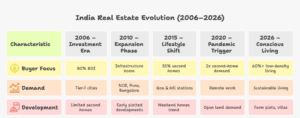
In 2006, buyers asked: “What will I get when I sell this?” In 2026, they ask: “What will I feel when I live here?” That shift — from pure ROI to lifestyle ROI — defines the last two decades of Indian real estate investment. Locations, usability, and long-term sustainability now carry as much weight as square footage and price per sq ft.
4. Which are the best locations in India for second homes and sustainable living?
Based on my 20 years across markets, locations like Goa, Sariska, Kufri, parts of Noida and Rajasthan offer the ideal combination of accessibility, natural surroundings, and appreciating land value. These are not just retirement destinations — they are lifestyle investments that work while you’re still enjoying your prime years.
5. Is farm-based living a viable investment option in India?
Absolutely — and it’s no longer a niche idea. Concepts like Agrivo Farms are built precisely for the urban Indian who wants a connection to land without farming expertise. Farm-based investments in India offer lower density, open environments, and long-term value — alongside the psychological benefit of actually having somewhere to go that isn’t a mall or a highway.
6. What makes plotted developments better than apartments for sustainable living?
Plots give you something apartments fundamentally cannot: choice. You decide the built area, the design, the garden, and the pace. In a country increasingly choking on high-density construction, a plot of land is not just real estate — it’s personal sovereignty. That’s why plotted developments aligned with sustainable living principles are outperforming traditional apartment inventory in several emerging markets.
7. How do I start evaluating real estate for lifestyle and not just returns?
Start by asking one question about any property: “Will I actually use this?” Not rent it, not flip it — actually use it. If the honest answer is no, you’re buying anxiety, not an asset. Real estate that aligns with sustainable living should serve your life, not just your portfolio statement.
