
How Extreme Summer Heat in India 2026 Is Reshaping Urban Living
Extreme Summer Heat in India 2026 is no longer just a seasonal concern — it is becoming one of the biggest environmental and human crises of our time.As someone who strongly believes in sustainability, conscious development, and eco-friendly living, I genuinely feel India’s rising temperatures are warning us about climate change, urban heat islands, pollution, and environmental imbalance.There was a time when summer in India meant longer evenings, mango trees, sudden rain showers, and warm sunlight that still allowed people to breathe comfortably. Today, when I step outside in many Indian cities, the experience feels very different. The air feels heavier. The roads radiate heat. Concrete walls trap warmth long after sunset. Even nights no longer provide relief.
As someone who deeply believes in sustainability, conscious development, and the healing power of nature, I genuinely feel that India’s extreme summer heat in 2026 is not just another seasonal change. It is a visible environmental warning.
Across India, temperatures in May 2026 have already crossed 45°C in multiple regions. Cities in Delhi, Rajasthan, Haryana, Uttar Pradesh, and Punjab are witnessing dangerous heatwave conditions that are affecting public health, productivity, ecosystems, and urban living itself. According to the India Meteorological Department (IMD), several northern states have been under severe heatwave alerts as temperatures continue to rise rapidly.
But what concerns me even more than the numbers is the reality behind them.
Extreme Summer Heat in India 2026 is affecting cities, public health, water resources, and environmental sustainability across the country.
This Extreme Summer Heat in India 2026 is not appearing in isolation. It is connected to climate change, disappearing green cover, rising pollution, rapid urbanization, unsustainable infrastructure, and the gradual replacement of natural ecosystems with concrete-heavy expansion. In many ways, our cities are becoming hotter because we are moving further away from nature.
Today, climate change is no longer a future prediction. We are already living inside its consequences.
And unless we rethink how we build, consume, develop, and coexist with the environment, the future could become even more difficult for generations to come.
India’s Rising Temperatures in 2026 Are Breaking More Than Just Records
Extreme Summer Heat in India 2026 is becoming one of the strongest reminders that environmental imbalance has real and immediate consequences.
Recent reports show that multiple Indian regions have already crossed 45°C during May 2026. Cities and districts across Haryana, Rajasthan, Delhi, Punjab, and Uttar Pradesh have witnessed severe heatwave conditions. According to weather observations reported through the India Meteorological Department (IMD), parts of North India have recorded temperatures nearing 46–47°C.
What makes this situation even more dangerous is the “feels like” temperature in urban regions.
Concrete roads, glass buildings, dense traffic, pollution, and reduced airflow are making cities feel significantly hotter than the actual recorded temperature. Many people are now experiencing physical exhaustion within minutes of outdoor exposure. Extreme Summer Heat in India 2026 Heat-related illnesses are increasing, while electricity and water demand are rising sharply .
The growing impact of Extreme Summer Heat in India 2026 clearly shows how climate change and unsustainable urban development are interconnected.
As I observe these changes, I often think about how quickly extreme heat is becoming normalized in our daily lives. We have started accepting unbearable temperatures as “usual summer weather,” even though, scientifically and environmentally, these conditions are far from normal.
The World Health Organization has repeatedly warned that climate-related heat exposure is becoming one of the biggest environmental health risks globally. According to the WHO Climate Change and Health Reports, heatwaves are becoming more frequent, more intense, and more prolonged because of global warming.
Sustainable living and green infrastructure may become the strongest long-term solutions against Extreme Summer Heat in India 2026.
This is no longer just about discomfort.
This is about:
- Public health
- Climate resilience
- Urban sustainability
- Environmental survival
- Economic productivity
- Human well-being
And India, with its massive population and rapidly urbanizing cities, is becoming one of the most climate-vulnerable regions in the world.
Climate Change Is No Longer Invisible — We Are Living Inside Its Consequences
For many years, climate change was treated like a distant global conversation. It was discussed in conferences, environmental reports, documentaries, and scientific journals. But today, climate change is no longer distant.
It is visible in our summers.
It is visible in our air quality.
It is visible in our floods, droughts, and disappearing forests.
Most importantly, it is visible in the unbearable heat that millions of people are experiencing today.
Rising pollution, disappearing trees, and concrete-heavy cities are intensifying Extreme Summer Heat in India 2026
According to the Intergovernmental Panel on Climate Change (IPCC), human-driven greenhouse gas emissions are directly increasing global temperatures and intensifying extreme weather events across the world.
Heatwaves that once occurred once in several decades are now becoming more frequent because the Earth’s atmosphere is warming continuously and you see this in Extreme Summer Heat in India 2026.
As someone who believes deeply in environmental consciousness, I feel that one of the biggest problems is that humanity often sees development and nature as separate ideas. In reality, they are interconnected.
When forests disappear, temperatures rise.
When wetlands vanish, cities flood faster.
When pollution increases, heat becomes more dangerous.
When concrete replaces green spaces, urban environments become hostile to human health.
Climate change is not happening because of one single action. It is the cumulative outcome of decades of unsustainable living, excessive emissions, ecological destruction, and infrastructure development that ignored environmental balance.
The United Nations Climate Action Platform clearly states that without immediate sustainability-focused action, global temperatures could continue rising dangerously over the coming decades.
And honestly, when I look at many modern urban environments today, I feel we are already witnessing the early consequences of that future.
How Concrete Cities Are Turning Into Urban Heat Islands
One of the most alarming environmental realities today is the Urban Heat Island Effect.
Many people wonder why cities feel significantly hotter than surrounding rural areas. The answer lies in how modern cities are being designed.
According to research highlighted by the World Health Organization Urban Environment Studies, urban areas absorb and trap heat because of:
- Asphalt roads
- Concrete infrastructure
- Glass-heavy buildings
- Reduced tree cover
- Traffic emissions
- Industrial pollution
These surfaces absorb solar radiation during the day and slowly release heat during the night, which is why many Indian cities no longer cool down properly after sunset.
I personally feel this is one of the biggest planning failures of modern urbanization.
Cities are expanding rapidly, but environmental integration is often ignored. Green spaces are shrinking while concrete surfaces continue increasing. Old neighborhoods with trees, open spaces, and natural ventilation often remain cooler compared to newly developed zones filled entirely with high-rise infrastructure.
When I think about childhood summers, I remember shaded roads, cooler evenings, and neighborhoods where trees naturally balanced temperatures. Today, in many cities, those same roads are surrounded by concrete walls and heat-reflecting surfaces.
Nature was silently regulating temperatures for us.
We simply failed to value it.
Urban heat islands also worsen:
- Energy consumption
- Air pollution
- Heat-related illnesses
- Water stress
- Mental fatigue
This is why sustainable urban development is no longer optional. Cities of the future cannot survive on concrete alone.
The Silent Environmental Cost of Deforestation and Unsustainable Development
Every tree removed for short-term expansion quietly increases the temperature of our future.
I strongly believe this is one of the most painful truths of modern development.
Across India, rapid urbanization has transformed natural landscapes into commercial zones, highways, infrastructure corridors, and dense residential clusters. While development is important, the environmental cost of careless expansion is becoming impossible to ignore.
According to the Ministry of Environment, Forest and Climate Change India, protecting ecological systems and maintaining green cover are essential for long-term climate resilience Extreme Summer Heat in India 2026.
Trees naturally:
- Reduce surrounding temperatures
- Improve air quality
- Retain groundwater
- Absorb carbon dioxide
- Protect biodiversity
- Improve urban livability
Yet many cities continue losing green spaces at alarming rates.
The environmental imbalance created by deforestation directly contributes to:
- Hotter urban climates
- Increased dust pollution
- Poor rainfall patterns
- Reduced ecological stability
I often feel that modern infrastructure planning has become too focused on short-term visual development rather than long-term environmental sustainability.
True progress should not destroy nature.
True progress should coexist with it.
Heatwaves Are Becoming a Public Health Emergency
Extreme summer heat is no longer just an environmental issue. It is becoming a serious public health emergency.
The WHO Heat and Health Guidance warns that rising temperatures significantly increase risks of:
- Heatstroke
- Severe dehydration
- Cardiovascular stress
- Respiratory illnesses
- Kidney complications
- Mental exhaustion
The most vulnerable populations include:
- Outdoor workers
- Elderly individuals
- Children
- Labor communities
- Low-income urban populations
Every summer, millions of people across India continue working outdoors despite dangerous heat exposure. Construction workers, delivery workers, street vendors, traffic personnel, and laborers face some of the harshest climate conditions daily.
Whenever I witness people working for hours under intense sunlight surrounded by concrete and pollution, I feel that climate discussions must become more human-centered.
Because behind every climate statistic is a real person struggling to survive rising temperatures.
Pollution also worsens heat-related risks significantly. Poor air quality combined with high temperatures increases respiratory stress and environmental health vulnerabilities.
Climate change is not affecting everyone equally.
The most vulnerable communities often suffer the most.
Why Sustainable Living Is Becoming Essential — Not Optional
For years, sustainability was often treated as a lifestyle trend. Today, I believe sustainable living has become a necessity for survival itself.
The environmental challenges we are witnessing today are deeply connected to how we consume resources, design cities, build homes, travel, and interact with nature.
Sustainable living is not about perfection.
It is about conscious choices.
It includes:
- Reducing unnecessary consumption
- Conserving water
- Supporting renewable energy
- Planting trees
- Reducing waste
- Supporting eco-conscious development
- Respecting natural ecosystems
As climate conditions worsen, eco-friendly lifestyles will become essential for improving resilience and reducing environmental stress.
I strongly believe sustainability begins with awareness.
When people start understanding the connection between their lifestyle and environmental impact, meaningful transformation becomes possible.
Green Infrastructure Could Decide the Future of Indian Cities
One of the most powerful solutions to rising urban heat is green infrastructure.
Cities around the world are increasingly investing in:
- Urban forests
- Green roofs
- Vertical gardens
- Public parks
- Climate-responsive planning
- Biodiversity restoration
According to research from World Resources Institute (WRI), increasing urban greenery significantly reduces heat stress and improves public health outcomes.
Trees naturally cool surrounding environments through shade and evapotranspiration. Green corridors also improve airflow, reduce pollution, and create healthier urban ecosystems.
I genuinely believe future cities must integrate nature into infrastructure instead of treating greenery as decoration.
Environmental sustainability should become a core part of urban planning itself.
Because without green infrastructure, many cities may eventually become environmentally unlivable during peak summers.
Sustainable Construction Is No Longer a Luxury — It Is Climate Responsibility
As someone who strongly supports conscious development, I believe sustainable construction will play a major role in shaping climate-resilient futures.
Modern infrastructure should not fight nature.
It should work with nature.
Sustainable construction focuses on:
- Natural ventilation
- Passive cooling
- Energy efficiency
- Eco-friendly materials
- Solar integration
- Water efficiency
- Reduced carbon impact
Organizations like the Indian Green Building Council (IGBC) and Bureau of Energy Efficiency India continue promoting sustainable infrastructure practices that reduce environmental damage.
Buildings designed with climate-responsive architecture naturally remain cooler and consume less energy.
Unfortunately, many modern structures are being built with little consideration for environmental sustainability. Glass-heavy buildings and heat-absorbing materials often increase indoor cooling dependency and energy consumption.
I believe the future of development must prioritize:
- Environmental harmony
- Sustainable architecture
- Green communities
- Long-term ecological responsibility
Because the infrastructure we build today will shape environmental conditions for decades.
Water Conservation May Become India’s Biggest Climate Survival Strategy
Extreme heat and water stress are becoming deeply interconnected.
As temperatures rise, water demand increases dramatically while groundwater reserves continue declining in many regions.
According to the Ministry of Jal Shakti India, sustainable water management is essential for long-term environmental resilience.
India urgently needs:
- Rainwater harvesting
- Groundwater recharge
- Wetland restoration
- Lake conservation
- Water-sensitive urban planning
Traditional Indian water systems once worked in harmony with local ecosystems. Many ancient communities understood sustainability far better than modern cities do today.
I often feel that environmental wisdom already existed in our culture.
We simply moved away from it.
Renewable Energy and Urban Farming Can Redefine Sustainable Living
The future of sustainability will also depend heavily on renewable energy adoption and localized ecological systems.
The Ministry of New and Renewable Energy India continues promoting solar energy expansion to reduce fossil fuel dependency and carbon emissions.
Solar energy offers:
- Cleaner energy generation
- Lower emissions
- Reduced pollution
- Long-term sustainability
At the same time, urban farming and rooftop gardening are emerging as important sustainability movements.
Urban farming improves:
- Local food resilience
- Urban greenery
- Ecological awareness
- Community participation
I believe sustainability becomes most powerful when people actively reconnect with nature in their everyday lives.
The Future Will Belong to Climate-Resilient Communities
The future of development cannot rely only on economic growth.
It must also prioritize environmental resilience.
Climate-resilient communities will become increasingly important for:
- Investors
- Policymakers
- Urban planners
- HNIs
- NRIs
- Sustainability-conscious families
Nature-first communities with:
- Green infrastructure
- Sustainable construction
- Renewable energy
- Ecological planning
- Water-conscious systems
will likely become more valuable and environmentally secure over time.
I truly believe the next generation of responsible development will focus on balance rather than excess.
My Personal Reflection: Development Without Nature Is No Longer Progress
As I observe India’s rising temperatures and worsening environmental conditions, I feel one thought becoming clearer every year:
Development without nature is no longer progress.
For decades, humanity measured success through expansion, consumption, and infrastructure growth. But today, nature itself is reminding us that environmental balance cannot be ignored forever.
The question is no longer whether climate change is real.
The real question is whether we are willing to change before nature forces us to.
I genuinely believe sustainability is not about limiting progress.
It is about protecting the future.
Protecting:
- Human health
- Ecological systems
- Future generations
- Natural resources
- Environmental harmony
If we continue prioritizing short-term convenience over long-term sustainability, future summers may become even more dangerous.
But if we choose conscious development today, we still have an opportunity to create greener, healthier, and more climate-resilient communities.
FAQ
1. Why is India experiencing extreme summer heat in 2026?
India’s extreme summer heat in 2026 is primarily linked to climate change, rising greenhouse gas emissions, rapid urbanization, deforestation, and increasing concrete-based infrastructure. According to the Intergovernmental Panel on Climate Change (IPCC), global warming is intensifying heatwaves worldwide, making them more frequent, prolonged, and dangerous.
In India, multiple regions have already crossed 45°C during May 2026, with severe heatwave alerts issued by the India Meteorological Department (IMD). Rising temperatures in India are no longer isolated weather events — they are signs of long-term environmental imbalance Extreme Summer Heat in India 2026.
2. How does climate change increase heatwaves in India?
Climate change increases global temperatures by trapping heat in the Earth’s atmosphere through greenhouse gas emissions. As temperatures rise globally, heatwaves becom Extreme Summer Heat in India 2026e:
- More frequent
- More intense
- Longer-lasting
- More dangerous for human health
According to the United Nations Climate Action Platform, human activities such as fossil fuel consumption, industrial pollution, and deforestation are accelerating climate warming.
India is particularly vulnerable because of:
- Dense urban populations
- Rising pollution
- Shrinking green cover
- High dependence on climate-sensitive resources
3. What is the Urban Heat Island Effect and why are cities becoming hotter?
The Urban Heat Island Effect occurs when cities become significantly hotter than surrounding rural areas due to:
- Concrete roads
- Asphalt surfaces
- Glass buildings
- Traffic emissions
- Lack of trees and green spaces
According to the World Health Organization (WHO) Urban Environment Research, urban temperatures can become several degrees higher because concrete absorbs and stores heat throughout the day.
This is why many Indian cities now remain hot even at night. Extreme Summer Heat in India 2026
4. Why is deforestation worsening India’s heat crisis?
Trees naturally regulate temperatures by:
- Providing shade
- Releasing moisture into the atmosphere
- Absorbing carbon dioxide
- Cooling surrounding environments
However, rapid urban expansion and unsustainable development are reducing green cover across India. According to the Ministry of Environment, Forest and Climate Change India, ecological conservation is critical for long-term climate resilience Extreme Summer Heat in India 2026.
Deforestation contributes to:
- Higher urban temperatures
- Poor air quality
- Reduced biodiversity
- Increased climate vulnerability
5. How dangerous are heatwaves for human health?
Extreme heatwaves can become life-threatening, especially for:
- Elderly people
- Children
- Outdoor workers
- Individuals with respiratory or heart conditions
The WHO Heat and Health Guidance warns that rising temperatures increase risks of:
- Heatstroke
- Severe dehydration
- Kidney stress
- Cardiovascular diseases
- Mental fatigue
- Respiratory illnesses
Heatwaves combined with pollution make urban living even more dangerous Extreme Summer Heat in India 2026.
6. How can sustainable living help reduce climate change and extreme heat?
Sustainable living helps reduce environmental pressure by promoting:
- Energy efficiency
- Water conservation
- Reduced waste
- Renewable energy
- Eco-conscious consumption
- Green mobility
Small lifestyle changes collectively reduce carbon emissions and environmental degradation. According to the United Nations Sustainable Development Goals Platform, sustainable living is essential for long-term environmental stability.
Sustainability also improves climate resilience and supports healthier urban ecosystems Extreme Summer Heat in India 2026.
7. Can tree plantations really reduce urban temperatures?
Yes. Scientific studies show that trees significantly reduce surrounding temperatures through:
- Shade creation
- Moisture release
- Surface cooling
- Air purification
Research supported by organizations like the World Resources Institute (WRI) highlights that urban greenery can reduce heat stress and improve city livability Extreme Summer Heat in India 2026.
Tree plantations also:
- Improve biodiversity
- Reduce pollution
- Lower energy demand
- Improve mental well-being
8. What is sustainable construction and why is it important in hotter climates?
Sustainable construction focuses on designing buildings that are environmentally responsible and climate-responsive.
This includes:
- Natural ventilation
- Passive cooling
- Solar energy integration
- Eco-friendly materials
- Water-efficient systems
- Heat-reflective roofing
Organizations like the Indian Green Building Council (IGBC) promote sustainable architecture that reduces energy consumption and environmental impact Extreme Summer Heat in India 2026.
In hotter climates like India, sustainable construction helps reduce indoor heat and cooling dependency.
9. Why is water conservation becoming critical during heatwaves?
Rising temperatures increase water demand while groundwater levels continue declining across many Indian regions.
According to the Ministry of Jal Shakti India, sustainable water management is becoming essential for climate resilience.
Important water conservation methods include:
- Rainwater harvesting
- Groundwater recharge
- Wetland restoration
- Water-efficient infrastructure
- Greywater recycling
Water conservation is directly linked to environmental sustainability and future climate security Extreme Summer Heat in India 2026.
10. What are the long-term solutions for India’s climate and heatwave crisis?
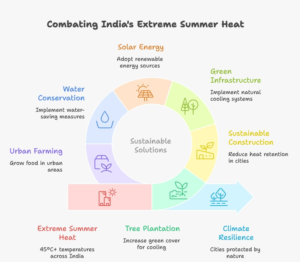
India’s long-term climate resilience depends on balancing development with environmental responsibility.
Key sustainable solutions include:
- Green infrastructure
- Tree plantation drives
- Renewable energy adoption
- Sustainable construction
- Urban farming
- Eco-conscious urban planning
- Climate-resilient communities
According to the Ministry of New and Renewable Energy India, renewable energy expansion will play a major role in reducing future emissions.
The future belongs to cities and communities that prioritize sustainability, ecological balance, and climate resilience over short-term expansion Extreme Summer Heat in India 2026.
India’s Heat Crisis Must Become a Turning Point for Sustainable Change
India’s extreme summer heat in 2026 is more than a weather event.
It is a reflection of:
- Climate change
- Ecological imbalance
- Urban overheating
- Deforestation
- Pollution
- Unsustainable infrastructure
But within this crisis also lies an opportunity.
An opportunity to rethink how we live.
How we build.
How we consume.
How do we coexist with nature?
I strongly believe sustainability is no longer a niche conversation for environmentalists alone. It is becoming one of the most important foundations for future economic stability, urban resilience, public health, and human survival itself.
If we truly want future generations to inherit breathable cities, balanced climates, cleaner air, and healthier ecosystems, then sustainable living must become a collective responsibility.
Because ultimately, nature does not need humanity to survive.
Humanity needs nature.
