
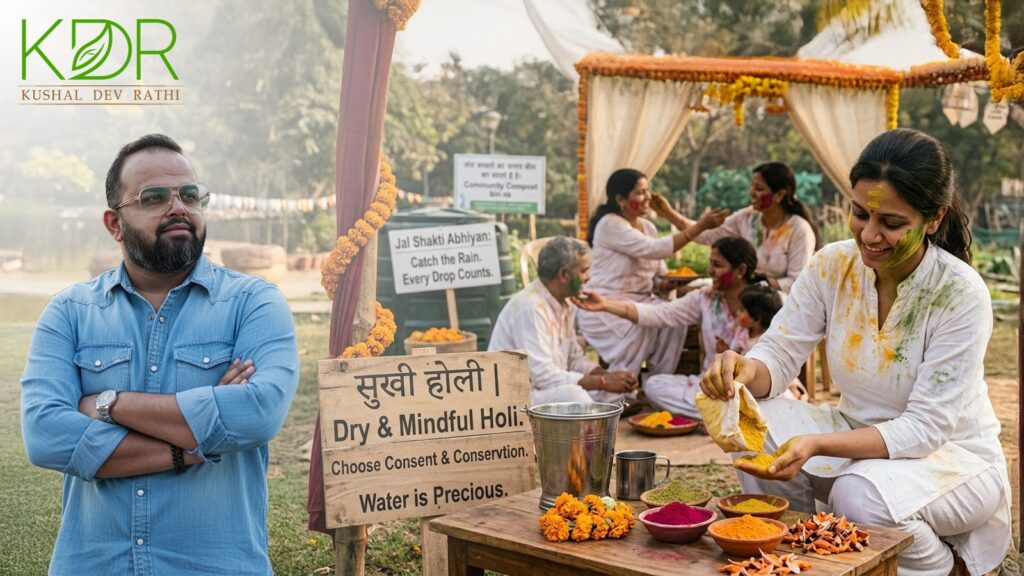
Water-Saving Holi: Why I Choose a Dry Holi as a Quiet Water Ethic
Every year, as Holi approaches, I pause.
Not because I do not love the festival.
But because I do.
Holi is colour, laughter, forgiveness, reunion, and release. It is the celebration of spring — of soil warming again, of fields shifting tone, of trees quietly preparing for fruit.
But over the years, my relationship with Holi has evolved.
As someone who works closely with land systems, soil cycles, water tables, and sustainable development, I cannot separate celebration from context.
And context today tells us one thing very clearly:
Water is precious.
That is why I chose a water-saving Holi.
That is why I celebrate a dry Holi.
Not out of restriction.
But out of respect.
The Moment Water Became More Than Just a Resource
When you work with land long enough, you begin to see water differently.
You see it as:
- Moisture that sustains crops.
- Recharge that replenishes groundwater.
- Flow that nourishes rivers.
- Balance that supports ecosystems.
Water is not just something that flows from a tap. It is something that arrives through complex natural cycles.
India, like many countries, is actively working on water sustainability through initiatives such as the Jal Shakti Abhiyan – Catch the Rain campaign, which encourages citizens to conserve water and recharge sources locally.
The National Water Policy (2012) also emphasizes that water is a scarce and valuable resource that must be conserved and managed responsibly Water-Saving Holi.
These frameworks are not alarmist. They are practical.
They reflect a simple truth: water conservation is a shared responsibility.
So when Holi arrives, I ask myself — can my celebration align with that responsibility?
The answer for me is yes.
Through a water-saving Holi.
Why Water-Saving Holi Is About Alignment, Not Limitation
A common misunderstanding is that a dry Holi reduces fun.
I have found the opposite to be true.
A water-saving Holi:
- Encourages intentional celebration.
- Reduces chaos.
- Makes interaction more respectful.
- Minimizes waste.
- Keeps joy intact.
The spirit of Holi is not measured in litres of water used.
It is measured in connection.
And connection does not require excess water-saving Holi.
Understanding the Larger Water Context
According to the NITI Aayog Composite Water Management Index (CWMI), many regions in India face increasing water stress and groundwater challenges.
Groundwater assessments conducted periodically highlight the importance of sustainable extraction and recharge balance.
(Reference: Central Ground Water Board updates via pib.gov.in)
Simultaneously, missions such as the Jal Jeevan Mission focus on ensuring long-term drinking water security through source sustainability and greywater management Water-Saving Holi.
These initiatives show that water conservation is not an isolated concern — it is part of national and community thinking.
A water-saving Holi is simply an extension of that mindset into our cultural life.
It is not about judgment.
It is about harmony.
My Personal Framework for a Water-Saving Holi
Over time, I have developed a simple, practical way to celebrate Holi that feels joyful yet responsible.
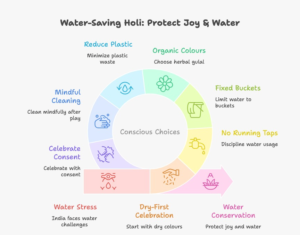
1. Dry First, Always
The foundation of my water-saving Holi is simple:
Start with dry colours.
No running taps.
No pressure hoses.
No continuous flow.
When water is not the default, consumption drops naturally.
This one shift alone transforms the festival.
2. Conscious Water Use If Needed
If light water play happens, I keep it:
- Time-bound
- Bucket-based
- Minimal
A bucket encourages awareness. A hose encourages excess.
The principle is not zero water.
It is mindful water.
That is the essence of a water-saving Holi.
3. Choose Organic and Safer Colours
Studies have indicated concerns about harmful substances in certain non-standardized colours, including heavy metals like lead.
So I prefer:
- Herbal gulal
- Natural plant-based colours
- Reliable, certified suppliers
Better yet, small-batch natural colours that can safely return to soil.
If something cannot decompose safely, I hesitate to use it.
That is not fear — it is ecological thinking.
If It Cannot return to Soil, It Does Not Belong on Skin
As an urban farmer, I operate with a simple filter:
Would I compost this?
Natural alternatives include:
- Turmeric for yellow
- Beetroot powder for pink
- Henna for green
- Marigold petals
- Palash/Tesu-based hues
These are not nostalgic ideas.
They are regenerative ones.
When colour meets soil again without harm, celebration becomes cyclical — not extractive Water-Saving Holi.
The Hidden Footprint of Holi
Water is visible.
Waste is less visible.
Every plastic packet of colour becomes landfill.
Every balloon fragment becomes micro-waste.
Every synthetic residue entering drains adds load to wastewater systems.
A sustainable Holi looks beyond the surface.
I reduce waste by:
- Buying colours in minimal packaging.
- Avoiding plastic décor.
- Using reusable cloth decorations.
- Composting flower waste.
- Cleaning consciously.
A water-saving Holi is part of a larger low-waste ethic.
Community Celebration Without Conflict
In societies and gated communities, small guidelines help.
I recommend:
- Dry-first celebration rules.
- Clear play areas.
- Fixed time windows.
- No forced participation.
- Herbal colour preference.
- Shared cleanup responsibility.
When guidelines are positive, people respond positively.
Children can be redirected toward:
- Flower Holi
- Music games
- Cultural storytelling
- Food-based celebration
Joy does not diminish when water reduces.
It evolves.
Policy and Personal Responsibility
Government campaigns like Catch the Rain remind us that water conservation is collective.
The Jal Jeevan Mission integrates source sustainability and reuse concepts into long-term planning.
When systems think about conservation, citizens can support that thinking through everyday behaviour.
A water-saving Holi is not activism.
It is alignment.
My Holi Pledge
Each year, before Holi, I remind myself:
- I will celebrate with awareness.
- I will choose dry colours first.
- I will minimize water use.
- I will reduce plastic waste.
- I will respect consent.
- I will clean up responsibly.
This is my version of Holi.
A quiet, dignified, joyful water-saving Holi.
FAQs
1. What is a water-saving Holi, and why is it important?
A water-saving Holi is a mindful way of celebrating the festival by minimizing unnecessary water usage, prioritizing dry colours, and reducing environmental impact.
It becomes important in the context of increasing water stress across many regions. According to the NITI Aayog Composite Water Management Index, several states face significant water management challenges, including groundwater depletion and demand-supply imbalance.
By choosing a dry Holi approach, we align celebration with ecological responsibility without compromising joy.
2. How can I celebrate a water-saving Holi at home?
To celebrate a water-saving Holi at home:
- Make dry colours the default.
- Avoid running hoses or open taps.
- If water is used, limit it to fixed buckets.
- Use pre-oiling methods to reduce water during cleanup.
- Choose herbal or natural colours.
Even small adjustments significantly reduce water usage. A water-saving Holi begins with awareness and a simple decision to reduce excess.
3. Is dry Holi really more environmentally friendly?
Yes. A dry Holi reduces freshwater consumption and minimizes wastewater generation.
Government initiatives like Jal Shakti Abhiyan – Catch the Rain encourage citizens to conserve water locally and adopt sustainable practices.
When festivals align with these conservation efforts, they strengthen long-term sustainability goals.
4. Does celebrating a water-saving Holi make a meaningful difference?
Collectively, yes.
Individually, one household may use a small amount of water. But when millions participate in high-volume water play, the cumulative impact increases pressure on already stressed systems.
The National Water Policy (2012) emphasizes conservation and responsible use of water resources.
A water-saving Holi is a citizen-level contribution to that larger framework.
5. Are synthetic Holi colours harmful to health or the environment?
Some studies have identified harmful substances, including heavy metals such as lead, in certain non-standardized Holi colours.
While not all products are unsafe, choosing certified herbal or natural colours reduces potential risks to skin, eyes, and respiratory health.
A water-saving Holi paired with safer colour choices creates a more responsible celebration.
6. What are the best natural alternatives for a sustainable Holi?
For a more sustainable and eco-friendly Holi celebration, consider:
- Turmeric for yellow tones
- Beetroot powder for pink/red
- Henna for green hues
- Marigold petals
- Palash (Tesu) flower-based colours
Natural colours are biodegradable and safer for soil systems, making them ideal for a water-saving Holi approach.
7. How can housing societies organize a water-saving Holi?
Communities can implement simple guidelines:
- Dry-first celebration rule
- Limited water use policy
- Designated play areas
- Herbal colour recommendation
- Shared cleanup responsibility
Aligning celebration with conservation reinforces collective responsibility and reduces unnecessary waste.
8. What is the connection between water-saving Holi and national water initiatives?
National programs such as the Jal Jeevan Mission emphasize source sustainability, recharge, and greywater management.
A water-saving Holi complements these efforts by encouraging citizens to reduce non-essential freshwater usage and think consciously about water systems.
Festivals can support policy by reinforcing sustainable habits at the household level.
9. How can I reduce water usage during Holi cleanup?
To maintain a water-saving Holi mindset even after the celebration:
- Apply oil before playing to ease colour removal.
- Use mild soap.
- Avoid long showers.
- Do not keep taps running continuously.
- Reuse initial rinse water for flushing (where practical and safe).
Cleanup discipline often saves more water than people realize.
10. Can I celebrate Holi meaningfully without using water at all?
Absolutely.
Holi is fundamentally about:
- Community
- Renewal
- Forgiveness
- Seasonal transition
A completely dry Holi — using colours, flowers, music, and food — preserves the spirit of the festival while fully embracing the philosophy of water conservation.
A water-saving Holi does not reduce celebration. It refines it.
The Most Beautiful Colour Is Consciousness
There is a moment in every Holi celebration that stays with me.
It is not the loudest song.
Not the brightest shade of pink.
Not even the most dramatic photo.
It is the quiet moment after.
When the streets begin to settle. When the excitement softens. When the water in the buckets turns cloudy. When coloured foam gathers near drains. When discarded plastic sachets and broken balloons start revealing the real footprint of our “fun.”
That moment is where the festival speaks honestly.
And that is why I’ve come to believe: the most beautiful colour is consciousness.
Not because consciousness is fashionable — but because it is necessary.
Consciousness is the missing ingredient in most celebrations
We live in a time where water is not guaranteed in the way our grandparents assumed it would be. Some places have enough today, and uncertainty tomorrow. Others have uncertainty already. The land reminds us of this again and again.
When I say I prefer a water-saving Holi, I’m not trying to make anyone feel guilty. I’m only asking us to do what mature cultures have always done:
Adapt rituals to reality, without losing the soul of the ritual.
That’s not a “modern idea.” That is how traditions survive.
The truth is, India is actively trying to strengthen water security — and we’re being reminded of it through policy, campaigns, and planning at the national level.
For example, the National Water Policy (2012) clearly frames water as a scarce natural resource fundamental to life and sustainable development. It also highlights the structural challenge: India supports a large share of the world’s population with a small fraction of global renewable freshwater.
When a country’s policy documents talk about scarcity, it’s a signal. Not panic. A signal.
And if policies are nudging us toward conservation, our festivals can become a beautiful place to practice it — gently, voluntarily, joyfully.
Water-saving Holi is not “less Holi” — it’s wiser Holi
Many people assume a dry Holi is a compromise.
I see it as evolution.
A festival is not a fixed script. A festival is a living expression of a culture. And living things evolve with their environment.
The NITI Aayog’s Composite Water Management Index (CWMI) was created as a tool to strengthen water management across states and bring water challenges into sharper focus.
So when I choose a water-saving Holi, it is my small way of aligning with that larger direction — not because the government says so, but because the land says so.
Because:
- A running hose doesn’t understand scarcity,
- But a bucket does,
- a dry-first celebration doesn’t steal from tomorrow,
- And a mindful cleanup doesn’t burden rivers invisibly.
This is what consciousness looks like in practice.
Conscious celebration means we protect what makes celebration possible
A festival is only possible because basic resources exist. Water is one of them.
And whether we acknowledge it or not, our society is already investing effort and public imagination into water conservation.
The Jal Shakti Abhiyan: Catch the Rain campaign exists precisely to encourage rainwater harvesting and local water conservation — “where it falls, when it falls” — and has been positioned as an annual effort since 2021.
Similarly, the Jal Jeevan Mission isn’t only about tap connections. It also speaks about source sustainability, including measures like recharge and reuse through greywater management, water conservation, and rainwater harvesting.
These are not just government lines. They are reminders of a deeper truth:
We can’t behave like water is infinite, and then hope systems will save us.
Systems and citizens have to cooperate.
And festivals are one of the best places to practice cooperation — because festivals are collective by nature.
Consciousness also includes what we put on our skin and into our drains
A sustainable Holi isn’t only about water. It’s also about what travels with water.
I’ve always believed:
If something cannot safely return to soil, I don’t want it on my body — and I definitely don’t want it in groundwater or rivers.
This is why I prefer organic, herbal, and natural colours whenever possible.
Research has raised concerns that some dry colours sold in markets can contain harmful substances, including heavy metals such as lead (depending on source and quality).
(In the final published blog, this line should cite the peer-reviewed study directly; if you want, I’ll add the exact Springer citation again and format it cleanly with your site’s linking style.)
This isn’t about fear. It’s about filtering.
If you can choose colours that are gentler on skin, easier to clean with less water, and safer for soil — why wouldn’t you?
A water-saving Holi becomes even more powerful when paired with safer, eco-conscious colour choices, because then the festival footprint becomes lighter in every direction.
Consciousness is not a lecture — it’s a personal standard
I don’t want sustainability to become another way we shame people.
That’s not my style. It’s not my belief.
I see sustainability as a form of dignity.
A water-saving Holi is simply a dignified Holi.
It says:
- I can celebrate without excess.
- I can enjoy without waste.
- I can laugh without a running tap.
- I can honour culture without burdening ecology.
That is not a restriction.
That is self-respect.
The quiet call-to-action I believe in
If you ask me what you should do this Holi, I won’t ask you to become perfect.
I’ll ask you to become aware.
Start with one shift:
- Make it a dry-first Holi.
- Reduce water use during cleanup.
- Avoid hoses.
- Choose herbal or natural colours.
- Keep the celebration consensual and kind.
That’s it.
Because when consciousness enters a tradition, tradition doesn’t die.
It deepens.
And when we practice a water-saving Holi, we are doing something very beautiful:
We are proving that joy and responsibility can live in the same home, in the same community, in the same country.
This, to me, is the real colour of leadership.
Not loud.
Not performative.
Just steady — like water itself.
