

India’s Real Estate Evolution and the Foundation of Long-Term Wealth
Why Real Estate Investment in India Is Entering a New Era
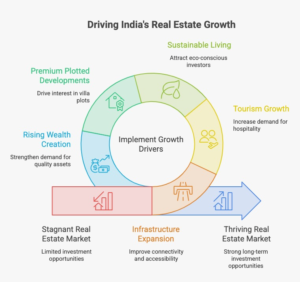
For decades, Real Estate Investment in India has been regarded as one of the country’s most reliable avenues for wealth creation. However, the sector today is fundamentally different from what it was even a decade ago. The conversation has shifted beyond buying apartments in metropolitan cities to identifying emerging investment corridors, premium plotted developments, sustainable communities, villa plots, and second-home destinations that offer both long-term capital appreciation and lifestyle value.
India’s robust economic growth, unprecedented infrastructure spending, rising household incomes, and rapidly expanding tourism industry are creating favourable conditions for Real Estate Investment in India. Investors today are no longer evaluating land purely as a physical asset; they increasingly view it as a strategic component of diversified wealth portfolios capable of preserving capital across generations.
According to the India Brand Equity Foundation (IBEF), the Indian real estate sector is projected to contribute significantly more to the country’s GDP by 2030, supported by urbanisation, infrastructure development, digital transformation, and sustained economic expansion. These structural changes are strengthening the long-term outlook for Real Estate Investment in India.
For discerning investors—including HNIs, NRIs, entrepreneurs, business owners, family offices, and wealth advisors—the focus has shifted toward acquiring premium land in locations where infrastructure, tourism, environmental sustainability, and economic development intersect. Regions such as Sindhudurg (Maha Goa), North Goa, Rajasthan, Himachal Pradesh, and other emerging investment corridors illustrate how long-term planning and government-led development can gradually transform underdeveloped regions into high-potential investment destinations.
Equally important is the growing preference for environmentally responsible developments. Sustainable communities, low-density living, wellness-oriented neighbourhoods, and regenerative real estate projects are attracting investors seeking financial returns alongside quality of life. This evolution reflects changing buyer aspirations and reinforces why Real Estate Investment in India continues to be viewed as a future-ready asset class.
Understanding Why Real Estate Investment in India Continues to Appreciate
Unlike many financial assets that fluctuate with short-term market sentiment, Real Estate Investment in India is influenced by structural drivers that evolve over years or even decades. Population growth, infrastructure creation, industrial expansion, tourism development, government policy reforms, and increasing land scarcity collectively contribute to long-term appreciation.
Land Is a Finite Resource
One of the strongest fundamentals supporting Real Estate Investment in India is the finite nature of land. While buildings depreciate over time and require maintenance, well-located land remains a scarce resource. As cities expand and infrastructure reaches new regions, the availability of strategically located land gradually decreases while demand continues to rise.
This principle becomes particularly relevant in premium plotted developments and villa communities, where investors are purchasing not only land ownership but also future development potential. Whether the objective is to build a holiday home, create a family legacy asset, or develop a boutique hospitality venture, premium land offers flexibility that many built assets cannot.
Industry research from leading real estate consultancies consistently highlights the growing demand for plotted developments across India, driven by buyers seeking greater control over design, lower-density living environments, and stronger long-term appreciation potential.
Infrastructure Is Reshaping Investment Geography
Historically, investment opportunities were concentrated within established metropolitan regions. Today, major infrastructure investments are expanding economic activity into previously overlooked destinations, creating new opportunities for Real Estate Investment in India.
Government initiatives such as the PM Gati Shakti National Master Plan, Bharatmala Pariyojana, Sagarmala Programme, airport expansion, railway modernisation, and industrial corridor development are improving accessibility across the country. Better connectivity not only reduces travel time but also stimulates tourism, logistics, commerce, hospitality, and residential demand.
For investors, infrastructure serves as one of the strongest indicators of future land appreciation. Regions witnessing improvements in highways, airports, ports, and multimodal transport networks often experience increased economic activity over the long term, encouraging residential and commercial development.
Rising Wealth Is Supporting Premium Real Estate Demand
India’s growing economy has created a significant increase in affluent households, successful entrepreneurs, business owners, and globally mobile professionals. This demographic shift is changing investment behaviour.
Instead of concentrating wealth exclusively in equities or traditional residential apartments, many investors now allocate capital toward premium plotted developments, villa plots, sustainable communities, and second homes. These assets provide opportunities for capital appreciation while also serving as lifestyle investments that can be enjoyed by future generations.
According to global wealth reports published by Knight Frank, India continues to witness growth in its high-net-worth population, reinforcing long-term demand for premium real estate assets.
Sustainable Living Is Becoming a Major Investment Theme
Another defining trend influencing Real Estate Investment in India is the growing preference for environmentally responsible developments.
Modern investors increasingly prioritise communities that incorporate:
- Rainwater harvesting
- Renewable energy integration
- Native landscaping
- Organic farming
- Open green spaces
- Water conservation
- Biodiversity preservation
- Wellness-focused planning
These features not only improve residents’ quality of life but also align with global sustainability goals and evolving consumer preferences.
As climate resilience becomes an increasingly important consideration, projects integrating sustainable planning are expected to remain attractive for long-term investors seeking future-ready assets.
Tourism Is Creating New Investment Opportunities
India’s tourism sector has become an important catalyst for Real Estate Investment in India. Domestic travel has expanded significantly over the past decade, while international tourism continues to recover and diversify.
Experience-led tourism has increased demand for:
- Holiday homes
- Boutique resorts
- Luxury villas
- Eco-retreats
- Wellness destinations
- Vacation rentals
Emerging destinations offering natural beauty, improved infrastructure, and authentic cultural experiences are benefiting from this shift. Investors increasingly recognise that premium land in tourism-driven regions can support multiple value propositions, including personal use, hospitality development, and long-term appreciation.
According to the Ministry of Tourism, domestic tourism continues to play a major role in supporting regional economies and encouraging investment in hospitality infrastructure.
Infrastructure, Tourism & Premium Land Are Transforming Real Estate Investment in India
Infrastructure Development: The Strongest Catalyst for Real Estate Investment in India
Infrastructure has historically been one of the most reliable indicators of long-term real estate appreciation. Around the world, improved connectivity has transformed regional economies, and India is witnessing a similar evolution. Today, Real Estate Investment in India is increasingly influenced by government-led infrastructure initiatives that are opening new growth corridors beyond traditional metropolitan markets.
The Government of India has significantly increased capital expenditure on roads, railways, airports, ports, logistics parks, and multimodal transportation. These investments are reducing travel time, improving accessibility, attracting businesses, and creating employment opportunities. As a result, surrounding land markets often experience gradual increases in demand over the medium and long term.
Some of the country’s most influential infrastructure initiatives include:
- PM Gati Shakti National Master Plan, integrating infrastructure planning across multiple ministries.
- Bharatmala Pariyojana, enhancing national highway connectivity.
- Sagarmala Programme, improving port-led economic development.
- Expansion of regional airports through the UDAN Scheme.
- Ongoing railway modernization and freight corridor development.
For investors evaluating Real Estate Investment in India, these projects provide valuable indicators of future economic activity rather than short-term speculation.
How Infrastructure Supports Capital Appreciation
Infrastructure contributes to property appreciation by:
- Improving connectivity to emerging destinations.
- Increasing tourism and visitor footfall.
- Encouraging commercial investments.
- Creating employment hubs.
- Supporting hospitality and retail development.
- Expanding residential demand.
For example, destinations connected by new highways or airports often become attractive for second homes, villa communities, boutique resorts, and premium plotted developments. While appreciation rates vary by location and market conditions, infrastructure has consistently been identified by leading real estate consultancies as one of the most significant long-term value drivers.
Tourism Growth Is Creating New Opportunities for Real Estate Investment in India
Tourism is no longer viewed solely as a hospitality industry—it has become a major driver of Real Estate Investment in India. As domestic and international travel continues to grow, destinations offering natural beauty, cultural heritage, wellness experiences, and coastal or mountain lifestyles are attracting sustained investment interest.
According to the Ministry of Tourism, domestic tourism in India has witnessed a strong recovery in recent years, supported by improved connectivity, digital travel platforms, and rising disposable incomes. This growth is encouraging investment in accommodation, holiday homes, eco-resorts, and premium villa developments.
Regions such as Sindhudurg (Maha Goa), North Goa, Rajasthan, and Himachal Pradesh are benefiting from this trend because they combine tourism potential with infrastructure improvements and lifestyle-driven demand.
Why Tourism Supports Long-Term Property Demand
Tourism creates a multiplier effect across the local economy. As visitor numbers increase, demand rises for:
- Vacation homes
- Boutique hotels
- Eco-resorts
- Wellness retreats
- Holiday villas
- Restaurants and retail
- Local services and experiences
This expanding ecosystem can strengthen long-term demand for strategically located land and premium residential developments. For investors, Real Estate Investment in India in tourism-oriented destinations offers the possibility of combining capital appreciation with future hospitality or rental opportunities, subject to local regulations and market conditions.
The Rise of Experience-Led Tourism
Modern travellers increasingly seek immersive experiences rather than conventional hotel stays. Wellness retreats, farm experiences, nature escapes, heritage tourism, and coastal holidays are becoming key segments of India’s tourism economy.
This shift has increased interest in:
- Sustainable villa communities
- Nature-inspired second homes
- Boutique hospitality projects
- Eco-tourism developments
- Regenerative real estate concepts
Developments designed around sustainability, wellness, and environmental stewardship are particularly well-positioned to benefit from these changing travel preferences.
Premium Plotted Developments Are Reshaping Real Estate Investment in India
One of the most significant trends identified by industry research is the increasing demand for premium plotted developments. Investors are increasingly choosing land over built structures because of the flexibility and long-term value that land ownership can provide.
Unlike apartments, which may experience physical depreciation over time, well-located land remains a finite asset. As urban centres expand and infrastructure reaches surrounding regions, the availability of premium land gradually decreases, supporting long-term demand.
Leading consultants such as Knight Frank, JLL, ANAROCK, CBRE, and Colliers have observed growing interest in plotted developments driven by changing buyer preferences, post-pandemic lifestyle shifts, and the desire for greater space and flexibility.
Why Investors Prefer Premium Villa Plots
Premium plotted developments appeal to investors because they offer:
- Long-term capital appreciation potential.
- Freedom to build according to future needs.
- Lower-density living environments.
- Opportunity to create family legacy assets.
- Flexibility for holiday homes or retirement residences.
- Potential integration with sustainable design principles.
For many HNIs, entrepreneurs, and NRIs, Real Estate Investment in India through premium villa plots represents both a financial investment and a lifestyle decision aligned with future aspirations.
Looking Ahead
The convergence of infrastructure development, tourism expansion, and rising demand for premium plotted communities is fundamentally reshaping Real Estate Investment in India. Rather than focusing solely on established metropolitan markets, investors are increasingly evaluating emerging destinations where long-term structural growth is supported by connectivity, sustainability, and evolving lifestyle preferences.
The next section explores how second-home ownership, Airbnb rentals, boutique hospitality, and sustainable communities are creating additional opportunities for long-term wealth creation while reinforcing the investment case for premium land across India’s emerging growth corridors.
The Rise of Second Homes, Sustainable Communities, HNI Investments & Emerging Growth Corridors
The Growing Demand for Second Homes Is Transforming Real Estate Investment in India
Over the past few years, one of the most significant shifts in Real Estate Investment in India has been the rapid growth of the second-home market. Once considered a luxury reserved for a select few, second homes have now become an integral part of wealth creation, lifestyle planning, and long-term investment strategies for affluent buyers.
The COVID-19 pandemic fundamentally changed how people perceive living spaces. Remote working, hybrid work models, increased focus on wellness, and the desire for healthier environments encouraged many investors to move beyond traditional city apartments. Instead, buyers started exploring premium villa plots, nature-inspired communities, coastal destinations, mountain retreats, and holiday homes that provide both lifestyle benefits and long-term appreciation.
Today, Real Estate Investment in India is increasingly driven by investors who seek a balance between financial returns and quality of life. Second homes are no longer viewed simply as vacation properties—they are evolving into flexible assets that can serve as family retreats, retirement homes, rental properties, or long-term legacy investments.
According to industry reports by ANAROCK, Knight Frank, and Savills, demand for second homes has grown significantly in destinations that offer strong infrastructure, tourism potential, and environmental appeal.
Why Investors Are Choosing Second Homes
Several factors are driving this trend:
- Flexible work culture allows professionals to work from scenic destinations.
- Families increasingly prioritize wellness and outdoor living.
- Rising disposable incomes support lifestyle investments.
- Investors seek diversification beyond traditional financial assets.
- Premium plotted developments offer future construction flexibility.
- Holiday homes can generate rental income while appreciating over time.
Rather than purchasing purely for immediate returns, many investors are adopting a multi-generational perspective, viewing premium land and second homes as assets that future generations can enjoy.
Airbnb, Boutique Hospitality & Vacation Rentals Are Creating New Investment Opportunities
The rapid growth of India’s tourism sector has significantly influenced Real Estate Investment in India, particularly in destinations known for beaches, mountains, heritage tourism, and nature-based experiences.
Platforms offering short-term holiday accommodation have expanded the earning potential of premium villas and holiday homes. Investors are increasingly evaluating properties not only for capital appreciation but also for their ability to generate recurring rental income during peak tourism seasons.
This has encouraged the development of:
- Boutique resorts
- Luxury villas
- Farm stays
- Eco-resorts
- Wellness retreats
- Premium holiday homes
- Nature-based hospitality projects
The popularity of experiential travel has also increased demand for accommodations that provide privacy, sustainability, and authentic local experiences rather than conventional hotel stays.
For investors, Real Estate Investment in India in tourism-oriented locations offers multiple avenues for value creation:
- Long-term land appreciation.
- Potential rental income.
- Lifestyle usage.
- Hospitality development opportunities.
- Diversification of investment portfolios.
It is important to note that rental performance varies based on location, tourism demand, local regulations, occupancy rates, operational quality, and seasonality. Investors should evaluate these factors carefully before making investment decisions.
Sustainable Communities Are Redefining Real Estate Investment in India
Environmental consciousness is increasingly influencing investment decisions across the real estate sector. Modern investors are no longer evaluating projects solely on location and pricing—they are also considering sustainability, climate resilience, wellness, and long-term environmental impact.
As a result, Real Estate Investment in India is witnessing growing interest in sustainable communities that integrate responsible planning with modern infrastructure.
These developments often include:
- Rainwater harvesting systems.
- Solar-powered common infrastructure.
- Native landscaping.
- Organic farming spaces.
- Water recycling.
- Green mobility.
- Open green areas.
- Biodiversity conservation.
- Low-density layouts.
Sustainability is no longer viewed as an optional feature. Instead, it is becoming a defining characteristic of premium developments that seek to remain relevant over the coming decades.
Organizations such as the Indian Green Building Council (IGBC) and GRIHA continue promoting environmentally responsible construction practices that improve resource efficiency while reducing environmental impact.
For long-term investors, sustainable developments may benefit from stronger buyer preference as awareness regarding climate resilience and environmental responsibility continues to increase.
Why HNIs, NRIs & Family Offices Continue to Increase Real Estate Investment in India
India’s growing affluent population has changed the investment landscape considerably. High-net-worth individuals (HNIs), non-resident Indians (NRIs), entrepreneurs, business owners, family offices, and wealth managers increasingly consider Real Estate Investment in India an essential component of diversified portfolios.
Unlike volatile financial instruments, premium land provides investors with tangible ownership, long-term appreciation potential, and wealth preservation characteristics.
Key reasons institutional and affluent investors prefer premium real estate include:
- Portfolio diversification.
- Inflation hedge.
- Legacy planning.
- Limited land availability.
- Capital preservation.
- Long-term appreciation potential.
- Strategic asset allocation.
The annual Wealth Report published by Knight Frank consistently highlights India’s expanding affluent population and the increasing importance of real estate within diversified investment portfolios.
Similarly, global property consultants such as CBRE, JLL, and Colliers continue to identify India as one of the world’s most attractive long-term real estate investment destinations due to strong economic fundamentals, urbanization, and infrastructure development.
Emerging Investment Corridors Are Expanding Opportunities Across India
One of the defining characteristics of modern Real Estate Investment in India is the emergence of high-growth investment corridors beyond traditional metropolitan cities.
Regions supported by improving infrastructure, tourism, industrial development, and environmental appeal are attracting increasing attention from long-term investors.
Among the destinations receiving growing interest are:
Sindhudurg (Maha Goa)
- Mopa International Airport connectivity
- Mumbai–Goa Highway improvements
- Coastal tourism
- Marine tourism
- Luxury hospitality
- Premium plotted developments
- Sustainable communities
North Goa
- International tourism
- Luxury villa demand
- Strong hospitality ecosystem
- Holiday home investments
Rajasthan
- Heritage tourism
- Luxury hospitality
- Cultural tourism
- Wellness resorts
- Highway connectivity
Himachal Pradesh
- Nature-based tourism
- Mountain wellness destinations
- Second-home demand
- Eco-tourism
- Sustainable living communities
Each of these destinations demonstrates how infrastructure, tourism, environmental quality, and economic development collectively influence Real Estate Investment in India over the long term.
Rather than relying on speculation, successful investors increasingly focus on locations supported by measurable structural growth drivers and government-backed development initiatives.
Government Policies Are Strengthening the Foundation of Real Estate Investment in India
One of the strongest reasons Real Estate Investment in India continues to attract long-term investors is the government’s sustained focus on infrastructure, connectivity, tourism, industrial development, and urban transformation. These initiatives are not designed to increase property prices directly; instead, they improve accessibility, stimulate economic activity, create employment opportunities, and enhance the overall investment ecosystem.
Over the last decade, several flagship initiatives have reshaped India’s physical infrastructure and investment landscape.
PM Gati Shakti National Master Plan
The PM Gati Shakti National Master Plan aims to integrate infrastructure planning across various ministries to improve logistics efficiency, reduce transportation costs, and accelerate economic development. Better road, rail, port, and airport connectivity can indirectly support Real Estate Investment in India by making emerging regions more accessible for businesses, residents, and tourists.
Bharatmala Pariyojana
The Bharatmala programme focuses on expanding India’s highway network and improving freight movement. Enhanced road connectivity often contributes to increased commercial activity, tourism, and residential demand in surrounding regions.
Sagarmala Programme
India’s extensive coastline presents significant economic opportunities. The Sagarmala Programme seeks to modernize ports, improve coastal logistics, and encourage port-led industrial development. Coastal destinations experiencing improved connectivity may benefit from growing tourism and hospitality investment over the long term.
Smart Cities Mission
The Smart Cities Mission continues to encourage better urban infrastructure, digital governance, mobility solutions, and sustainable urban planning. Such initiatives contribute to improving the livability and investment appeal of many Indian cities.
UDAN Regional Connectivity Scheme
Regional airport development under the UDAN initiative has significantly improved air connectivity to several emerging destinations, supporting tourism and economic activity.
Expert Insights: Why Long-Term Investors Continue to Prefer Real Estate Investment in India
Leading real estate consultancies consistently identify India as one of the world’s most promising long-term property markets.
Several structural factors continue supporting Real Estate Investment in India:
- Strong economic growth.
- Expanding middle and affluent classes.
- Increasing urbanization.
- Infrastructure modernization.
- Digital transformation.
- Rising tourism.
- Higher disposable incomes.
- Growing institutional participation.
- Stable long-term demand for quality residential assets.
According to research published by CBRE, JLL, Knight Frank, Colliers, and Savills, premium residential developments, plotted communities, logistics infrastructure, hospitality assets, and sustainable projects remain among the strongest long-term themes shaping the sector.
Rather than short-term speculation, experienced investors increasingly evaluate:
- Infrastructure quality.
- Tourism potential.
- Environmental sustainability.
- Economic development.
- Governance.
- Long-term demographic trends.
These factors provide a stronger foundation for investment decisions than temporary market fluctuations.
The Future Outlook for Real Estate Investment in India
The future of Real Estate Investment in India is expected to be shaped by multiple long-term structural trends rather than isolated market cycles.
Increasing Infrastructure Investment
India continues to prioritize roads, airports, logistics, industrial corridors, ports, and multimodal transportation to improve accessibility across emerging destinations.
Expansion of Sustainable Communities
Developers are increasingly integrating environmentally responsible planning through renewable energy, water conservation, biodiversity preservation, and green infrastructure.
Growth of Experience-Led Tourism
Nature tourism, heritage tourism, wellness tourism, eco-tourism, and experiential hospitality continue to create opportunities for premium residential and hospitality developments.
Digital Transformation
Technology is improving transparency across property transactions, project management, investment research, and customer experiences.
Rising Demand for Lifestyle Investments
Future buyers are expected to prioritize wellness, open spaces, flexible living, and environmentally conscious developments rather than conventional high-density housing.
Collectively, these trends indicate that Real Estate Investment in India will increasingly focus on quality, sustainability, connectivity, and long-term value creation.
Key Takeaways for Long-Term Investors
Investors evaluating Real Estate Investment in India should focus on measurable growth drivers rather than short-term market sentiment.
Important considerations include:
- Infrastructure connectivity.
- Government development initiatives.
- Tourism growth.
- Employment generation.
- Environmental sustainability.
- Quality of planning.
- Long-term demographic demand.
- Availability of social infrastructure.
- Regulatory compliance.
- Responsible development practices.
A disciplined investment approach based on research and long-term fundamentals generally provides stronger outcomes than decisions based solely on speculative appreciation expectations.
FAQs
1. Why is Real Estate Investment in India considered a long-term wealth-building strategy?
Real Estate Investment in India benefits from long-term structural drivers such as urbanization, infrastructure expansion, economic growth, tourism development, and increasing demand for premium residential communities. While returns vary by location and market conditions, well-researched investments can contribute to long-term wealth creation.
2. Why are premium plotted developments gaining popularity?
Premium plotted developments offer land ownership, flexibility for future construction, lower-density living, and the potential to create long-term family assets. They are also increasingly associated with sustainable community planning and lifestyle-oriented investments.
3. How does infrastructure influence Real Estate Investment in India?
Infrastructure improves connectivity, stimulates business activity, attracts tourism, enhances accessibility, and encourages residential and commercial development. These factors often strengthen the long-term investment appeal of surrounding regions.
4. Are second homes becoming a major investment trend?
Yes. Hybrid work, wellness-focused lifestyles, and increased domestic tourism have encouraged many buyers to consider second homes as both lifestyle assets and long-term investments.
5. Can tourism contribute to long-term property demand?
Tourism supports hospitality, retail, transportation, and local economic activity. Destinations experiencing sustained tourism growth often witness increased demand for holiday homes, boutique hospitality projects, and premium residential developments.
6. Why are HNIs and NRIs increasing their Real Estate Investment in India?
Many HNIs and NRIs view premium real estate as a tangible asset that supports portfolio diversification, wealth preservation, legacy planning, and long-term capital appreciation.
7. What role does sustainability play in modern real estate investment?
Sustainability has become a major consideration for both developers and investors. Green infrastructure, water conservation, renewable energy, biodiversity protection, and environmentally responsible planning are increasingly influencing purchasing decisions.
8. Which factors should investors evaluate before purchasing premium land?
Investors should assess:
Infrastructure connectivity.
Government development plans.
Regulatory approvals.
Tourism potential.
Environmental conditions.
Accessibility.
Long-term demand.
Local market fundamentals.
Professional legal and financial advice.
The evolution of Real Estate Investment in India reflects far more than rising property values—it represents the convergence of infrastructure development, economic expansion, environmental responsibility, tourism growth, and changing lifestyle aspirations. As India continues to invest in highways, airports, logistics networks, digital infrastructure, and sustainable urban development, new investment corridors are emerging across the country.
For long-term investors, premium plotted developments, villa communities, sustainable neighbourhoods, and strategically located land parcels offer opportunities that extend beyond financial returns. They provide flexibility, legacy planning, lifestyle value, and the potential to participate in India’s long-term growth story.
At the same time, successful investing requires discipline, thorough research, regulatory due diligence, and a long-term perspective. Rather than chasing short-term market movements, experienced investors increasingly focus on structural growth drivers such as infrastructure, tourism, governance, environmental sustainability, and demographic trends.
As India’s investment landscape continues to evolve, Real Estate Investment in India is expected to remain an important asset class for those seeking resilient, future-ready opportunities aligned with responsible development and sustainable wealth creation.
