

How India’s Infrastructure Revolution Is Creating the Next Generation of High-Return Land Investments
The Greatest Investment Opportunities Often Begin with Infrastructure
Over the years, I have had the privilege of observing India’s real estate landscape through multiple economic cycles, policy reforms, and infrastructure transformations. While every investment cycle has its own unique characteristics, one lesson has remained remarkably consistent—infrastructure has the power to redefine the future of a location long before the market fully recognizes its potential.
In my experience, successful land investing is rarely about chasing today’s popular destinations. Instead, it is about understanding tomorrow’s growth corridors. The investors who consistently create long-term wealth are often those who identify opportunities when roads are still being planned, airports are under construction, metro corridors are being surveyed, and industrial parks exist only on government blueprints.
Today, India stands at one of the most exciting moments in its development journey. Massive public investments in expressways, metro rail systems, industrial corridors, multimodal logistics parks, ports, airports, and smart cities are reshaping not only how people travel but also where businesses operate, industries expand, and communities flourish. This unprecedented transformation is creating entirely new destinations for infrastructure-led land investments in India, making connectivity one of the most influential drivers of long-term land appreciation.
Unlike previous decades, where growth was largely concentrated in a handful of metropolitan cities, India’s current infrastructure strategy is far more integrated and future-oriented. Initiatives such as the PM Gati Shakti National Master Plan, the National Infrastructure Pipeline (NIP), Bharatmala Pariyojana, Sagarmala Programme, Dedicated Freight Corridors, and expanding metro networks are designed to connect cities, industries, logistics hubs, and rural regions into a unified economic ecosystem. Together, these initiatives are laying the foundation for sustainable economic growth over the coming decades.
According to the Government of India, the National Infrastructure Pipeline envisages investments exceeding ₹111 lakh crore across key sectors such as transportation, energy, urban development, and logistics, highlighting the country’s long-term commitment to infrastructure-led growth. You can explore these initiatives through the official portals of the National
As someone who believes in responsible and long-term investing, I have always considered infrastructure not merely as physical development but as an economic catalyst. Roads do not simply reduce travel time. Airports do not merely connect cities. Metro systems do not only transport commuters. They create employment, attract industries, encourage migration, improve accessibility, and ultimately reshape the economic identity of an entire region.
That is why I believe infrastructure-led land investments in India deserve far greater attention from investors than short-term market speculation. In this article, I want to share the principles I have learned over years of studying infrastructure-driven growth, explain how connectivity influences land appreciation, explore historical examples that validate this pattern, and discuss why India’s ongoing infrastructure revolution may create some of the country’s most significant long-term investment opportunities.
India’s Largest Infrastructure Revolution Since Independence
When I look at India’s current development trajectory, I do not see isolated infrastructure projects. I see a coordinated national vision that aims to transform the country’s economic geography.
Over the past decade, infrastructure has moved to the center of India’s development agenda. Successive Union Budgets have significantly increased capital expenditure, with public investment reaching historic levels to improve transportation, logistics, manufacturing, and urban infrastructure. This strategic focus reflects the understanding that infrastructure is not merely an expense—it is an investment in future productivity, competitiveness, and economic resilience.
One of the most transformative initiatives is the PM Gati Shakti National Master Plan, launched to integrate infrastructure planning across multiple ministries using digital mapping and data-driven coordination. Rather than developing roads, railways, ports, airports, and industrial zones independently, the objective is to ensure they function as a connected ecosystem that reduces logistics costs and improves operational efficiency.
Similarly, the National Infrastructure Pipeline (NIP) outlines long-term investments across transport, energy, water, digital infrastructure, and urban development, creating a comprehensive roadmap for India’s future growth.
The scale of infrastructure development is equally visible on the ground.
Projects such as the Delhi–Mumbai Expressway, Delhi–Dehradun Expressway, Mumbai Trans Harbour Link, Jewar International Airport, Dedicated Freight Corridors, expanding metro networks, industrial corridors, and multimodal logistics parks are reshaping how people, goods, and businesses move across the country.
For investors evaluating infrastructure-led land investments in India, these projects represent more than engineering achievements—they are indicators of where future economic activity is likely to concentrate.
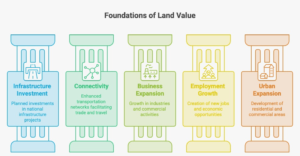
In my view, infrastructure investment creates a chain reaction. Improved connectivity encourages industries to establish manufacturing facilities. Businesses follow industrial growth. Employment opportunities attract skilled professionals. Residential demand increases. Retail and commercial developments emerge. Over time, these interconnected factors contribute to stronger land demand and sustained appreciation.
This is precisely why experienced investors spend considerable time studying government infrastructure announcements, master plans, industrial policies, and transportation networks rather than relying solely on current property prices. Infrastructure often changes the long-term potential of a location before that transformation becomes visible in the real estate market.
Why Infrastructure Has Become India’s Biggest Wealth Creator
One question I am often asked is: Why does infrastructure have such a profound impact on land values?
My answer is simple.
Infrastructure changes economics before it changes skylines.
When a new expressway reduces travel time between two cities, businesses gain access to larger markets. Logistics become more efficient. Manufacturers reduce transportation costs. Tourism becomes more accessible. Residential communities become viable farther from city centers. Commercial establishments expand to serve growing populations.
The result is a gradual but powerful shift in demand.
This is why I believe infrastructure-led land investments in India are fundamentally different from speculative investments. Their potential is often supported by tangible improvements in connectivity, economic activity, employment generation, and regional development rather than short-term market sentiment.
Consider the evolution of many of India’s fastest-growing urban regions. Whether it is Gurugram’s emergence alongside improved highway connectivity, the transformation of Greater Noida through expressways and metro expansion, or Hyderabad’s western growth corridor supported by the Outer Ring Road, the underlying pattern remains remarkably consistent. Infrastructure attracts opportunity, and opportunity attracts investment.
How Connectivity Creates Value: The Direct Relationship Between Infrastructure and Land Appreciation
Throughout my years of studying India’s real estate markets, I have realized that land appreciation is rarely accidental. Behind every successful investment corridor lies a combination of strategic planning, economic activity, and most importantly, infrastructure.
Whenever I evaluate a location, I ask a simple question: What is changing here that will influence how people live, work, travel, and conduct business over the next decade? More often than not, the answer begins with infrastructure.
Roads, expressways, airports, metro systems, industrial corridors, and logistics hubs do far more than improve transportation. They redefine accessibility, attract businesses, create employment, and expand urban boundaries. Together, these forces become the foundation of Infrastructure-led land investments in India, where long-term value is created through economic transformation rather than short-term speculation.
Expressways: Compressing Distance, Expanding Opportunity
One of the most powerful catalysts for regional development is the expressway.
While the physical distance between two cities may never change, improved road infrastructure dramatically reduces travel time, making previously distant locations commercially and residentially viable.
This phenomenon is evident across several landmark infrastructure projects.
The Delhi–Mumbai Expressway, stretching approximately 1,350 kilometres, is expected to significantly improve connectivity across Delhi, Haryana, Rajasthan, Madhya Pradesh, Gujarat, and Maharashtra. Beyond faster travel, the corridor is anticipated to strengthen logistics, manufacturing, tourism, warehousing, and industrial investments, creating entirely new economic ecosystems.
Similarly, the Delhi–Dehradun Expressway is expected to reduce travel time between Delhi and Dehradun considerably while supporting tourism, hospitality, education, healthcare, and residential expansion across Uttarakhand and western Uttar Pradesh.
Another significant development is Maharashtra’s proposed Shaktipeeth Expressway, which aims to improve connectivity across several districts while strengthening pilgrimage tourism, agricultural logistics, and regional commerce.
For investors focused on Infrastructure-led land investments in India, these projects demonstrate how transportation infrastructure often becomes the first step toward long-term regional economic growth.
As I often say, roads rarely create value by themselves—they create access, and access creates opportunity.
Airports: Catalysts for New Economic Cities
Airports have evolved far beyond being transportation facilities. Today, they function as economic growth engines capable of transforming surrounding regions into thriving business districts.
The concept of the Aerotropolis—an urban ecosystem built around airports—is increasingly shaping modern urban planning worldwide.
India offers a compelling example through the development of Noida International Airport (Jewar Airport).
As one of the country’s largest upcoming aviation hubs, the airport is expected to support aviation services, logistics parks, manufacturing clusters, hospitality, commercial developments, and residential communities. The surrounding Yamuna Expressway Industrial Development Area (YEIDA) has already witnessed significant planning activity driven by long-term infrastructure expectations.
Likewise, the Navi Mumbai International Airport, combined with the operational Mumbai Trans Harbour Link (Atal Setu), is expected to further integrate Mumbai and Navi Mumbai while supporting industrial growth, logistics, financial services, and commercial development.
These examples illustrate an important lesson I have observed repeatedly: airports create much more than passenger traffic—they attract businesses, investments, talent, and long-term urban expansion.
Metro Rail Networks: Redefining Urban Growth
When metro rail systems expand, cities begin to grow differently.
Instead of concentrating development only around traditional commercial centres, metro connectivity encourages distributed growth by making peripheral neighbourhoods more accessible.
Cities such as Delhi, Bengaluru, Hyderabad, Mumbai, Pune, Ahmedabad, Nagpur, Lucknow, Kochi, and Chennai continue expanding their metro networks, influencing residential demand, office development, retail activity, and mixed-use communities.
Global real estate consultancies including JLL, Knight Frank, Colliers, and CBRE have consistently highlighted the growing importance of transit-oriented development, where improved public transport contributes to higher occupancy, stronger commercial activity, and increased investor interest in well-connected locations.
From my perspective, metro infrastructure changes something fundamental—it gives people the confidence to live farther from traditional city centres without sacrificing accessibility.
That confidence gradually reshapes urban demand.
Industrial Corridors and Logistics Parks: The Economic Backbone of Future Growth
If expressways improve mobility and airports enhance connectivity, industrial corridors create the economic foundation that sustains long-term development.
Manufacturing, warehousing, logistics, exports, and industrial production generate employment on a scale that permanently changes regional economies.
The Delhi–Mumbai Industrial Corridor (DMIC) remains one of India’s most ambitious infrastructure initiatives, integrating industrial townships, freight connectivity, logistics hubs, smart cities, and manufacturing zones across multiple states.
Complementing these initiatives are the Dedicated Freight Corridors (DFC), designed to improve freight movement while reducing logistics costs and increasing supply chain efficiency.
The Western and Eastern Dedicated Freight Corridors are expected to support industrial competitiveness while encouraging the development of warehousing clusters, manufacturing parks, and multimodal logistics hubs.
According to the National Logistics Policy, reducing logistics costs remains a strategic priority for enhancing India’s global competitiveness. Efficient freight movement strengthens industrial investments, which in turn generates sustained demand for commercial, residential, and industrial land.
For anyone studying Infrastructure-led land investments in India, industrial infrastructure deserves equal attention alongside residential development because employment remains one of the strongest long-term drivers of real estate demand.
What History Teaches Us About Infrastructure-Led Land Appreciation
While future infrastructure projects generate excitement, I believe the most valuable lessons come from history.
India has repeatedly demonstrated that infrastructure-led development is not a theoretical concept—it is an observable economic pattern.
Consider Gurugram.
Several decades ago, much of the region consisted of agricultural villages. However, improved highway connectivity through NH-48, the development of Cyber City, metro connectivity, and commercial expansion transformed Gurugram into one of India’s largest corporate and residential markets.
Similarly, Noida and Greater Noida evolved through the combined impact of expressways, metro rail connectivity, planned industrial development, educational institutions, and more recently, the announcement of Jewar International Airport. Infrastructure did not merely improve transportation—it fundamentally reshaped the region’s economic identity.
Hyderabad offers another compelling example. The Outer Ring Road (ORR) significantly improved accessibility to the western part of the city, encouraging IT expansion in Gachibowli, the Financial District, Kokapet, and nearby locations. As employment opportunities increased, residential and commercial demand followed.
North Bengaluru presents a similar story. The establishment of Kempegowda International Airport, coupled with technology parks, aerospace industries, and expanding road infrastructure, accelerated urban growth in areas that were once considered peripheral.
Even Pune’s western growth corridor demonstrates how infrastructure influences long-term appreciation. The combination of the Mumbai–Pune Expressway, metro expansion, Ring Road planning, and a thriving IT ecosystem has supported continuous residential and commercial development over the years.
These examples reinforce a principle I have consistently observed throughout my career.
Infrastructure does not guarantee appreciation overnight.
However, when supported by employment generation, industrial activity, urban planning, and demographic growth, it creates the conditions under which Infrastructure-led land investments in India have historically delivered sustainable long-term value.
India’s Next Generation of Infrastructure Projects Could Define the Investment Corridors of the Next Decade
One of the most valuable lessons I have learned as a long-term investor is that every generation witnesses a handful of infrastructure projects that reshape the country’s economic geography. These projects do much more than improve connectivity—they influence where industries establish operations, where businesses expand, where employment is generated, and eventually where cities grow.
As I observe India’s current infrastructure pipeline, I believe we are entering one of the most transformative decades in the nation’s history. The combination of expressways, airports, industrial corridors, logistics parks, freight networks, and metro expansions is laying the foundation for the next chapter of Infrastructure-led land investments in India.
While no investment outcome can ever be guaranteed, history consistently shows that major infrastructure development often becomes the catalyst for long-term regional transformation.
The Delhi–Mumbai Expressway: Redefining Economic Connectivity
Among India’s most ambitious infrastructure projects, the Delhi–Mumbai Expressway stands out as a remarkable example of long-term nation-building.
Connecting Delhi with Mumbai across multiple states, the expressway is expected to improve freight movement, reduce travel time, strengthen manufacturing, encourage tourism, and support logistics infrastructure throughout its corridor.
For investors, the significance lies beyond transportation.
Every major expressway creates opportunities for industrial parks, logistics hubs, hospitality businesses, commercial centres, and residential communities. As these ecosystems mature, they contribute to increasing economic activity and long-term demand for land.
Official project details are available through the National Highways Authority of India (NHAI).
Delhi–Dehradun Expressway: Unlocking New Growth Across Northern India
The Delhi–Dehradun Expressway is another project that reflects how strategic connectivity can influence regional development.
By significantly reducing travel time between Delhi NCR and Uttarakhand, the project is expected to strengthen tourism, healthcare, education, hospitality, logistics, and residential demand across multiple districts.
Whenever travel becomes easier, businesses begin to rethink expansion plans, professionals become willing to commute farther, and investors start evaluating locations that were previously overlooked.
This gradual shift often creates new opportunities for Infrastructure-led land investments in India, particularly in regions supported by complementary economic activity.
Shaktipeeth Expressway: Strengthening Maharashtra’s Emerging Corridors
Another infrastructure initiative that deserves attention is the proposed Shaktipeeth Expressway.
Although discussions around the project continue to evolve, its broader vision highlights an important investment principle.
Large-scale road connectivity has the potential to improve regional accessibility, facilitate agricultural logistics, strengthen pilgrimage tourism, and encourage commercial development across previously underserved districts.
From my perspective, infrastructure should never be evaluated in isolation.
The real question investors should ask is:
What industries, businesses, institutions, and employment opportunities are likely to emerge once connectivity improves?
That answer often reveals far more than the infrastructure project itself.
Dedicated Freight Corridors and Industrial Corridors: Building India’s Manufacturing Future
While highways receive considerable public attention, I believe some of India’s most significant long-term opportunities may emerge through industrial infrastructure.
The Western Dedicated Freight Corridor and Eastern Dedicated Freight Corridor are transforming freight transportation by improving cargo efficiency and reducing logistics costs.
Complementing these freight networks are large-scale industrial corridor programmes, including:
- Delhi–Mumbai Industrial Corridor (DMIC)
- Chennai–Bengaluru Industrial Corridor
- Bengaluru–Mumbai Economic Corridor
- Amritsar–Kolkata Industrial Corridor
- East Coast Economic Corridor
These initiatives are designed to integrate manufacturing, logistics, exports, urban development, and industrial investment.
Information is available through the National Industrial Corridor Development Corporation (NICDC).
In my opinion, industrial corridors deserve close attention because sustainable land appreciation is rarely driven by speculation alone.
Long-term value is generally supported by employment generation, industrial production, business expansion, and population growth—all of which are strengthened through integrated infrastructure planning.
Metro Expansion and Multimodal Connectivity Will Continue Reshaping Urban India
India’s urban infrastructure story is equally compelling.
Metro rail networks continue expanding across cities such as Delhi, Mumbai, Bengaluru, Pune, Ahmedabad, Nagpur, Lucknow, Kanpur, Kochi, Chennai, Indore, Patna, and several emerging urban centres.
At the same time, the Government’s PM Gati Shakti National Master Plan is integrating highways, railways, ports, airports, logistics parks, and industrial zones into a single coordinated infrastructure ecosystem.
I believe this integrated planning approach represents one of the most important shifts in India’s infrastructure strategy.
Rather than developing isolated projects, the emphasis is now on creating interconnected economic corridors capable of supporting manufacturing, trade, logistics, exports, and urban development simultaneously.
This integrated approach strengthens the long-term foundation for Infrastructure-led land investments in India, particularly in locations where multiple infrastructure assets converge.
Why Experienced Investors Buy Land Before Infrastructure Is Completed
People often ask me why experienced investors prefer entering a market years before a major infrastructure project becomes operational.
The answer lies in understanding how markets discover value.
In most cases, land prices evolve through several distinct stages.
Infrastructure Announcement
↓
Government Approvals
↓
Land Acquisition
↓
Construction Begins
↓
Private Investments Follow
↓
Businesses Establish Operations
↓
Employment Increases
↓
Residential Demand Accelerates
↓
Commercial Development Expands
↓
Market Recognition and Price Discovery
By the time a project is fully operational and widely celebrated in the media, much of the early pricing advantage may already have narrowed in several locations.
This does not imply that opportunities disappear after completion.
Rather, it illustrates why patient investors often spend considerable time studying government policies, infrastructure announcements, and regional development plans before the broader market fully appreciates their significance.
Throughout my investment journey, I have learned that successful investing is rarely about predicting the future with certainty.
It is about recognizing long-term structural trends earlier than the majority of market participants.
Infrastructure planning provides one of the clearest windows into those structural trends.
My Framework for Identifying India’s Future High-Growth Corridors
Many readers ask me whether there is a structured approach to evaluating future investment destinations.
While every region has unique characteristics, I generally rely on a combination of economic, infrastructure, and planning indicators rather than short-term market sentiment.
1. Government Infrastructure Announcements
I carefully study projects announced by the Ministry of Road Transport & Highways, NHAI, Ministry of Railways, and state infrastructure agencies.
2. Regional Master Plans
Urban development authorities often reveal future land use, transportation corridors, industrial zones, and planned urban expansion years before large-scale private investment begins.
3. Employment Drivers
I prefer locations where infrastructure is likely to support manufacturing, logistics, technology, healthcare, education, tourism, or industrial growth because employment remains one of the strongest indicators of sustainable demand.
4. Multiple Connectivity Advantages
The most resilient growth corridors often benefit from more than one infrastructure asset.
For example:
- Expressway
- Airport
- Railway
- Metro
- Logistics Park
- Industrial Corridor
The convergence of multiple infrastructure projects typically creates stronger long-term economic ecosystems.
5. Regulatory and Planning Clarity
Before considering any opportunity related to Infrastructure-led land investments in India, I believe investors should carefully examine land titles, zoning regulations, environmental permissions, development plans, and legal compliance.
Infrastructure alone cannot substitute for proper due diligence.
Ultimately, my investment philosophy has remained remarkably consistent over the years.
I do not attempt to identify the fastest-growing location for the next six months.
Instead, I look for regions where infrastructure, employment, governance, planning, and economic activity are likely to reinforce one another over the next ten to twenty years.
That long-term perspective has repeatedly proven far more valuable than chasing short-term market excitement.
Important Risks Every Investor Should Evaluate Before Making Infrastructure-Led Land Investments in India
Throughout this article, I have discussed how infrastructure has the potential to transform regions, improve connectivity, generate employment, and create long-term economic opportunities. However, over the years, I have also learned that successful investing is never driven by optimism alone—it is driven by disciplined research.
One of the biggest misconceptions I encounter is that every infrastructure announcement automatically translates into immediate land appreciation. While infrastructure has historically played a significant role in shaping Infrastructure-led land investments in India, every opportunity deserves careful evaluation before capital is committed.
As investors, our objective should never be to chase announcements. Instead, we should seek to understand whether the supporting fundamentals are strong enough to sustain long-term growth.
Legal Due Diligence Must Always Come First
No infrastructure project can compensate for an unclear land title.
Before considering any investment, I believe every investor should verify ownership records, legal documentation, land use permissions, mutation status, encumbrances, and applicable regulations. Proper due diligence remains the foundation of responsible investing.
Understand Project Timelines
Large infrastructure projects often span several years.
Expressways, airports, industrial corridors, metro systems, and logistics parks involve multiple phases of planning, approvals, land acquisition, construction, and commissioning.
As investors, patience is often one of our greatest assets.
Rather than expecting immediate appreciation, I believe it is wiser to align investment horizons with realistic infrastructure development timelines.
Evaluate the Complete Economic Ecosystem
Infrastructure alone rarely creates sustained appreciation.
Whenever I evaluate Infrastructure-led land investments in India, I ask whether the surrounding ecosystem is equally capable of supporting long-term growth.
Questions I typically consider include:
- Will industries establish operations here?
- Are employment opportunities expected to increase?
- Is population growth likely?
- Will educational institutions, hospitals, commercial centres, and retail infrastructure follow?
- Does the master plan support long-term urban expansion?
When infrastructure is accompanied by these broader economic drivers, regions often develop stronger and more resilient growth trajectories.
Diversification Remains an Important Principle
No single infrastructure project should determine an entire investment strategy.
Diversifying across different regions, development stages, and economic corridors can help investors manage uncertainties associated with policy changes, execution timelines, or market cycles.
In my experience, disciplined diversification often proves more valuable than attempting to identify one perfect investment destination.
Why I Believe India’s Infrastructure Story Is Still in Its Early Chapters
Whenever I travel across India, I am reminded that our infrastructure journey is far from complete.
Instead, I believe we are witnessing the beginning of one of the most significant development cycles in independent India’s history.
The country’s urbanisation rate continues to rise. Manufacturing is receiving renewed policy support through initiatives such as Make in India and the Production Linked Incentive (PLI) Scheme. Logistics efficiency remains a national priority. Metro rail systems continue expanding into newer cities. Airports are connecting emerging regions. Industrial corridors are encouraging manufacturing investments, while expressways are bringing previously distant districts closer to economic centres.
I often view infrastructure as a long-term enabler rather than a short-term event.
Roads create access.
Access attracts businesses.
Businesses generate employment.
Employment encourages migration.
Population growth increases demand for housing, commercial establishments, education, healthcare, and services.
This chain reaction has repeatedly shaped some of India’s most successful urban regions, and I believe similar patterns may continue to emerge as the country’s infrastructure network expands.
For investors studying Infrastructure-led land investments in India, this reinforces the importance of evaluating economic fundamentals alongside physical infrastructure.
Wealth Is Often Created Where Vision Meets Infrastructure
As I reflect on India’s remarkable infrastructure journey, one thought continues to resonate with me.
Infrastructure does far more than connect places—it connects possibilities.
Throughout history, the most successful investment destinations have rarely emerged overnight. They evolved because transportation improved, industries expanded, businesses invested, employment increased, and communities gradually flourished around these developments.
This pattern has repeated itself across numerous regions in India, from expanding metropolitan corridors to emerging industrial hubs.
That is why I believe Infrastructure-led land investments in India should never be viewed purely through the lens of property prices.
Instead, they should be understood as part of a much larger economic transformation.
Whenever I study a location, I try to look beyond today’s headlines.
I ask where future employment may emerge.
I observe where governments are investing in connectivity.
I analyse master plans, logistics networks, industrial corridors, demographic trends, and urban expansion.
Most importantly, I remind myself that patience often creates opportunities that speculation cannot.
India’s infrastructure ambitions are among the largest in the world today.
From expressways and freight corridors to airports, metro systems, logistics parks, industrial townships, and integrated economic corridors, the country is laying the foundation for decades of future growth.
Not every project will produce identical outcomes, and not every location will appreciate at the same pace. Markets remain dynamic, infrastructure timelines may evolve, and every investment carries its own risks.
However, history consistently demonstrates that regions supported by strong connectivity, sound planning, employment generation, and sustained economic activity often become the places where long-term value is created.
As investors, our responsibility is not to predict the future with certainty.
Our responsibility is to prepare for it with knowledge.
For me, that has always been the true philosophy behind Infrastructure-led land investments in India.
The future is rarely built overnight.
It is built kilometre by kilometre, corridor by corridor, and connection by connection.
Those who learn to recognise these patterns with patience, discipline, and perspective are often better positioned to participate in India’s next chapter of growth.
FAQs
1. What are Infrastructure-led land investments in India?
Infrastructure-led land investments in India refer to investing in land located near upcoming or existing infrastructure such as expressways, airports, metro networks, industrial corridors, logistics parks, and economic zones that have the potential to improve connectivity and stimulate long-term economic development.
2. Why do expressways often influence land appreciation?
Expressways reduce travel time, improve accessibility, strengthen logistics, encourage industrial development, and support residential and commercial expansion. These factors can contribute to increased demand for surrounding land over time.
3. How do airports contribute to real estate growth?
Modern airports often become economic hubs by attracting logistics companies, aviation-related businesses, hospitality projects, commercial developments, and residential communities, creating long-term regional growth opportunities.
4. Why do experienced investors often buy before infrastructure is completed?
Many long-term investors study infrastructure announcements because market recognition frequently develops gradually during planning, construction, and operational phases. Early research may provide greater visibility into future growth trends, although investment outcomes are never guaranteed.
5. Which infrastructure projects are expected to influence future Infrastructure-led land investments in India?
Projects such as the Delhi–Mumbai Expressway, Delhi–Dehradun Expressway, Dedicated Freight Corridors, industrial corridors, metro expansions, Jewar International Airport, multimodal logistics parks, and PM Gati Shakti initiatives are expected to influence future regional development.
6. How do industrial corridors support long-term land demand?
Industrial corridors encourage manufacturing, logistics, exports, employment generation, and urban development, creating broader economic ecosystems that may contribute to sustained demand for residential, commercial, and industrial land.
7. What indicators help identify future high-growth corridors?
Some important indicators include:
Government infrastructure announcements
Master plans
Employment potential
Logistics connectivity
Airport and railway expansion
Population growth
Urban development policies
Regulatory clarity
8. What risks should investors evaluate before making Infrastructure-led land investments in India?
Investors should assess legal documentation, land title, zoning regulations, environmental permissions, infrastructure timelines, accessibility, utility availability, and the long-term economic viability of the region before making investment decisions.
9. Are infrastructure projects alone enough to drive land appreciation?
Infrastructure is an important catalyst, but long-term appreciation is generally influenced by multiple factors including employment generation, industrial growth, urban planning, demographics, governance, and overall economic development.
10. What is the biggest lesson investors can learn from India’s infrastructure story?
Perhaps the most important lesson is that successful investing is rarely about reacting to today’s popularity. It is about understanding how infrastructure, economic activity, and long-term planning come together to shape tomorrow’s opportunities. Investors who combine patience, research, and disciplined decision-making are often better equipped to identify sustainable long-term value.
