
Vengurla vs Goa: Why Low-Density Coastal Living Is Defining the Future of Sustainable Wealth Creation
Rethinking Coastal Wealth in a Changing World
Over the years, as an environmentalist, urban farmer, sustainability advocate, and responsible real estate developer, I have observed a fascinating shift in how people define wealth, success, and quality of life.
Traditionally, coastal destinations were evaluated through the lens of tourism numbers, hospitality growth, and commercial activity. The assumption was simple: the more visitors a destination attracted, the greater its economic value.
Today, that equation is changing.
Across the world, investors, entrepreneurs, NRIs, business leaders, and future-focused families are increasingly asking a different set of questions:
- Where can I find a healthier environment?
- Which destinations offer long-term livability?
- Where is ecological quality being preserved?
- Which regions can balance development with sustainability?
- How can wealth creation align with environmental stewardship?
These questions have given rise to a powerful global trend: low-density coastal living.
In this context, the discussion around Vengurla vs Goa becomes far more interesting than a simple destination comparison. It becomes a lens through which we can understand how coastal living, sustainability, and long-term wealth creation are evolving in the twenty-first century.
The conversation is not about which destination is better.
Rather, it is about understanding how mature coastal economies and emerging coastal ecosystems represent different stages in the evolution of sustainable value creation.
According to the United Nations, more than 40% of the world’s population lives within 100 kilometers of a coastline, making coastal regions some of the most economically and environmentally significant landscapes on Earth.
At the same time, global sustainability reports increasingly emphasize the importance of balancing economic development with ecosystem preservation. This balance may become one of the defining investment themes of the coming decades.
The Global Rise of Low-Density Coastal Living
One of the most important trends emerging globally is the movement away from overcrowded urban environments toward nature-rich, lower-density destinations.
The pandemic accelerated this shift, but the underlying drivers were already present.
Remote work technologies, changing lifestyle priorities, growing awareness of mental well-being, and increasing environmental consciousness have collectively transformed residential preferences worldwide.
The traditional dream of living close to a central business district is gradually being complemented by another aspiration:
Living close to nature while remaining connected to opportunity.
Research published by the World Economic Forum has highlighted how remote and hybrid work models have permanently altered residential decision-making for millions of professionals.
People are increasingly prioritizing:
- Open spaces
- Clean air
- Natural landscapes
- Wellness-oriented lifestyles
- Community-centered environments
Instead of evaluating locations solely through economic activity, many are evaluating them through quality-of-life metrics.
This shift has created renewed interest in coastal regions that offer environmental quality without excessive urban density.
From Portugal’s Algarve hinterland to Australia’s Tasmania coast and Costa Rica’s Nicoya Peninsula, investors are increasingly attracted to destinations where ecological integrity remains intact.
The broader lesson is clear:
Future value creation may increasingly emerge from places that preserve their natural capital while enabling responsible growth.
Why Density Is Becoming a New Quality-of-Life Indicator
When most investors evaluate a destination, they typically consider:
- Infrastructure
- Accessibility
- Economic activity
- Property prices
- Tourism growth
These factors remain important.
However, modern urban planning and sustainability research are introducing another critical metric:
Density.
Density affects nearly every aspect of daily life.
It influences:
- Traffic congestion
- Resource consumption
- Water availability
- Waste generation
- Environmental quality
- Noise levels
- Public infrastructure pressure
In sustainability planning, experts often discuss the concept of carrying capacity.
Carrying capacity refers to the maximum level of human activity that an ecosystem can support without degrading environmental quality.
When development exceeds carrying capacity, destinations often experience:
- Infrastructure strain
- Ecological stress
- Resource shortages
- Declining visitor experiences
This does not imply that growth is negative.
Rather, it highlights the importance of balancing growth with environmental resilience.
The Organisation for Economic Co-operation and Development (OECD) has repeatedly emphasized that sustainable development requires integrating environmental considerations into economic planning.
As investors become increasingly sophisticated, many are beginning to evaluate not just what exists today, but how a destination may evolve over the next twenty or thirty years.
This perspective is particularly relevant when discussing Vengurla vs Goa.
Goa: Understanding the Evolution of a Successful Coastal Economy
Any discussion around Vengurla vs Goa must begin by recognizing Goa’s remarkable success story.
Few destinations in India have built a stronger global tourism brand.
Over several decades, Goa has transformed from a niche coastal destination into one of India’s most recognized tourism and lifestyle economies.
Today, Goa benefits from:
- International recognition
- Established hospitality infrastructure
- Strong tourism demand
- Extensive second-home markets
- Diverse economic activity
According to government and industry reports, tourism contributes significantly to Goa’s economy and employment generation.
The state’s ability to attract both domestic and international visitors has made it one of India’s most mature coastal destinations.
As a result, Goa offers valuable lessons in destination development.
It demonstrates how:
- Infrastructure investment
- Brand creation
- Tourism growth
- Private-sector participation
can collectively transform a regional economy.
From an investor’s perspective, mature destinations often provide:
- Established demand
- Market transparency
- Greater liquidity
- Predictable economic activity
These characteristics are important components of long-term economic stability.
The evolution of Goa is therefore not merely a tourism success story—it is a case study in destination economics.
Understanding the Next Phase of Coastal Destination Growth
While mature destinations offer important advantages, global investment trends suggest that attention is increasingly expanding toward emerging regions with different characteristics.
Historically, coastal growth followed a relatively predictable pattern:
- Infrastructure arrives.
- Tourism grows.
- Development accelerates.
- Property values increase.
- Destination matures.
Today, a new dimension has emerged.
Investors are no longer focused exclusively on growth volume.
Increasingly, they are evaluating:
- Environmental quality
- Ecosystem health
- Livability
- Sustainability
- Climate resilience
In other words, destinations are increasingly being assessed not only by how much they grow, but by how well they grow.
This represents a fundamental shift in investment thinking.
The future may belong to coastal regions capable of balancing:
- Economic development
- Ecological preservation
- Community well-being
- Infrastructure efficiency
This balance is becoming a competitive advantage.
Vengurla’s Ecological and Geographic Advantages
Situated along Maharashtra’s Konkan coastline, Vengurla occupies a unique geographic position within one of India’s most ecologically rich regions.
The broader Konkan belt is influenced by:
- The Arabian Sea
- Coastal ecosystems
- Western Ghats biodiversity
The Western Ghats are recognized as a global biodiversity hotspot by UNESCO due to their exceptional ecological significance.
What makes Vengurla particularly interesting from a sustainability perspective is the presence of natural assets that extend beyond beaches alone.
These include:
- Mangrove ecosystems
- Marine biodiversity
- Coastal vegetation
- Agricultural landscapes
- Traditional ecological knowledge
As an urban farmer, I often emphasize that nature should not be viewed as unused land.
Nature is infrastructure.
Mangroves, wetlands, forests, and coastal ecosystems perform functions that would otherwise require expensive man-made systems.
They contribute to:
- Flood protection
- Carbon sequestration
- Biodiversity preservation
- Climate resilience
- Environmental stability
Increasingly, economists and environmental planners recognize these ecosystems as forms of natural capital.
This shift in thinking may become one of the most important investment trends of the coming decades.
Infrastructure and Connectivity: A New Chapter for Coastal Regions
Historically, accessibility often determined which coastal regions attracted investment.
Many environmentally rich destinations remained overlooked simply because they lacked connectivity.
That equation is changing rapidly.
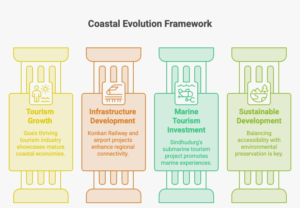
The Konkan region has experienced significant infrastructure improvements through:
- National Highway 66
- Konkan Railway
- Sindhudurg Airport (Chipi)
- Improved regional connectivity
- Enhanced tourism infrastructure
These developments are helping connect coastal communities with larger economic networks.
One of the most fascinating aspects of modern infrastructure development is that accessibility no longer requires large-scale urbanization.
Today, improved transportation and digital connectivity allow regions to remain environmentally balanced while still participating in broader economic opportunities.
This is a significant departure from older development models.
In the past, connectivity often led directly to urban concentration.
In the future, connectivity may enable distributed growth.
For investors evaluating Vengurla vs Goa, this distinction is particularly important.
The question is no longer simply:
“How accessible is a destination?”
The more relevant question may be:
“Can accessibility be achieved while preserving ecological integrity?”
This is where sustainability and investment intelligence begin to intersect.
When discussing Vengurla vs Goa, it is important to recognize that both destinations represent valuable chapters in India’s coastal development story.
Goa illustrates the power of destination maturity, tourism success, infrastructure development, and economic scale.
Vengurla highlights emerging conversations around ecological preservation, natural capital, environmental quality, and low-density coastal living.
More importantly, the comparison reveals a broader global transition.
Across continents, investors are increasingly recognizing that long-term value creation is not solely determined by economic activity.
It is also shaped by:
- Environmental stewardship
- Ecological resilience
- Quality of life
- Natural capital preservation
- Sustainable development practices
As someone who believes deeply in responsible growth, I see this transition as one of the most encouraging developments of our time.
The future of coastal wealth creation may not be defined by how much we build.
It may be defined by how wisely we preserve, protect, and integrate nature into the places we choose to call home.
Sustainability as the New Investment Moat
As I interact with investors, entrepreneurs, policymakers, and families across India, I increasingly notice a shift in how value is being defined.
A decade ago, conversations largely revolved around location, infrastructure, and appreciation potential.
Today, a new question is emerging:
Can a destination sustain its environmental quality while supporting economic growth?
This question lies at the heart of modern wealth creation.
Increasingly, sustainability is becoming an investment moat.
In business, a moat refers to a durable competitive advantage. In coastal destinations, sustainability can function in much the same way.
Regions that successfully preserve:
- Biodiversity
- Water resources
- Coastal ecosystems
- Air quality
- Community character
often develop long-term resilience that cannot be replicated easily.
This is particularly relevant in the discussion around Vengurla vs Goa.
While infrastructure and accessibility remain essential, environmental quality is becoming an equally important component of destination value.
The World Bank has consistently highlighted the importance of natural capital in supporting long-term economic prosperity.
Natural capital includes assets such as:
- Forests
- Wetlands
- Oceans
- Mangroves
- Biodiversity systems
These resources generate economic value while supporting ecological stability.
As investors increasingly adopt long-term perspectives, sustainability may become one of the most powerful indicators of future competitiveness.
The Blue Economy and the Future of Coastal Value Creation
One of the most important concepts shaping coastal development globally is the Blue Economy.
The Blue Economy promotes sustainable use of marine and coastal resources while creating economic opportunities.
Rather than viewing conservation and development as opposing forces, the Blue Economy seeks to align them.
India has identified the Blue Economy as a strategic growth area through various national initiatives and policy frameworks.
These initiatives focus on:
- Marine tourism
- Fisheries
- Coastal conservation
- Ocean-based industries
- Sustainable infrastructure
For coastal destinations, this represents a significant shift in thinking.
Historically, economic development often occurred at the expense of environmental assets.
The future may require the opposite approach.
Environmental preservation may become a driver of economic competitiveness.
As someone deeply committed to environmental stewardship, I believe this philosophy offers a practical framework for balancing growth and responsibility.
The destinations that thrive over the coming decades may be those that recognize nature not as a constraint, but as a strategic asset.
Coastal Living, Wellness, and Quality of Life
Perhaps one of the most underestimated aspects of low-density coastal living is its impact on human well-being.
Modern life has become increasingly fast-paced.
Urban populations around the world face growing challenges related to:
- Stress
- Air pollution
- Congestion
- Noise exposure
- Reduced access to nature
Numerous scientific studies have linked access to green and blue spaces with improved physical and mental health outcomes.
Research supported by the World Health Organization suggests that proximity to natural environments contributes positively to overall well-being.
As an urban farmer, I have always believed that our relationship with nature directly influences our quality of life.
When individuals live closer to natural systems, they often become more conscious of:
- Food production
- Water conservation
- Biodiversity
- Community engagement
- Sustainable living practices
These lifestyle benefits are increasingly influencing residential decisions.
For many families today, wealth is no longer defined solely by financial assets.
It is also measured through:
- Health
- Time
- Environmental quality
- Personal well-being
- Intergenerational opportunities
This broader definition of prosperity is helping drive interest in low-density coastal environments across the world.
Environmental Preservation and Long-Term Wealth Creation
One of the most important lessons I have learned through my journey in sustainability and responsible development is that preservation and prosperity are not mutually exclusive.
In fact, they often reinforce one another.
Historically, environmental conservation was viewed primarily as a social responsibility.
Today, it is increasingly recognized as an economic strategy.
Environmental preservation contributes to:
- Climate resilience
- Resource security
- Tourism appeal
- Public health
- Community stability
These factors influence the long-term attractiveness of destinations.
In discussions surrounding Vengurla vs Goa, this perspective becomes particularly relevant.
The future value of coastal regions may depend not only on development activity but also on the quality of environmental assets that remain protected.
The concept of wealth itself is evolving.
Beyond financial returns, investors are increasingly considering:
- Livability
- Sustainability
- Legacy
- Community impact
This shift aligns closely with the principles of responsible development.
When we preserve ecological systems today, we are effectively investing in future generations.
That may be one of the most meaningful forms of wealth creation available to us.
Global Examples of Low-Density Coastal Destinations Creating Premium Value
The trend toward low-density coastal living is not unique to India.
It is visible across multiple regions globally.
Costa Rica’s Nicoya Peninsula
The Nicoya Peninsula has become internationally recognized for its blend of ecological preservation, wellness-focused living, and sustainable tourism.
Rather than pursuing large-scale urbanization, the region has emphasized environmental protection and quality-of-life enhancement.
As a result, it has attracted global investors seeking nature-centered lifestyles.
Tasmania, Australia
Tasmania offers another compelling example.
Its appeal is rooted in:
- Natural landscapes
- Low population density
- Environmental quality
- Lifestyle-oriented communities
Over time, these characteristics have contributed to growing demand among both domestic and international buyers.
Portugal’s Algarve Hinterland
While Portugal’s coastline has experienced significant tourism growth, many investors have increasingly shifted their attention toward lower-density inland coastal communities.
These areas provide:
- Greater privacy
- Strong environmental quality
- Authentic cultural experiences
- Long-term lifestyle appeal
The broader lesson is clear.
The most successful destinations of the future may not necessarily be those attracting the largest crowds.
They may be the destinations that preserve their character while remaining connected to opportunity.
Emerging Trends Among HNIs, NRIs, and Lifestyle Investors
High-net-worth individuals and globally mobile families are increasingly making decisions based on lifestyle quality rather than purely financial metrics.
Reports from global wealth consultancies indicate growing interest in destinations that offer:
- Environmental quality
- Political stability
- Wellness opportunities
- Climate resilience
- Access to nature
Several trends are becoming increasingly visible.
Rise of Lifestyle Capital
People are investing in experiences, environments, and quality of life.
The destination itself becomes part of the value proposition.
Wellness-Oriented Decision Making
Health and well-being are becoming major investment considerations.
Nature-Integrated Living
Buyers increasingly seek environments where development coexists with natural landscapes.
Intergenerational Thinking
Families are evaluating how today’s decisions will influence future generations.
These trends suggest that long-term value creation is becoming increasingly holistic.
The Future of Responsible Coastal Development in India
India possesses one of the world’s most extensive coastlines.
This creates extraordinary opportunities.
However, it also creates significant responsibilities.
Future coastal development must address multiple priorities simultaneously:
- Economic growth
- Environmental conservation
- Community well-being
- Infrastructure efficiency
- Climate resilience
The challenge is not whether development should occur.
The challenge is how development should occur.
India’s Coastal Regulation Zone (CRZ) framework provides an important foundation for balancing these objectives.
Responsible development requires long-term thinking.
It requires us to ask:
- What should be built?
- What should be preserved?
- What should be regenerated?
As someone deeply committed to sustainability, I believe future coastal success stories will emerge from destinations that answer these questions thoughtfully.
Why Scarcity and Ecological Integrity Matter More Than Ever
Scarcity has always been a fundamental driver of value.
However, the definition of scarcity is evolving.
In the past, scarcity was often measured through limited land availability.
Today, another form of scarcity is becoming increasingly important:
Ecological scarcity.
Clean coastlines, biodiversity-rich landscapes, healthy ecosystems, and low-density environments are becoming increasingly rare in many parts of the world.
As a result, their value is rising.
This observation is particularly relevant when considering Vengurla vs Goa.
The comparison highlights a broader question facing investors everywhere:
How do we create prosperity while preserving the qualities that make destinations valuable in the first place?
The answer may lie in embracing development models that prioritize ecological integrity alongside economic opportunity.
The destinations that succeed in maintaining this balance may become some of the most desirable places to live, work, and invest over the coming decades.
Key Takeaways
Sustainability Lessons
- Environmental stewardship is becoming an economic advantage.
- Natural capital plays a growing role in destination competitiveness.
- Responsible development creates long-term resilience.
Investment Insights
- Quality of life is emerging as an important investment metric.
- Scarcity increasingly includes environmental quality.
- Long-term value creation requires a broader perspective than short-term appreciation.
Coastal Development Trends
- Low-density coastal living is gaining global momentum.
- Wellness and sustainability are influencing residential preferences.
- Investors are evaluating destinations through environmental as well as economic lenses.
Wealth Preservation Principles
- Protecting ecosystems can support long-term value creation.
- Livability and sustainability are increasingly interconnected.
- Future wealth may depend on balancing growth with preservation.
FAQs
1. Vengurla vs Goa: Which coastal destination is better suited for long-term sustainable wealth creation?
The Vengurla vs Goa discussion is less about choosing one destination over another and more about understanding different stages of coastal development. Goa represents a mature tourism-driven economy, while Vengurla reflects the growing global interest in low-density coastal living, ecological preservation, and long-term sustainability.
2. Why is the Vengurla vs Goa comparison becoming increasingly relevant for investors?
The Vengurla vs Goa comparison highlights a broader shift in investor preferences toward destinations that offer environmental quality, lower development density, improved connectivity, and long-term livability alongside economic growth.
3. How does low-density coastal living influence long-term property value in the Vengurla vs Goa debate?
Low-density coastal living can help preserve environmental quality, reduce infrastructure pressure, and maintain destination appeal over time. These factors increasingly influence how investors evaluate future value creation when analyzing Vengurla vs Goa.
4. What makes Vengurla unique in the Vengurla vs Goa discussion?
Vengurla benefits from its location within the ecologically rich Konkan coastline, proximity to the Western Ghats, coastal biodiversity, mangrove ecosystems, and improved regional connectivity, making it an interesting case study in sustainable coastal development.
5. How has Goa evolved as a coastal destination compared to Vengurla?
In the Vengurla vs Goa comparison, Goa represents decades of tourism growth, infrastructure development, and global recognition. Its evolution offers valuable lessons in destination economics, coastal planning, and tourism-led development.
6. Why is sustainability becoming important in the Vengurla vs Goa investment conversation?
Sustainability is increasingly viewed as a long-term competitive advantage. Environmental quality, biodiversity, climate resilience, and natural capital preservation are becoming important considerations for investors evaluating destinations such as Vengurla and Goa.
7. How does infrastructure development impact the Vengurla vs Goa investment outlook?
Infrastructure plays a critical role in destination growth. Improved connectivity through highways, airports, and rail networks can enhance accessibility while creating opportunities for balanced development and economic expansion.
8. What role does ecological preservation play in the Vengurla vs Goa comparison?
Ecological preservation helps protect biodiversity, strengthen climate resilience, support tourism appeal, and maintain quality of life. These factors increasingly contribute to long-term destination competitiveness and sustainable wealth creation.
9. Why are HNIs and NRIs paying attention to the Vengurla vs Goa trend?
Many HNIs, NRIs, and entrepreneurs are seeking destinations that offer wellness, privacy, environmental quality, and lifestyle value. This growing preference is contributing to increased interest in low-density coastal regions globally.
10. What does the future of the Vengurla vs Goa conversation tell us about coastal development in India?
The future of the Vengurla vs Goa discussion reflects a larger shift toward responsible coastal development, where economic growth, environmental stewardship, community well-being, and sustainable wealth creation are increasingly interconnected.
A New Vision for Coastal Wealth Creation
As I reflect on the future of India’s coastal regions, I believe we are entering a new era of thinking about value.
The discussion around Vengurla vs Goa is ultimately not about choosing one destination over another.
It is about understanding a larger transformation taking place across the world.
We are witnessing a shift from volume-driven growth toward value-driven growth.
A shift from short-term extraction toward long-term stewardship.
A shift from viewing nature as a resource to recognizing it as a partner in development.
As an environmentalist, urban farmer, and advocate of responsible development, I believe the most successful destinations of the future will be those that embrace this balance.
They will understand that prosperity and preservation are not opposing goals.
They are complementary forces.
The future of sustainable wealth creation will not be defined solely by economic output or infrastructure expansion.
It will be defined by our ability to create places where people can thrive while ecosystems continue to flourish.
For investors, policymakers, entrepreneurs, and future generations alike, that may be the most valuable opportunity of all.
