
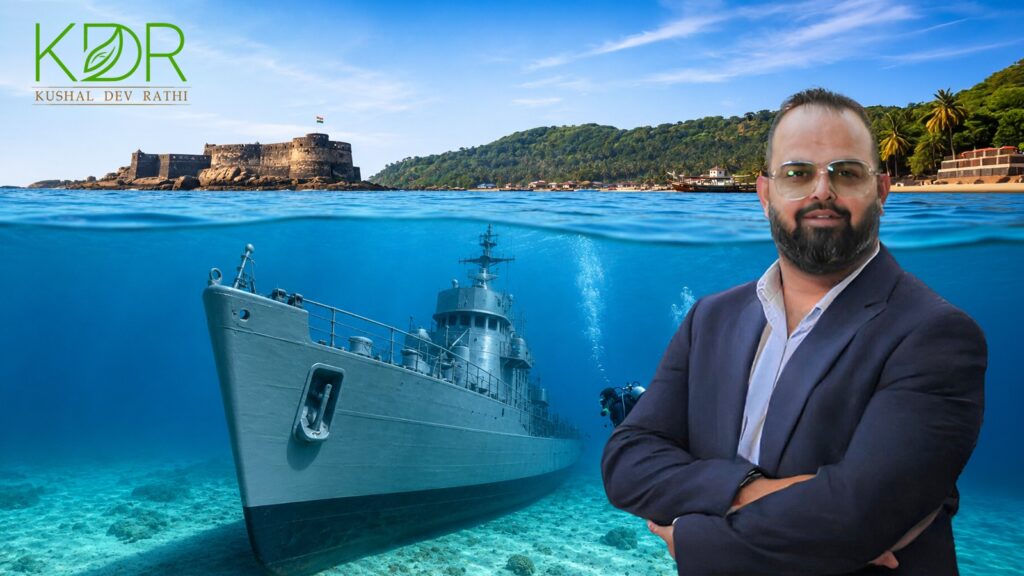
INS Guldar and the Rise of Marine Tourism in Sindhudurg: Understanding Maharashtra’s Emerging Coastal Growth Story
For decades, India’s coastal tourism narrative has largely revolved around Goa. Its beaches, hospitality sector, and tourism ecosystem have long dominated the conversation. Yet, as tourism preferences evolve and travellers increasingly seek authentic, experience-driven destinations, a new coastal story is beginning to unfold along Maharashtra’s Konkan coast.
I believe one of the most fascinating developments in this transformation is the arrival of INS Guldar beneath the waters of Sindhudurg.
At first glance, the scuttling of a retired naval vessel may appear to be a niche tourism initiative. However, when viewed through the lens of regional development, infrastructure expansion, blue economy growth, and destination creation, the INS Guldar project represents something much larger. It reflects a strategic shift in how coastal regions can leverage maritime heritage, environmental restoration, and experiential tourism to generate long-term economic value.
The emergence of marine tourism in Sindhudurg is not simply about attracting scuba divers. It is about positioning the district as a multidimensional coastal destination capable of generating employment, stimulating infrastructure investment, supporting local entrepreneurship, and strengthening Maharashtra’s place in India’s growing blue economy.
As investors, policymakers, tourism stakeholders, and development observers evaluate the future of coastal India, understanding the significance of INS Guldar marine tourism Sindhudurg becomes increasingly important.
The Legacy of INS Guldar: From Naval Service to Underwater Landmark
INS Guldar served the Indian Navy for nearly four decades as part of the Kumbhir-class Landing Ship Tank fleet.
Originally constructed in Poland and commissioned into the Indian Navy in 1985, the vessel played an important role in amphibious operations, troop transportation, logistics support, and humanitarian missions. Throughout its service life, the ship contributed to India’s maritime capabilities and coastal security operations.
According to the official website of the Indian Navy, retired naval assets are increasingly being repurposed in innovative ways that support education, heritage preservation, and public engagement. The transformation of INS Guldar into an underwater tourism attraction is one such example.
For many coastal destinations around the world, retired vessels have become valuable tourism assets. Rather than allowing these ships to deteriorate in scrapyards, governments and tourism authorities have successfully converted them into artificial reefs, diving attractions, and underwater museums.
This global model has now reached India through the INS Guldar marine tourism Sindhudurg initiative.
Why Was INS Guldar Scuttled?
The decision to deliberately sink a naval vessel may appear unusual. However, controlled ship scuttling has become a globally recognised marine tourism and environmental strategy.
Before submersion, vessels undergo extensive cleaning processes. Hazardous materials, pollutants, fuels, oils, and environmentally harmful substances are removed to ensure marine safety. Once prepared, the vessel is strategically placed on the seabed where it begins a new life as an artificial reef.
Artificial reefs create hard surfaces that attract marine organisms. Over time, corals, algae, fish, crustaceans, and other species colonize these structures, creating entirely new underwater ecosystems.
The Maharashtra Tourism Development Corporation (MTDC) envisioned INS Guldar as the centrepiece of India’s first large-scale underwater museum and submarine tourism project.
Instead of serving military operations, the ship will now support marine conservation awareness, underwater exploration, scientific study, and tourism diversification.
The Global Rise of Marine Tourism
Marine tourism has emerged as one of the fastest-growing segments within the global travel industry.
According to the World Travel & Tourism Council (WTTC), coastal and marine destinations continue to attract significant tourism spending due to their ability to offer unique experiences beyond conventional sightseeing.
Today, travelers increasingly seek:
- Adventure tourism
- Scuba diving
- Snorkeling
- Marine wildlife encounters
- Eco-tourism experiences
- Underwater heritage attractions
The global scuba diving tourism market alone is estimated to be worth several billion dollars annually and continues to grow as international travel expands.
This shift is significant because experiential tourism typically generates higher visitor spending compared to traditional sightseeing tourism.
Travellers participating in marine tourism often require:
- Certified dive operators
- Specialized equipment
- Boat services
- Accommodation
- Local transportation
- Hospitality services
- Guided experiences
This creates a larger economic multiplier effect across local economies.
What Makes Shipwreck Tourism So Successful?
Several international destinations demonstrate how marine tourism can become a major economic driver.
USS Oriskany, Florida
The USS Oriskany, a retired aircraft carrier intentionally sunk off Florida’s coast, became one of the world’s most famous artificial reefs.
Today, it attracts thousands of divers annually and contributes significantly to local tourism revenues.
HMAS Brisbane, Australia
Australia transformed the retired HMAS Brisbane into an artificial reef that now supports marine biodiversity while generating tourism activity throughout the region.
Malta’s Underwater Heritage Tourism
Malta has successfully developed underwater archaeological and shipwreck tourism experiences that attract divers from around the world.
SS Yongala, Australia
The Yongala shipwreck remains one of the most visited dive sites globally and supports a thriving regional tourism economy.
These examples demonstrate that successful shipwreck tourism is rarely about the vessel alone. Instead, it acts as an anchor attraction around which broader tourism ecosystems develop.
The INS Guldar marine tourism Sindhudurg project has the potential to follow a similar trajectory.
Why Sindhudurg Is Ideally Positioned for Marine Tourism
Location plays a decisive role in the success of marine tourism projects.
Fortunately, Sindhudurg possesses several natural advantages.
The district enjoys more than 120 kilometres of coastline, pristine beaches, rocky seabeds, rich marine biodiversity, and relatively clear waters compared to many other parts of India’s coastline.
Key destinations include:
Tarkarli
Widely known for water sports and scuba diving activities.
Devbagh
A scenic coastal destination attracting nature enthusiasts.
Malvan
One of Maharashtra’s most established coastal tourism centres.
Nivati
Located near the INS Guldar project site and increasingly gaining attention for its tourism potential.
Sindhudurg Fort
Built by the legendary Maratha ruler Chhatrapati Shivaji Maharaj, this historic maritime fort already attracts significant visitor interest.
Combined, these attractions create a tourism ecosystem that extends well beyond a single destination.
The Economic Impact Potential of INS Guldar Marine Tourism Sindhudurg
The true significance of INS Guldar lies in its potential economic impact.
Marine tourism generates direct, indirect, and induced economic benefits.
Direct Benefits
The most immediate beneficiaries include:
- Dive operators
- Boat operators
- Adventure tourism companies
- Hotels
- Homestays
- Restaurants
- Local transport providers
As visitor numbers increase, demand for these services grows correspondingly.
Indirect Benefits
Additional sectors also benefit:
- Fisheries support services
- Retail businesses
- Equipment suppliers
- Construction services
- Maintenance providers
- Tourism training institutes
Employment Creation
Marine tourism is labour-intensive.
Unlike capital-heavy industries, tourism creates employment across skill levels, including:
- Tour guides
- Dive instructors
- Hospitality staff
- Marine technicians
- Boat crews
- Safety personnel
For coastal communities, this diversification reduces dependence on traditional economic activities and strengthens resilience.
The Blue Economy Opportunity
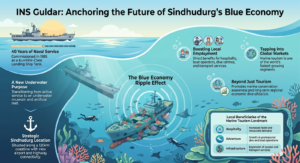
One of the most important aspects of INS Guldar Marine Tourism Sindhudurg is its alignment with India’s blue economy strategy.
The blue economy refers to sustainable economic activities linked to oceans, seas, and coastal regions.
According to the Ministry of Ports, Shipping and Waterways, India’s coastline extends over 7,500 kilometres, creating enormous opportunities across:
- Tourism
- Fisheries
- Maritime transport
- Renewable energy
- Coastal infrastructure
- Marine conservation
The Government of India has increasingly emphasised blue economy initiatives through programs such as Maritime India Vision 2030 and Sagarmala.
These initiatives recognise that coastal regions can become powerful engines of economic growth when developed sustainably.
Infrastructure Is Strengthening Sindhudurg’s Growth Story
Tourism growth rarely occurs without infrastructure development.
Several major infrastructure projects are strengthening Sindhudurg’s connectivity and attractiveness.
Improved Road Connectivity
The ongoing expansion of the Mumbai-Goa Highway is expected to improve travel efficiency throughout the Konkan region.
Enhanced road infrastructure can significantly reduce travel times and improve tourist accessibility.
Sindhudurg Airport
The operationalisation of Sindhudurg Airport represents a major milestone for regional connectivity.
Improved air access makes the district more attractive for:
- Domestic tourists
- International visitors
- Business travelers
- Investors
Coastal Infrastructure
The development of tourism jetties, marine facilities, boating infrastructure, and coastal amenities further supports long-term tourism expansion.
Together, these investments create an enabling ecosystem around projects such as INS Guldar Marine Tourism Sindhudurg.
Government Support for Marine Tourism
Government backing is one of the strongest indicators of long-term viability for emerging tourism sectors.
The Maharashtra government has actively supported:
- Coastal tourism initiatives
- Adventure tourism projects
- Eco-tourism development
- Marine tourism infrastructure
The INS Guldar project itself reflects a significant public-sector commitment to creating new tourism assets.
By investing in innovative attractions, policymakers are seeking to diversify tourism offerings and distribute visitor activity beyond traditional destinations.
This approach is particularly important as travelers increasingly seek unique experiences rather than crowded tourism hotspots.
Opportunities for Investors and Entrepreneurs
Whenever a new tourism ecosystem emerges, multiple business opportunities follow.
Hospitality
Growing visitor numbers typically support demand for:
- Boutique resorts
- Wellness retreats
- Premium holiday homes
- Vacation rentals
- Eco-friendly accommodations
Adventure Tourism
The marine tourism sector creates opportunities in:
- Scuba diving centres
- Snorkeling operations
- Boat excursions
- Marine education programs
- Adventure tourism services
Local Entrepreneurship
Community participation remains critical.
Potential opportunities include:
- Homestays
- Local food enterprises
- Guided tourism services
- Handicrafts
- Cultural experiences
The success of global marine tourism destinations consistently demonstrates that local communities benefit most when integrated into tourism value chains.
Environmental Benefits and Sustainability Considerations
The INS Guldar marine tourism Sindhudurg project also carries important environmental implications.
Artificial Reef Creation
Artificial reefs provide new habitats for marine life.
Research worldwide has shown that properly managed artificial reefs can:
- Increase fish populations
- Enhance biodiversity
- Support ecosystem restoration
- Improve marine habitat complexity
Conservation Awareness
Marine tourism often creates stronger public awareness regarding ocean conservation.
Visitors gain direct exposure to marine ecosystems, fostering greater appreciation for environmental stewardship.
Sustainability Challenges
However, growth must be carefully managed.
Potential risks include:
- Over-tourism
- Marine pollution
- Coral damage
- Habitat disturbance
Successful destinations implement strict regulations, visitor management systems, and conservation protocols.
Sindhudurg’s long-term success will depend on balancing tourism growth with ecological protection.
The Future of Marine Tourism in Sindhudurg
Looking ahead, the INS Guldar marine tourism Sindhudurg project represents far more than a single attraction.
It could become the foundation for an entirely new coastal tourism economy.
Several trends support this possibility:
- Rising demand for experiential tourism
- Growth of domestic travel
- Expansion of adventure tourism
- Increasing interest in marine experiences
- Improved regional infrastructure
- Government support for blue economy initiatives
If managed effectively, Sindhudurg could emerge as one of India’s leading marine tourism destinations over the next decade.
The district already possesses many essential ingredients:
- Natural beauty
- Marine biodiversity
- Coastal heritage
- Infrastructure momentum
- Government support
- Strategic location
INS Guldar simply provides a catalyst capable of accelerating these advantages.
FAQ
1: What is INS Guldar and why is it important for marine tourism in Sindhudurg?
INS Guldar was a Kumbhir-class Landing Ship Tank that served the Indian Navy for nearly four decades before being decommissioned. Today, it has been transformed into an underwater attraction off the Sindhudurg coast, making it a landmark project for INS Guldar marine tourism Sindhudurg. The vessel is expected to function as an artificial reef, underwater museum, and diving attraction, helping Maharashtra establish a unique marine tourism ecosystem while promoting maritime heritage and ocean conservation.
2: Where is the INS Guldar underwater tourism project located?
The INS Guldar project is located near the Nivati Rocks area in Sindhudurg district, Maharashtra, along the Konkan coastline. The site is strategically positioned near popular tourism destinations such as Tarkarli, Malvan, Devbagh, and Sindhudurg Fort, allowing visitors to combine marine tourism experiences with heritage, beach, and eco-tourism activities.
3: How does INS Guldar support marine tourism in Sindhudurg?
The INS Guldar marine tourism Sindhudurg project introduces a new category of experiential tourism to Maharashtra. It is expected to attract scuba divers, marine enthusiasts, underwater photographers, researchers, and adventure travellers. Similar projects worldwide have demonstrated that shipwreck tourism can significantly increase visitor spending, extend tourist stays, and diversify local tourism economies beyond traditional beach tourism.
4: What is an artificial reef and how does INS Guldar contribute to marine biodiversity?
An artificial reef is a human-made underwater structure designed to promote marine life by providing habitat for fish, corals, algae, and other aquatic species. Once submerged, INS Guldar is expected to gradually develop into an artificial reef ecosystem, creating new habitats and increasing biodiversity around the Sindhudurg coastline. Around the world, artificial reefs have successfully supported both conservation efforts and sustainable tourism development.
5: Why is Sindhudurg emerging as a major marine tourism destination in India?
Sindhudurg offers several natural advantages for marine tourism, including a long coastline, clear waters, rich marine biodiversity, coral habitats, and established beach destinations like Tarkarli and Malvan. Combined with improved connectivity through the Mumbai-Goa Highway and Sindhudurg Airport, the district is increasingly being viewed as one of India’s most promising coastal tourism destinations.
6: What economic impact could the INS Guldar marine tourism Sindhudurg project generate?
Marine tourism projects often create direct and indirect economic benefits. The INS Guldar marine tourism Sindhudurg initiative could support employment in hospitality, adventure tourism, transportation, diving services, food businesses, boating operations, and local entrepreneurship. International examples have shown that underwater tourism attractions can generate significant annual revenue while stimulating broader coastal economic activity.
7: How does INS Guldar fit into India’s Blue Economy strategy?
India’s Blue Economy strategy focuses on sustainable economic activities linked to oceans and coastal regions. The INS Guldar marine tourism Sindhudurg project aligns with this vision by promoting marine tourism, supporting coastal livelihoods, encouraging environmental conservation, and creating new economic opportunities within the maritime sector. It represents how tourism can become an important component of India’s broader ocean-based growth strategy.
8: How does INS Guldar compare with global shipwreck tourism destinations?
Globally, destinations such as the USS Oriskany in Florida, HMAS Brisbane in Australia, and Malta’s underwater heritage sites have successfully transformed shipwrecks into tourism assets. These attractions draw thousands of visitors annually and contribute significantly to local economies. INS Guldar represents India’s first large-scale effort to replicate this successful model and establish a dedicated underwater tourism attraction.
9: What opportunities does marine tourism in Sindhudurg create for investors and businesses?
As marine tourism expands, opportunities may emerge across hospitality, eco-resorts, vacation rentals, diving schools, marine equipment rentals, boating services, wellness retreats, restaurants, local experiences, and tourism infrastructure. The growth of the INS Guldar marine tourism Sindhudurg ecosystem could encourage new investments while supporting long-term regional development across the Konkan coast.
10: What is the future outlook for marine tourism in Sindhudurg?
The future of marine tourism in Sindhudurg appears promising due to growing domestic travel demand, rising interest in adventure tourism, improved infrastructure, government support, and increasing awareness of marine experiences. If managed sustainably, the INS Guldar marine tourism Sindhudurg project could help position the district as one of India’s leading marine tourism hubs while contributing to coastal development, employment generation, and blue economy growth over the coming decade.
More Than a Ship Beneath the Sea
When I examine the broader implications of the INS Guldar marine tourism Sindhudurg initiative, I see far more than a retired naval vessel resting beneath the Arabian Sea.
I see a blueprint for how coastal regions can create economic value through innovation, sustainability, and destination diversification.
The project sits at the intersection of tourism, infrastructure, environmental restoration, maritime heritage, and blue economy development.
Its significance extends beyond diving enthusiasts and tourism operators. It offers lessons for policymakers, investors, entrepreneurs, and regional planners seeking sustainable growth opportunities along India’s coastline.
The future of Sindhudurg will not be defined solely by beaches or scenic landscapes. It will increasingly be shaped by how effectively the region leverages its marine assets, strengthens infrastructure, supports local communities, and embraces the opportunities emerging within the blue economy.
In that larger story, INS Guldar is not the destination.
It is the beginning of a much bigger coastal transformation.
