
When Industry Follows Infrastructure: How YEIDA Is Creating a New Land & Growth Corridor
India’s emerging growth corridors are increasingly being shaped by something more powerful than a single road, airport or real estate project: the convergence of infrastructure, industry, employment, logistics, and human movement.
The latest developments around the Yamuna Expressway Industrial Development Authority (YEIDA) provide a compelling example.
As Uttar Pradesh hosts the UP–Japan Investment Meet 2026, two major projects worth a reported ₹3,191 crore have been launched in the YEIDA region. Escorts Kubota is investing around ₹2,000 crore in a new manufacturing facility, while Spark Minda is investing ₹1,166 crore across two manufacturing units. The latter is expected to create approximately 6,440 jobs, according to current reporting.
At the same time, Uttar Pradesh has announced a proposed 500-acre Japanese City in YEIDA, envisioned as an integrated industrial, commercial, and residential ecosystem for Japanese companies and citizens.
For anyone studying YEIDA land investment, these developments deserve attention—not because they guarantee land appreciation, but because they indicate something more fundamental: the gradual formation of an economic ecosystem around the corridor.
And that is where, in my view, the real long-term story begins.
YEIDA Land Investment: Why the Latest Industrial News Matters
The most important development this week is not simply the amount of money being invested.
It is the nature of the investment.
Escorts Kubota’s proposed manufacturing facility is designed around tractors, farm implements and construction equipment, with the company positioning India as an important manufacturing and export base. Spark Minda’s two proposed YEIDA units are focused on automotive components and are expected to create thousands of jobs.
This changes the way we should look at YEIDA land investment.
A manufacturing facility does not operate in isolation.
It requires employees, suppliers, transport operators, warehouses, professional services, maintenance providers, retailers, accommodation, healthcare, education and other supporting infrastructure.
Over time, these requirements can create a wider economic ecosystem.
That is why I believe the more intelligent way to study YEIDA land investment is not simply to ask:
“What is the land price today?”
The better question is:
“What economic activity is likely to surround this land over the long term?”
That distinction is critical for serious investors.
The ₹3,191 Crore Signal: Industry Is Becoming an Economic Anchor
The reported ₹3,191 crore investment represents two major industrial developments in the YEIDA region. Current reporting places Escorts Kubota’s investment at roughly ₹2,025 crore and Spark Minda’s investment at ₹1,166 crore, with combined employment potential running into thousands of jobs.
The projects should be viewed as economic anchors rather than simply real estate announcements.
For YEIDA land investment, this distinction is important.
An economic anchor can generate secondary activity around it.
The sequence often looks something like this:
Industrial investment → employment → supplier ecosystem → logistics → commercial services → housing demand → supporting infrastructure → broader urbanisation
This is not a guarantee of any particular land return. It is an economic mechanism that investors can monitor.
For example, Spark Minda’s two proposed units are expected to create approximately 6,440 jobs.
Thousands of jobs represent more than employment statistics. They potentially translate into additional demand for transportation, services, food, retail, accommodation, and other forms of economic activity.
This is why employment creation is one of the indicators I would encourage anyone evaluating YEIDA land investment to track carefully.
The Proposed 500-Acre Japanese City Adds Another Layer
Another important development is the proposed Japanese City in the YEIDA region.
Invest UP has previously described the proposal as a 500-acre integrated industrial and residential precinct, designed to provide infrastructure and urban amenities for Japanese investors. The proposal has been associated with sectors including automobile and OEM manufacturing, electronics, renewable energy, green hydrogen, IT/ITeS, GCCs and pharmaceuticals.
The word “proposed” matters.
It should not be treated as an already operational township.
But from a strategic perspective, the proposal is significant because it reflects an attempt to create industrial clustering.
Industrial clustering is important because companies often benefit from being closer to:
- suppliers,
- skilled workers,
- logistics networks,
- business services,
- infrastructure,
- institutions and
- complementary industries.
For YEIDA land investment, the emergence of a planned industrial-residential ecosystem can therefore be studied as a potential long-term economic driver.
The investment thesis is not “a Japanese City has been announced, therefore land prices will rise.”
The more responsible thesis is:
A dedicated economic ecosystem could increase the depth and diversity of activity in the region if the planned investments are successfully executed.
That is a much more evidence-led way of looking at YEIDA land investment.
Noida International Airport Has Changed the Connectivity Equation
The industrial story becomes considerably more interesting when viewed alongside another major transformation: Noida International Airport is now operational.
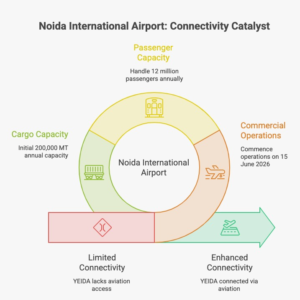
The airport commenced commercial operations on 15 June 2026, with IndiGo operating the first commercial flight. The airport’s Phase I is designed to handle 12 million passengers annually, while its broader masterplan provides for expansion to more than 70 million passengers annually in later phases.
This matters greatly when analysing YEIDA land investment because connectivity has moved from being primarily a future promise to becoming an operating economic asset.
The airport also has an important cargo dimension.
Its current cargo facilities have an initial annual handling capacity of 200,000 metric tonnes, with plans to scale towards 1.5 million tonnes.
The airport’s cargo infrastructure is being developed around road, air and logistics connectivity, strengthening the potential relationship between aviation and manufacturing activity.
For YEIDA land investment, this creates an important distinction.
The region is no longer being shaped only by passenger accessibility.
It is also developing capabilities connected with:
manufacturing + cargo + logistics + aviation + exports.
That combination can be much more consequential for an economic corridor than simple residential connectivity.
From Infrastructure Corridor to Economic Corridor
This is where I believe the broader lesson for YEIDA land investment becomes clear.
A road creates access.
An airport expands regional and international connectivity.
An industrial plant creates employment.
A logistics network facilitates movement of goods.
A cluster of businesses creates recurring economic activity.
Together, these elements can transform the character of a geography.
This is the difference between an infrastructure corridor and an economic corridor.
For investors studying YEIDA land investment, the distinction is worth remembering.
A location can be physically well connected without becoming a major economic centre.
The stronger transformation occurs when infrastructure begins supporting real economic activity.
That is why I would watch five indicators particularly closely:
- Industrial investment
- Employment generation
- Airport and logistics utilisation
- Supporting commercial and residential development
- Quality of urban infrastructure
The more of these indicators that become operational rather than merely proposed, the stronger the evidence for a developing economic ecosystem.
What Does This Mean for YEIDA Land Investment?
The answer requires discipline.
Industrial announcements do not automatically translate into land appreciation.
Airport development does not guarantee returns.
And proximity to infrastructure alone is not sufficient to justify an investment decision.
For YEIDA land investment, the more useful approach is to evaluate the underlying drivers.
1. Look at economic activity, not only announcements
Distinguish between:
- proposed projects,
- approved projects,
- projects under construction,
- operational projects and
- expansion phases.
The ₹3,191 crore projects now being launched provide stronger evidence than an unconfirmed proposal, while the airport provides an even more concrete example because commercial operations have already commenced.
2. Study employment
Employment is one of the clearest links between industrial investment and local economic activity.
For YEIDA land investment, job creation can potentially influence demand for housing, transportation, services and commercial infrastructure.
3. Study logistics
Manufacturing depends on the efficient movement of raw materials and finished products.
The presence of airport cargo infrastructure, the Yamuna Expressway and planned multimodal connectivity makes logistics an important part of the YEIDA story.
4. Study the surrounding urban ecosystem
A successful industrial corridor ultimately needs more than factories.
It needs:
- housing,
- healthcare,
- education,
- retail,
- hospitality,
- recreation,
- public transport and
- community infrastructure.
This is where YEIDA land investment becomes an urban transformation story rather than simply a land story.
The Sustainability Question Cannot Be Separated From Land Development
There is another dimension that I believe deserves far greater attention.
As economic corridors grow, we should not ask only:
“How much development can this land accommodate?”
We should also ask:
“What kind of environment will this development create for the next generation?”
This is particularly relevant to my own philosophy around land.
Land is not merely a financial instrument.
It is soil, water, biodiversity, food potential, open space and human habitat.
A genuinely future-ready growth corridor should therefore integrate economic development with:
- water conservation,
- efficient waste management,
- renewable energy,
- green infrastructure,
- biodiversity,
- productive landscapes,
- urban farming and
- climate-conscious planning.
This does not weaken the investment conversation.
In my view, it strengthens it.
Long-term wealth creation and responsible development should not be treated as opposing ideas.
The most enduring communities are likely to be those that combine economic opportunity with liveability.
What Entrepreneurs and Landowners Can Learn From YEIDA
The lessons from YEIDA land investment extend beyond investors.
For entrepreneurs
An emerging industrial ecosystem can create opportunities beyond manufacturing itself.
Ancillary services, logistics, hospitality, technology, professional services and workforce-oriented businesses can all become relevant as economic activity deepens.
For landowners
Land should be evaluated in its wider context.
What infrastructure is coming?
Which projects are actually approved?
Where are employment centres emerging?
How is connectivity improving?
What is the applicable land-use framework?
These questions are more useful than simply asking what someone else is willing to pay for a parcel today.
For long-term investors
The central lesson is patience.
YEIDA land investment should be viewed through a multi-year or multi-decade lens, because infrastructure and economic ecosystems rarely mature overnight.
For policymakers
The challenge is to ensure that industrialisation and urbanisation are accompanied by appropriate housing, mobility, water, environmental planning and social infrastructure.
Economic growth becomes more durable when communities can grow alongside it.
A Practical Framework for Evaluating YEIDA Land Investment
Before considering YEIDA land investment, I would suggest looking at the corridor through ten questions:
- What infrastructure is already operational?
- What projects have received formal approval?
- Which announced investments have entered execution?
- How many jobs could the industrial ecosystem create?
- How accessible is the location by road, air, rail and public transport?
- What logistics infrastructure is available?
- What commercial and residential ecosystem is developing?
- What is the applicable land-use and planning framework?
- What environmental and water considerations should be evaluated?
- Does the investment thesis still make sense over a 10–20 year horizon?
This framework is useful because YEIDA land investment should never be reduced to a single number.
Price is one variable.
The economic ecosystem around the land is another.
The quality of future development is another.
And sustainability is increasingly part of the long-term equation.
The 10–20 Year Perspective
One of the biggest mistakes in real estate is judging long-duration assets using short-duration thinking.
A road may take years to influence development.
An airport may take years to build its passenger and cargo ecosystem.
An industrial cluster may require multiple investment cycles.
A city itself evolves over decades.
Therefore, the most meaningful question around YEIDA land investment is not what happens next month.
It is what happens when infrastructure, industry, employment and urbanisation reinforce each other over the next 10–20 years.
The current developments provide several signals worth monitoring:
Operational airport
→ Industrial investment
→ Employment
→ Cargo and logistics
→ Supporting businesses
→ Urban services
→ Community formation
→ Long-term economic geography
None of these stages guarantees a specific investment outcome.
But together, they provide a framework for understanding why YEIDA land investment has become an increasingly relevant subject for long-term investors.
The Bigger Lesson: Land Value Follows Economic Purpose
After decades of observing real estate and land markets, I believe one principle remains remarkably consistent:
The best land decisions begin with understanding purpose.
Why is infrastructure being built?
Why are companies investing?
Where will employment come from?
Where will people live?
How will goods move?
How will communities function?
And how responsibly will the land be developed?
The emerging YEIDA story brings all of these questions together.
The current Japanese investment developments, the proposed 500-acre Japanese City and the operational Noida International Airport are not isolated events. They represent different components of a larger economic geography.
For anyone considering YEIDA land investment, that is the perspective I would recommend.
Do not look only at today’s price.
Study the infrastructure.
Study the economic anchors.
Study employment.
Study connectivity.
Study planning.
Study sustainability.
And above all, think in years and decades rather than weeks and quarters.
Because ultimately, land becomes truly valuable when it becomes part of a productive, connected and liveable ecosystem.
That is the difference between simply owning land and understanding its long-term potential.
FAQs
1. What is driving YEIDA land investment in 2026?
YEIDA land investment is gaining strategic attention because several major infrastructure and economic developments are converging in the region. These include the operational Noida International Airport, new industrial investments, expanding logistics infrastructure, and the proposed Japanese City.
The latest UP–Japan investment developments include reported investments of approximately ₹3,191 crore by Escorts Kubota and Spark Minda in the YEIDA region. Spark Minda’s proposed projects are expected to generate thousands of jobs, creating the potential for wider demand for logistics, services, commercial activity and supporting infrastructure.
For investors, the important point is that YEIDA land investment should be evaluated as part of a developing economic ecosystem rather than simply by today’s land prices.
The official Invest UP platform provides government information on investment initiatives and industrial development in Uttar Pradesh.
2. Why is YEIDA becoming an important growth corridor for YEIDA land investment?
The YEIDA land investment story is increasingly connected with the convergence of road, aviation, industrial and logistics infrastructure.
The Yamuna Expressway provides major road connectivity, while Noida International Airport began commercial operations on 15 June 2026. Phase I of the airport has a designed annual passenger capacity of 12 million, providing a new aviation gateway for the wider region. (Noida International Airport)
At the same time, industrial projects are bringing manufacturing activity closer to this infrastructure.
This creates a potentially powerful sequence:
Connectivity → Industry → Employment → Logistics → Services → Urbanisation
That ecosystem effect is one of the most important factors to monitor when evaluating YEIDA land investment over a long-term horizon.
3. What is the proposed 500-acre Japanese City in YEIDA?
The proposed Japanese City is an important component of the broader YEIDA land investment and industrial-development narrative.
According to Invest UP, the proposed development covers approximately 500 acres and is intended to provide an integrated environment for Japanese industrial, commercial and residential activity. The planned ecosystem has been associated with sectors including automobiles, electronics, renewable energy, green hydrogen, IT/ITeS, GCCs and pharmaceuticals. (Invest UP)
It is important to describe the Japanese City as a proposed/planned development, rather than an operational city.
From a YEIDA land investment perspective, its significance lies in the potential for industrial clustering. When businesses, suppliers, employees and supporting services operate within the same geographical ecosystem, the nature of local economic activity can change substantially.
However, investors should distinguish between announced plans, approved projects, construction and operational developments before making decisions.
4. What does the ₹3,191 crore investment mean for YEIDA land investment?
The reported ₹3,191 crore investment represents a significant industrial-development signal for YEIDA land investment.
Current reporting indicates approximately ₹2,025 crore of investment from Escorts Kubota and ₹1,166 crore from Spark Minda’s proposed projects. Spark Minda has stated that its two YEIDA units are expected to create approximately 6,440 jobs.
The significance extends beyond the factories themselves.
Large manufacturing projects can create demand for:
- Employees and workforce housing
- Logistics and warehousing
- Transportation
- Suppliers and ancillary businesses
- Retail and services
- Hospitality
- Professional services
This does not mean that surrounding land prices will automatically increase. Instead, it creates an economic driver that investors can monitor when evaluating YEIDA land investment.
5. How does Noida International Airport influence YEIDA land investment?
Noida International Airport is one of the most important infrastructure developments to consider when studying YEIDA land investment.
Commercial operations commenced on 15 June 2026, marking a transition from a planned infrastructure project to an operational aviation asset. Phase I has a designed capacity of 12 million passengers annually.
The airport also has a cargo dimension. Its initial cargo facilities have an annual handling capacity of approximately 200,000 metric tonnes, with planned expansion toward substantially higher capacity.
For YEIDA land investment, this means the region’s connectivity story is becoming broader than highway access.
It potentially combines:
Road + Airport + Cargo + Manufacturing + Logistics + Employment
That combination can support the development of a more diversified economic corridor over time.
6. Is YEIDA land investment suitable for long-term investors?
YEIDA land investment may be relevant for investors who understand and are comfortable with a long-duration land-investment strategy, but suitability depends on individual financial circumstances, land title, approvals, land-use regulations, location, liquidity requirements and investment horizon.
The strongest approach is to evaluate the underlying fundamentals rather than relying solely on current market sentiment.
Investors should examine:
- Infrastructure that is already operational
- Projects formally approved or under execution
- Industrial investment
- Employment potential
- Road, airport and logistics connectivity
- Applicable land-use regulations
- Surrounding development
- Environmental considerations
- Local demand
- Their own long-term financial objectives
The Invest UP and Noida International Airport websites can help investors distinguish between official infrastructure and investment information and market speculation.
Most importantly, YEIDA land investment should never be treated as a guaranteed-return proposition.
7. What factors should investors examine before considering YEIDA land investment?
Before considering YEIDA land investment, investors should look at the entire economic and planning context surrounding a parcel rather than focusing exclusively on its quoted price.
A useful evaluation framework includes:
Infrastructure: Is the promised infrastructure operational, under construction, or merely proposed?
Economic anchors: Are credible companies investing in the surrounding area?
Employment: Are projects expected to create meaningful employment?
Connectivity: How accessible is the location through roads, airport, rail, and public transport?
Land use: Is the proposed use legally and officially permissible?
Urban ecosystem: Are housing, healthcare, education, retail, and other services developing?
Environment: What are the area’s water, drainage, green-space and ecological considerations?
Time horizon: Does the investment thesis remain meaningful over 10–20 years?
For YEIDA land investment, this type of due diligence is more useful than relying on short-term price speculation.
Official information from Invest UP and Noida International Airport should be prioritised when verifying major infrastructure and investment developments.
8. Can industrial development increase demand around YEIDA land?
Industrial development can potentially influence surrounding demand, which is why it is an important consideration for YEIDA land investment.
A manufacturing facility creates direct employment. Employees and businesses then require transportation, food, retail, housing, healthcare, logistics and professional services.
As multiple companies establish themselves within the same geography, these requirements can contribute to a broader economic ecosystem.
The current YEIDA land investment narrative is particularly interesting because the region is seeing multiple layers develop simultaneously: industrial investment, airport connectivity and logistics infrastructure.
However, the relationship is not automatic.
A factory announcement alone does not establish a future property market. The actual impact depends on project execution, employment creation, supporting infrastructure, planning and real economic activity.
That is why the reported projects by Escorts Kubota and Spark Minda should be viewed as economic indicators, rather than guarantees of future land appreciation.
9. How important is sustainability to the future of YEIDA land investment?
Sustainability should become an increasingly important part of the YEIDA land investment conversation as the corridor develops.
Large-scale economic development requires more than roads, factories and buildings. Future communities also need effective water management, green infrastructure, waste management, energy efficiency, open spaces and climate-conscious planning.
From a long-term perspective, land is not merely a financial asset. It is also a physical ecosystem containing soil, water, vegetation and biodiversity.
This is particularly relevant to my own approach to YEIDA land investment and sustainable development: development should create economic value while also supporting healthier and more liveable communities.
Future-ready planning can potentially incorporate:
- Water conservation
- Renewable energy
- Green spaces
- Urban farming
- Productive landscapes
- Biodiversity
- Efficient waste systems
- Climate-resilient infrastructure
The Ministry of Housing and Urban Affairs is a useful primary source for India’s broader urban-development policies and planning frameworks.
10. What is the long-term outlook for YEIDA land investment?
The long-term outlook for YEIDA land investment should be viewed through the gradual development of an economic corridor rather than a short-term price forecast.
Several developments are worth monitoring:
- Noida International Airport’s passenger growth
- Expansion of airport cargo activity
- Industrial project execution
- Employment generation
- Japanese investment and the proposed Japanese City
- Logistics development
- Supporting commercial infrastructure
- Residential and social infrastructure
- Broader Yamuna Expressway regional development
The airport’s commercial operations and the latest industrial investments provide tangible developments to monitor, while the proposed Japanese City represents a longer-term planning initiative.
For YEIDA land investment, I believe the most useful perspective is therefore a 10–20 year framework.
Infrastructure may create accessibility. Industry can create employment. Employment can attract services. Services can support communities.
But the outcome will depend on execution, economic conditions, planning, and sustainable development.
The most important lesson is simple:
Do not evaluate land only by what it is today. Understand the economic, infrastructural and environmental ecosystem that may shape what it becomes tomorrow.
For official investment and industrial-development updates, investors should continue monitoring Invest UP, while aviation developments can be tracked through the official Noida International Airport website
Final Perspective
The story emerging from YEIDA is ultimately larger than real estate.
It is about how India is building new economic geographies.
When airports become operational, industries establish manufacturing capacity, logistics networks expand and employment begins to cluster, land can acquire a new economic context.
That is why YEIDA land investment deserves to be studied through a broader lens.
Not through hype.
Not through short-term speculation.
But through infrastructure, industry, employment, connectivity, sustainability and time.
Infrastructure may open the door. Industry may create the opportunity. But a sustainable economic ecosystem determines what comes next.
