

How Jewar’s New Airport Connectivity Corridor Could Shape North India’s Next Investment Hub
Infrastructure Builds More Than Roads—It Shapes the Future
For years, I have believed that true wealth creation begins long before buildings rise or land values appreciate. It starts with visionary infrastructure, thoughtful planning, and a commitment to creating ecosystems where businesses, communities, and nature can thrive together. Every major economic transformation around the world has been driven by investments in connectivity, and India is now witnessing a similar evolution through strategic infrastructure corridors that promise to redefine regional development.
One such transformative initiative is the Jewar Airport Connectivity Corridor, a project that goes far beyond improving travel time. In my view, the Jewar Airport Connectivity Corridor represents a significant step toward building an integrated economic ecosystem where transportation, logistics, industry, sustainable development, and long-term investment converge. Rather than viewing it as merely another road project, I see it as a catalyst that has the potential to reshape how North India grows over the coming decades.
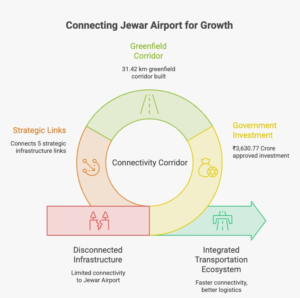
The Government of India’s recent approval of the revised ₹3,630.77 crore capital investment for the 31.42-kilometre greenfield connectivity corridor demonstrates the strategic importance of this project. The corridor will establish a direct connection between the Delhi–Mumbai Expressway and the upcoming Noida International Airport at Jewar, improving accessibility from Delhi, Gurugram, Faridabad, and surrounding regions while integrating with the Yamuna Expressway and other major transport networks. This integrated planning reflects a long-term vision of creating seamless mobility for people, businesses, and industries alike.
As someone who advocates responsible development and sustainable land planning, I believe infrastructure should never be evaluated solely by its construction cost or physical dimensions. Its true value lies in the opportunities it creates—new industries, employment generation, improved logistics, enhanced regional competitiveness, and better quality of life for future generations. The Jewar Airport Connectivity Corridor has the potential to become one of those defining infrastructure projects that influences economic activity for decades rather than years.
History consistently demonstrates that airports do much more than facilitate air travel. They become magnets for manufacturing, logistics, warehousing, hospitality, commercial development, technology parks, and residential communities. Around the world, successful airport-led development has transformed entire regions into thriving economic hubs, and India is steadily adopting a similar approach through integrated infrastructure planning. The Jewar Airport Connectivity Corridor is expected to play a critical role in connecting these emerging economic opportunities with one of the country’s largest consumer and industrial markets.
Understanding the Jewar Airport Connectivity Corridor
The Jewar Airport Connectivity Corridor has been designed to strengthen regional mobility while supporting India’s broader infrastructure and economic development goals. Instead of functioning as an isolated transportation project, the corridor forms an essential component of a larger multimodal network that connects expressways, industrial corridors, freight movement, and the upcoming Noida International Airport.
According to the Government of India, the project will provide direct connectivity between the Delhi–Mumbai Expressway and the airport, significantly improving access for travellers, cargo operators, industries, and logistics companies. The project is also expected to reduce congestion on existing routes, improve travel efficiency, and strengthen connectivity between major economic centres across the National Capital Region.
What makes the Jewar Airport Connectivity Corridor particularly significant is not merely the road itself but the strategic planning behind it. When infrastructure projects are interconnected with airports, expressways, freight corridors, and industrial zones, they create powerful economic networks that attract businesses, encourage private investment, and support long-term regional development.
Another encouraging aspect of India’s evolving infrastructure strategy is the growing emphasis on sustainability. Recent highway initiatives have demonstrated the government’s commitment to incorporating recycled construction materials, bio-mined waste, extensive plantation drives, and environmentally responsible engineering practices into major infrastructure projects. This reflects an important shift toward balancing economic growth with environmental stewardship—a philosophy that closely aligns with my belief that development should enhance both prosperity and ecological resilience.
As I see it, the Jewar Airport Connectivity Corridor is not simply creating a faster route to an airport. It is laying the foundation for a future-ready growth corridor where infrastructure, sustainability, investment, and responsible urban planning work together to build stronger communities and a more resilient regional economy. Understanding this broader perspective is essential for policymakers, investors, entrepreneurs, and anyone seeking to appreciate how transformative infrastructure can shape the future of an entire region.
Why Connectivity Creates Economic Growth: The Real Value of the Jewar Airport Connectivity Corridor
Whenever I analyse a major infrastructure project, I look beyond its engineering specifications or construction budget. Roads, expressways, and airports are not merely physical assets—they are economic catalysts that influence how businesses operate, where industries invest, how communities grow, and ultimately how regions create long-term prosperity. This is precisely why I believe the Jewar Airport Connectivity Corridor deserves attention not only from urban planners and policymakers but also from long-term investors, entrepreneurs, and business leaders.
Infrastructure has always been one of the strongest indicators of future economic growth. Across the world, regions with superior connectivity have consistently attracted higher levels of industrial investment, commercial activity, and employment. Improved transportation networks reduce travel time, lower logistics costs, enhance supply chain efficiency, and increase the competitiveness of businesses operating within the region. The Jewar Airport Connectivity Corridor has been planned with exactly this long-term vision in mind.
According to the National Highways Authority of India (NHAI) and the Ministry of Road Transport & Highways, improving multimodal connectivity remains one of the key priorities for strengthening India’s logistics ecosystem and reducing transportation costs. Better connectivity not only benefits businesses but also enhances the efficiency of trade, manufacturing, exports, and regional development.
One of the most significant advantages of the Jewar Airport Connectivity Corridor is that it is not being developed as an isolated transport project. Instead, it forms part of an integrated infrastructure network that connects the Delhi–Mumbai Expressway, Yamuna Expressway, Eastern Peripheral Expressway, Dedicated Freight Corridor, and the upcoming Noida International Airport. This interconnected approach creates a seamless movement of passengers, cargo, goods, and services, making the region increasingly attractive for industries that depend on efficient logistics.
In my experience, airports have always acted as powerful economic engines rather than simple transportation facilities. Around every successful international airport, one eventually sees the emergence of logistics parks, warehousing clusters, commercial centres, hospitality projects, manufacturing units, technology parks, and supporting residential communities. The Jewar Airport Connectivity Corridor is expected to strengthen this ecosystem by ensuring that businesses can access the airport quickly while remaining connected to some of India’s most important industrial and economic corridors.
Global institutions such as the World Bank have repeatedly highlighted that investments in quality infrastructure contribute directly to productivity, employment generation, and long-term economic competitiveness. Efficient transport networks reduce operational inefficiencies, improve market access for businesses, and encourage greater private investment in emerging regions.
Similarly, NITI Aayog has consistently emphasised that integrated infrastructure development is essential for achieving sustainable economic growth, improving logistics performance, and supporting India’s ambition of becoming a globally competitive manufacturing and investment destination.
Another important dimension of the Jewar Airport Connectivity Corridor is its potential to create a multiplier effect across multiple sectors of the economy. Every major infrastructure investment generates opportunities that extend far beyond the construction phase. Improved connectivity attracts industries, industries generate employment, employment increases housing demand, housing supports commercial development, and commercial activity stimulates further investment in public infrastructure. This interconnected cycle has been observed in many successful infrastructure-led growth corridors across the world.
From an investment perspective, I believe it is essential to understand this economic sequence rather than focusing only on short-term market movements. Sustainable wealth creation is rarely driven by speculation. Instead, it is built upon strong economic fundamentals such as infrastructure, employment growth, industrial expansion, governance, and long-term regional planning. The Jewar Airport Connectivity Corridor represents one of these foundational developments that can influence the trajectory of an entire region over many years.
However, infrastructure alone does not guarantee success. Responsible planning, environmental stewardship, efficient implementation, and coordinated policy support remain equally important. When these elements work together, infrastructure becomes more than a transportation network—it becomes the backbone of resilient, future-ready communities.
As I see it, the Jewar Airport Connectivity Corridor is not simply improving connectivity between an expressway and an airport. It is creating the conditions for a more integrated regional economy where mobility, commerce, sustainability, innovation, and long-term investment reinforce one another. Understanding this broader economic relationship allows investors to look beyond immediate headlines and appreciate how thoughtfully planned infrastructure can shape the future of an entire growth corridor.
The Integrated Infrastructure Network Transforming Jewar: Why the Jewar Airport Connectivity Corridor Is More Than a Road Project
Whenever I evaluate a large-scale infrastructure project, I never assess it in isolation. Roads, airports, railways, logistics parks, industrial corridors, and urban development plans are all interconnected pieces of a much larger economic puzzle. In my experience, it is this integration—not individual projects—that creates sustainable regional growth. That is precisely what makes the Jewar Airport Connectivity Corridor one of India’s most strategically significant infrastructure initiatives today.
The true strength of the Jewar Airport Connectivity Corridor lies in its ability to connect multiple national infrastructure assets into one seamless mobility network. Rather than serving only as an access road to the upcoming Noida International Airport, the corridor will integrate some of India’s most important transportation networks, creating a future-ready ecosystem for trade, industry, logistics, tourism, and sustainable urban development.
According to the Press Information Bureau (PIB), the newly approved corridor will directly connect the Delhi–Mumbai Expressway with Noida International Airport while significantly improving accessibility from Delhi, Gurugram, Faridabad, and neighbouring regions. This strategic connectivity is expected to reduce travel time, improve freight movement, and strengthen regional mobility.
The Delhi–Mumbai Expressway: India’s Economic Spine
One of the most significant advantages of the Jewar Airport Connectivity Corridor is its direct integration with the Delhi–Mumbai Expressway, India’s flagship infrastructure project. Spanning approximately 1,386 kilometres, the expressway is expected to reduce travel time between Delhi and Mumbai while enhancing freight efficiency and industrial connectivity across several states.
For businesses, manufacturers, exporters, and logistics companies, faster transportation translates into lower operational costs, quicker deliveries, and improved competitiveness. For investors, it signals the creation of an infrastructure ecosystem capable of supporting long-term economic expansion rather than short-term speculative growth.
Yamuna Expressway: Strengthening Regional Mobility
The Jewar Airport Connectivity Corridor also benefits from its integration with the Yamuna Expressway, one of North India’s most important transportation corridors. Connecting Greater Noida with Agra, the expressway has already transformed regional accessibility and supported industrial, institutional, residential, and commercial development along its route.
The addition of the Jewar Airport Connectivity Corridor further strengthens this network by creating faster access to the airport while improving connectivity for businesses and communities across western Uttar Pradesh and the National Capital Region.
Dedicated Freight Corridor: Powering India’s Logistics Future
Another defining feature of the Jewar Airport Connectivity Corridor is its proximity to the Dedicated Freight Corridor (DFC), one of India’s largest logistics infrastructure initiatives. Developed to enhance the movement of goods across the country, the DFC is expected to reduce congestion on passenger rail networks while significantly improving freight efficiency.
When airports, expressways, and freight corridors function together, they create an integrated logistics ecosystem capable of supporting manufacturing, exports, e-commerce, warehousing, and supply chain operations. This level of connectivity makes regions more attractive to domestic and global businesses seeking efficient transportation infrastructure.
Noida International Airport: A Catalyst for Regional Transformation
In my opinion, the upcoming Noida International Airport is not merely another aviation project—it is a catalyst for economic transformation. Globally, major airports have evolved into centres for commerce, innovation, hospitality, logistics, and employment. The Jewar Airport Connectivity Corridor will play an equally important role by ensuring that this emerging airport ecosystem remains efficiently connected to national transport networks.
The airport is expected to support passenger mobility, cargo operations, aviation services, tourism, and international business connectivity, creating opportunities across multiple sectors. However, these opportunities can only be fully realised through efficient road and multimodal connectivity, which is precisely where the Jewar Airport Connectivity Corridor becomes indispensable.
Building an Integrated Growth Corridor
What inspires me most about the Jewar Airport Connectivity Corridor is the government’s broader vision of integrated infrastructure planning. Rather than investing in isolated assets, India is increasingly developing interconnected transportation systems that link highways, airports, industrial corridors, logistics parks, and urban centres into one coordinated growth network.
This integrated approach aligns closely with recommendations from NITI Aayog, which has consistently highlighted that multimodal infrastructure and logistics integration are essential for improving economic productivity, reducing logistics costs, and enhancing India’s global competitiveness.
As I see it, the Jewar Airport Connectivity Corridor represents far more than enhanced connectivity. It demonstrates how thoughtful infrastructure planning can strengthen regional resilience, encourage industrial diversification, improve mobility, and create the foundation for sustainable economic growth. When expressways, airports, freight corridors, and urban development are planned together, they do not simply connect destinations—they connect opportunities. It is this integrated vision that has the potential to shape the future of the Jewar region and position it as one of North India’s most promising long-term growth corridors.
Infrastructure and Sustainable Development: Building Beyond Roads Through the Jewar Airport Connectivity Corridor
As someone who has always believed that development should create value for both people and the planet, I see infrastructure as far more than an engineering achievement. Roads, airports, and expressways should not only improve connectivity but also strengthen environmental resilience, support responsible urbanisation, and enhance the quality of life for future generations. This philosophy is particularly relevant when evaluating the Jewar Airport Connectivity Corridor, a project that has the potential to become a benchmark for integrated and sustainable infrastructure development in India.
For decades, infrastructure projects were often measured by their size, speed of execution, or economic output. Today, the conversation is evolving. Governments, policymakers, investors, and developers increasingly recognise that future-ready infrastructure must balance economic growth with environmental responsibility. The Jewar Airport Connectivity Corridor reflects this broader transition, where connectivity is being planned alongside long-term regional development rather than as an isolated transportation project.
One encouraging aspect of India’s infrastructure strategy is the growing emphasis on sustainable construction practices. According to the Ministry of Road Transport & Highways (MoRTH), several national highway projects are incorporating innovative approaches such as the use of bio-mined waste from landfill sites, recycled construction materials, extensive plantation drives, improved drainage systems, and environmentally responsible engineering techniques. These initiatives demonstrate that infrastructure can support both economic progress and environmental conservation.
In my opinion, this approach represents the future of infrastructure planning. Every kilometre of road should contribute not only to economic efficiency but also to climate resilience, resource conservation, and sustainable land use. As the Jewar Airport Connectivity Corridor becomes part of North India’s expanding transport network, integrating environmentally responsible practices will be essential for ensuring that growth remains balanced and inclusive.
The importance of sustainable infrastructure is also recognised globally. The United Nations Sustainable Development Goals (SDGs) highlight resilient infrastructure, sustainable cities, responsible consumption, and climate action as key priorities for long-term economic prosperity. Similarly, the World Economic Forum has consistently emphasised that infrastructure investments should improve environmental performance while supporting economic competitiveness and social well-being.
For me, sustainable development also extends beyond construction methods. It includes thoughtful land use planning, preservation of natural ecosystems, efficient water management, green mobility, biodiversity conservation, and creating communities that remain liveable for generations. Infrastructure should enable progress without compromising ecological balance. This principle is particularly important in emerging growth corridors where urban expansion is expected to accelerate over the coming decades.
Real Estate, Industry and Investment Outlook: Looking Beyond Short-Term Market Cycles
Whenever a transformative infrastructure project is announced, conversations often shift immediately towards property prices. While market appreciation naturally attracts attention, I believe the more important question is why infrastructure influences long-term economic value. The answer lies in the broader ecosystem that projects like the Jewar Airport Connectivity Corridor help create.
Infrastructure attracts businesses. Businesses create employment. Employment generates demand for housing, retail, healthcare, education, hospitality, and commercial services. As these sectors expand, they contribute to a stronger regional economy that supports sustainable real estate growth over the long term. The Jewar Airport Connectivity Corridor is expected to strengthen this cycle by improving accessibility between industrial zones, logistics hubs, commercial centres, and the upcoming Noida International Airport.
Leading real estate consulting firms such as JLL, Knight Frank, CBRE, Colliers, ANAROCK, and Savills have consistently observed that high-quality infrastructure remains one of the strongest long-term drivers of real estate demand, institutional investment, and commercial expansion across emerging urban corridors. Rather than reacting to short-term market sentiment, these organisations emphasise the importance of infrastructure, economic activity, employment generation, and governance as the true foundations of sustainable market growth.
From an investor’s perspective, I believe the Jewar Airport Connectivity Corridor should be viewed through the lens of long-term regional transformation rather than short-term speculation. Successful infrastructure corridors evolve gradually as connectivity improves, industries establish operations, businesses expand, employment opportunities increase, and supporting urban infrastructure develops over time. This phased development creates stronger economic fundamentals and encourages more resilient growth.
The most successful investment decisions are rarely driven by headlines alone. They are built upon careful analysis of infrastructure planning, government policy, environmental sustainability, demographic trends, industrial expansion, and long-term economic vision. The Jewar Airport Connectivity Corridor represents one such opportunity to understand how integrated infrastructure can shape future growth while reinforcing the importance of responsible development.
As I reflect on India’s evolving infrastructure landscape, I remain convinced that projects like the Jewar Airport Connectivity Corridor are not simply connecting destinations—they are connecting industries, people, ideas, and opportunities. When infrastructure is planned responsibly, supported by sustainable practices, and integrated with long-term regional development strategies, it becomes far more than a transportation asset. It becomes the foundation upon which resilient economies, thriving communities, and lasting prosperity are built.
Lessons for Long-Term Investors: Why the Jewar Airport Connectivity Corridor Should Be Viewed Through a Long-Term Lens
Throughout my journey in real estate and sustainable land development, I have observed one consistent pattern: the most successful investments are rarely driven by short-term market excitement. Instead, they are built upon strong economic fundamentals, visionary infrastructure planning, responsible governance, and patience. This is exactly how I believe investors should evaluate the Jewar Airport Connectivity Corridor.
Major infrastructure projects often attract immediate attention because of the opportunities they appear to create. However, experienced investors understand that true value is not created overnight. Roads may be constructed within a few years, but the economic ecosystem that develops around them—industries, commercial centres, educational institutions, healthcare facilities, logistics hubs, hospitality businesses, and thriving communities—takes time to mature. The Jewar Airport Connectivity Corridor should therefore be viewed as a long-term economic catalyst rather than simply another transportation project.
India’s infrastructure strategy is increasingly centred on creating integrated economic corridors instead of standalone assets. Government initiatives such as the PM Gati Shakti National Master Plan aim to improve multimodal connectivity by bringing together highways, railways, airports, ports, industrial corridors, and logistics infrastructure under a unified planning framework. The Jewar Airport Connectivity Corridor aligns closely with this national vision by enhancing connectivity between the Delhi–Mumbai Expressway, Noida International Airport, the Dedicated Freight Corridor, and the wider National Capital Region.
From my perspective, investors should always begin by asking one simple question: What problem does this infrastructure solve? In the case of the Jewar Airport Connectivity Corridor, the answer extends far beyond reducing travel time. It improves freight movement, enhances airport accessibility, supports industrial development, encourages commercial investment, and strengthens regional competitiveness. These are structural improvements that can influence economic activity for decades.
Five Principles I Believe Every Long-Term Investor Should Consider
Rather than focusing solely on current market sentiment, I believe investors should evaluate infrastructure-led regions using a structured framework.
1. Infrastructure Before Appreciation
In my experience, infrastructure usually precedes economic expansion. Expressways, airports, industrial corridors, and logistics networks create the conditions that allow businesses and communities to flourish. The Jewar Airport Connectivity Corridor is one of these enabling investments that can strengthen the region’s long-term economic foundation.
2. Employment Drives Sustainable Demand
Economic growth is ultimately supported by people. As industries expand and businesses establish operations, employment opportunities increase. This creates demand for housing, retail, healthcare, hospitality, education, and commercial spaces. Sustainable real estate demand is therefore closely linked to job creation rather than speculation alone.
According to Invest India, infrastructure and industrial development remain among the key drivers supporting manufacturing, logistics, exports, and employment across India’s emerging economic corridors.
3. Connectivity Creates Competitive Regions
Regions with efficient transportation infrastructure generally become more attractive for businesses because they reduce logistics costs and improve operational efficiency. The Jewar Airport Connectivity Corridor strengthens multimodal connectivity by linking national highways, expressways, freight corridors, and an international airport into a single integrated transport ecosystem.
The World Bank has consistently recognised quality infrastructure as one of the primary contributors to long-term productivity and sustainable economic competitiveness.
4. Sustainability Is Becoming an Investment Indicator
As an environmentalist, I strongly believe sustainability should no longer be viewed as an optional consideration. Around the world, investors increasingly evaluate regions based on environmental resilience, resource management, green infrastructure, and responsible planning.
Projects that integrate ecological conservation with infrastructure development are likely to create healthier, more resilient communities over the long term. The Jewar Airport Connectivity Corridor, when supported by sustainable construction practices and responsible urban planning, has the opportunity to contribute positively to this evolving investment landscape.
5. Patience Creates Long-Term Wealth
Perhaps the most valuable lesson I have learned is that infrastructure-led development follows a gradual cycle. First comes planning. Then infrastructure. This is followed by industrial activity, employment generation, commercial expansion, residential demand, and eventually broader regional economic maturity.
Attempting to predict short-term price movements often distracts investors from understanding these larger structural changes. The Jewar Airport Connectivity Corridor should therefore be appreciated as part of a much longer development journey rather than a short-term market event.
Responsible Investing Begins with Responsible Understanding
I believe every investment decision should be guided by research rather than emotion. Before evaluating any emerging growth corridor, investors should study official government announcements, infrastructure master plans, environmental policies, demographic trends, and independent market research. Understanding how these factors interact provides a far stronger foundation than relying solely on market speculation.
The Jewar Airport Connectivity Corridor demonstrates how thoughtful infrastructure planning can influence mobility, industrial development, logistics, sustainability, and regional competitiveness simultaneously. For me, this is its greatest significance. It is not merely creating a faster route to an airport—it is contributing to the development of a future-ready economic corridor where connectivity, responsible planning, and sustainable growth work together to create enduring value.
As I often say, successful real estate investment begins long before construction starts. It begins with understanding where governments are investing, how infrastructure is evolving, and whether that growth is supported by sustainable planning. Viewed through this perspective, the Jewar Airport Connectivity Corridor is far more than an infrastructure project—it is an example of how integrated development can shape the future of an entire region for generations to come.
Challenges, Responsible Development and the Road Ahead
As optimistic as I am about the transformative potential of the Jewar Airport Connectivity Corridor, I also believe that every major infrastructure project should be viewed with a balanced perspective. Infrastructure has the power to reshape economies, but its long-term success depends on thoughtful planning, efficient execution, environmental stewardship, and collaborative governance. Sustainable prosperity is achieved not merely by constructing roads or airports but by creating resilient ecosystems that continue to benefit society for decades.
One of the most important lessons I have learned over the years is that infrastructure should always be evaluated over its entire lifecycle. Planning, land acquisition, engineering, environmental approvals, construction, operational efficiency, and future expansion are all interconnected phases that determine the lasting impact of a project. The Jewar Airport Connectivity Corridor is no exception. While the government’s vision is ambitious and strategically significant, the corridor’s true success will depend on how effectively these stages are implemented.
According to the PM Gati Shakti National Master Plan, India’s infrastructure development strategy focuses on integrated planning across highways, railways, airports, logistics parks, ports, and industrial corridors to improve efficiency while reducing project delays and enhancing inter-agency coordination.
This integrated approach is encouraging because it recognises that economic growth cannot rely on isolated infrastructure projects. Instead, long-term competitiveness depends upon well-coordinated transportation systems, sustainable urban planning, efficient logistics, environmental protection, and responsible governance working together.
Sustainable Development Must Remain the Foundation
As an environmentalist, I firmly believe that infrastructure and ecology should never be viewed as competing priorities. Economic progress becomes truly meaningful only when it enhances environmental resilience rather than diminishing it. The Jewar Airport Connectivity Corridor provides an opportunity to demonstrate how modern infrastructure can coexist with responsible environmental practices.
The Government of India has already introduced several sustainability initiatives within national highway development, including recycled construction materials, bio-mined landfill waste utilisation, roadside plantation programmes, improved drainage systems, and environmentally conscious engineering techniques. These initiatives illustrate that infrastructure development can contribute to both economic productivity and ecological conservation.
Similarly, the United Nations Sustainable Development Goals (SDGs) continue to emphasise the importance of resilient infrastructure, sustainable cities, responsible resource management, and climate-conscious development as essential pillars of long-term prosperity.
For me, responsible development means preserving natural ecosystems, encouraging efficient land use, strengthening water conservation, promoting biodiversity, and ensuring that future urban expansion remains environmentally balanced. Infrastructure should create opportunities for both economic advancement and ecological well-being.
A Vision Beyond Connectivity
When I reflect on the broader significance of the Jewar Airport Connectivity Corridor, I do not see merely a road connecting an airport to an expressway. I see an infrastructure ecosystem that has the potential to improve mobility, strengthen supply chains, encourage industrial diversification, enhance regional competitiveness, and support sustainable economic growth across North India.
However, I also believe investors should avoid viewing such projects through the lens of short-term market speculation. Real value emerges gradually as infrastructure attracts businesses, businesses generate employment, employment supports communities, and communities contribute to a stronger regional economy. Understanding this development cycle is far more valuable than chasing temporary market sentiment.
Independent research by leading global real estate advisory firms such as JLL, Knight Frank, CBRE, Colliers, and Savills consistently highlights infrastructure quality, economic fundamentals, governance, and demographic trends as critical drivers of long-term regional growth and investment confidence.
Infrastructure Creates the Future We Choose to Build
Throughout this article, I have attempted to look beyond the headlines surrounding the Jewar Airport Connectivity Corridor and examine its broader implications for infrastructure, sustainability, regional development, and long-term investment.
For me, the Jewar Airport Connectivity Corridor represents more than improved transportation. It reflects India’s evolving approach towards integrated infrastructure planning—where expressways, airports, logistics networks, industrial corridors, environmental responsibility, and sustainable urban development work together to create resilient economic ecosystems.
History consistently shows that transformative infrastructure creates opportunities far beyond its original purpose. It improves productivity, attracts businesses, supports employment, strengthens regional competitiveness, and enhances the quality of life for future generations. Yet these benefits are realised only when infrastructure is supported by responsible governance, environmental stewardship, and long-term planning.
As someone deeply committed to sustainable land development, I remain convinced that the future of real estate lies not in speculative growth but in creating places where infrastructure, ecology, communities, and economic opportunity exist in harmony. The Jewar Airport Connectivity Corridor offers an important opportunity to move in that direction.
Ultimately, successful investment is not about predicting tomorrow’s headlines—it is about understanding today’s structural transformations. Infrastructure is one of the clearest indicators of those transformations. By studying projects like the Jewar Airport Connectivity Corridor through the lens of sustainability, connectivity, economic fundamentals, and responsible planning, we gain a deeper appreciation of how enduring wealth and resilient communities are truly created.
FAQs
1. What is the Jewar Airport Connectivity Corridor, and why is it important?
The Jewar Airport Connectivity Corridor is a 31.42-kilometre greenfield road project approved by the Government of India to provide direct connectivity between the Delhi–Mumbai Expressway and the upcoming Noida International Airport (Jewar Airport). The corridor has been designed to improve passenger mobility, freight transportation, and regional accessibility while integrating with major infrastructure such as the Yamuna Expressway, Eastern Peripheral Expressway, and the Dedicated Freight Corridor.
Beyond improving transportation, the Jewar Airport Connectivity Corridor is expected to strengthen logistics efficiency, encourage industrial investment, support employment generation, and contribute to long-term regional economic development across the National Capital Region (NCR).
2. How will the Jewar Airport Connectivity Corridor improve regional connectivity across North India?
The Jewar Airport Connectivity Corridor will significantly enhance connectivity by integrating India’s major transportation networks into one seamless mobility ecosystem. Once operational, it will provide faster access between Delhi, Gurugram, Faridabad, Greater Noida, western Uttar Pradesh, and the Noida International Airport.
This improved connectivity is expected to reduce travel time, lower logistics costs, improve freight movement, and enhance accessibility for businesses, industries, tourists, and residents. Better transportation infrastructure also supports stronger regional integration, making the corridor an important component of India’s long-term infrastructure strategy.
3. How does the Jewar Airport Connectivity Corridor influence long-term real estate and land investment?
The Jewar Airport Connectivity Corridor should be viewed as an infrastructure-led development initiative rather than simply a transportation project. Historically, integrated infrastructure projects improve regional accessibility, attract industries, strengthen commercial activity, and support long-term economic growth.
As businesses establish operations and employment opportunities increase, demand for residential, commercial, hospitality, warehousing, and logistics infrastructure generally grows over time. While infrastructure alone does not guarantee appreciation, the Jewar Airport Connectivity Corridor contributes to stronger economic fundamentals that may positively influence long-term real estate demand when combined with responsible planning and sustainable development.
4. Which industries are expected to benefit from the Jewar Airport Connectivity Corridor?
The Jewar Airport Connectivity Corridor is expected to support multiple sectors that rely on efficient transportation and logistics infrastructure. These include aviation services, manufacturing, logistics, warehousing, e-commerce, hospitality, tourism, commercial real estate, industrial parks, and export-oriented businesses.
Improved connectivity between the Delhi–Mumbai Expressway, the Dedicated Freight Corridor, and Noida International Airport creates an integrated ecosystem that enhances supply chain efficiency and reduces operational costs for businesses operating in the region.
5. Why is sustainable infrastructure important for the success of the Jewar Airport Connectivity Corridor?
Sustainability plays a crucial role in ensuring that the Jewar Airport Connectivity Corridor delivers long-term economic and environmental benefits. Modern infrastructure projects increasingly incorporate recycled construction materials, bio-mined waste utilisation, roadside plantation programmes, efficient drainage systems, and environmentally responsible engineering practices.
By integrating sustainable construction methods with strategic infrastructure planning, projects like the Jewar Airport Connectivity Corridor can contribute to climate resilience, resource conservation, healthier communities, and responsible urban development while supporting long-term economic growth.
6. How does the Jewar Airport Connectivity Corridor align with India’s PM Gati Shakti National Master Plan?
The Jewar Airport Connectivity Corridor closely aligns with the objectives of the PM Gati Shakti National Master Plan, which focuses on integrating highways, railways, airports, ports, logistics parks, and industrial corridors into a unified transportation network.
The objective is to improve multimodal connectivity, reduce logistics costs, minimise project delays, strengthen supply chains, and enhance India’s global economic competitiveness. The corridor supports this vision by improving connectivity between key infrastructure assets and facilitating coordinated regional development.
7. What factors should long-term investors evaluate before considering opportunities around the Jewar Airport Connectivity Corridor?
Long-term investors should evaluate infrastructure projects using a comprehensive framework rather than focusing solely on short-term market trends. Important considerations include government infrastructure plans, regional connectivity, industrial development, employment generation, environmental sustainability, urban planning, governance, demographic trends, and future economic activity.
The Jewar Airport Connectivity Corridor represents one component of a broader infrastructure ecosystem. Investors should therefore analyse how expressways, airports, freight corridors, industrial zones, and supporting social infrastructure work together to create sustainable regional growth before making investment decisions.
8. Why is the Jewar Airport Connectivity Corridor considered a long-term growth corridor rather than a short-term infrastructure project?
The Jewar Airport Connectivity Corridor is considered a long-term growth corridor because its impact extends beyond transportation. Major infrastructure projects typically influence regional development over many years by improving accessibility, encouraging industrial expansion, creating employment opportunities, supporting commercial activity, and attracting institutional investment.
As infrastructure networks mature, they contribute to stronger economic ecosystems where businesses, communities, and supporting services grow together. This long-term development cycle makes the Jewar Airport Connectivity Corridor an important example of integrated infrastructure planning designed to strengthen regional competitiveness and sustainable economic development.
