

Jewar Airport Connectivity: The Infrastructure Shift Reshaping NCR Real Estate
Jewar Is No Longer Just an Airport Story
After decades of observing real estate markets, I have learned one principle repeatedly: the most important property stories rarely begin with property.
They begin with infrastructure.
A highway changes accessibility. An airport changes geography. Industrial infrastructure changes employment patterns. Logistics infrastructure changes where businesses choose to locate. And when all of these begin developing around the same region, the real estate story can become considerably larger than any individual project.
That is precisely why I am watching the Jewar Airport connectivity story so closely.
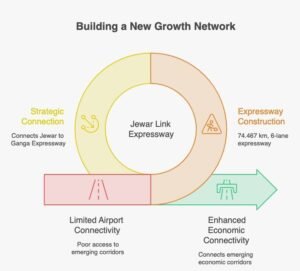
The latest development is particularly important. The Uttar Pradesh Cabinet has approved a ₹8,585.51-crore, 74.467-km greenfield Jewar Link Expressway connecting Noida International Airport with the Ganga Expressway through Bulandshahr. The approved road is six lanes, with provision for expansion to eight lanes.
But the more significant development today is implementation.
The Uttar Pradesh e-Procurement portal shows that tenders for both packages of the Jewar Link Expressway are active, with bid submission scheduled to close on September 7, 2026 and opening scheduled for September 8. The authority-engineer procurement is also progressing.
For me, that movement from approval to procurement is where the infrastructure story becomes more consequential.
Because Jewar is no longer being developed around one airport.
It is beginning to look like an emerging economic corridor.
The Jewar–Ganga Expressway Changes the Connectivity Equation
The approved Jewar Link Expressway will extend approximately 74.467 kilometres from the Jewar Airport side towards the Ganga Expressway via Bulandshahr.
The project has been conceived as a six-lane access-controlled expressway with provision for future expansion to eight lanes. The approved project cost is ₹8,585.51 crore, and the project is being taken up through the Engineering, Procurement and Construction model.
The distinction between six lanes and eight-lane provision is important.
I would not describe this as an eight-lane expressway today. It is a six-lane project designed with the ability to expand as future traffic requirements evolve.
That tells me something about how policymakers are thinking about the corridor.
They are not planning only for today’s traffic.
They are creating infrastructure capacity around an economic region that is expected to grow.
And that is precisely the type of signal long-term investors should study.
The Bigger Story Is the Network Around Jewar
The most common mistake in infrastructure-led real estate analysis is looking at one road in isolation.
I prefer to look at the network.
Today, the emerging Jewar ecosystem brings together:
Noida International Airport + Yamuna Expressway + Jewar Link Expressway + Delhi–Faridabad connectivity + Eastern Peripheral Expressway + Dedicated Freight Corridor + industrial clusters + logistics infrastructure + Film City + planned urban development.
This is a fundamentally different proposition from simply saying that an airport has been built near a particular location.
The YEIDA Master Plan 2041 explicitly describes the objective of developing a sustainable, well-connected greenfield city around the economic opportunities created by Noida International Airport and regional economic corridors.
The plan also identifies logistics facilities near the airport, industrial-worker housing, public transport integration, peripheral movement for heavy industrial traffic and green buffers as components of future development.
That tells us that Jewar is being planned as an integrated economic geography.
And real estate tends to respond more strongly to economic geography than to isolated infrastructure announcements.
Jewar Airport Connectivity Is Becoming a Multi-Directional System
The strength of the emerging network lies in the number of directions it can serve.
The Yamuna Expressway already provides controlled-access connectivity between Greater Noida and Agra and forms the primary road spine serving the airport region.
Noida International Airport itself is directly connected with the six-lane Yamuna Expressway. The airport’s official information states that Phase 1 has capacity for 12 million passengers annually, while its four-phase masterplan provides for capacity of more than 70 million passengers annually.
The airport also commenced commercial flight operations on June 15, 2026, marking the transition from a major infrastructure project into an operating economic asset.
That transition matters enormously.
An airport under construction creates expectations.
An operating airport creates economic behaviour.
Airlines schedule flights.
Passengers travel.
Businesses move.
Cargo begins to flow.
Hotels respond.
Employees require housing.
Retail follows footfall.
And investors begin reassessing accessibility.
The Delhi Connection Adds Another Layer
The other important piece of the network is the greenfield connectivity between Jewar International Airport and the Delhi–Faridabad–Ballabhgarh–Sohna spur of the Delhi-Mumbai Expressway.
In March 2026, the Union Cabinet approved a revised total capital cost of ₹3,630.77 crore for the 31.42-km corridor.
The official Press Information Bureau announcement states that the corridor will provide direct, high-speed connectivity from South Delhi, Faridabad and Gurugram to Jewar Airport.
More importantly, the government notes that this corridor will intersect the Eastern Peripheral Expressway, Yamuna Expressway and Dedicated Freight Corridor.
This is where the infrastructure story becomes particularly interesting.
The airport is not simply receiving passengers from one direction.
It is increasingly being connected to multiple metropolitan, industrial and freight networks.
That is the essence of Jewar Airport connectivity.
Why Eight-Lane Provision Matters to Long-Term Investors
Infrastructure capacity is a useful indicator of planning horizons.
When a road is designed with future expansion in mind, the underlying assumption is that the surrounding economic geography may require greater capacity over time.
That does not guarantee traffic volumes.
Nor does it guarantee property appreciation.
But it does indicate that the corridor is being planned with long-term scalability in mind.
For investors, this distinction matters.
A short-term property thesis asks:
“What is happening here today?”
A long-term infrastructure thesis asks:
“What capacity is being created for the economy that may exist here tomorrow?”
I believe the second question is more valuable.
From Airport Connectivity to Economic Connectivity
The next phase of Jewar’s growth will not be determined by passengers alone.
It will increasingly depend on the movement of people, products, capital and businesses.
This is where airport-led development becomes more interesting.
The YEIDA Master Plan 2041 identifies airport city-side development involving logistics hubs, warehouses, freight complexes, logistics parks, office corridors, hotels, service apartments, retail, entertainment, medical and wellness facilities.
That is effectively a blueprint for an aerotropolis.
In simple terms:
Airport → Infrastructure → Industry → Jobs → Housing → Services → Consumption → Real Estate
When these links reinforce one another, the real estate market can evolve alongside the economy.
Logistics Could Become One of Jewar’s Most Important Growth Engines
For years, airports were primarily viewed through passenger traffic.
Modern airports are increasingly economic platforms for cargo, logistics and high-value supply chains.
Noida International Airport’s own masterplan anticipates substantial cargo and logistics infrastructure. Its long-term plan provides for cargo capacity rising from approximately 249,600 tonnes in Phase I to more than 1.12 million tonnes by Phase IV.
That is a significant shift in perspective.
Cargo-intensive industries value:
- High-speed highways
- Airport access
- Warehousing
- Freight infrastructure
- Reliable connectivity
- Large development parcels
- Access to labour
- Proximity to consumption centres
Jewar’s emerging infrastructure network addresses several of these requirements simultaneously.
The airport has also been developing its cargo ecosystem. In August 2026, Noida International Airport announced an agreement involving Air India SATS, Spicexpress and Total Solutions aimed at expanding freighter operations.
This is important because cargo creates a different economic multiplier from passenger traffic.
A passenger may spend money once.
A supply chain can generate repeated economic activity through manufacturing, storage, transportation, processing and distribution.
Industrial Growth Could Strengthen Residential Demand
Real estate follows people.
And people often follow jobs.
This is one of the most fundamental relationships in infrastructure-led development.
If industrial, logistics, aviation, manufacturing and commercial activity expand around Jewar, the demand for housing and services can broaden correspondingly.
YEIDA’s planning framework recognises this relationship.
Its Master Plan 2041 specifically identifies affordable housing for industrial workers alongside airport development, logistics facilities and employment-generation objectives.
That is significant.
It means housing is not being considered separately from industrial development.
It is being considered as part of the economic ecosystem.
For the real estate sector, this can create multiple layers of demand:
Workforce housing → Rental housing → Mid-income housing → Premium housing → Serviced accommodation → Commercial property
Different segments will develop at different speeds.
That is why investors should avoid assuming that every property category will perform identically.
Film City Adds Another Demand Generator
Other major planned developments also support the airport ecosystem.
One of the most visible is the International Film City proposed in YEIDA Sector 21.
According to YEIDA, approximately 1,000 acres have been identified for the project, with commercial and industrial uses planned.
The authority states that a detailed feasibility report prepared by CBRE South Asia has been approved by the Uttar Pradesh government.
Film production, post-production, VFX, entertainment, hospitality, retail and commercial services can create a different economic cluster around the airport.
This is another reason I believe the Jewar story needs to be studied through the lens of economic diversification.
The future demand base does not have to depend upon aviation alone.
What Does This Mean for Real Estate?
The relationship between infrastructure and property value is often oversimplified.
A new road does not automatically increase the value of every property around it.
Instead, infrastructure changes the underlying variables that influence real estate.
For Jewar, I would watch five.
1. Accessibility
How easily can residents, employees, tourists, businesses and goods reach a particular location?
This is the most direct impact of Jewar Airport connectivity.
2. Employment
Are industries, logistics companies, aviation businesses and commercial enterprises actually creating jobs?
Employment is one of the strongest foundations for sustainable housing demand.
3. Economic Activity
Are businesses establishing themselves?
Are warehouses being occupied?
Are hotels opening?
Are commercial districts gaining tenants?
These are stronger signals than speculative land quotations.
4. Urban Planning
Is growth being organised through planned land use and infrastructure?
YEIDA’s Master Plan 2041 is particularly relevant here because it explicitly integrates industrial, logistics, residential, commercial, transportation and environmental considerations.
5. Time
Infrastructure-led real estate is rarely a one-year story.
The most meaningful value creation generally occurs when infrastructure is followed by actual economic absorption.
NCR’s Premiumisation Makes the Timing Interesting
A broader residential-market trend is also worth considering.
ANAROCK’s 2025 NCR outlook describes the region as entering a period of sustained capital appreciation and consolidation, with premium residential development becoming increasingly important. It specifically identifies the operationalisation of Jewar International Airport as a catalyst for the Noida, Greater Noida and Yamuna Expressway markets.
JLL’s research similarly found that homes priced above ₹1 crore represented 62% of residential sales in India’s top seven cities during H1 2025, while Delhi NCR recorded the highest year-on-year property-price growth among those markets during Q2 2025.
This is not a prediction specifically for Jewar.
It is broader market context.
But it does tell us that India’s urban buyers are increasingly moving towards premium housing and that NCR remains an important market for higher-value residential demand.
For Jewar, the question is whether the emerging infrastructure and economic ecosystem can convert that broader demand into sustained local absorption.
Land Investment Requires a Different Mindset
I have always believed that land should be evaluated through future utility, not simply present price.
The most important question is not:
“How much can this land appreciate?”
It is:
“What will this land be connected to five, ten or fifteen years from now?”
That requires studying:
- Master-plan zoning
- Road hierarchy
- Airport access
- Industrial proximity
- Logistics infrastructure
- Employment centres
- Planned commercial development
- Public infrastructure
- Legal title
- Development permissions
This is especially important in an infrastructure-led market.
The closer a region moves towards genuine economic activity, the more important the distinction becomes between strategically located land and land that is merely marketed as being “near the airport.”
Those are not the same thing.
Commercial Real Estate Could Follow the Economic Base
An airport economy requires an ecosystem around it.
Businesses need offices.
Passengers need hotels.
Employees need restaurants.
Companies need meeting spaces.
Visitors need retail.
Logistics companies need support services.
Professionals need healthcare, education and housing.
This creates opportunities for commercial real estate to evolve in stages.
The YEIDA planning framework already anticipates office corridors, hotels, service apartments, retail, entertainment and healthcare as part of the airport city-side ecosystem.
That is important because successful airport cities are not simply transportation facilities.
They become places of economic activity.
Employment May Be the Most Important Multiplier
Investors often focus on roads and property prices.
I prefer to watch employment.
Why?
Because employment creates recurring demand.
An industrial worker needs housing.
A logistics professional needs housing.
An airport employee needs housing.
A hotel employee needs housing.
A corporate executive may require a premium residence.
Each new employment cluster creates secondary consumption.
That consumption supports:
- Retail
- Food and beverage
- Education
- Healthcare
- Transport
- Hospitality
- Rental housing
- Residential development
This is why I see Jewar Airport connectivity as an economic story before I see it as a property story.
The Infrastructure Convergence Is the Real Opportunity
If I were evaluating Jewar today, I would not focus on one expressway.
I would draw the infrastructure map.
I would look at:
Noida International Airport
↓
Yamuna Expressway
↓
Jewar Link Expressway
↓
Ganga Expressway
And separately:
Delhi–Faridabad–Ballabhgarh–Sohna connectivity
↓
Eastern Peripheral Expressway
↓
Yamuna Expressway
↓
Dedicated Freight Corridor
Then I would overlay:
Industrial clusters + Logistics + Film City + Commercial development + Residential planning
That is when the picture becomes much clearer.
The investment thesis is not one road.
It is the convergence of infrastructure and economic activity.
What Investors Should Watch From Here
Infrastructure announcements create attention.
Execution creates value.
Therefore, the next stage should be watched carefully.
I would monitor five indicators.
First: Tender and Construction Progress
The UPEIDA procurement process is already active, with Jewar Link packages moving through the tender stage.
Second: Airport Traffic
Passenger and cargo volumes will reveal whether the airport is achieving the economic scale envisioned in its masterplan.
Third: Industrial Occupancy
Announcements are useful.
Actual companies occupying industrial and logistics facilities are better indicators.
Fourth: Residential Absorption
Watch actual transactions, launches, occupancy and rental demand rather than only quoted prices.
Fifth: Further Connectivity
The strongest markets are usually those where several infrastructure networks reinforce one another.
What I Would Not Assume
There is an important distinction between optimism and speculation.
I would not assume that:
- Every property near Jewar Airport will appreciate equally.
- Every announced infrastructure project will be completed simultaneously.
- A new expressway automatically guarantees returns.
- Today’s land prices represent tomorrow’s value.
- Short-term price movement is the same as long-term wealth creation.
Instead, I would evaluate the fundamentals.
Location.
Connectivity.
Planning.
Economic activity.
Demand.
Land quality.
Execution.
Time.
That framework is far more useful than chasing the latest property headline.
My Strategic Perspective: Follow the Economy, Not the Headline
For me, the most compelling part of the Jewar story is not the number eight.
It is not even the ₹8,585.51-crore investment.
It is the possibility that multiple infrastructure systems are beginning to operate around the same economic geography.
The airport provides global access.
Expressways provide regional access.
Freight infrastructure provides industrial access.
Planned development provides urban structure.
Employment creates people-driven demand.
And real estate sits at the intersection of all of these.
That is how infrastructure can create long-term real estate opportunity.
Not because a road automatically makes land valuable.
But because a well-connected economic corridor can create reasons for people and businesses to be there.
Jewar’s Next Chapter Could Be Bigger Than the Airport
The transformation of Jewar should ultimately be judged by what develops around the airport.
Will businesses establish themselves?
Will logistics scale?
Will manufacturing deepen?
Will employment expand?
Will commercial districts mature?
Will residential communities become established?
Will connectivity continue improving?
Those are the questions I would ask as a long-term investor.
The YEIDA Master Plan 2041 already provides a useful indication of the intended direction: an integrated, sustainable, well-connected urban region built around airport-led economic opportunity.
That is a much bigger proposition than an airport alone.
And it is why Jewar Airport connectivity deserves to be studied as one of the emerging infrastructure-led real estate stories of NCR.
The Road Is Bigger Than the Road
The most important consequence of the Jewar–Ganga connectivity project may ultimately not be the road itself.
It may be the economic geography that the road helps create.
An airport brings connectivity.
Expressways extend that connectivity.
Logistics infrastructure moves goods.
Industrial clusters create employment.
Employment creates housing demand.
Commercial activity follows.
And over time, these forces can reshape how investors perceive an entire region.
This is why I believe long-term real estate investors should look beyond today’s price and today’s headline.
The better question is:
What kind of economy is today’s infrastructure helping to build?
Jewar is increasingly giving us an interesting answer.
It is evolving towards a connected ecosystem where aviation, logistics, industry, commerce, employment and urban development can reinforce one another.
For me, that is the real investment story.
Infrastructure creates access.
Economic activity creates demand.
Time reveals value.
And in real estate, understanding that sequence has always been more important than trying to predict tomorrow’s price.
FAQs
1. What is Jewar Airport connectivity and why is it important for NCR?
Jewar Airport connectivity refers to the growing network of expressways, highways and high-speed road links connecting Noida International Airport at Jewar with Delhi-NCR, Greater Noida, Bulandshahr, the Ganga Expressway and other major economic corridors. Its importance goes beyond airport access because improved connectivity can support passenger movement, logistics, employment and commercial development across the wider Yamuna Expressway region.
The proposed 74.467-km Jewar Link Expressway will connect the airport with the Ganga Expressway through Bulandshahr. According to the Uttar Pradesh government approval, the six-lane access-controlled expressway has provision for future expansion to eight lanes.
For official project and tender updates, investors can follow UPEIDA’s official e-procurement portal.
2. How will the Jewar Link Expressway improve Jewar Airport connectivity?
The Jewar Link Expressway is expected to become one of the most important additions to Jewar Airport connectivity because it creates a direct high-speed connection between Noida International Airport and the Ganga Expressway corridor.
The project is planned as a 74.467-km, six-lane access-controlled greenfield expressway, with the provision to expand it to eight lanes in the future. The route is intended to connect the airport/Yamuna Expressway side with the Ganga Expressway through Bulandshahr, creating a larger eastward and western Uttar Pradesh connectivity network.
This is particularly significant because infrastructure of this scale can reduce dependence on individual urban roads and create new development corridors around major junctions.
3. Is the Jewar Link Expressway already an eight-lane expressway?
Not currently. A key point when discussing Jewar Airport connectivity is the distinction between the project’s present configuration and its future expansion potential.
The approved Jewar Link Expressway is planned as a six-lane access-controlled expressway with provision for expansion to eight lanes. Therefore, it should not be described as an operational eight-lane expressway today.
For investors, this distinction matters because planned capacity expansion indicates how authorities are anticipating future traffic and economic activity. The latest project procurement information can be checked through
4. How does Jewar Airport connectivity connect with the Ganga Expressway?
One of the strongest aspects of Jewar Airport connectivity is its planned integration with the Ganga Expressway network.
The Jewar Link Expressway is designed to connect Noida International Airport with the Ganga Expressway through Bulandshahr. This creates a strategic north-west/east-west connection between the airport ecosystem and several parts of western Uttar Pradesh.
The route is therefore more than an airport access road. It has the potential to strengthen movement between airport-linked businesses, industrial areas, logistics facilities, emerging urban centres and the broader expressway network.
5. How will Jewar Airport connectivity affect real estate around the Yamuna Expressway?
In my view, Jewar Airport connectivity is likely to be one of the most important infrastructure variables shaping the long-term real estate story of the Yamuna Expressway region.
The impact should not be viewed simply as “airport nearby, therefore property prices rise.” The stronger mechanism is the creation of an interconnected economic ecosystem involving aviation, logistics, manufacturing, commercial activity, hospitality, employment and supporting residential demand.
ANAROCK has identified the operationalisation of Jewar Airport as a significant catalyst for Noida, Greater Noida and the Yamuna Expressway region, with potential implications for residential and commercial capital growth.
6. Why is Jewar Airport connectivity important for logistics and industrial development?
Jewar Airport connectivity has significance far beyond passenger travel. Noida International Airport is being developed with a substantial cargo and logistics ecosystem, while the surrounding YEIDA region is planned around industrial, logistics and commercial uses.
The airport’s long-term masterplan includes significant cargo capacity and dedicated logistics-related infrastructure. YEIDA’s planning documents also identify logistics hubs, warehouses, freight complexes, logistics parks, distribution activity and an intermodal freight hub as part of the wider development framework.
The airport authority has also announced MoUs exploring freighter operations at the AISATS Multi Modal Cargo Hub, reinforcing the importance of air-cargo infrastructure in the airport’s development.
For businesses, this combination of Jewar Airport connectivity + expressway connectivity + logistics infrastructure can create a powerful location advantage.
7. How does Jewar Airport connectivity connect the airport with Delhi-NCR?
Jewar Airport connectivity is being developed through multiple transportation links rather than relying on a single corridor.
The airport is directly connected to the six-lane Yamuna Expressway, while additional projects are improving links toward Delhi, Faridabad, Gurugram and other parts of NCR. The Government of India has also approved revised capital expenditure for a 31.42-km greenfield connectivity project linking the Delhi-Faridabad-Ballabhgarh-Sohna corridor toward Jewar Airport.
This creates what I consider an important infrastructure principle: multiple connectivity routes create resilience and widen the airport’s effective economic catchment.
8. What role will Film City play in Jewar Airport connectivity and regional growth?
The proposed Film City in YEIDA Sector 21 adds another important economic layer to Jewar Airport connectivity.
YEIDA’s Film City is planned across approximately 1,000 acres and is located around 4 km from Noida International Airport. Its proximity to the airport means that aviation access can support movement of professionals, visitors, production teams, equipment and businesses associated with the entertainment ecosystem.
From a real estate perspective, the significance is not limited to the Film City itself. Large employment and commercial destinations can generate secondary demand for hospitality, retail, offices, serviced accommodation and housing.
9. Is Jewar Airport connectivity a good long-term investment theme?
I believe Jewar Airport connectivity is better understood as a long-term infrastructure-led investment theme rather than a short-term property speculation story.
The investment thesis is built around several interconnected developments: Noida International Airport, Yamuna Expressway, Jewar Link Expressway, Ganga Expressway connectivity, logistics infrastructure, Film City, industrial development and expanding NCR connectivity.
ANAROCK’s NCR research has highlighted the potential impact of Jewar Airport on Noida, Greater Noida and the Yamuna Expressway region, while Colliers has also identified infrastructure-led micro-markets around Greater Noida and the Jewar belt as areas that could gain momentum.
For anyone evaluating Jewar Airport connectivity as an investment theme, I would focus on legally clear land, approved development plans, actual infrastructure progress, accessibility and the surrounding economic ecosystem rather than buying purely on speculation.
10. What should investors monitor when evaluating Jewar Airport connectivity?
When evaluating Jewar Airport connectivity, I would monitor five major indicators: actual infrastructure execution, expressway connectivity, airport passenger and cargo growth, employment-generating projects and planned urban development.
The first is execution. Investors should distinguish between an announced project, an approved project, a tendered project and an operational project. The Jewar Link Expressway, for example, has moved into the procurement stage, with UPEIDA publishing package-level tender information.
The second is the airport itself. Noida International Airport commenced commercial operations in June 2026, providing a new aviation gateway for NCR and western Uttar Pradesh.
Finally, I would study the entire connectivity ecosystem, not one road in isolation. The real opportunity created by Jewar Airport connectivity lies in how airports, expressways, logistics, industry, employment and planned urbanisation reinforce one another over time.
