
India’s Changing Monsoon: 7 Critical Himalayan Lessons
What if the most important question about India’s changing monsoon is not whether India is receiving more rain or less rain, but whether we are beginning to receive rain differently?
I have been thinking about this question while looking at what has happened across Uttarakhand and Himachal Pradesh through the 2026 monsoon. The picture is not as simple as saying that rainfall is increasing everywhere. In fact, the data tells a much more interesting story.
India’s changing monsoon is increasingly marked by uneven rainfall, intense bursts, longer dry intervals, shifting seasonal patterns, and growing interactions between weather and vulnerable landscapes.
This distinction matters.
Because a place can receive rainfall close to its seasonal average and still experience devastating landslides, flash floods or infrastructure failures. India’s changing monsoon is therefore not simply a story about the quantity of rainfall. It is also a story about when, where, how quickly, and with what intensity rainfall arrives.
The 2026 experience in the Himalayas gives us a powerful opportunity to understand this.
What India’s Changing Monsoon Is Telling Us in 2026
The first lesson is that rainfall averages do not tell the entire story.
Uttarakhand offers one of the clearest examples.
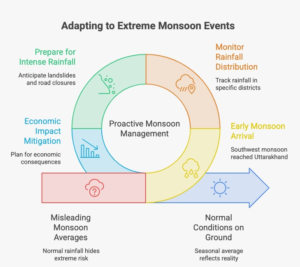
The southwest monsoon reached Uttarakhand on June 30, 2026. By July 21, the state’s overall rainfall was only around 4% below normal, a figure still within the normal range. Yet the district-level picture was dramatically different. Some districts had received more than twice their normal rainfall, while others were experiencing near-drought conditions.
This is one of the most important lessons from India’s changing monsoon.
A state-wide average can suggest relative normality while individual communities are dealing with very abnormal conditions.
The same pattern appeared later in the season. On September 5, Uttarakhand recorded rainfall around 13% above its daily normal, while several districts experienced much larger surpluses. Landslides and boulder falls resulted in more than a hundred road closures.
This is what India’s changing monsoon can look like on the ground: not necessarily a uniformly wetter state, but a landscape receiving water in highly concentrated and uneven ways.
The India Meteorological Department’s rainfall statistics are particularly useful here because they allow us to move beyond state-level averages and examine rainfall at more granular scales.
That shift in perspective is essential to understanding India’s changing monsoon.
India’s Changing Monsoon in Himachal Pradesh: When Rainfall Becomes an Infrastructure Story
Himachal Pradesh provides another dimension of India’s changing monsoon.
By September 9, 2026, reported monsoon losses in the state had crossed approximately ₹1,550 crore. The Public Works Department accounted for more than ₹1,100 crore, while the Jal Shakti Department reported losses of more than ₹368 crore. Dozens of roads remained blocked.
There is another important point in these numbers.
Of the 286 reported deaths, 114 were attributed to natural disasters while 172 were associated with road accidents. The distinction matters because it prevents us from presenting every monsoon-related death as a direct climate disaster.
India’s changing monsoon interacts with roads, traffic, settlements, construction, slope stability and human exposure.
This interaction is becoming increasingly important.
The Government of India has itself recognised the growing concern. In August 2026, the Ministry of Home Affairs constituted a Multi-Sectoral Central Team in response to increasing incidents of cloudbursts, flash floods, landslides and extreme rainfall in Himachal Pradesh. The team includes institutions such as NDMA, CBRI, IITM and IIT Indore, along with inputs from IMD, CWC and GSI.
The government statement also pointed towards climate change, accelerated snowmelt, moraine instability and anthropogenic factors as contributors to increasing risk.
This is why India’s changing monsoon cannot be discussed only from the perspective of weather forecasting.
It has become an infrastructure question.
A Delayed Monsoon Can Still Become a Difficult Monsoon
There is another misconception worth challenging.
A delayed monsoon does not automatically mean a weak or harmless monsoon.
In Himachal Pradesh, the southwest monsoon covered the entire state around July 1, 2026, several days later than the normal date of around June 25.
Yet timing alone tells us very little about the eventual consequences.
This is important because monsoon behaviour is not a simple on-off system.
The timing of onset, the distribution of rainfall, the duration of dry spells and the occurrence of high-intensity rainfall events all interact with one another.
The IMD’s official rainfall information therefore becomes more useful when rainfall is examined across different periods rather than through a single seasonal number.
For planners, this means that the question should not simply be:
How much rain should we expect this year?
It should also be:
What kind of rainfall distribution should we design for?
That is a very different question.
Is India’s Changing Monsoon Actually Changing?
The scientific answer needs nuance.
There is strong evidence that climate change is affecting temperature, precipitation characteristics, and the probability of certain extremes. The IPCC’s assessment for South Asia projects increases in mean and variability of summer monsoon precipitation, as well as increases in heavy precipitation extremes as warming continues.
At the same time, rainfall trends are not uniform across India.
Some regions have experienced increasing extreme rainfall while others show different or weaker trends. Natural variability also remains an important part of the Indian monsoon system.
This is why the phrase India’s changing monsoon should not be interpreted as “everywhere will get more rainfall.”
It means the rainfall system is becoming more variable and complex in ways that matter for people and infrastructure.
One of the most important findings from long-term Indian rainfall research is that extreme rainfall can increase even when total rainfall does not increase proportionately.
Research published in Nature Communications, for example, found a substantial increase in widespread extreme rainfall events over central India during 1950–2015 even as moderate rainfall declined.
That finding changes how we should think about water.
More extreme rain does not necessarily mean more usable water.
Rain falling rapidly over a short period can generate runoff and flooding rather than slowly replenishing soil moisture, groundwater or reservoirs.
So India’s changing monsoon is simultaneously a flood risk and water-management challenge.
India’s Changing Monsoon: More Rain or Different Rain?
This distinction deserves greater attention.
Imagine two years receiving the same total monsoon rainfall.
In the first year, rainfall is distributed across many moderate events.
In the second, much of the rainfall arrives in a few intense episodes separated by long dry periods.
The annual total may look identical.
The consequences will not be.
Agriculture may face moisture stress between rainfall events.
Urban drainage may be overwhelmed during intense episodes.
Mountain slopes may become saturated rapidly.
Rivers may rise sharply and then fall.
Roads and bridges may face repeated cycles of stress.
This is why India’s changing monsoon should increasingly be understood through rainfall distribution and intensity, not just accumulation.
For an investor or developer, this distinction is equally important.
A location with attractive connectivity and strong economic potential may still require careful examination of drainage, topography, water availability and natural-hazard exposure.
Climate resilience is becoming part of location intelligence.
Why the Himalayas Amplify Weather Risk
The Himalayas are not an ordinary landscape.
They are geologically young, steep and structurally complex. Many settlements and transport routes occupy narrow valleys or slopes. Roads frequently require substantial cutting into mountainsides.
When intense rainfall arrives, gravity becomes part of the equation.
Water infiltrates soil and fractured rock.
Slopes become heavier.
Drainage channels carry sudden volumes of water.
Loose material can move downhill.
Rivers can rapidly change their flow and sediment loads.
A rainfall event that might cause limited disruption in a flat region can have very different consequences in a steep mountain environment.
The Department of Science and Technology has highlighted the interaction of natural and human factors in Himalayan landslide vulnerability, including rainfall, temperature, slope conditions, road cutting, construction and land-use change.
This does not mean that every landslide is caused by construction.
It means that natural hazards and human exposure increasingly interact.
That distinction matters.
When Heavy Rain Becomes a Landslide
The relationship between rainfall and landslides is particularly important.
A mountain slope does not respond only to the rainfall falling at that exact moment.
Its response can depend on what happened over previous days or weeks.
If the ground is already saturated, additional rainfall can have a disproportionate effect.
If a road has altered natural drainage, water may be redirected into vulnerable areas.
If vegetation has been removed, soil stability can change.
If a slope has been heavily cut, its natural geometry may have been disturbed.
This is where India’s changing monsoon intersects directly with land-use planning.
A rainfall forecast may tell us that heavy rain is coming.
Risk-aware development asks a second question:
Which slopes, roads, settlements and structures are most vulnerable to that rainfall?
The second question is where the next generation of planning needs to become much stronger.
The Cryosphere Is Changing Alongside the Monsoon
Rainfall is only one part of the Himalayan climate story.
The other is what happens to snow and ice.
The Hindu Kush Himalaya is undergoing substantial cryospheric change. In 2026, the International Centre for Integrated Mountain Development reported that glaciers across the region are losing ice at an accelerating rate, with ice-loss rates approximately doubling after 2000 compared with the previous decades.
The snow story is equally important.
ICIMOD reported in April 2026 that snow persistence across the Hindu Kush Himalaya was 27.8% below its long-term average, marking the fourth consecutive year of below-normal snow persistence.
This matters because snow is not simply something we see on mountain peaks.
It is a seasonal water-storage system.
Changes in snowfall, snowmelt, glaciers and runoff can influence rivers, agriculture, hydropower, ecosystems and downstream water security.
The ICIMOD regional cryosphere outlook makes this larger relationship increasingly visible.
India’s changing monsoon is therefore occurring alongside a changing Himalayan water system.
That combination deserves much more attention.
The 2025 Dharali Lesson
The catastrophic Dharali event in Uttarkashi in August 2025 provides an important case study.
The event generated a massive debris flow and caused extensive destruction to buildings, roads, bridges and other assets.
But scientific research conducted after the event has also demonstrated why disaster attribution needs to be careful.
Studies have examined rainfall-triggered debris mobilisation, steep slopes, unconsolidated sediments and local geomorphology. Other explanations have also been debated.
The larger lesson is not simply about Dharali.
It is about how we investigate extreme events.
India’s changing monsoon creates a changing background climate, but a particular disaster can still have a complex chain of causes.
Good climate communication should acknowledge that complexity rather than turning every event into a simplistic climate-change headline.
In my view, this actually makes the argument for preparedness stronger.
If multiple factors can combine to create a disaster, then resilience must address multiple factors as well.
India’s Changing Monsoon and the Future of Development
There is an uncomfortable but necessary question here:
Are we building infrastructure for the climate we had, or for the climate we are beginning to experience?
I am not arguing against development.
Quite the opposite.
Good infrastructure is essential for mountain communities, tourism, agriculture, healthcare, education and economic opportunity.
But India’s changing monsoon means that infrastructure planning needs to become more risk-aware.
Roads need stronger drainage.
Slope stabilisation needs to be treated as a core engineering function.
Bridges need adequate hydraulic capacity.
Construction needs to consider local geology and natural drainage.
Emergency access needs to remain possible even when one route fails.
This is not anti-development.
It is better development.
The National Highways Authority of India and government agencies have undertaken measures on vulnerable Himalayan road stretches that include slope stabilisation, drainage improvements and protective works.
The direction is important.
We should not move away from infrastructure.
We should move towards infrastructure that understands the landscape in which it exists.
Tourism and the New Himalayan Exposure
Tourism adds another layer.
The Himalayan states have become increasingly important destinations for domestic and international travellers.
Tourism creates employment, supports local businesses and generates demand for hotels, restaurants, transport and services.
But more visitors also mean greater exposure.
A road blocked by a landslide is not merely an engineering problem.
It can strand tourists.
A damaged bridge can disrupt supply chains.
A prolonged water shortage can affect hospitality.
A slope failure can damage both private and public assets.
Therefore, India’s changing monsoon needs to become part of tourism infrastructure planning.
The objective should not be to restrict tourism unnecessarily.
It should be to ensure that tourism growth is compatible with the carrying capacity and resilience of the landscape.
The Economics of Climate Risk
Climate risk is often discussed as an environmental issue.
I increasingly see it as an economic issue.
A blocked highway delays goods.
A damaged bridge disrupts tourism.
A landslide cuts off communities.
A disrupted water supply affects households and businesses.
A damaged power network creates secondary losses.
The economic cost therefore extends well beyond the first repair estimate.
This is particularly relevant for real estate and land investment.
Location will remain important.
Connectivity will remain important.
Economic growth will remain important.
But investors increasingly need another layer of information: resilience.
How secure is the water supply?
How does stormwater leave the site?
What is the slope profile?
What are the geological conditions?
How dependent is the location on a single road?
How exposed is it to flooding or landslides?
How adaptable is the surrounding infrastructure?
India’s changing monsoon is making these questions increasingly relevant to long-term asset thinking.
India Does Not Have One Monsoon
Perhaps the biggest lesson I take from all of this is that there is no single Indian monsoon experience.
The rainfall received by Kerala is not the rainfall received by Rajasthan.
Central India has a different rainfall regime from the Himalayan foothills.
Even within Uttarakhand, district-level conditions can vary dramatically.
India’s changing monsoon therefore needs to be understood at multiple scales.
National averages remain important for policy.
State-level data helps with planning.
District-level data reveals exposure.
Local topography determines how rainfall translates into risk.
This hierarchy is critical.
The more local our understanding becomes, the more intelligent our response can be.
What Should Change About the Way We Build?
I believe India’s changing monsoon requires us to rethink three things.
1. Design for extremes, not just averages
Historical averages remain useful, but they should not be the only basis for infrastructure planning.
Drainage, bridges, roads, buildings and slopes must account for changing rainfall intensity and variability.
2. Treat landscapes as part of the infrastructure
A forested slope, wetland, river channel or natural drainage system performs an economic function.
When we remove that function, we often replace it with expensive engineered infrastructure.
The natural landscape should therefore be considered part of our resilience system.
3. Move from response to preparedness
India has become better at responding to disasters.
The next step is to become much better at anticipating them.
That means better rainfall monitoring, local early-warning systems, slope monitoring, hazard mapping, climate-resilient infrastructure and transparent risk information.
The National Water Data Portal and IMD’s rainfall databases demonstrate how increasingly important accessible local data will become.
What This Means for the Future of Indian Development
The conversation about climate resilience should not remain limited to disaster-management departments.
It belongs in urban planning.
It belongs in infrastructure design.
It belongs in real estate.
It belongs in agriculture.
It belongs in tourism.
It belongs in investment strategy.
India’s changing monsoon is effectively creating a new variable in long-term decision-making.
The most resilient locations may not necessarily be those with the most dramatic growth stories.
They may be the places where connectivity, water security, land characteristics, infrastructure quality and environmental conditions work together.
This is an important shift in how we should think about land.
Land is not simply a parcel on a map.
It is part of a living geographical system.
Its value is connected to roads, rivers, drainage, water, climate, surrounding development and the ability of the larger ecosystem to absorb change.
That is why climate awareness is increasingly becoming a part of responsible investment thinking.
So, Is India’s Changing Monsoon Really Changing?
Yes — but not in the simplistic sense that every part of India is becoming uniformly wetter.
India’s changing monsoon is better understood as a combination of shifting rainfall distribution, variability, intense rainfall episodes, changing dry periods and interactions with a warming atmosphere and changing Himalayan cryosphere.
At the same time, natural variability remains important, regional trends differ, and individual disasters require careful scientific attribution.
That nuance is important.
Because the purpose of climate science is not to create fear.
It is to improve decisions.
For me, the most important lesson from Uttarakhand and Himachal Pradesh in 2026 is that climate, geography and development can no longer be treated as separate conversations.
India’s changing monsoon is exposing the connections between them.
The Future Question Is Bigger Than the Monsoon
The Himalayas are not telling us that development should stop.
They are asking us to become more intelligent about development.
If rainfall is becoming more variable, infrastructure must become more adaptive.
If slopes are vulnerable, construction must respect geological realities.
If snow and glaciers are changing, water planning must change with them.
If extreme rainfall can disrupt entire economic corridors, resilience must become part of the investment equation.
And if our understanding of climate risk improves, our definition of good development should improve with it.
India’s changing monsoon is ultimately not just a weather story.
It is a story about the relationship between natural systems and human decisions.
Perhaps that is the question we should be asking more seriously:
If the climate is changing the way water moves through our landscapes, shouldn’t we also rethink the way we build, invest, travel and live within them?
FAQs
1. What is India’s changing monsoon and why is it important?
India’s changing monsoon refers to the evolving patterns of rainfall across the country, including changes in rainfall distribution, intensity, timing, variability and the occurrence of extreme rainfall events. It does not necessarily mean that every part of India is receiving more rainfall every year.
The important issue is that rainfall can become more uneven and concentrated. A region may record rainfall close to its seasonal average while individual districts experience intense rainfall, prolonged dry periods or sudden heavy precipitation.
The India Meteorological Department’s rainfall statistics provide district-level, state-level and subdivision-level rainfall information, making it possible to understand these variations beyond national averages.
Understanding India’s changing monsoon is important for agriculture, water management, infrastructure, disaster preparedness, tourism and long-term development planning.
2. Is India receiving more rainfall because of India’s changing monsoon?
Not necessarily. India’s changing monsoon is more complicated than simply saying that the country is becoming wetter.
Long-term observations show considerable regional differences in rainfall trends. The IPCC notes that South Asia has experienced changes in monsoon precipitation and that recent increases in heavy precipitation have occurred in the region, while trends in annual precipitation vary considerably by location.
The IPCC assessment of Asia’s climate highlights this regional variation and reports an increase in heavy precipitation in South Asia.
This means the more useful question is not simply, “Is India getting more rain?” but rather:
Where is rainfall changing, when is it arriving, how intense is it, and how is the landscape responding?
That is a much more accurate way to understand India’s changing monsoon.
3. Why can normal seasonal rainfall still cause floods and landslides?
A seasonal rainfall average can hide short-duration and highly concentrated rainfall.
For example, a region could receive close to its normal seasonal rainfall overall, but a large proportion of that rainfall may arrive within a few intense episodes. Such rainfall can overwhelm drainage systems, saturate slopes and rapidly increase river or stream flows.
This is particularly significant in mountainous areas such as Uttarakhand and Himachal Pradesh, where steep slopes and narrow valleys can amplify the impact of intense rainfall.
The IMD rainfall monitoring system tracks rainfall at daily, weekly, monthly and cumulative levels, helping demonstrate why looking only at seasonal averages can be misleading.
This is one of the most important lessons from India’s changing monsoon: rainfall distribution can matter as much as rainfall totals.
4. What is Uttarakhand telling us about India’s changing monsoon?
Uttarakhand demonstrates how dramatically rainfall can vary within a relatively small geographical area.
During the 2026 monsoon, Uttarakhand’s overall rainfall at one point remained close to normal, yet individual districts experienced substantial excess rainfall. Later in the season, intense rainfall episodes were associated with landslides and road closures across the state.
This demonstrates why India’s changing monsoon should be studied at district and local scales rather than relying only on state-wide averages.
The IMD’s district rainfall database provides daily, weekly, monthly and cumulative rainfall information, allowing researchers and policymakers to identify these local variations.
For a mountainous state, this information can be critical because rainfall conditions can change significantly from one valley or district to another.
5. How is India’s changing monsoon affecting Himachal Pradesh?
Himachal Pradesh illustrates the connection between extreme weather, fragile terrain and infrastructure.
During the 2026 monsoon, the state experienced repeated incidents involving landslides, flash floods, cloudbursts and infrastructure disruption. The Government of India constituted a Multi-Sectoral Central Team to scientifically assess the causes of increasing extreme weather events and recommend long-term measures.
According to the Ministry of Home Affairs statement released through PIB, assessments by scientific institutions and authorities point to climate change, accelerated snowmelt, moraine instability and anthropogenic factors as contributors to increased risk in the Himalayan region.
Therefore, India’s changing monsoon is not only a weather concern for Himachal Pradesh. It is also an infrastructure, economic and disaster-management concern.
Roads, bridges, power systems, water networks, tourism infrastructure and settlements all need to be evaluated against changing risk conditions.
6. Does climate change cause every flood, cloudburst or landslide in the Himalayas?
No. It is important not to automatically attribute every individual disaster to climate change.
Extreme events can result from several interacting factors, including rainfall intensity, geology, slope conditions, drainage, land-use changes, river morphology, construction and natural climate variability.
However, this does not mean climate change is irrelevant.
The broader scientific evidence indicates that a warming climate can influence the intensity of heavy precipitation and alter snow, glacier and hydrological systems across the Himalayan region.
The IPCC’s regional climate assessment for South Asia explains the region’s complex monsoon, Himalayan and cryospheric interactions.
Therefore, when discussing India’s changing monsoon, it is better to distinguish between event attribution and long-term climate trends.
A particular landslide may require detailed scientific investigation, while the broader changes in climate and extreme-weather risk can be studied through long-term observations.
7. Why are the Himalayas particularly vulnerable to India’s changing monsoon?
The Himalayas combine several natural characteristics that can magnify rainfall-related hazards.
They contain steep and geologically young slopes, narrow valleys, rapidly flowing rivers and areas vulnerable to landslides. Roads and settlements are also frequently located along constrained mountain corridors.
This means intense rainfall can quickly become surface runoff, slope saturation, debris movement or flash flooding.
The situation is further complicated by changes in snow and glaciers. The International Centre for Integrated Mountain Development (ICIMOD) has documented accelerating glacier loss across the Hindu Kush Himalaya and continuing changes in snow conditions.
The IPCC also highlights the importance of changing precipitation, snow and glacier systems in high-mountain Asia.
Consequently, India’s changing monsoon cannot be considered independently from Himalayan landscape change.
Rainfall is one part of a much larger system involving mountains, rivers, snow, glaciers, infrastructure and human settlement.
8. What role do glaciers and snow play in India’s changing monsoon story?
Glaciers and seasonal snow act as important components of the Himalayan water system.
Changes in glacier mass, snowfall and snowmelt can affect the timing and availability of water downstream. This has implications for rivers, agriculture, hydropower, ecosystems and communities.
In 2026, ICIMOD reported continued glacier ice loss across the Hindu Kush Himalaya, while its regional snow update highlighted exceptionally low snow persistence.
The ICIMOD 2026 glacier assessment provides detailed information about recent glacier changes.
This matters because India’s changing monsoon is occurring alongside a changing cryosphere.
The future water equation therefore cannot be understood by looking only at monsoon rainfall. Rainfall, snow, glaciers, evaporation, runoff and groundwater need to be considered together.
9. What should infrastructure planning consider because of India’s changing monsoon?
Infrastructure planning should increasingly move beyond historical rainfall averages and consider rainfall intensity, drainage capacity, slope stability, flood exposure and long-term climate risk.
For mountain infrastructure, this is particularly important.
Roads need effective drainage. Bridges need adequate hydraulic capacity. Slopes need geological assessment and stabilisation. Settlements need to avoid high-risk zones where possible. Tourism infrastructure should consider water availability, emergency access and environmental carrying capacity.
The India Meteorological Department provides rainfall observations and forecasting products that can support such planning.
The broader lesson from India’s changing monsoon is that resilience should be considered during the design stage rather than only after a disaster.
Better planning can reduce both physical damage and economic disruption.
10. What does India’s changing monsoon mean for the future of development and investment?
India’s changing monsoon suggests that climate and weather resilience will increasingly become part of responsible development and investment decisions.
Location, connectivity and economic potential will remain important, but other factors may become equally relevant: water security, drainage, geological stability, flood exposure, infrastructure resilience and the ability of an area to adapt to changing environmental conditions.
This is particularly important in regions experiencing rapid infrastructure growth, tourism development and urbanisation.
The objective should not be to stop development. It should be to make development more informed and resilient.
As the India Meteorological Department’s rainfall monitoring data and the IPCC’s climate assessments show, climate conditions need to be evaluated through regional and local evidence rather than broad assumptions.
Ultimately, India’s changing monsoon is forcing us to ask a larger question: Are we designing today’s infrastructure and investments for yesterday’s climate, or preparing them for the conditions of tomorrow?
