
Infrastructure-Led Real Estate: 7 Shifts Reshaping India
When I look at India’s changing real estate landscape today, I see something larger than a conventional property-market cycle taking shape.
I see the geography of development itself beginning to change.
For decades, India’s biggest metropolitan cities dominated the real estate conversation. They attracted capital, jobs, businesses, infrastructure and, consequently, large-scale development.
But the latest land-market data points towards a broader transition.
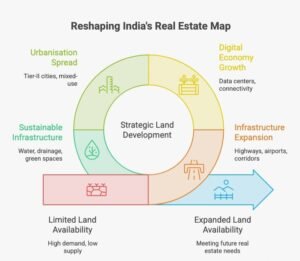
Development is increasingly extending into emerging cities and locations connected by highways, expressways, airports, industrial corridors, logistics networks and digital infrastructure.
This is where infrastructure-led real estate becomes an important lens through which I believe we should understand India’s next phase of development.
According to the latest Cushman & Wakefield India land-market research, 18,158 acres were transacted across more than 880 deals in 33 Indian cities between 2021 and Q1 2026.
Annual transacted acreage increased from 813 acres in 2021 to 6,181 acres in 2025, representing approximately 66% CAGR during the period.
The numbers are significant.
But for me, the more important question is what they reveal about India’s future development map.
Are we gradually moving from a city-centric real estate model towards a more corridor-led model?
If so, what should investors, landowners, developers, and urban observers look for?
What Is Infrastructure-Led Real Estate?
I use the term infrastructure-led real estate to describe development patterns where connectivity and supporting infrastructure become important catalysts for economic and urban activity.
This can include highways, expressways, metro networks, airports, industrial corridors, logistics infrastructure, and increasingly, digital infrastructure such as data centres and fibre networks.
However, I would make one distinction very clear.
Infrastructure does not automatically guarantee an increase in land value.
The more useful way to understand the relationship is:
Infrastructure → connectivity → accessibility → economic activity → development → potential real estate demand
The strength of that chain depends on many factors.
Planning, employment, utilities, regulations, environmental conditions, affordability and actual market demand all matter.
That is why I believe responsible real estate analysis should look beyond announcements and headlines.
A proposed road is not the same as an operational road.
An airport is not the same as an airport-led economic ecosystem.
And connectivity alone does not create a sustainable city.
The real opportunity lies in understanding what develops around the infrastructure.
India’s Land Market Is Moving Beyond Traditional Metros
One of the most interesting developments in India’s current land market is the increasing activity outside established metropolitan centres.
The latest Cushman & Wakefield research provides compelling evidence of this transition.
Between 2021 and Q1 2026, India recorded 18,158 acres of land transactions across more than 880 deals in 33 cities.
Annual transacted acreage increased from:
- 813 acres in 2021
- 6,181 acres in 2025
That represents approximately 66% CAGR in annual transacted acreage.
But the Tier-II story is perhaps even more interesting.
Annual Tier-II transaction acreage increased from only 16 acres in 2021 to 2,120 acres in 2025.
The annual share of land transactions in Tier-II cities also increased from approximately 2% in 2021 to 34% in 2025.
A September 2026 report by The Economic Times also highlighted the growing importance of Tier-II cities, reporting that these markets accounted for 67% of land transacted in Q1 2026.
For me, the story is not simply that Tier-II cities are growing.
It is that the scale and geography of land activity itself are changing.
There is another important dimension.
Average Tier-I land deal size declined from approximately 21 acres to 10 acres between 2021 and 2025, while Tier-II average deal size increased from approximately 8 acres to 53 acres.
This suggests that developers are increasingly able to assemble or access larger parcels in emerging markets.
That matters because large parcels can support different forms of development, including integrated residential projects, logistics parks, industrial developments and mixed-use communities.
In other words, the future of infrastructure-led real estate may not be confined to India’s traditional urban cores.
Infrastructure Corridors Are Creating New Development Nodes
A road by itself does not create a city.
But connectivity can change the economic relationship between places.
When an expressway reduces travel time, when a metro connects a peripheral district to an employment centre, or when an industrial corridor links manufacturing clusters with logistics networks, the land around those systems can become part of a larger development ecosystem.
This is why I believe infrastructure corridors deserve to be studied differently from individual infrastructure projects.
The question should not simply be:
“What infrastructure is coming here?”
The better question is:
“What does this infrastructure connect, and what economic activity can that connectivity support?”
The latest Cushman & Wakefield research identifies expressways, metro rail networks, industrial corridors and airport-linked developments among the infrastructure factors influencing land demand.
This is an important distinction.
A highway connecting two major economic centres may have a different development impact from a road that simply improves access to a small local area.
Similarly, an airport connected to hotels, offices, logistics, public transport and commercial districts creates a different economic ecosystem from an airport considered only as a passenger terminal.
This is why infrastructure-led real estate should be studied through an ecosystem rather than through a single project.
The infrastructure checklist I would use
When I study an emerging location, I would ask:
- Is the infrastructure approved?
- Is funding committed?
- What is its implementation stage?
- What locations does it connect?
- What economic activity does it support?
- What supporting infrastructure exists?
- What does local planning permit?
- What are the environmental and water considerations?
These questions help separate genuine structural change from short-term speculation.
Residential Is Still Dominant, But the Land Story Is Diversifying
Residential development remains the largest category in India’s land market.
According to Cushman & Wakefield, residential accounted for approximately 45% of transacted acreage between 2021 and Q1 2026.
But the broader trend is diversification.
Office-linked land transactions increased approximately five times between 2021–22 and 2024–25.
Industrial and logistics acquisitions increased nearly 13 times.
Mixed-use land transactions increased approximately 2.6 times.
This is important because it tells us that India’s land market is increasingly being connected to different economic activities.
Residential demand is still central.
But industrial employment, logistics, offices, technology infrastructure and mixed-use development are becoming increasingly important components of the land story.
I find this transition particularly significant.
Land is not simply a physical asset waiting for construction.
It is increasingly becoming part of an economic network.
A parcel may derive its strategic importance from its relationship with an employment hub, logistics corridor, airport, industrial cluster or digital infrastructure.
That is one reason why I believe the conversation around infrastructure-led real estate needs to move beyond residential property alone.
Data Centres Are Expanding the Definition of Infrastructure-Led Real Estate
One of the most interesting changes happening beneath India’s real estate story is the growth of digital infrastructure.
According to Cushman & Wakefield’s India Data Centre Market H1 2026 research, India’s operational data-centre capacity has reached approximately 1.8 GW, compared with around 400 MW in 2019.
The development pipeline is approximately 3.9 GW.
India is now the third-largest data-centre market in the Asia-Pacific region by operational capacity, according to the research.
Mumbai remains the country’s largest data-centre market, while Hyderabad, Chennai and Delhi NCR continue to be significant markets.
The research also identifies Visakhapatnam as an emerging destination for AI-focused data-centre investment.
Why does this matter for land?
Because data centres require a very different infrastructure ecosystem.
They need:
- suitable land
- reliable electricity
- fibre connectivity
- cooling infrastructure
- water systems
- security
- strong network connectivity
This means the definition of infrastructure-led real estate is becoming much broader.
It is no longer only about roads, railways and airports.
Increasingly, it is also about the infrastructure powering India’s digital economy.
AI, cloud computing and data consumption may sound like purely technological subjects.
But ultimately, they require physical infrastructure occupying physical land.
That connection between the digital economy and real estate is one of the trends I believe deserves considerably more attention.
Airports Are Becoming Economic Ecosystems
Airports have traditionally been viewed primarily as transport infrastructure.
But the airport-city model is beginning to demonstrate how aviation infrastructure can become part of a wider urban ecosystem.
In 2026, Adani Airports announced an integrated airport-city development programme covering more than 655 acres across six airports in five states.
According to the company’s official announcement, the first phase involves more than ₹20,000 crore of investment and approximately 22 million sq ft of development across Mumbai, Navi Mumbai, Ahmedabad, Lucknow, Jaipur and Guwahati.
The planned developments include offices, hospitality, retail, entertainment and convention infrastructure integrated with airport and city transportation.
This is a useful example of how infrastructure can become the nucleus of a broader economic ecosystem.
The potential progression is:
Airport → mobility → tourism → employment → hospitality → commercial activity → urban development
But once again, I would avoid a simplistic assumption that airport proximity automatically means higher land values.
The more meaningful question is whether the airport is accompanied by:
- employment generation
- business activity
- public transportation
- hospitality
- logistics
- urban services
- appropriate planning
That is the difference between simply being near infrastructure and being part of an infrastructure-led development ecosystem.
The Question Is No Longer Only “Where Is Land Cheap?”
I believe this is where India’s land-investment conversation needs to mature.
Price will always matter.
But price alone does not tell us whether a location has long-term development potential.
When I examine land connected to major infrastructure, I prefer to ask a broader set of questions.
Is the infrastructure actually approved?
There is a significant difference between an idea, an announcement and an approved project.
Is funding available?
Financial commitment provides a stronger basis for assessing execution than a headline about a future project.
What is the implementation timeline?
Infrastructure that may take several years to become operational should be evaluated differently from infrastructure already serving users.
What does it connect?
Connectivity becomes more meaningful when it links economic centres, employment clusters, logistics hubs or established urban areas.
What supporting infrastructure exists?
Road access alone may not create a complete development ecosystem.
Power, water, public transport, healthcare, education and other services also influence liveability and economic activity.
What does the planning framework allow?
Zoning, land-use regulations, development controls and approvals remain fundamental.
What are the environmental constraints?
Natural drainage, water availability, ecological sensitivity and climate exposure should be considered before making long-term land decisions.
What is the actual demand?
Infrastructure can create possibilities.
But sustainable development ultimately requires people, businesses and economic activity.
This is why I see infrastructure-led real estate as a framework for research rather than a shortcut to an investment conclusion.
India’s Future Development Map Could Become More Distributed
The latest land-market research provides another indication of the scale of India’s potential development pipeline.
Cushman & Wakefield estimates that land transacted between 2021 and Q1 2026 represents nearly 1.4 billion sq ft of potential future built-up area, based on prevailing planning norms and capital values.
The estimated potential spans several asset classes.
Asset class | Estimated potential |
Residential | 559–768 million sq ft |
Industrial & logistics | 205–225 million sq ft |
Office | 109–179 million sq ft |
Data centres | 113–124 million sq ft |
Retail | 8–26 million sq ft |
The research estimates an indicative future revenue potential of approximately ₹16.67 lakh crore based on prevailing planning norms and capital values.
I would treat this number carefully.
It should not be interpreted as guaranteed development, sales or investment returns.
Instead, I see it as an indication of the sheer scale of development capacity represented by land that has already changed hands.
That distinction is important.
India’s future real estate supply is not being created only inside its largest cities.
It is increasingly being assembled across a wider network of cities, corridors and economic clusters.
This is perhaps the biggest structural insight emerging from the current land-market data.
Infrastructure Cannot Be Separated From Sustainability
As someone who has spent years thinking about land, development and the relationship between people and nature, I believe another question must sit alongside every conversation about infrastructure-led real estate.
How do we develop without weakening the systems that make a place liveable?
A highway can improve connectivity.
An airport can expand economic access.
An industrial corridor can create employment.
A new urban district can create housing and commercial opportunities.
But every form of development also interacts with water systems, natural drainage, green spaces, local ecosystems and climate conditions.
This is why I believe the next generation of development needs a broader definition of value.
Economic value matters.
But so do:
- water security
- environmental resilience
- liveability
- mobility
- green spaces
- waste management
- energy efficiency
- long-term climate resilience
India’s urbanisation story cannot simply be about building more.
It must also be about building better.
The National Mission on Sustainable Habitat reflects this wider policy direction, with urban sustainability indicators covering areas such as water management, waste management, mobility and green spaces.
For me, responsible development is not about choosing between growth and nature.
It is about designing growth with a better understanding of nature.
How I Would Study an Infrastructure-Linked Land Opportunity
When I examine an emerging location, I prefer to move beyond the excitement surrounding a new project.
My framework is straightforward.
First, verify the infrastructure.
Second, understand its stage of development.
Third, study what it connects.
Fourth, identify the economic activity it can support.
Fifth, understand the planning and regulatory framework.
Sixth, examine utilities and water availability.
Seventh, assess environmental and climate-related constraints.
Finally, think in decades rather than headlines.
This last point is particularly important.
There is a significant difference between:
Announcement → approval → funding → construction → operation → economic absorption
A location can move through these stages at very different speeds.
That is why, when considering infrastructure-led real estate, patience and verification are as important as identifying the infrastructure itself.
The best research begins where the headline ends.
The Bigger Picture
When I look at India’s land market today, I see a country gradually developing a more distributed geography of growth.
The latest transaction data shows significant land activity.
Tier-II markets are becoming more important.
Larger parcels are enabling different forms of development.
Industrial and logistics demand is expanding.
Data centres are creating new forms of digital infrastructure demand.
Airport-city models are demonstrating how transport infrastructure can become part of a wider economic ecosystem.
But I do not believe the future of land should be reduced to one simple equation.
Infrastructure does not automatically create value.
It creates possibilities.
The real question is what happens next.
Does economic activity follow?
Does employment grow?
Do communities become better connected?
Does planning support responsible development?
Are water and environmental systems protected?
Does the location become more liveable?
These are the questions I believe we should be asking when we discuss India’s next development cycle.
For me, the most important lesson from the latest data is simple: India’s real estate map is expanding beyond traditional metropolitan boundaries.
The next generation of development may increasingly be shaped by corridors, connectivity and economic ecosystems.
And if we want that growth to remain valuable over the long term, we must look at land not merely as an asset, but as part of a much larger system of infrastructure, economy, community and nature.
FAQs
1) What is infrastructure-led real estate?
Infrastructure-led real estate refers to development and land-market activity influenced by major infrastructure such as expressways, airports, metro systems, industrial corridors, logistics networks and other connectivity improvements. The underlying idea is that better connectivity can expand development catchments and improve access to economic activity.
Recent data from Cushman & Wakefield’s India land-market research shows that infrastructure-led growth corridors are increasingly influencing land demand across India. Between 2021 and Q1 2026, 18,158 acres were transacted across more than 880 deals in 33 cities.
2) How does infrastructure affect real estate demand?
Infrastructure can influence real estate by improving accessibility, reducing travel friction and expanding the areas that businesses, residents and developers can practically reach. An expressway, airport or metro connection can therefore become one component of a broader development ecosystem.
However, infrastructure alone does not guarantee property appreciation. Investors also need to examine employment growth, commercial activity, population movement, planning regulations, utilities, land-use permissions and actual demand.
Cushman & Wakefield specifically identifies expressways, metro networks, industrial corridors and airport-linked developments as important drivers of land demand.
3) Why are Tier-II cities becoming increasingly important for land investment?
Tier-II markets are gaining attention because infrastructure expansion, larger land parcels and new economic activity are allowing development to move beyond established metropolitan cores.
According to Cushman & Wakefield, annual Tier-II land transactions increased from just 16 acres in 2021 to 2,120 acres in 2025, while their annual share of transacted acreage increased from around 2% to 34%. The average Tier-II deal size also increased from 8 acres to 53 acres during the broader period covered by the research.
This does not mean every Tier-II location will perform similarly. The quality, timing and execution of infrastructure remain critical factors.
4) Which types of infrastructure are most relevant to infrastructure-led real estate?
Several categories can influence development patterns. These include expressways and highways, airports, metro and rail networks, industrial corridors, logistics infrastructure, ports, urban utilities and digital infrastructure.
Their impact can also be interconnected. For example, an airport can improve regional accessibility, while highways and logistics infrastructure can support industrial and commercial activity around it. Digital infrastructure such as data centres introduces another land-demand category where power availability and connectivity are particularly important.
Cushman & Wakefield notes that India’s land acquisitions are becoming more diversified, with residential, industrial and logistics, office, mixed-use and data-centre developments all contributing to land demand.
5) Does infrastructure guarantee real estate appreciation?
No. Infrastructure should be viewed as a potential development catalyst, not a guarantee of returns or appreciation.
A new road or airport may improve accessibility, but the eventual real estate outcome depends on several other factors: land-use permissions, project completion, surrounding infrastructure, employment generation, population growth, supply and demand, environmental constraints, financing and the quality of development.
This distinction is particularly important for long-term investors. The more useful question is not simply “What infrastructure is coming?” but “What economic and urban activity can this infrastructure realistically support?”
6) Why are industrial, logistics and data-centre developments becoming important to land markets?
India’s land market is becoming more diversified beyond conventional residential development. Cushman & Wakefield reports that industrial and logistics land acquisitions expanded nearly 13 times between 2021–22 and 2024–25, while office-linked land transactions increased five-fold. Data-centre acquisitions also expanded in absolute terms.
Digital infrastructure is another emerging driver. Cushman & Wakefield’s India Data Centre Market H1 2026 research tracks the expansion of India’s data-centre market and the growing importance of locations offering suitable connectivity and power infrastructure.
For land-market analysis, this means future demand should be assessed across multiple economic uses rather than residential development alone.
7) How can airports influence surrounding real estate development?
Airports can become anchors for wider economic ecosystems when supported by highways, public transport, hospitality, commercial development, logistics and employment-generating activities.
The effect is therefore broader than simply reducing travel time. Improved air connectivity can support tourism, business travel, hospitality and commercial activity, while associated infrastructure can expand the development footprint around an airport.
Airport-city development is also becoming part of India’s broader urban-development conversation. For example, Adani Airports’ 2026 airport-city development announcement outlines plans for integrated development across multiple airport locations.
The important point for investors is to examine the entire ecosystem around an airport, rather than assuming that proximity by itself creates value.
8) What should investors examine before considering land along an infrastructure corridor?
I would look beyond the headline announcement and examine the development fundamentals systematically. Key questions include:
Is the infrastructure project officially approved and funded?
What is its current construction and completion status?
How much will accessibility actually improve?
Are connecting roads and utilities also being developed?
What is the land-use and zoning status?
Is there evidence of employment or commercial activity emerging nearby?
Are there environmental, water, drainage or ecological constraints?
Is there genuine end-user or occupier demand?
What is the existing and planned competing supply?
What is the realistic development timeline?
This approach is especially important because infrastructure-led real estate is ultimately about the interaction between connectivity, economic activity, land use and long-term urban development. India’s current land-market data shows the scale of this transition, but individual locations still require their own due diligence.
Final Perspective
I believe India’s next real estate story will not be written by property prices alone.
It will be written by connectivity, economic activity, infrastructure, planning and the quality of development that follows.
The opportunity is therefore not simply to ask where development is happening today.
It is to understand why it is happening, what is enabling it, and whether that growth can remain meaningful over the long term.
That is the perspective from which I look at infrastructure-led real estate—not as a promise of returns, but as a way of understanding how India’s physical and economic geography is evolving.
