Lifestyle

Category: Lifestyle

The Hidden Pay Raise Every Indian Just Received

Picture this: the same ₹5,000 grocery basket now costs you 3–5% less. Your EMI feels lighter. Your festive shopping bill doesn’t sting as much.

This is the real, personal impact of GST reforms in 2025. While headlines declare “rates slashed,” what they don’t capture is the direct increase in disposable income for millions of households. The GST reforms of 2025 are having a noticeable impact on Indians, akin to a hidden pay raise — from lighter grocery bills to reduced EMIs and festive relief.

As Kushal Dev Rathi explains:

“GST reforms gave Indians a hidden pay raise. The only question is — will we spend it or invest it?”

GST Rate Cuts 2025 — What It Means for Indians Today

The Goods and Services Tax is no longer new. Eight years since its rollout, GST has become India’s backbone of tax reform. Gross GST collections touched ₹22.08 lakh crore in 2024–25, up 9.4% year-on-year.

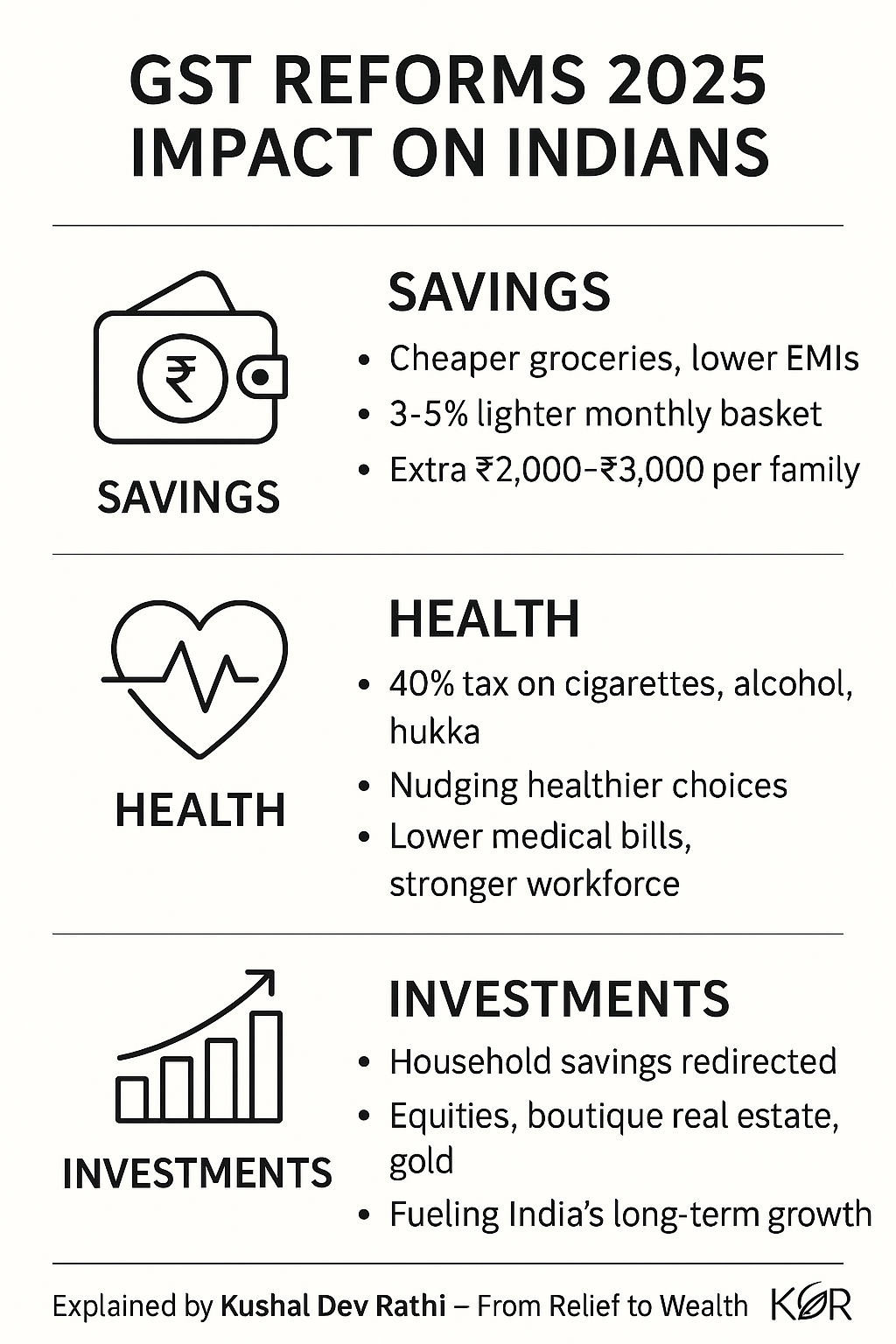
Infographic on GST reforms 2025 impact on Indians showing savings, health benefits, and investments, explained by Kushal Dev Rathi
GST Reforms 2025: Impact on Indians — Savings, Health, and Investments explained by Kushal Dev Rathi.

Prime Minister Narendra Modi had hailed GST as “a path-breaking legislation for New India.” Today, the proof lies in both revenue and relief:

  • Businesses benefit → 85% of firms report simplified compliance and lower logistics hurdles.

  • Consumers benefit → A Finance Ministry study found households save at least 4% on monthly essentials like cereals, oils, sugar, and snacks.

  • Government benefits → Wider tax base = more fiscal room for development and welfare.

This is a win-win-win reform — and your monthly budget is the first to feel it.

GST and Household Savings — Turning Relief into Wealth

The superficial impact of GST cuts is noticeable: cheaper bills. But the deeper story is how those savings can fuel long-term wealth creation. Another impact of the GST reforms 2025 on Indians is higher disposable income for investments, giving households the chance to turn small savings into long-term wealth.

More Disposable Income → More Savings

With GST cuts, a household saving ₹2,000 each month ends up with ₹3.6 lakh in 10 years, even before investment returns.

Savings → Investments → Growth

According to Kushal Dev Rathi, the most brilliant move is to redirect these “invisible raises” into long-term assets:

  • Equities (SIPs, ETFs) → to capture India’s market growth.

  • Boutique luxury real estate → Goa villas, Sariska retreats, Delhi-NCR premium homes.

  • Gold & bonds → hedging against uncertainty.

  • Sustainability funds → aligning with India’s green future.

Individual Choices → National Strength

When millions of households channel GST savings into investments, India’s capital pool deepens, fueling infrastructure, business expansion, and jobs. What starts as relief on your bills ends as a stronger national economy.

As Kushal Dev Rathi frames it:

“Reforms open doors. But it takes discipline to walk through them. If Indians turn GST savings into financial assets, we secure both personal and national wealth.”

GST and Health — Why Cigarettes & Alcohol Got Costlier

GST reforms are not just about money — they’re also about nudging lifestyle choices. A social GST reform in 2025 is expected to have a positive impact on Indians, leading to healthier lifestyle choices, as higher taxes on cigarettes, alcohol, and hukka discourage harmful spending.

By placing 40% taxes on cigarettes, alcohol, and hukka, the government is making unhealthy lifestyles more expensive. This is behavioural economics at work.

The results are visible:

  • Between 2016 and 2021, the share of men who consumed alcohol dropped from 29.2% to 17.5%, and tobacco use fell from 44.5% to 32.6%.

As Kushal Dev Rathi puts it:

“Just like mothers hold our ears and force us to eat vegetables, the government has taken on the role of a strict parent. We refused to listen earlier — higher taxes ensure we are listening now.”

This “tough love” approach not only saves lives but also reduces medical costs, thereby freeing more savings for productive use.

Healthcare Spending — Lower Bills, Healthier India

The Economic Survey 2024–25 highlights a major social shift:

  • Government health expenditure rose from 29% in FY2015 to 48% in FY2022.

  • Out-of-pocket medical costs fell from 62.6% to 39.4%.

  • Ayushman Bharat (AB-PMJAY) has saved households over ₹1.25 lakh crore so far.

For families, this means fewer medical shocks that erode wealth. As Kushal Dev Rathi notes:

“Lower medical bills aren’t just about healthcare. They translate into higher household savings — which can power investments, education, and security.”

This is why GST reforms are about more than consumption relief — they align with India’s vision of building a healthier, financially stronger nation.

GST Reforms 2025 Impact on Indians’ Household Savings

Despite reforms, there’s a warning light: India’s household savings rate dropped to 30% of GDP in 2022–23, the lowest in four decades.

Why Savings Fell

  • Pandemic disruptions forced families to dip into reserves.

  • Inflation eroded purchasing power.

  • A cultural shift toward YOLO consumption.

Why It Matters

  • Thinner safety nets for families.

  • Less domestic capital for infrastructure.

  • More vulnerability to shocks.

The Turnaround Plan

  • Union Budget 2025–26: No tax on annual income up to ₹12 lakh, freeing liquidity for middle-class households.

  • Financialisation push: SIPs, NPS, sovereign bonds, and small savings schemes are gaining traction.

  • Goldman Sachs projection: Indian households will generate $9.5 trillion in new financial assets over the next decade.

For Kushal Dev Rathi, this is the moment of discipline:

“The challenge isn’t lack of money. It’s lack of discipline. GST reforms give us the cushion — now we must convert that into compounding wealth.”

India vs USA — Why Timing of Reforms Matters

The global context makes GST reforms even more significant.

  • USA: battling inflation, debt, and slowing growth.

  • India: cutting taxes, attracting global investors, boosting domestic demand.

As Kushal Dev Rathi explains:

“Uncle Sam may be losing his punch, but the golden bird is spreading its wings. The eagle is rising in the East — and every Indian is part of that rise.”

For global investors, this makes India the preferred growth engine of the 2030s.

Action Plan — How to Invest GST Savings

Don’t let your “hidden pay raise” slip away. Here’s a 3-step plan:

Step 1: Calculate Your Relief

Even ₹2,000/month saved = ₹24,000/year = ₹4.8 lakhs in 20 years (without returns).

Step 2: Allocate With Intention

  • 30% → Equities (SIPs, ETFs)

  • 30% → Boutique luxury real estate

  • 20% → Gold / sovereign bonds

  • 20% → Sustainability & innovation funds

Step 3: Stay Consistent

Wealth isn’t built by windfalls but by compounding discipline over decades.

FAQs on GST Reforms and Their Impact

Q1. How do GST reforms affect the commoner?
They lower costs on essentials, freeing money for savings and investments.

Q2. Can small GST savings really build wealth?
Yes. Even ₹2,000/month invested in SIPs for 20 years can grow into ₹25–30 lakhs.

Q3. Why did the government raise taxes on cigarettes and alcohol?
To encourage healthier lifestyles, reduce medical costs, and boost productivity.

Q4. How do GST reforms strengthen India’s economy?
By boosting compliance, expanding formalisation, and deepening domestic savings.

Q5. Why is this timing critical compared to the USA?
India’s reforms coincide with America’s slowdown, positioning India as the next global growth hub.

Q6. What should middle-class Indians do with GST savings?
Treat them as seed capital — split between equities, real estate, gold, and sustainable investments.

Closing Perspective from Kushal Dev Rathi –

The GST reforms 2025 impact on Indians goes beyond immediate relief — it is reshaping habits, savings, and the nation’s growth story.

“GST reforms gave Indians more than financial relief. They gave us a chance to transform our habits, our savings, and our nation’s future. Most will spend it. The wise will invest it. The future will belong to the latter.”

For more thought-provoking articles :

Medium 

Substack 

Linkedin

Blogs

-->
class="post-4051 post type-post status-publish format-standard has-post-thumbnail hentry category-investment category-lifestyle tag-boutique-real-estate-india tag-de-dollarization-india tag-gst-and-investments tag-gst-and-personal-finance tag-gst-and-savings tag-gst-impact-on-indians tag-gst-reforms-2025 tag-gst2-0 tag-health-taxes-india tag-india-reforms-2025-economy tag-india-vs-usa-economy tag-kushal-dev-rathi tag-kushal-dev-rathi-insights tag-land-banking-india tag-next-billionaires-india ast-grid-common-col ast-full-width ast-article-post" id="post-4051" itemtype="https://schema.org/CreativeWork" itemscope="itemscope">

Category: Lifestyle

India’s food story is at a crossroads. On one hand, our plates are fuller than ever — supermarkets brimming with options, kitchens stocked with convenience, and policies that ensure fewer people sleep hungry. But behind this apparent success lies a darker truth: the food we trust is quietly betraying us.

From fake paneer rackets in Noida to protein powders laced with chalk and milk diluted with detergent, adulteration has become a silent epidemic. Even those who avoid junk food, smoking, or alcohol are not spared — cancers, autoimmune diseases, and lifestyle disorders are rising at alarming rates. The question is no longer “Are we eating enough?” but “Are we eating safe?”

This shift — from food security to nutrition security — is where the real battle lies. And it’s a battle that cannot be won through packaged promises or calorie counts alone. As wealth strategist Kushal Dev Rathi argues, the answer lies deeper, rooted in the soil itself. His Soil-to-Soul philosophy reframes nutrition as not just a dietary choice but an investment choice — one where owning and developing land secures not just wealth, but wellness.

With that in mind, here are 7 reasons why nutrition security matters more than ever — and why land could be the forgotten nutrition policy India needs.

Fake Food is India’s Silent Epidemic

Just last month, authorities in Noida seized 1,400 kg of fake paneer. And this isn’t an isolated case. FSSAI data shows that 1 in 5 food samples tested in India fail safety standards. From paneer laced with starch to milk diluted with detergents, adulteration is poisoning what we consider daily nutrition.

“Food adulteration is not a one-off scandal — it’s a systemic health risk,” says Kushal Dev Rathi.

Adulteration Goes Beyond Paneer

While paneer tops the list, it’s not alone. FSSAI tests have flagged edible oils mixed with harmful solvents, spices colored with lead chromate, protein powders bulked up with chalk, and even tea dust adulterated with coal tar dye.
What’s more alarming? Even Indians who don’t consume junk, smoke, or drink alcohol are now being diagnosed with autoimmune diseases, cancers, and lifestyle disorders — raising a chilling question: Is the real culprit our “daily food” itself?

The “Uncontrollable Variable” in Daily Life

We can control our habits — but what about what makes it to our kitchen shelves? Every day, we unknowingly consume toxins hidden in the food chain.
This uncontrollable variable — the gap between what’s available and what’s safe — is the true nutrition challenge.

Nutrition Security ≠ Food Security

In India, food security often just means “no one should sleep hungry.” But as PM Modi recently warned, obesity is emerging as one of India’s biggest health challenges — showing that calories alone don’t guarantee health.
Nutrition security must mean:

  • What we eat is pure and safe
  • What we consume is within our control
  • What we pass on to the next generation is sustainable

Land: The Forgotten Nutrition Policy

For Kushal Dev Rathi, the solution goes beyond policing food chains. His philosophy is clear:

“The only way to secure what goes inside your body is to control where it comes from — and that means land.”

Even one acre of land can transform a family’s health:

  • Fresh vegetables grown without pesticides
  • Pure milk from cows and buffaloes raised naturally
  • Safe water harvested and managed sustainably

This is the Soil-to-Soul Strategy — where land becomes both a wealth multiplier and a nutrition protector.

Global & Indian Momentum Toward Food Sovereignty

  • Japan leads the world in urban farming — Tokyo alone produces thousands of tons of vegetables annually from rooftop farms.
  • Europe incentivizes micro-farms as part of climate and health policy.
  • In India, small farm plots near metros are being rediscovered as family health investments, not just financial ones.

India’s organic food market is projected to reach ₹75,000 crore by 2030, proving that the demand for safe, traceable food is exploding.

Wealth Beyond Balance Sheets: The Future is Land + Health

Unlike gold (which stores value but doesn’t feed you) or stocks (which fluctuate), land is the only asset that provides both wealth and wellness.
Rathi frames it powerfully:

“Land is not just buy-and-hold. It’s buy-and-evolve — wealth for the balance sheet and health for the body.”

As India aspires to rise globally, Rathi urges that nutrition must be treated as a national imperative. A nation that cannot trust its food supply cannot trust its future.

Conclusion & CTA

Nutrition security is India’s next big challenge — but also its biggest opportunity. The Soil-to-Soul strategy offers a path where land investment secures not just financial wealth, but the very food on our plates.

👉 Explore more of Kushal Dev Rathi’s insights at kushaldevrathi.com.
👉 Follow him on LinkedIn & Medium for weekly thought leadership.


     Read More:

-->
class="post-3945 post type-post status-publish format-standard has-post-thumbnail hentry category-lifestyle tag-fake-panner-racket-india tag-food-adulteration-india-2 tag-kushal-dev-rathi tag-land-investment-for-health-2 tag-national-nutrition-week-india tag-nutrition-security-india-2 ast-grid-common-col ast-full-width ast-article-post" id="post-3945" itemtype="https://schema.org/CreativeWork" itemscope="itemscope">

Category: Lifestyle

One algorithm changed global industries overnight. But at my urban farm? Growth remained steady, digitally precise, and powerfully predictable.

Last week marked World Youth Skills Day, centered around the powerful theme, “Youth empowerment through AI and digital skills.” While global headlines buzzed about tech layoffs and economic uncertainties, I watched a young intern at our urban farm quietly recalibrating a drone for optimal irrigation.

And there it was, vividly clear: Skills aren’t just learned, they are investments.

India houses the world’s largest youth population over 356 million individuals aged 10-24. Yet, according to UNICEF, nearly half lack adequate digital skills required for future employment. That’s not just a challenge; it’s a critical investment gap.

Globally, AI-driven economies are projected to add $15.7 trillion by 2030, according to PwC. In India alone, investments in AI and digital startups surged to $1.7 billion in 2023. While headlines may worry about technology displacing jobs, the World Economic Forum confidently states that AI will generate 97 million new jobs by 2025, significantly outweighing the 85 million jobs potentially displaced.

At our urban farms, digital tools and AI technology aren’t just innovations, they’re essentials. Our precision irrigation system, driven by AI, reduces water use by up to 90% compared to conventional methods. Machine learning tools track soil health, boosting crop yield by over 30% consistently.

One young team member recently utilized AI to optimize plant growth schedules, enhancing our productivity by 35%. Another developed a mobile app, transforming urban gardening into a widespread community activity.

Amid global digital volatility, one thing is evident: true stability comes from nurturing human skill and potential.

As investors, leaders, and mentors, our real ROI is ensuring youth are digitally empowered. This isn’t just about employment, it’s about sustainable survival and enduring prosperity.

In a fast-paced, unpredictable world, investing in youth AI skills isn’t just smart—it’s necessary.

Because future growth, quite literally, depends on it.

-->
class="post-3645 post type-post status-publish format-standard has-post-thumbnail hentry category-lifestyle category-nature ast-grid-common-col ast-full-width ast-article-post" id="post-3645" itemtype="https://schema.org/CreativeWork" itemscope="itemscope">

Category: Lifestyle

When we think of luxury, images of exclusive mansions, opulent lifestyles, and premium amenities immediately spring to mind. But today, a profound transformation is underway: Luxury now also means responsibility luxury intertwined seamlessly with sustainability.

India’s affluent, driven by both personal values and market foresight, are increasingly integrating sustainable practices into their luxurious lifestyles. According to Knight Frank’s latest Wealth Report, over 70% of ultra-high-net-worth individuals in India see sustainable investing as integral to their portfolio strategies.

Urban farming is at the heart of this transformation. Picture a sophisticated rooftop farm overlooking a bustling city skyline, employing AI-driven hydroponics systems that reduce water usage by up to 90%, or luxury residences seamlessly integrating organic farming into architectural designs. These aren’t mere concepts, they are active realities reshaping modern urban living.

Studies reveal properties featuring sustainable urban farming amenities see their valuation enhanced by as much as 15-20%. This isn’t merely about aesthetics or novelty; it’s about strategic investment and forward-thinking vision.

Urban farming luxury isn’t just sustainable, it’s strategic. Smart technology monitors crop health, enhancing productivity, reducing costs, and even purifying air quality. For India’s elite, investing in urban sustainability is a clear demonstration of foresight, sophistication, and responsibility.

One influential business leader recently shared with me, “Sustainability isn’t a trend, it’s a necessity. And now, luxury that doesn’t account for sustainability is outdated.”

In the emerging narrative of luxury, the true symbol of status isn’t excess, it’s sustainable abundance. Urban luxury now means living in harmony with the environment, demonstrating that wealth and ecological responsibility can coexist beautifully.

Ultimately, true luxury today is not just about possessing it’s about preserving.

-->
class="post-3639 post type-post status-publish format-standard has-post-thumbnail hentry category-nature category-lifestyle ast-grid-common-col ast-full-width ast-article-post" id="post-3639" itemtype="https://schema.org/CreativeWork" itemscope="itemscope">

Category: Lifestyle

Did you know that nearly 51% of India’s net sown area is rainfed? And yet, these regions contribute over 40% of our total food grain production.

For eco-farmers, monsoon isn’t just weather, it’s wealth.

With the right natural systems in place like soil cover, contour bunding, and native water channels rain-fed farms perform with remarkable efficiency. In states like Maharashtra and Chhattisgarh, millet farms have shown 30–40% higher resilience during drought years, directly tied to consistent monsoon years.

In our FarmHome plots, we’ve implemented water-harvesting trenches and native tree lines that channel monsoon rains into deep soil nourishment. The result? Better soil structure, improved microbial activity, and lower input costs.

Monsoon rain, when welcomed wisely, becomes more than just water. It becomes a collaborator.

And in the hands of eco-conscious landowners, that collaboration turns into a cycle of abundance one that feeds not just crops, but communities.

Because when rain meets readiness, nature rewards us in kind.

-->
class="post-3679 post type-post status-publish format-standard has-post-thumbnail hentry category-nature category-lifestyle ast-grid-common-col ast-full-width ast-article-post" id="post-3679" itemtype="https://schema.org/CreativeWork" itemscope="itemscope">

Category: Lifestyle

Cities are rapidly expanding, often at the expense of green spaces. Yet, amid towering skyscrapers and congested streets, urban farming emerges as a powerful antidote, transforming concrete jungles into thriving green sanctuaries.

India’s urban areas are expected to house 40% of its population by 2030. The challenge: balancing growth with sustainability. Urban agriculture is rising as a strategic solution. According to a report by MarketsandMarkets, the global urban farming market is projected to reach $288.71 billion by 2030, growing at an impressive CAGR of 9.6%.

Take Bengaluru, for instance, where urban farming initiatives have rejuvenated abandoned spaces, turning them into productive food hubs. Community farms there have notably reduced local temperatures by up to 2°C, significantly improving air quality and reducing pollution levels by up to 20%.

At our urban farms, I see firsthand how technology and tradition intersect beautifully. Smart hydroponic systems use 90% less water compared to traditional agriculture, and AI-driven farming practices increase crop yields by up to 30%.

Urban farming isn’t merely about ecological benefit, it offers substantial economic returns. According to FAO, urban agriculture provides employment to over 100 million people globally, significantly boosting local economies.

A recent visitor, an influential city planner, reflected, “Urban farming isn’t a trend, it’s an urban lifeline.” He’s right. It’s more than planting seeds, it’s about nurturing cities for future resilience.

In India’s urban evolution, green sanctuaries aren’t just attractive, they’re essential. Urban farming offers a proven pathway to sustainability, livability, and economic vitality.

Because thriving cities are those that learn to grow, sustainably.

-->
class="post-3633 post type-post status-publish format-standard has-post-thumbnail hentry category-lifestyle category-nature ast-grid-common-col ast-full-width ast-article-post" id="post-3633" itemtype="https://schema.org/CreativeWork" itemscope="itemscope">

Category: Lifestyle

Markets frequently tremble at mere whispers of trade conflicts. Stocks fluctuate, currencies swing unpredictably, but at urban farms? The soil remains resolutely calm.

Increasingly, India’s elite—politicians, business magnates, and seasoned investors—are discreetly shifting their focus back to the earth beneath their feet. Why? Because in a volatile global environment, soil offers a steadfast refuge.

India’s urban farming sector has quietly attracted investments totaling nearly ₹2,000 crores in the past three years. It’s not just financial prudence, it’s strategic foresight in uncertain times.

Unlike volatile stocks or cryptic cryptocurrencies, soil provides tangible assurance. According to a recent survey by KPMG, 63% of high-net-worth investors in India view urban farming and sustainable agriculture as essential hedges against economic volatility.

Our urban farming ventures go beyond sustainable agriculture; they’re pillars of resilience. Advanced AI-driven technologies optimize resources, reducing water use by up to 70% and boosting productivity by approximately 40%. Urban farms aren’t just growing crops; they’re cultivating sustainability, stability, and solid returns.

A senior politician recently remarked, “Land doesn’t merely deliver returns, it offers peace of mind.” Amid fluctuating oil prices, uncertain geopolitics, and unpredictable climate events, land provides unmatched immunity compared to other assets.

Investment in urban farms today isn’t merely prudent, it’s essential. It’s an anchor in turbulent times, ensuring food security and ecological balance.

The smartest investments aren’t simply about growth above ground they’re deeply rooted in
the stability beneath.

-->
class="post-3621 post type-post status-publish format-standard has-post-thumbnail hentry category-nature category-lifestyle ast-grid-common-col ast-full-width ast-article-post" id="post-3621" itemtype="https://schema.org/CreativeWork" itemscope="itemscope">

Category: Lifestyle

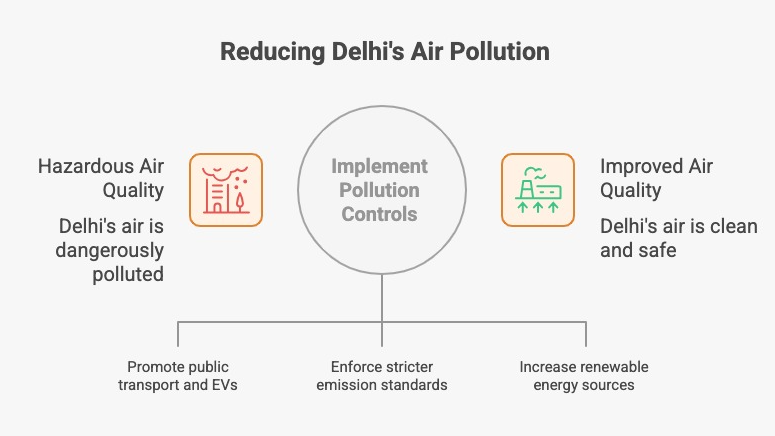
Today, real-feel temperatures in Delhi are hovering around 51.9°C, with actual highs between 43–45.5°C, and nighttime lows stuck at 30–35.6°C . But numbers tell only part of the story.

The Everyday Crisis

  • Throbbing heat isn’t just discomfort—it’s health danger. Children, elderly, informal workers risk dehydration and heatstroke .
  • Power grids groan under A/C loads; demand spikes to 30,000+ MW, pushing some areas into brownouts .
  • Air quality worsens. Latest Delhi AQI is “poor” at ~227, hitting “unhealthy” levels at 245.
  • Spike in mental stress is real. Research shows extreme heat elevates anxiety and depression—especially in low-income zones .

On paper, IMD forecasts relief only after June 13–14, with possible thunderstorms from moist monsoon winds.

What I See (and What We Need)

Delhi’s problem isn’t just weather—it’s urban design, policy inertia, and climate variance colliding. Solutions exist, but execution is slow. Here’s the path:

Short-term Fix Medium-Long Solution

Mandatory midday shade and water zones in public areas Green corridor expansion: tree cover to cut UHI effect Cool-roof programs in schools/residential buildings City-wide rainwater harvesting and aquifer replenishment Emergency A/C for vulnerable communities Phased greening of roads, parks, rooftops, public buildings Heat-health alerts via WhatsApp/IVR for vulnerable groups Migratory tree plantation drives in NCR, villages, & farmlands Retrofit pub.

This Isn’t a Repeat of Last Year

Delhi endured over 40,000 heatstroke cases during 2024’s heatwave, and more than 100 deaths   We cannot fail again. We must prepare, adapt, and build—not just endure.

Why Now?

  • Delhi hit all-time June highs—real temperatures of 52°C, even as farmlands
    saw 47°C .
  • IMD warnings—red alert till June 13, relief by 14
  • A wake-up call: monsoon delayed, heatwave intensified, Delhi’s resilience infrastructure tested—and failing.

My Personal Take: “Heal the Soil, Cool the City”

If we can build generational wealth in land and nature, we can also build generational resilience in cities. Begin with:

  • Motherland first: Protect soil under trees to reduce city heat
  • Mothers first: Heat alerts for schools, maternity centers
  • Markets next: Mandate green canopies and shade lanes

Each incremental step changes Delhi’s temperature curve—and its future. Heat isn’t just about weather—it’s about how we build, govern, and plan. The cost of inaction? Lives, productivity, sanity.

Because Delhi’s heat wave isn’t just a climate event—it’s a leadership test.

If we fail to act, the next 52°C won’t be the last—and it might break more than our tolerance. It’s time to solve it together.

-->
class="post-3615 post type-post status-publish format-standard has-post-thumbnail hentry category-lifestyle ast-grid-common-col ast-full-width ast-article-post" id="post-3615" itemtype="https://schema.org/CreativeWork" itemscope="itemscope">

Category: Lifestyle

India’s wealth is no longer confined within its borders—it’s strategically expanding globally. In 2025, High Net-Worth Individuals (HNIs) from India are investing internationally at unprecedented levels, driven by a blend of opportunity and prudence.

📊 The Shift in Numbers

  • Liberalised Remittance Scheme (LRS): Outward remittances reached approximately $30 billion in FY2024-25, slightly down from the previous year but reflecting sustained interest in global investments.

  • Dubai Real Estate: Indian investments in Dubai’s real estate market are projected to grow from $20 billion in 2024 to $22 billion in 2025, solidifying India’s role as a leading foreign investor.

  • Portugal’s Golden Visa: Applications from Indian HNIs have surged, with thousands of family applications annually, underscoring the program’s appeal for those seeking European residency.

📊 Why This Trend?

This shift isn’t just about luxury—it’s strategic. Key drivers include:

  • Rising domestic market volatility

  • Geopolitical uncertainties

  • Currency fluctuations

Global investments act as critical hedges, stabilizing portfolios and ensuring long-term wealth preservation.

📊 Role of Family Offices

Family offices are leading this charge, leveraging the Liberalised Remittance Scheme (LRS) to:

  • Facilitate strategic asset allocation across global markets.

  • Build resilience and seize international opportunities.

These entities are not merely transferring funds but are proactively shaping diversified portfolios.

📊 Global Investment Isn’t Capital Flight

This movement isn’t capital flight—it’s capital evolution. Indian HNIs remain deeply committed to domestic growth, reinvesting in key sectors such as:

  • Agriculture

  • Alternative assets

  • Education

This dual strategy strengthens India’s economic growth while expanding global footprints.

📊 What We Need

To sustain and amplify this trend, India requires:

  • Policy Support: Strengthened policies to facilitate global investments while safeguarding domestic interests.

  • Financial Literacy: Enhanced programs to educate investors on global investment avenues.

  • Regulatory Frameworks: Transparent regulations to promote secure international diversification.

✅ Why This Matters

Global investment strategies are vital for wealth stability. As borders blur, wise financial globalism doesn’t dilute patriotism—it enriches it, fostering economic stability both globally and locally.

India’s HNIs are not just going global—they’re proactively shaping India’s economic future from within and beyond.

-->
class="post-3602 post type-post status-publish format-standard has-post-thumbnail hentry category-lifestyle ast-grid-common-col ast-full-width ast-article-post" id="post-3602" itemtype="https://schema.org/CreativeWork" itemscope="itemscope">

Category: Lifestyle

When we think of oceans, we often picture distant coastlines, crashing waves, and blue horizons far from our farms, our cities, our daily lives. But standing here — in the heart of inland India, among fields I’ve nurtured for over a decade . I know a different truth: the ocean begins on land.

Every time we use chemicals in our soil, they find their way into rivers. Every plastic bottle tossed on a roadside eventually meets a drain, a stream, and then the sea. Our oceans are choking not just because of offshore drilling or overfishing, but because of inland choices made every day in agriculture, in waste management, in land planning.

In my work at Sportsland, we’ve tried to reverse that tide. We compost every leaf, we harvest every drop of rain, and we grow food without poison. Not because it’s trendy, but because it’s necessary. Healthy land holds water. Clean soil filters runoff. Conscious communities create cleaner oceans whether we live beside them or miles away.

It’s time we stop treating marine degradation as a coastal problem. It’s a systems problem. It’s our problem.

To those in positions of influence — policymakers, developers, investors the responsibility is even greater. Every decision you make about land use, industrial waste, urban planning, and agricultural subsidy echoes in our oceans.

This World Ocean Day, I ask you to see the unseen connections. What you do on land doesn’t stay on land.

Protecting our oceans doesn’t start at the shore. It starts at the source — with soil, with streams, with how we treat the Earth beneath our feet.

Because in the end, there’s only one ecosystem. And one chance to get it right.

-->
class="post-3586 post type-post status-publish format-standard has-post-thumbnail hentry category-lifestyle ast-grid-common-col ast-full-width ast-article-post" id="post-3586" itemtype="https://schema.org/CreativeWork" itemscope="itemscope">

Talk to us?