
India’s Coastal Story Is Entering a New Chapter
For decades, whenever India spoke about premium coastal tourism, second homes, lifestyle migration, or beachfront investment, one destination dominated the conversation — Goa.
I have personally witnessed Goa evolve from a quiet coastal retreat into one of India’s most recognized tourism and lifestyle economies. What once represented untouched beaches, slow living, and nature-centric experiences gradually transformed into a highly commercialized, globally recognized coastal market.
But every successful coastal economy eventually reaches a point of maturity.
Today, Goa faces increasing land saturation, rising infrastructure pressure, tourism overcrowding, ecological stress, and premium real estate pricing. The demand for coastal living, however, has not slowed down. If anything, the post-pandemic world has accelerated humanity’s desire to reconnect with nature, open landscapes, wellness-focused environments, and sustainable lifestyles.
This is precisely where the story of the Vengurla Coastal Destination begins.
Over the last few years, I have closely observed a silent but extremely important shift taking place along India’s western coastline. Investors, entrepreneurs, hospitality brands, NRIs, wellness-focused buyers, and sustainability-conscious individuals are beginning to look beyond saturated coastal markets and identify regions that still preserve ecological authenticity while offering long-term growth potential.
In my view, the Vengurla Coastal Destination represents one of the most strategically positioned emerging coastal corridors in India today.
What makes this transition particularly fascinating is that the growth story of the Vengurla Coastal Destination is not merely being driven by tourism hype. It is being shaped by a combination of:
- infrastructure expansion,
- airport connectivity,
- tourism spillover from Goa,
- coastal lifestyle migration,
- sustainability-driven living preferences,
- marine tourism,
- luxury second-home demand,
- and long-term land scarcity economics.
At the same time, the region still retains something that many developed coastal destinations have lost — ecological purity.
Unlike overcrowded tourism hubs, the Vengurla Coastal Destination still offers:
- cleaner beaches,
- lower-density development,
- biodiversity-rich ecosystems,
- authentic Konkan culture,
- and a slower, nature-connected lifestyle.
As an environmentalist and sustainability advocate, I believe this distinction is extremely important.
Because the future of coastal development cannot simply be about aggressive commercialization.
The future belongs to destinations that can balance:
- economic growth,
- environmental stewardship,
- biodiversity conservation,
- and responsible infrastructure development.
And this is why I believe the Vengurla Coastal Destination deserves serious attention from long-term investors, policymakers, entrepreneurs, and sustainability-focused individuals.
Understanding the Strategic Importance of Vengurla Coastal Destination
The first reason the Vengurla Coastal Destination is gaining momentum lies in geography.
Historically, geography has always shaped the destiny of coastal economies. Cities and towns located near ports, tourism corridors, trade routes, and transportation infrastructure naturally evolve into economic growth centers over time.
Vengurla sits within Maharashtra’s Sindhudurg district along the Konkan coast, strategically positioned close to:
- Goa,
- MOPA International Airport,
- Konkan Railway,
- NH-66,
- and the expanding western coastal tourism corridor.
According to the official Maharashtra Tourism Department, Vengurla is known for its pristine beaches, marine beauty, natural landscapes, and relatively untouched tourism ecosystem.
This geographic positioning creates a powerful spillover advantage.
Whenever mature tourism economies become saturated, nearby emerging regions typically experience accelerated growth. Globally, this pattern has repeated itself across coastal markets in Southeast Asia, Europe, the Middle East, and even parts of India.
In the case of the Vengurla Coastal Destination, the spillover is increasingly coming from Goa.
Goa already possesses:
- strong tourism branding,
- international recognition,
- airport infrastructure,
- luxury hospitality ecosystems,
- and established visitor traffic.
As tourism and investment pressure expands outward, adjacent regions naturally become the next frontier.
The Vengurla Coastal Destination is now entering that phase.
Goa’s Maturity Is Creating a New Coastal Investment Cycle
To understand why the Vengurla Coastal Destination is emerging so rapidly, we must first understand what is happening in Goa.
Goa today is no longer an “emerging” tourism market.
It is a mature coastal economy.
While Goa remains highly attractive, the market now faces several structural realities:
- premium land scarcity,
- rising acquisition costs,
- heavy tourism congestion,
- environmental stress,
- increasing commercialization,
- and limited inventory in prime coastal belts.
Many premium coastal plots in North Goa have already reached extremely high valuations. This has made entry difficult for newer investors seeking long-term appreciation potential.
At the same time, affluent buyers are increasingly searching for:
- lower-density living,
- privacy,
- cleaner environments,
- authentic experiences,
- and nature-driven luxury.
This shift is directly benefiting the Vengurla Coastal Destination.
The reality is simple:
people still want coastal living — but they increasingly want a more balanced version of it.
The Vengurla Coastal Destination offers precisely that balance.
It still retains:
- ecological calm,
- lower tourism density,
- less commercialization,
- and significant land availability compared to Goa.
This combination is becoming increasingly attractive to:
- HNIs,
- NRIs,
- entrepreneurs,
- wellness investors,
- second-home buyers,
- and long-term land investors.
How MOPA International Airport Is Reshaping the Future of Vengurla Coastal Destination
In infrastructure-led growth cycles, airports often become the single most transformative catalyst.
The operationalization of Manohar International Airport (MOPA Airport) is one of the biggest reasons the Vengurla Coastal Destination is now gaining serious investor attention.
Airport infrastructure changes everything:
- tourism flow,
- hospitality expansion,
- investor confidence,
- accessibility,
- and regional economic integration.
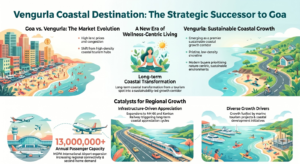
According to official airport development data, MOPA Airport’s future expansion capacity is expected to exceed 13 million passengers annually.
That scale of connectivity has enormous implications for nearby coastal regions.
The Vengurla Coastal Destination benefits directly because:
- travel time has reduced significantly,
- luxury tourism accessibility has improved,
- weekend tourism becomes more viable,
- and hospitality investment becomes more attractive.
Historically, airport-led growth has transformed numerous global tourism destinations.
We saw similar patterns in:
- Dubai,
- Bali,
- Phuket,
- and even Goa itself.
Improved air connectivity attracts:
- higher-spending travelers,
- premium hospitality operators,
- wellness tourism,
- and second-home buyers.
This is now beginning to happen across the Sindhudurg coastal belt.
Several real estate and infrastructure studies already suggest that land markets surrounding the airport influence zone have witnessed strong appreciation momentum over the last two years.
The long-term implication is extremely important.
The Vengurla Coastal Destination is no longer isolated.
It is becoming increasingly integrated into India’s premium coastal economy.
Tourism Trends Are Supporting the Rise of Vengurla Coastal Destination
Tourism itself is changing globally.
The modern traveler no longer seeks only crowded nightlife or high-density commercial tourism.
Today’s affluent traveler increasingly prioritizes:
- wellness,
- slower living,
- eco-tourism,
- marine experiences,
- sustainability,
- and authentic local culture.
This behavioral shift strongly supports the rise of the Vengurla Coastal Destination.
Unlike heavily commercialized tourism hubs, Vengurla still offers:
- quieter beaches,
- cleaner coastlines,
- authentic Konkan heritage,
- biodiversity-rich landscapes,
- and nature-led experiences.
This is becoming increasingly valuable.
According to tourism market studies and hospitality reports, experiential tourism and wellness tourism are among the fastest-growing segments globally.
India itself is witnessing strong growth in:
- eco-tourism,
- marine tourism,
- wellness retreats,
- and slow-travel experiences.
The Maharashtra government has also increased its focus on coastal tourism expansion and regional tourism diversification.
Recent tourism policy discussions covered by The Times of India indicate increasing emphasis on destination management and tourism infrastructure improvement.
This broader tourism transformation directly supports the long-term potential of the Vengurla Coastal Destination.
Infrastructure Is Accelerating the Growth of Vengurla Coastal Destination
Infrastructure always precedes large-scale economic transformation.
And today, the infrastructure story around the Vengurla Coastal Destination is becoming increasingly compelling.
Several important developments are reshaping regional connectivity:
- NH-66 expansion,
- Konkan Railway accessibility,
- airport connectivity,
- tourism road upgrades,
- and coastal tourism projects.
The Mumbai-Goa highway upgrades alone are expected to significantly improve travel efficiency along the Konkan belt.
Better roads directly impact:
- tourism mobility,
- logistics,
- hospitality growth,
- and real estate demand.
At the same time, the Konkan Railway continues to remain one of western India’s most strategically important transportation corridors.
This connectivity is crucial because accessibility determines tourism scalability.
Without infrastructure, tourism economies remain limited.
With infrastructure, coastal economies can rapidly transform.
That transformation is increasingly visible in the Vengurla Coastal Destination.
Marine Tourism Could Become a Massive Growth Driver
One of the most interesting developments in Maharashtra’s coastal tourism strategy is the approval of India’s first submarine tourism project in Sindhudurg.
According to The Times of India report on Maharashtra’s submarine tourism project, the initiative aims to create underwater tourism experiences linked to marine biodiversity and coastal ecosystems.
This is highly significant.
Globally, marine tourism has emerged as a premium tourism category.
Destinations with strong marine ecosystems often attract:
- scuba tourism,
- underwater exploration,
- luxury tourism,
- and experiential travel.
The Vengurla Coastal Destination possesses several natural advantages here:
- marine biodiversity,
- cleaner waters,
- coastal ecosystems,
- and relatively lower tourism pressure.
If managed sustainably, marine tourism alone could become a major economic driver for the region over the next decade.
Sustainability Is the Biggest Long-Term Advantage of Vengurla Coastal Destination
As someone deeply committed to environmental stewardship, I believe sustainability is not just an ethical responsibility anymore.
It is becoming an economic advantage.
Globally, investors and travelers are increasingly prioritizing destinations that preserve:
- nature,
- biodiversity,
- ecological integrity,
- and low-density development.
This is where the Vengurla Coastal Destination holds enormous long-term strength.
Unlike overdeveloped coastal regions, Vengurla still retains:
- natural vegetation,
- cleaner beaches,
- biodiversity-rich ecosystems,
- and lower construction density.
That ecological purity itself becomes valuable over time.
Because once coastal ecosystems are destroyed, rebuilding them becomes extremely difficult.
This is precisely why responsible coastal planning matters.
The future success of the Vengurla Coastal Destination should not depend on aggressive commercialization.
It should depend on:
- conscious tourism,
- eco-sensitive infrastructure,
- regenerative hospitality,
- and sustainability-led urban planning.
The regions that preserve nature intelligently will ultimately become the most valuable destinations economically.
Why Investors Are Closely Watching Vengurla Coastal Destination
Every major coastal investment cycle follows a recognizable pattern:
- Infrastructure improves
- Accessibility increases
- Tourism expands
- Hospitality grows
- Investors enter early
- Land scarcity develops
- Premiumization accelerates
Many signs indicate that the Vengurla Coastal Destination is entering the early-middle stage of this cycle.
Several factors are contributing to investor interest:
- airport connectivity,
- tourism spillover,
- lower land entry pricing,
- infrastructure growth,
- and increasing coastal demand.
Importantly, premium coastal land is finite.
This scarcity itself creates long-term appreciation potential.
The Vengurla Coastal Destination is especially attracting attention from:
- long-term land investors,
- second-home buyers,
- hospitality entrepreneurs,
- wellness brands,
- and NRIs seeking lifestyle assets.
Unlike speculative short-term markets, coastal regions with genuine infrastructure growth and tourism demand often experience sustained long-term value creation.
That is why strategic land acquisition in emerging coastal corridors becomes important.
The Rise of Second Homes and Nature-Centric Living
The pandemic fundamentally changed how people think about living environments.
Urban professionals increasingly realized the importance of:
- space,
- nature,
- slower living,
- mental wellness,
- and healthier environments.
This has accelerated demand for:
- second homes,
- wellness retreats,
- coastal villas,
- and eco-luxury hospitality.
The Vengurla Coastal Destination aligns strongly with these changing lifestyle preferences.
People today are not only buying properties.
They are buying:
- experiences,
- wellness,
- privacy,
- ecological quality,
- and emotional connection with nature.
That is a very important shift.
Luxury itself is being redefined globally.
Increasingly, true luxury means:
- silence,
- greenery,
- clean air,
- lower density,
- and environmental quality.
This transformation strongly supports the future positioning of the Vengurla Coastal Destination.
Challenges That Must Be Managed Carefully
Despite the opportunities, the future of the Vengurla Coastal Destination depends heavily on responsible governance.
Every growing coastal region faces risks:
- unregulated construction,
- ecological damage,
- waste management problems,
- water stress,
- and tourism imbalance.
If growth becomes uncontrolled, the very qualities that make Vengurla attractive could eventually be damaged.
That is why sustainable development frameworks are essential.
The long-term success of the Vengurla Coastal Destination should prioritize:
- biodiversity preservation,
- low-density planning,
- eco-sensitive zoning,
- marine ecosystem protection,
- and responsible tourism policies.
India has an opportunity to learn from the mistakes made in several over-commercialized coastal regions globally.
Future coastal development must evolve differently.
Nature cannot remain an afterthought.
It must remain central to development planning.
Why I Believe Vengurla Coastal Destination Represents the Future of Responsible Coastal Growth
When I look at the long-term future of India’s coastline, I believe the biggest opportunities will not emerge from hyper-commercialized urban tourism models.
They will emerge from destinations that successfully balance:
- infrastructure,
- tourism,
- sustainability,
- and ecological preservation.
The Vengurla Coastal Destination has the potential to become one of those rare examples.
Its rise is not accidental.
It is being shaped by:
- geography,
- infrastructure momentum,
- airport connectivity,
- tourism transformation,
- marine tourism,
- lifestyle migration,
- and growing sustainability awareness.
But perhaps most importantly, it still possesses something priceless — ecological authenticity.
And in the coming decade, I believe ecological authenticity itself will become one of the world’s most valuable assets.
The future belongs to destinations that preserve nature while creating thoughtful economic growth.
The future belongs to regions that understand that sustainability and prosperity are not opposites.
They are deeply interconnected.
That is why I believe the Vengurla Coastal Destination is far more than a tourism story.
It represents a larger shift in how India may begin to imagine the future of coastal living, responsible development, and long-term wealth creation.
And if developed consciously, sustainably, and intelligently, the Vengurla Coastal Destination could very well become one of India’s most important coastal growth stories in the years ahead.
FAQs
1: Why is Vengurla Coastal Destination emerging as the next major coastal region after Goa?
The Vengurla Coastal Destination is emerging rapidly because it combines strategic geography, improving infrastructure, tourism spillover from Goa, and strong sustainability potential. Unlike saturated coastal markets, the Vengurla Coastal Destination still offers lower-density development, cleaner beaches, biodiversity-rich landscapes, and comparatively affordable land opportunities.
The operationalization of MOPA International Airport has significantly improved accessibility to the Vengurla Coastal Destination, attracting growing interest from investors, hospitality brands, NRIs, and second-home buyers.
Additionally, Maharashtra’s increasing focus on Konkan tourism development is accelerating the long-term growth potential of the Vengurla Coastal Destination.
2: How is MOPA Airport impacting the growth of Vengurla Coastal Destination?
The impact of MOPA Airport on the Vengurla Coastal Destination is transformative. Airport-led infrastructure historically accelerates tourism growth, hospitality investments, and real estate appreciation.
According to the official MOPA Airport website, the airport’s future expansion capacity is expected to exceed millions of passengers annually, creating major regional connectivity advantages.
For the Vengurla Coastal Destination, this means:
- improved tourism accessibility,
- faster travel connectivity,
- rising second-home demand,
- stronger hospitality potential,
- and increasing investor confidence.
The airport is positioning the Vengurla Coastal Destination as a serious emerging coastal growth corridor along India’s western coastline.
3: Why are investors showing interest in Vengurla Coastal Destination?
Investors are increasingly exploring the Vengurla Coastal Destination because it represents an early-stage coastal growth opportunity with long-term appreciation potential.
Several factors are driving investor interest:
- proximity to Goa,
- airport connectivity,
- lower land acquisition costs,
- tourism expansion,
- and sustainability-led coastal demand.
Unlike mature tourism destinations, the Vengurla Coastal Destination still retains significant land availability and ecological value. Investors see this as an opportunity for:
- long-term land banking,
- eco-tourism projects,
- hospitality development,
- second homes,
- and wellness-focused investments.
Reports published by Maharashtra Tourism and infrastructure analysts increasingly highlight the growing importance of the Konkan coastal belt.
4: What makes Vengurla Coastal Destination different from Goa?
The biggest difference between Goa and the Vengurla Coastal Destination lies in market maturity and ecological density.
Goa today is a mature coastal economy with:
- higher land prices,
- tourism congestion,
- infrastructure pressure,
- and increasing commercialization.
In contrast, the Vengurla Coastal Destination still offers:
- quieter coastal living,
- cleaner beaches,
- biodiversity-rich ecosystems,
- authentic Konkan culture,
- and lower-density development.
For many investors and lifestyle buyers, the Vengurla Coastal Destination represents what Goa looked like before large-scale commercialization transformed its coastal landscape.
5: Is Vengurla Coastal Destination good for second-home investments?
Yes, the Vengurla Coastal Destination is increasingly becoming attractive for second-home investments because of its natural environment, accessibility improvements, and long-term lifestyle appeal.
Post-pandemic lifestyle trends have accelerated demand for:
- coastal retreats,
- wellness living,
- eco-luxury homes,
- and low-density environments.
The Vengurla Coastal Destination aligns strongly with these preferences because it offers:
- cleaner surroundings,
- peaceful coastal environments,
- and nature-centric living experiences.
Improving infrastructure and airport connectivity further enhance the viability of the Vengurla Coastal Destination as a long-term second-home market.
6: How does sustainability support the future of Vengurla Coastal Destination?
Sustainability is one of the strongest long-term advantages of the Vengurla Coastal Destination.
Globally, environmentally preserved destinations are increasingly attracting:
- high-value tourism,
- wellness-focused travelers,
- eco-conscious investors,
- and premium hospitality operators.
The Vengurla Coastal Destination still retains:
- natural coastal ecosystems,
- marine biodiversity,
- low-density landscapes,
- and ecological authenticity.
According to Maharashtra Tourism, the region is known for its scenic coastal beauty and marine environment.
If developed responsibly, the Vengurla Coastal Destination could become a model for sustainable coastal development in India.
7: What tourism opportunities are emerging in Vengurla Coastal Destination?
The tourism opportunities in the Vengurla Coastal Destination are expanding across multiple sectors, including:
- eco-tourism,
- marine tourism,
- wellness tourism,
- experiential travel,
- boutique hospitality,
- and coastal recreation.
One major catalyst is Maharashtra’s submarine tourism initiative in Sindhudurg.
According to The Times of India report on India’s first submarine tourism project, the project aims to create underwater tourism experiences linked to marine ecosystems.
This strengthens the long-term tourism positioning of the Vengurla Coastal Destination as a future experiential tourism hub.
8: Why are NRIs and HNIs interested in Vengurla Coastal Destination?
NRIs and HNIs are increasingly attracted to the Vengurla Coastal Destination because of its combination of:
- coastal beauty,
- long-term appreciation potential,
- lower-density living,
- and improving infrastructure.
Many affluent buyers today prioritize:
- wellness-focused lifestyles,
- private coastal environments,
- sustainable living,
- and long-term land value creation.
Compared to highly saturated tourism markets, the Vengurla Coastal Destination still offers early-entry opportunities for investors seeking future coastal growth potential.
9: What infrastructure projects are supporting Vengurla Coastal Destination?
Several infrastructure developments are strengthening the long-term growth potential of the Vengurla Coastal Destination, including:
- MOPA International Airport,
- NH-66 highway upgrades,
- Konkan Railway connectivity,
- tourism road improvements,
- and marine tourism infrastructure.
Improved connectivity directly impacts:
- tourism growth,
- logistics,
- hospitality expansion,
- and investment activity.
The Maharashtra government’s tourism and Konkan development initiatives are also increasing regional economic momentum around the Vengurla Coastal Destination.
Additional updates can be tracked through Maharashtra Tourism official portal.
10: Can Vengurla Coastal Destination become India’s next major coastal investment hub?
The long-term indicators suggest that the Vengurla Coastal Destination has strong potential to emerge as one of India’s next important coastal investment corridors.
Historically, successful coastal economies grow through:
- infrastructure expansion,
- tourism development,
- accessibility improvements,
- hospitality growth,
- and land scarcity dynamics.
The Vengurla Coastal Destination is increasingly showing many of these characteristics simultaneously.
However, its future success will ultimately depend on whether growth remains:
- environmentally responsible,
- sustainable,
- and ecologically balanced.
If managed carefully, the Vengurla Coastal Destination could evolve into one of India’s most significant examples of sustainable coastal development and long-term coastal wealth creation.
